

 And it's an interesting observation that it's become more antagonistic –– I hadn't consciously noticed that, but I guess it's my simmering anger at what we've done to the world bleeding through and giving nature a route to fight back in my writing Here at Ginger Nuts of Horror we are gearing up for the release of The Last Storm by Tim Lebbon, the near future horror thriller from one of the UK's leading authors. Described by Christopher Golden as "Grim, dusty Americana, family drama, near-future horror. The best thing he’s ever done!" Ginger Nuts of Horror we kind of have to agree. The Last Storm is brilliant. To celebrate the launch of The Last Strom, we have tried to do something special. Kicking off with an in depth interview with Tim with added help from the fabulous Kelly White, we have also created a little road trip for the launch of the book with help from some of the best genre review websites, so be sure to check in each day for directions on how to read the full interview. There will also be a review from yours truly on Friday and next Tuesday I will be posting a feature on my five favourite Tim Lebbon books. Hello Tim, how are things with you? Afternoon, mate! I'm OK thank you. Hot and sweaty (we're currently in Wales's traditional 3-day summer), busy, but good. The Last Storm is published early July, it must feel good to have a book coming out after the mess of the pandemic? Absolutely. This is actually my first original novel in two years (following on from Eden), so I'm very excited to see it out there. As usual Titan have come up with a glorious cover, and I'm lucky enough to have loads of very lovely blurbs from writers I respect and admire. In some ways Covid feels like just a momentary blip ... but in other ways it's been a ten-year-long 18 months of nothing. So yes, it'll be good to have a new book on the shelves. How much do you think the pandemic affected book releases from authors such as yourselves, with so many events being cancelled during the lock down years? Eden was launched in May of 2020 and ... it didn't perform well. I think it's a great book, but it came out just at the wrong time. Everywhere was closed (I was supposed to be going on book tour, and there was a London Underground poster campaign which, of course, no one saw), and it was also just into Covid. Later, people started buying lots of books when they realised they might be in the house for a good long while. But I think people who didn't normally buy books looked at the bestsellers on Amazon and bought one of them. And Eden was not on that list, of course! So it wasn't a particularly good time. I remain upbeat though, I've written a TV pilot for Eden and my manager is currently showing it around LA. So, who knows. If it gets optioned, and even made, the book might have a second life. Nature and the climate feel like characters in their own right in your fiction, and they have become more antagonistic in your most recent novels. How does this reflect your view of our world and what drives you in these portrayals? I've always written about nature in my novels, from my very earliest mass market novel The Nature of Balance. I'm a real lover of nature, always have been, and I love living in the countryside, so I guess it's only natural that it often creeps into my fiction. It is featuring more heavily now, probably because I'm more worried than I've ever been about what we've done to the world and how we continue to influence the climate. Isn't everyone? I hope so! And it's an interesting observation that it's become more antagonistic –– I hadn't consciously noticed that, but I guess it's my simmering anger at what we've done to the world bleeding through and giving nature a route to fight back in my writing. Even with The Nature of Balance, though, nature was giving humanity a bit of a kicking! So I guess that aspect has always been there too. I do think we'll adapt and change as nature changes, and hopefully we'll also do our best to stop how much we're changing nature. But in my darker moments, such optimism feels pretty naive. You wrote this novel longhand. How did that affect your experience of crafting the story compared with typing it? Is this a method you’ll stick with? It was a hell of a task, more in the typing-up process than anything else. I started just before lockdown (I blame Rio Yours, one of my best friends and our best writers, who writes everything longhand. So, I thought I'd give it a try). Unfortunately, rather than travelling away from home and writing in cafes or on the tops of our local mountains, due to lockdown I had to find a quiet corner in our own house (with my son finishing A levels, my wife working at home, and my daughter completing her degree) and scritch and scratch into a series of notebooks. I really enjoyed the process, and I think it made the story flow much more naturally. I'm not a great typist -- even though I've written almost 50 novels, they're all been written using 4 or 5 fingers! So usually when I type I'm often breaking the flow because I'm constantly going back, correcting mistakes, and inevitably editing the writing. Working by hand, there was very little editing going on ... this was all pure first draft, and I think that helped the flow immensely. Saying that ... I have yet to repeat the experience! I probably will one day. It's all storytelling, whichever method you use. The Last Storm feels like a logical successor to Eden, but where Eden felt somewhat upbeat in tone The Last Storm is a far angrier and more rural novel, where did this shift in tone come from? Maybe because I was writing it during Covid? I don't know, it is a more brutal downbeat book in many ways, but there's always optimism in my work (although sometimes maybe you have to dig deep). It was a very strange time, writing the novel longhand in a pile of notebooks, trying to find a quiet spot in our small house with my wife working from home, my son finishing his A levels from home, and my daughter home from uni finishing her degree. Luckily we all get on great and lockdown never felt difficult for us, but being the writer I am, I did let the anxieties of Covid get to me sometimes. Maybe that bled through into the novel. Are the two books set in the same version of our world? I did think about that as I was writing The Last Storm, but I decided not to be overt about it. Simple answer ... yes, they could be. But there's no real connection in the stories. In both novels the world is broken and on the brink of total shutdown, however The Last Storm to me has characters that are more akin to the world they live in, every single one of the main protagonists, is broken, was this a conscious decision on your part? Hmmm, no I don't think that was conscious. In Eden my group of characters was a team from the beginning, supporting each other through their troubles. The Last Storm features a fractured family also confronting dangers from outside, so the set up is very different from the start. I don't think this was a conscious decision, just something that I think served the story best. It's as much a novel about the family coming together and discovering themselves again, as it is about the more supernatural elements and challenges from outside. And I think that's the sort of novel that works best for me. Which of your characters did you get to know best in the process of writing The Last Storm? All of them to different degrees. There are five POV characters in this novel, so that meant I had a great time getting into their heads, especially Ash who I wrote first person. Some people don't like novels that chop between first and third person perspectives, but I really like working like this, and it really suited how I wanted to tell this story. So while it doesn't suit every novel, I felt it worked well in The Last Storm. In a way Ash is the narrator of the whole story, and her sections are the actions that influence and drive everyone else. She is the star around which all the other characters orbit. I also really enjoyed writing Jimi, because he's the main antagonist, even though he has his reasons for doing the terrible things he does. Bad guys are fun to write, right? It felt odd not having a traditional hero in the story, did having a cast of characters like this allow you more freedom with what you put them through? I think it makes for a more realistic narrative, and also allows me to follow several points of view, which was essential to the story. I couldn't have told this tale from one point of view. They're each the hero of their own story, and I think writing about characters who are all driven and determined––whatever their faults, and however they start out in the novel––gives the story great forward momentum. It also allows me to explore the darker and lighter sides of each character. Even Jimi, the main antagonist, has his good side, though it's buried pretty fucking deep. I was fascinated by the descriptions of the world in which The Last Storm is set in, particularly the world in balance where the world still has some of the features of ours like cars, mobile phones and a nationwide media, and yet it also had a Mad Max feel to it. Was there any reasons as to why you chose to do this? From the very beginning I wanted this to read like an American road novel. It's built around journeys and pursuits. It's near future when the climate crisis is much, much worse than it is now, but while I wanted to ground it in a recognisible world, I wanted it to play out across that wonderfully epic American landscape––long dusty roads, little towns with one gas station, the wild. As it's called in the novel, the Desert. It could almost be a western. I think that makes the supernatural elements feel more settled and grounded, and also allows for the lawlessness that pervades the landscape of the book. It could be set the day after tomorrow. I worked hard on the US setting, always conscious that while I've been to the USA a dozen times or more, there's no way I really know the place that well. Luckily my agent said it doesn't read like someone who isn't American, so hopefully I got enough right to make it work. As for the Mad Max feel ... I honestly never really thought about that! But yes, I guess with the Soakers and the HotBloods, there's a hint of that sort of futuristic petrol-soaked endless highway landscape. I’ve got to admit I was initially thrown by the prospect of rainmakers in the book, your depiction of them and they way in which they bring the rain, was totally left field, what was the inspiration for them? A short story I wrote maybe 18 years ago called Hell Came Down. I've always been fascinated by stories of creatures falling from the sky––fish, frogs, all that Charles Fort/Arthur C Clark's Mysterious World sort of stuff––and I wrote the first story with that in mind. I adapted that into a screenplay which never went anywhere, and I guess the story just stayed with me, begging to be expored in more detail. I did research rainmaking efforts, both scientific methods and otherwise, and I wanted to come up with a way that felt more science-based than just purely magic. Hence the apparatus, and the way the rainmakers have to sort of plug into our world, and other worlds, to make it work. And I’m probably grasping at straws but have we seen the rain world before? It’s been a while since I last read them but that wasn’t Noreela was it? Not consciously. But now you say that ... maybe! I remember chatting to Christopher Golden about the book, and he mentioned that i should buckle in for the final act, oh boy was he right, that has to be one of the most balls to the wall, final acts i have read in a long time, did you always plan to go to the max? I tend not to plan in great detail, but I knew the climax would be the drawing together of these different characters, and that Ash's rainmaking would have been getting more and more intense and dangerous throughout the novel. There's a lot of stuff in there that actually surprised even me, to be honest. This doesn't always happen to me, but the climax of this book was one of those that told me the way it needed to be, not the other way around. It's good when I finsih a writing day surprised at how things went.* (*who died that I wasn't expecting to die). And I have got to ask, why Jimi, everyone knows apart from Hendrix, it’s Jimmy? Er, I can't remember to be honest. I should change his name to honour you! Quick, Titan, can I do that? Let’s talk drinks and nibbles. If you could choose a glass of whiskey, or two, to go well with The Last Storm, what would that be? And perhaps more importantly, if readers were to enjoy the book with a slice of cake, what would you recommend? Now you're talking my language! I don't claim to be a whiskey connoisseur, but my favourite regular tipple is probably Jamesons, so smooth and lovely. I'm also fond of a nice Glenmorangie. As for cake ... how long have we got? I guess for The Last Storm a nice chocolate cake would be good, heavy and tasty, and a decent amount of calories to see you through the Desert. There ... now I want cake. Thanks! What would you like the readers to take away from reading The Last Storm? The memory of an exciting, action-packed story that has family at its heart. Rather than asking what you are working on next, what’s the one book of yours that you wish you could go back and write a sequel to? Aha ... great question. Well, it's The Silence. After the movie was released on Netflix, for several months there was talk of a sequel happening, and I was heavily involved in developing ideas. I went through a dozen drafts of different ideas. First it was happening, then it wasn't, then Tucci was coming back, then he wasn't ... and eventually of course it never did. So rather than waste all that effort, I put together all the ideas I thought worked as a sequel (and honestly, some of those we'd come up with didn't), and wrote a second novel proposal. I also wrote the first three chapters, and I think it's a really great sequel that honours the first book while moving the story on. But unfortunately it wasn't to be right then, and instead I wrote The Last Storm, which I actually see as a good thing. But maybe one day. I know I'm not the only one who wants to know what became of that family. The Last Storm |

 |  |
THE HEART AND SOUL OF HORROR REVIEW WEBSITES

Could you tell the readers a little bit about yourself?
There isn’t enough time to write all the novels I want to write, so I have to hustle now to make up for lost time. I’ve been writing professionally on and off since 1983.
Which one of your characters would you least like to meet in real life?
Wang Fat Fang, a villain in The Enigma Club. You just can’t talk to him. He’s a dick.
Other than the horror genre, what else has been a major influence on your writing?
The pulps, especially the Martian stories of Edgar Rice Burroughs; and comic books, particularly the Bronze Age up to the mid ‘80s. Tomb of Dracula was seminal to me.
The term horror, especially when applied to fiction always carries such heavy connotations. What’s your feeling on the term “horror” and what do you think we can do to break past these assumptions?
I think horror is best when it is developed gradually and used sparingly, in the same way that Spielberg only allows short glimpses of the shark in Jaws until it’s time for the reveal. King used this technique in ‘Salem’s Lot, and Frank Miller used it in The Dark Knight Returns. The best horror surpasses the name of the genre, and reader or moviegoers accept some titles as mainstream thrillers, when in fact they are true horror, such as Jaws or Silence of the Lambs. Alien is minimally a sci-fi movie, and truly a horror film. I have to think that scaring people today is best done under the guise of a different genre. In that way audiences will accept scares that otherwise they would avoid…simply because it’s called “horror.”
A lot of good horror movements have arisen as a direct result of the socio/political climate, considering the current state of the world where do you see horror going in the next few years?
Escapism. A few novels and films will explore pandemic-related dystopias, but as a reader, I don’t want to be reminded of the Trump years or COVID, and I think most audiences will be like that. I envision more supernatural-based films and streaming; more films and series based on popular novels; and many more titles embracing diversity, showing genre-related stories from marginalized creators.
Given the dark, violent and at times grotesque nature of the horror genre why do you think so many people enjoy reading it?
There are so many reasons people like horror that the answers are almost repetitious. Some like the supernatural, some like the occult. Some like the gore and the slashers; some like the vampires and werewolves. What I have noticed is that certain types of stories engage the imagination, especially at certain times in our lives. Horror and dystopian fiction seem to stimulate adolescent minds, and those loves linger with us, sometimes for the rest of our lives. We are thrilled by these stories, even with the blood and gore, because most of us see this and can say (somewhere deep in our minds) that this is only a movie, and the blood ain’t real. It’s like a roller coaster ride that is 100% safe, but scares us nevertheless. And it happens in real life when we slow down to look at terrible accidents, and leave, thinking, “Well, at least we’re safe.” It’s a form of aesthetic distancing. We’re fascinated by the show, but avoid the danger.
What, if anything, is currently missing from the horror genre?
1. Pacing, timing, and building development slowly. There is something to be said for starting off a story with a bang, but it’s not always necessary—and I argue that the best stories start with a small, but consequential scene, and gradually rise from there. Again, I point to Close Encounters, Jaws, and The Dark Knight Returns, and their deliberate build up of both story and tension…and the eventual revelation of their characters’ inner strengths.
2. Heart. Having a story that means something. Carpenter’s Halloween asked (and answered) What if the Boogeyman came to town? But, of the uncounted slasher movies that followed it, did a single one of them really have anything to say? King has argued in Danse Macabre that all horror is allegorical. I hate to disagree, but I think that all GOOD horror is allegorical; we have too many bad books and movies that say absolutely nothing, but instead are merely gratuitous, which somehow creates cult audiences for them. Perhaps this is why the mainstream audience is averse to the term “horror”. Maybe the stories as told just aren’t well-rounded enough and substantial.
What new and upcoming authors do you think we should take notice off?
Michael Howarth.
Are there any reviews of your work, positive or negative that have stayed with you?
Ghostflowers has been getting some nice advance reviews, but I can’t say that I memorized them. I’m extremely grateful for the kind things other writers have told me.
What aspects of writing to do you find the most difficult?
Coming up with initial ideas! I write subconsciously while I’m in the middle of a novel, so things flow and ideas come. But original ideas for a new novel are hard to come by. The best stories I’ve written have come when ideas triangulated in my mind. Ghostflowers sprang like that: my wife gave me a simple premise, and in minutes I knew the characters, I knew the setting, and I knew the time period. Once those three things triangulated in my mind, the story opened up for me.
Is there one subject you would never write about as an author?
Two: the killing of animals, and torture.
Writing, is not a static process, how have you developed as a writer over the years?
We almost always start writing by imitating our imagination’s heroes, at least to a degree. My mother taught me how to read by the time I was 3 1/2, by using comic books. So I grew up on comic book adventures, which led to Edgar Rice Burroughs and the Shadow pulps, which led to Dark Shadows and Dracula and Tomb of Dracula, to Stephen King and Ray Bradbury. In college writing workshops, I was emulating King and Bradbury, and realized my prose had grown bloated and purple. In the years since, I’ve learned to pull back, be more direct. That last sentence right there has a comma splice in it. That’s bad writing, and I’ve taught myself as best I could to not use comma splices, and to check myself for bad grammar. And I realized that I have my own distinct voice, and that voice is the one I need to use to tell stories. But I couldn’t tell stories without experiencing first all the other voices, of King and Bradbury and Englehart and Goodwin and Stoker and Burroughs…
What is the best piece of advice you ever received with regards to your writing?
Cut it back. Don’t overwrite.
Which of your characters is your favourite?
I absolutely love Summer Moore, the protagonist of Ghostflowers. I’ve always loved strong women characters—I think it was because The Avengers and Emma Peel were such a powerful influence on me. Also, Summer Moore is much more than just a character. I envisioned her as the embodiment of summer in the South, and I love the heat of summer in Virginia, the way the sky is so blue, and how a haze hangs over the trees.
Which of your books best represents you?
The Enigma Club (unpublished). It represents many of my literary interests, and my sense of humor, as well as reflecting the past and the future. It’s bookish and fun and stupid, combining text and pictures. It’s Animal House meets Indiana Jones. And it’s me.
Do you have a favorite line or passage from your work, and would you like to share it with us?
The Half Shell was no frills: concrete floors, wooden tables and benches, chalkboard menus, and wide windows open to the ocean breeze. Up at the bar it was mostly locals, drinking beers, peeling shrimp and slurping oysters off the shell. Outside, an orange tabby slept on the bare wood railing separating the tables from the docks, and beyond that boats rocked gently in the shallow harbor.
Dee insisted that we have conch fritters for an appetizer, and she fed me half the first one and popped the rest in her mouth, grinning as though she'd won a contest. Dinner was a dolphin filet that had been grilled in garlic butter and lime juice. She had the same, and we washed it down with cheap white wine in plastic cups while I told her about the puzzle box and why I had come here. She told me about moving to Key West with her parents when she was a kid and falling in love with it instantly. People laughed somewhere behind me, but I was falling into her wide green eyes, and everything else was merely a whisper—flickering glimpses that danced like candlelight: the mingling aromas of cooked fish and stale beer, the way she twirled her hair while we talked, the sound of boats creaking against the docks; a woman at the bar, laughing at her boyfriend, her hair slick with sweat. I ordered more wine, and told her how much I loved hearty reds; and couples flirted, and the breeze sent me a whiff of Dee's perfume, a wild tropical flower. Yellow light played along a woman's bare shoulder. I smelled salt water and heard the sound of a rock band from somewhere out in the night. A flash of light from the docks, and we laughed as a woman pulled up her tank top for her boyfriend's camera. The moon and stars hung above the Gulf, and a warm breeze sighed through the wide windows, and I thought there was no place and no time finer than this.
Excerpt from The Enigma Club by Rus Wornom
Can you tell us about your last book, and can you tell us about what you are working on next?
So, I finished The Enigma Club in 2012, I think, then I started Ghostflowers in 2013, and finished it in 2014. The draft being published is the 13th draft. I actually began Ghostflowers in 1996, when my wife gave me the idea, but real life and jobs and commuting three or more hours a day got in the way of writing…and then The Enigma Club took over my imagination.
That started out as an outline/timeline for a jungle hero story—I had the idea to write a parody of the Tarzan novels. When I created the locale for my jungle man—a mysterious island in the Gulf of Mexico—the island itself became more important than my main character, and I knew that the island was instead the location of a club of pulp-era explorers, going on pulp adventures. The idea still thrills me, even though the novel has been finished for years. Hell, I was just making notes on additions to it earlier today.
My next novel is a horror novel that takes place in Miami, and I’m also working on a mystery series with a writing partner.
If you could erase one horror cliché what would be your choice?
There are too many I despise, such as couples that have sex or smoke pot will be killed by the slasher, or anything to do with silver bullets. But I’ll just leave it with a very superficial cliché, but one that pisses me off: Dracula ALWAYS wears a cape. Look, I accepted it for Lugosi and Universal; I accepted it for Lee in the Hammer Draculas because, hell, it worked for Lee. But let’s move on. Give the greatest of vampires an equally impressive look, damn it! Get original!
What was the last great book you read, and what was the last book that disappointed you?
The Queen’s Gambit by Walter Tevis was outstanding. I saw the series, then had to read the book, and the writing just blew me away. It’s the best book I’ve read in the last year and a half. On the other hand, The Shadow, the reboot novel by Patterson and Sitts, was ludicrous. It’s the single worst thing I’ve read—on every level—in a long time. It’s an insult to the original hero.
What's the one question you wish you would get asked but never do? And what would be the answer?
What’s your favorite type of monster?
Answer: Same as my favorite hero. Both wear black capes.
There isn’t enough time to write all the novels I want to write, so I have to hustle now to make up for lost time. I’ve been writing professionally on and off since 1983.
Which one of your characters would you least like to meet in real life?
Wang Fat Fang, a villain in The Enigma Club. You just can’t talk to him. He’s a dick.
Other than the horror genre, what else has been a major influence on your writing?
The pulps, especially the Martian stories of Edgar Rice Burroughs; and comic books, particularly the Bronze Age up to the mid ‘80s. Tomb of Dracula was seminal to me.
The term horror, especially when applied to fiction always carries such heavy connotations. What’s your feeling on the term “horror” and what do you think we can do to break past these assumptions?
I think horror is best when it is developed gradually and used sparingly, in the same way that Spielberg only allows short glimpses of the shark in Jaws until it’s time for the reveal. King used this technique in ‘Salem’s Lot, and Frank Miller used it in The Dark Knight Returns. The best horror surpasses the name of the genre, and reader or moviegoers accept some titles as mainstream thrillers, when in fact they are true horror, such as Jaws or Silence of the Lambs. Alien is minimally a sci-fi movie, and truly a horror film. I have to think that scaring people today is best done under the guise of a different genre. In that way audiences will accept scares that otherwise they would avoid…simply because it’s called “horror.”
A lot of good horror movements have arisen as a direct result of the socio/political climate, considering the current state of the world where do you see horror going in the next few years?
Escapism. A few novels and films will explore pandemic-related dystopias, but as a reader, I don’t want to be reminded of the Trump years or COVID, and I think most audiences will be like that. I envision more supernatural-based films and streaming; more films and series based on popular novels; and many more titles embracing diversity, showing genre-related stories from marginalized creators.
Given the dark, violent and at times grotesque nature of the horror genre why do you think so many people enjoy reading it?
There are so many reasons people like horror that the answers are almost repetitious. Some like the supernatural, some like the occult. Some like the gore and the slashers; some like the vampires and werewolves. What I have noticed is that certain types of stories engage the imagination, especially at certain times in our lives. Horror and dystopian fiction seem to stimulate adolescent minds, and those loves linger with us, sometimes for the rest of our lives. We are thrilled by these stories, even with the blood and gore, because most of us see this and can say (somewhere deep in our minds) that this is only a movie, and the blood ain’t real. It’s like a roller coaster ride that is 100% safe, but scares us nevertheless. And it happens in real life when we slow down to look at terrible accidents, and leave, thinking, “Well, at least we’re safe.” It’s a form of aesthetic distancing. We’re fascinated by the show, but avoid the danger.
What, if anything, is currently missing from the horror genre?
1. Pacing, timing, and building development slowly. There is something to be said for starting off a story with a bang, but it’s not always necessary—and I argue that the best stories start with a small, but consequential scene, and gradually rise from there. Again, I point to Close Encounters, Jaws, and The Dark Knight Returns, and their deliberate build up of both story and tension…and the eventual revelation of their characters’ inner strengths.
2. Heart. Having a story that means something. Carpenter’s Halloween asked (and answered) What if the Boogeyman came to town? But, of the uncounted slasher movies that followed it, did a single one of them really have anything to say? King has argued in Danse Macabre that all horror is allegorical. I hate to disagree, but I think that all GOOD horror is allegorical; we have too many bad books and movies that say absolutely nothing, but instead are merely gratuitous, which somehow creates cult audiences for them. Perhaps this is why the mainstream audience is averse to the term “horror”. Maybe the stories as told just aren’t well-rounded enough and substantial.
What new and upcoming authors do you think we should take notice off?
Michael Howarth.
Are there any reviews of your work, positive or negative that have stayed with you?
Ghostflowers has been getting some nice advance reviews, but I can’t say that I memorized them. I’m extremely grateful for the kind things other writers have told me.
What aspects of writing to do you find the most difficult?
Coming up with initial ideas! I write subconsciously while I’m in the middle of a novel, so things flow and ideas come. But original ideas for a new novel are hard to come by. The best stories I’ve written have come when ideas triangulated in my mind. Ghostflowers sprang like that: my wife gave me a simple premise, and in minutes I knew the characters, I knew the setting, and I knew the time period. Once those three things triangulated in my mind, the story opened up for me.
Is there one subject you would never write about as an author?
Two: the killing of animals, and torture.
Writing, is not a static process, how have you developed as a writer over the years?
We almost always start writing by imitating our imagination’s heroes, at least to a degree. My mother taught me how to read by the time I was 3 1/2, by using comic books. So I grew up on comic book adventures, which led to Edgar Rice Burroughs and the Shadow pulps, which led to Dark Shadows and Dracula and Tomb of Dracula, to Stephen King and Ray Bradbury. In college writing workshops, I was emulating King and Bradbury, and realized my prose had grown bloated and purple. In the years since, I’ve learned to pull back, be more direct. That last sentence right there has a comma splice in it. That’s bad writing, and I’ve taught myself as best I could to not use comma splices, and to check myself for bad grammar. And I realized that I have my own distinct voice, and that voice is the one I need to use to tell stories. But I couldn’t tell stories without experiencing first all the other voices, of King and Bradbury and Englehart and Goodwin and Stoker and Burroughs…
What is the best piece of advice you ever received with regards to your writing?
Cut it back. Don’t overwrite.
Which of your characters is your favourite?
I absolutely love Summer Moore, the protagonist of Ghostflowers. I’ve always loved strong women characters—I think it was because The Avengers and Emma Peel were such a powerful influence on me. Also, Summer Moore is much more than just a character. I envisioned her as the embodiment of summer in the South, and I love the heat of summer in Virginia, the way the sky is so blue, and how a haze hangs over the trees.
Which of your books best represents you?
The Enigma Club (unpublished). It represents many of my literary interests, and my sense of humor, as well as reflecting the past and the future. It’s bookish and fun and stupid, combining text and pictures. It’s Animal House meets Indiana Jones. And it’s me.
Do you have a favorite line or passage from your work, and would you like to share it with us?
The Half Shell was no frills: concrete floors, wooden tables and benches, chalkboard menus, and wide windows open to the ocean breeze. Up at the bar it was mostly locals, drinking beers, peeling shrimp and slurping oysters off the shell. Outside, an orange tabby slept on the bare wood railing separating the tables from the docks, and beyond that boats rocked gently in the shallow harbor.
Dee insisted that we have conch fritters for an appetizer, and she fed me half the first one and popped the rest in her mouth, grinning as though she'd won a contest. Dinner was a dolphin filet that had been grilled in garlic butter and lime juice. She had the same, and we washed it down with cheap white wine in plastic cups while I told her about the puzzle box and why I had come here. She told me about moving to Key West with her parents when she was a kid and falling in love with it instantly. People laughed somewhere behind me, but I was falling into her wide green eyes, and everything else was merely a whisper—flickering glimpses that danced like candlelight: the mingling aromas of cooked fish and stale beer, the way she twirled her hair while we talked, the sound of boats creaking against the docks; a woman at the bar, laughing at her boyfriend, her hair slick with sweat. I ordered more wine, and told her how much I loved hearty reds; and couples flirted, and the breeze sent me a whiff of Dee's perfume, a wild tropical flower. Yellow light played along a woman's bare shoulder. I smelled salt water and heard the sound of a rock band from somewhere out in the night. A flash of light from the docks, and we laughed as a woman pulled up her tank top for her boyfriend's camera. The moon and stars hung above the Gulf, and a warm breeze sighed through the wide windows, and I thought there was no place and no time finer than this.
Excerpt from The Enigma Club by Rus Wornom
Can you tell us about your last book, and can you tell us about what you are working on next?
So, I finished The Enigma Club in 2012, I think, then I started Ghostflowers in 2013, and finished it in 2014. The draft being published is the 13th draft. I actually began Ghostflowers in 1996, when my wife gave me the idea, but real life and jobs and commuting three or more hours a day got in the way of writing…and then The Enigma Club took over my imagination.
That started out as an outline/timeline for a jungle hero story—I had the idea to write a parody of the Tarzan novels. When I created the locale for my jungle man—a mysterious island in the Gulf of Mexico—the island itself became more important than my main character, and I knew that the island was instead the location of a club of pulp-era explorers, going on pulp adventures. The idea still thrills me, even though the novel has been finished for years. Hell, I was just making notes on additions to it earlier today.
My next novel is a horror novel that takes place in Miami, and I’m also working on a mystery series with a writing partner.
If you could erase one horror cliché what would be your choice?
There are too many I despise, such as couples that have sex or smoke pot will be killed by the slasher, or anything to do with silver bullets. But I’ll just leave it with a very superficial cliché, but one that pisses me off: Dracula ALWAYS wears a cape. Look, I accepted it for Lugosi and Universal; I accepted it for Lee in the Hammer Draculas because, hell, it worked for Lee. But let’s move on. Give the greatest of vampires an equally impressive look, damn it! Get original!
What was the last great book you read, and what was the last book that disappointed you?
The Queen’s Gambit by Walter Tevis was outstanding. I saw the series, then had to read the book, and the writing just blew me away. It’s the best book I’ve read in the last year and a half. On the other hand, The Shadow, the reboot novel by Patterson and Sitts, was ludicrous. It’s the single worst thing I’ve read—on every level—in a long time. It’s an insult to the original hero.
What's the one question you wish you would get asked but never do? And what would be the answer?
What’s your favorite type of monster?
Answer: Same as my favorite hero. Both wear black capes.
GHOSTFLOWERS
BY RUS WORNOM

The weekend of July Fourth, 1971
The jukebox is playing "Everything is Beautiful"...
Old Glory flaps against the blue, Southern sky...
The aromas of burgers and hot dogs hang in the still air...
Children laugh as they play with sparklers in the park...
And the night fills with screams when a girl's body is found, her throat torn out by savage teeth...
Summer Moore is a waitress at the Dixie Dinette.
Twenty, blonde and beautiful, Summer desperately needs to break free from her mother's constant nagging and the dull monotony of life in the small mountain town of Stonebridge, Virginia. She wants out.
His buddies in 'Nam called him the Midnight Rider.
Trager's the name on his Army jacket, but a dark shadow of the unknown hangs over this Vietnam vet as he rides into town on a night-black Electra Glide, called on a quest that's tainted by blood.
Sheriff Buddy Hicks doesn't like hippies in his town...especially not long-haired hippie bikers.
As soon as the sheriff saw him, he knew the biker was trouble. Now something feels different in Stonebridge-something he doesn't understand-and he's not going to put up with radicals in his town...not some biker, and not some smart mouth like Summer Moore.
There are secrets in the woods.
Ben Castle, who summoned the biker with a note scrawled in blood...
Louise Moore, who refuses to lose control of her daughter like she lost her husband...
Summer and the biker, locked in a dance, an embrace of shadows that has lasted for centuries...
And even the mountains themselves hold secrets...
It's a rock and roll Grand Guignol.
It's a death-dance in the moonlight.
ghostflowers
It's a love story. With blood.
The jukebox is playing "Everything is Beautiful"...
Old Glory flaps against the blue, Southern sky...
The aromas of burgers and hot dogs hang in the still air...
Children laugh as they play with sparklers in the park...
And the night fills with screams when a girl's body is found, her throat torn out by savage teeth...
Summer Moore is a waitress at the Dixie Dinette.
Twenty, blonde and beautiful, Summer desperately needs to break free from her mother's constant nagging and the dull monotony of life in the small mountain town of Stonebridge, Virginia. She wants out.
His buddies in 'Nam called him the Midnight Rider.
Trager's the name on his Army jacket, but a dark shadow of the unknown hangs over this Vietnam vet as he rides into town on a night-black Electra Glide, called on a quest that's tainted by blood.
Sheriff Buddy Hicks doesn't like hippies in his town...especially not long-haired hippie bikers.
As soon as the sheriff saw him, he knew the biker was trouble. Now something feels different in Stonebridge-something he doesn't understand-and he's not going to put up with radicals in his town...not some biker, and not some smart mouth like Summer Moore.
There are secrets in the woods.
Ben Castle, who summoned the biker with a note scrawled in blood...
Louise Moore, who refuses to lose control of her daughter like she lost her husband...
Summer and the biker, locked in a dance, an embrace of shadows that has lasted for centuries...
And even the mountains themselves hold secrets...
It's a rock and roll Grand Guignol.
It's a death-dance in the moonlight.
ghostflowers
It's a love story. With blood.

THE HEART AND SOUL OF HORROR REVIEW WEBSITES

I am not interested in making characters likeable. It’s cheap and trivial and you don’t get depth that way. Personally as a writer, I find that to truly understand a character you have to find the damage, the scar that won’t heal, and go to the secret bad or contentious place even in your hero.
Following the recent release of his new short story collection, Lies Of Tenderness, Stephen Volk sits down with Ginger Nuts Of Horror to discuss the collection, writing during the pandemic, and ‘the edge of okay’. Enjoy!
Ginger Nuts Of Horror: Thanks so much for taking the time to talk with us. I guess my first question is, how does it feel to have Lies Of Tenderness out in the world? I saw your recent unboxing video on Twitter and you looked absolutely delighted.
Stephen Volk: It’s always a big day for me! The best part, really, because it’s the first time I can hold in my hands the cover by Pedro Marques and see it in all its glory. Pedro has designed all my books for PS – starting with The Parts We Play (my third collection), then The Little Gift as a standalone volume, then The Dark Masters Trilogy, then Under a Raven’s Wing. He does a brilliant job every time and it’s always a joy to see what he comes up with.
GNoH: As noted in our review, the collection covers an expansive range of subjects, themes and styles, from the mythic to the mundane. How much time is spent on sequencing the collection so the stories flow well?
SV: I fiddled with it over months, obsessively. I probably have 20 versions of the Contents list on file! I knew when Under a Raven’s Wing came out in March 2021 I wanted my next book for PS to be a more conventional, diverse collection of short stories, and I thought I had a few that pushed in the direction of a theme. The title Lies of Tenderness occurred to me (from something else I was writing for telly), and I liked that, but soon realised that certain stories I had in mind fitted and others didn’t. (I decided my novella “Vardøger” fitted perfectly and it was a way to give it a new lease of life since the Gray Friar Press original was out of print.) But I was surprised to find myself writing new material during lockdown, so, as a result, there are 6 brand new stories out of 17, and three of the new ones are almost novella-length. The last story I wrote was a tale about a Minotaur. Strangely, that fitted right in as well! But you have to consider the place it goes as if you are planning a tasting menu for fine dining (hopefully!). By then I felt strongly what the last three were going to be, so the Minotaur slotted in somewhere in the middle. I wanted “Vardøger” dead centre of the book because I didn’t want to give it undue weight at the beginning or end; I wanted a pivot point before my more recent stories, culminating with “Orr”, which I hope leaves the reader with something to ponder.
GNoH: Were any of those stories written with the collection expressly in mind? And do you feel the impact of lockdown on those more recent tales?
SV: I always write short stories with a future collection in mind! In consideration of the new ones, “The Holocaust Crasher” wasn’t, I think, influenced by lockdown. “Outside of Truth or Consequences” was a story idea I’d had for a long, long while so, if anything, it was a bit of escapism for me. But the last three stories became very fixed in my mind as the three I wanted to end the collection with. “Agog” was written during the first lockdown, when everyone (including me) was saying: “The last thing I want to write about is a pandemic!” So I started this story about the last giant of Albion, a fantasy story unlike anything I’d written before and pretty remote from contemporary life. But as I was writing it, I started to write about The Black Death and I thought, hello, what’s this? And I just followed the story as it came out and it became about mortality. So that was that and it came sort of unbidden, so I didn’t fight it.
“Bad Language” was, again, a story idea I’d had ages ago but when my mother died of COVID in April 2020, I knew I had to write it with her death woven in as very much part of it. I recount that in almost documentary detail, and, even though the story is complete fiction, I think some of my anger and emotion filtered into it. I wrote it when Dominic Cummings was jaunting off to Barnard Castle so the sense of blame and betrayal is embedded, I think. I’m not sure where Orr came from, this lost soul who wants to reject his so-called specialness in search of his humanity. I can’t precisely tell you what that story is about but I can tell you it felt exactly about now, to me. The main character saying “You have to live with uncertainty” is a phrase I heard on the radio when a doctor was talking about the various mutations of COVID. They said “We have to get used to living with uncertainty now.” So I wanted the story to end in uncertainty and that made it have to be the last story, that question mark left in the air.
GNoH: One of the things that really struck me about “Orr” was the collision of the extraordinary with the mundane; somebody has to carry the statistical fluke of the main character, but at the same time, it’s arbitrary… or is it? How can it be? How can it not be?
SV: In a way the story is about "specialness" - the modern curse, you could say, if you spend any amount of time on social media. The cast in the story have had a life-changing brush with death and from it feel they have a great, even spiritual, purpose. My protagonist, Orr, is sceptical. He believes what happened to him was just dumb luck. But what does he have in place of what they have? There are many things in the tale that edge into the biblical. The Doubting Thomas, the revelation on the mountain top, the desert, the fruit of knowledge. (I only just realised that last one.) While I was writing it, it constantly evaded my grasp even though I felt deeply committed to something in it, quite mysteriously, and I liked that. I like that it leaves gaps for the reader to fill.
GNoH: “Outside Of Truth Or Consequences” had, I felt, a true Twilight Zone atmosphere, complete with a punch-the-air twist. Did the idea start out as a screenplay? And can you talk a little about the process of reimagining a screenplay into a story?
SV: It was written very much as a Twilight Zone story. It won't come as a huge surprise that in a story like this the twist comes first. The last paragraph came first, in fact. But no, it didn't start as a screenplay. A different story in the collection did. I co-wrote an anthology series for the BBC in 1995 and “Vardøger” was going to be the first episode in season two. But there was no season two, so I reconfigured it as a novella, which basically involved embellishing the description and focusing on the internal narrative. It still retains a televisual quality - the cross-cutting towards the end is a bit of a giveaway - but, hey.
GNoH: A common thread of the collection are lead characters that might not immediately seem sympathetic or (pet hate term, but) ‘relatable’. Can you talk a bit about what the attraction is for you, as a writer, to such characters?
SV: I hate the term “relatable”, it makes me squirm. How can you make someone “relatable” to every single reader, Black, white, Chinese, male, female, transgender? You end up being vague and indistinct and, actually, cowardly in your lack of specificity. Plus, I am not interested in making characters likeable. It’s cheap and trivial and you don’t get depth that way. Personally as a writer, I find that to truly understand a character you have to find the damage, the scar that won’t heal, and go to the secret bad or contentious place even in your hero. I know Sam Raimi says “Horror is about creating likeable characters and then putting them through hell” – (mainly because he told me to my face when we worked together!) But that is the credo of mainstream horror and I’m about being a bit more confrontational. I want to get under the reader’s safety net and get them to question their own presumptions and morality.
The thing is this – I don’t find it interesting to have a horror subject and the story tells you “This is horrible, this person is a monster.” That’s boring. I think it is much more interesting to show a monster and say, hey, what if they’re actually like you and me? What if, in spite of the bad thing they’ve done, you find them amusing? Or the other way around – this person you assume is the hero, what if they’ve done something terrible? You don’t want them to, but there it is on the page. I think there’s a frisson in that that aims for more than opening a door and there’s a bigfoot there.
I have said before (I think I said it on my first panel at my very first convention) that a horror story about horror is - “meh”. A horror story about love, on the other hand – that’s interesting. There’s a friction between the two and somewhere to go. If you notice, there’s an epigraph at the beginning of Lies of Tenderness that says, in effect, if your story is not about love at some level, don’t bother. The purpose of stories is empathy. And I suppose these stories in particular are trying to get you to question your empathy.
GNoH: The opening tale, “The Holocaust Crasher”, feels like an excellent example of this; what the narrator does is, in the abstract, clearly monstrous, and yet he is charming and thoughtful, and I found the story both uncomfortable and moving. To what degree do you think this story is about the anxieties of creating fiction in general (a lie told in service of The Truth, and all that…)?
SV: That’s a good observation. He is a wounded individual, and the salve to that wound is a fiction. He protects himself by becoming a different person. To an extent we do that when we write fiction. We live vicariously. Perhaps it’s a coward’s way to shirk living in the present, with all the responsibilities that entails. You could say most writers are cowards. We hide from real life because it’s too messy and we can control what’s on the page. We generally watch rather than do – with the notable exception of Lord Byron, who went off to fight a war. But we can’t all be Lord Byron!
Also, I think discomfort is a beautiful thing, by the way. I was reading only yesterday that the novelist Julie Myerson says “I like reading work that makes me slightly uncomfortable. That’s why I write. I want to be on the edge of OK.” The edge of OK is exactly where I want to be.
GNoH: Do you think that’s why almost all of your work has at least one toe in the horror genre? That drive to feel around the edge of the comfort zone, or even start lifting up rocks to see what’s underneath?
SV: I don't really tend to do comfortable. The expression "cosy crime" gets my goat. What's cosy about crime? What's fun about an axe murderer? There is enough real horror to be in our lives and in the wider world. Today I received a newsletter from the International Liberty Association and read what a Ukrainian MP observed in terms of mass graves, civilians shot with their hands tied behind their backs, and women raped in front of their children. In another article I learned that one of the leading poets and writers in Iran had been found dead under suspicious circumstances. The article said: "The misogynistic clerical regime using a familiar method of applying constant pressure on artists has driven many of them towards their demise." This is the stuff of horror, to me. Not just the comforting tradition of spooky fun and B-movie nostalgia - though I'm a huge advocate of that as well.
I happen to think it's important and interesting to question what horror is and what it is for. That's why I have at least "toe" in the genre, if not a whole limb or my entire body. The relationship between the genre I love and the world around us, be it dark or light, is what motivates and inspires me.
GNoH: The use of first person in the opening tale, and also “The Little Gift” and “Bad Language” all serve to bring us close to the protagonists, which is part of what makes those particular stories so effective. Can you talk in general about how you make the first/third person determination when writing? How early in the process do you make that decision, and have you ever changed it in revision/drafting?
SV: It sometimes takes me a ridiculously long time to figure out where the POV is coming from, who is telling the tale, or how the tale should be told, but I don’t think I’ve ever rewritten from a totally different point of view. I don’t usually put pen to paper until I feel secure in which direction I’m coming from. With “The Holocaust Crasher” it was purely my aim to be confrontational by writing it in the first person – to involve the reader with the narrator intimately. Third person would have been arm’s-length, too easy to shrug off. Similarly in “The Little Gift” and “Bad Language” (as well as “The House That Moved Next Door”) I want you deeply involved so you can feel the blow when it falls. For the Minotaur story, though, it simply seemed fun to talk in the voice of the monster.
GNoH: Picking up on the humanising of monsters, that theme feels especially strong in “Agog”, “A Meeting At Knossos”, and “Unchain The Beast”, but each story takes that in very different directions. Can you talk a bit about how each of those tales coalesced, and the different directions they took?
SV: I’d always liked the name Gogmagog – whoever that was (or were, plural) – then, staring at Gogmagog, the word “Agog” jumped out at me, which intrigued me as a title. So I had a giant and I had an image of a butt-naked giant sitting on a hill, but he had to be invisible because I didn’t want him harassed by pitchfork wielding villagers, so why was he invisible? Then I thought, what if he’d been there all through British history – so that was a bit of a lark, a bit of a yarn, playing with that. Then the dying boy came into it and it swerved into something different. I didn’t plan it like that. I initially thought it would be a sort of earthy sound poem somewhere between Ted Hughes and Dylan Thomas. So the destination wasn’t the one I set out for.
“A Meeting at Knossos” was just this simply idea of the Minotaur meeting the fallen Icarus. The contrast of the two. I wanted the creature to care for the injured boy, but I didn’t know where it went from that. I was hoping the Minotaur would be the hero of the tale, poor thing. Then I realised, by way of legend, they had good old Daedalus in common. So, again, it took a path I hadn’t expected in the end, which nevertheless felt right.
So both of those are shading the characters of the abnormal. Agog in a way symbolises “story” – the power of the tales we tell, which encircle us and strengthen us. Huge but invisible. The Minotaur is locked away, but when he is let free he has to decide the person or being he needs to be. The best drama for me is about a character who has to decide who they need to be, for instance Tyrion Lannister in Game of Thrones, or Don Draper in Mad Men. Don Draper repeatedly asks throughout the series “What do you want me to do?” I think that’s great. I don’t think a hero should always know what to do, be driven and set on a goal. They should be as existentially confused as the rest of us.
“Unchain the Beast” is more akin to a fable in which I wanted to reflect on kids growing up devoted to horror. El Coyote, the werewolf of the story, is a device, a creation that gets out of hand (as in Gothic, as in Ghostwatch) – it brings the creators fame and fortune but be careful what you wish for. And it uses the simple pleasure of making art as a contrast to the punitive activities of a tyranny. So we have fictional monster versus true monster. The Mexican setting evolved because of the political events that come from history. Reality butting up against imagination. My stomping ground, you could say.
GNoH: That political dimension of “Unchain The Beast” I found fascinating; the way the fictional monster becomes a propaganda tool of the monstrous state - in a way, the ‘purity’ of the monster is attacked, becomes diminished…
SV: Again, the juxtaposition between art and reality. Most horror fans know that Curt Siodmak's inspiration for The Wolf Man (1945) was the Nazis - ordinary humans who could become inhuman beasts. Also I was intrigued by the concept of the film Mephisto - which I haven’t actually seen - but it's about an actor who becomes a crony of Hitler, with all the benefits that entails. I wanted to ask, where does the artist stand against a totalitarian regime? Where do any of us stand? Are we so sure we would be valiant, or even true to ourselves? Are we so sure we could never be the monster?
GNoH: I can’t let you go without talking about “Adventurous”. It may be in part the huge emotional weight of the tales that surround it, but I found this story genuinely uplifting, as well as guffaw out loud funny in parts. What made you decide to take a more humorous approach with this particular tale, and how did that inform your approach to writing it?
SV: Thank you. I'm glad it was uplifting. It's admittedly light - but hopefully a palette cleanser between darker fare. I've written about the clash between suburban banality and big, mythic ideas before, in a story called “Easter”, in which a middle class couple in Bristol wake up to find a crucifixion going on in their front garden. Naturally they complain to the council. I love the contrast between ordinary life and grandeur. Maybe we'd all like to go off fighting dragons rather than having a meeting with the accounts department, but maybe it's better to find a sense of adventure in the lives we have, rather than escaping into make believe. I like escaping into make believe - so I can hardly talk.
GNoH: Finally, what does the rest of 2022 and beyond hold for you? What are you working on now?
SV: To be brutally honest, I have found the last two years of COVID lockdown downright stultifying, not least because the TV and film industry seemed to go into suspended animation, and the death of my mother might have upended me a bit. I have always been fairly self-motivated in terms of output, but I found it difficult to think of long-haul stories (like pitches for series) and concentrated on what I could do, which was shorter stories. Having said that, last year I wrote a really dark, weird spec screenplay that is doing the rounds: I like to picture it as a film Ken Russell might have made after Gothic. I have my next collection on the back burner, which I think will be a book made up exclusively of ghost stories. And while I am waiting for news on-screen projects, I’m writing a novel, which technically might be my “first” novel (discounting the novelisation of Gothic and Netherwood - which was over 60,000 words but part of The Dark Masters Trilogy). It might be the most transgressive thing I’ve written, I won’t say what it’s about but it’s very much in line with the themes we’ve discussed in this interview. One agent a while back (not my current agent, I should add) called it “the most uncommercial thing I could ever conceive of” – so that just adds fuel to the fire for me. I’m going to write it, come what may. “Write without commitment to outcome,” as they say. If you don’t trust your heart more than an agent, you’re in trouble.
Ginger Nuts Of Horror: Thanks so much for taking the time to talk with us. I guess my first question is, how does it feel to have Lies Of Tenderness out in the world? I saw your recent unboxing video on Twitter and you looked absolutely delighted.
Stephen Volk: It’s always a big day for me! The best part, really, because it’s the first time I can hold in my hands the cover by Pedro Marques and see it in all its glory. Pedro has designed all my books for PS – starting with The Parts We Play (my third collection), then The Little Gift as a standalone volume, then The Dark Masters Trilogy, then Under a Raven’s Wing. He does a brilliant job every time and it’s always a joy to see what he comes up with.
GNoH: As noted in our review, the collection covers an expansive range of subjects, themes and styles, from the mythic to the mundane. How much time is spent on sequencing the collection so the stories flow well?
SV: I fiddled with it over months, obsessively. I probably have 20 versions of the Contents list on file! I knew when Under a Raven’s Wing came out in March 2021 I wanted my next book for PS to be a more conventional, diverse collection of short stories, and I thought I had a few that pushed in the direction of a theme. The title Lies of Tenderness occurred to me (from something else I was writing for telly), and I liked that, but soon realised that certain stories I had in mind fitted and others didn’t. (I decided my novella “Vardøger” fitted perfectly and it was a way to give it a new lease of life since the Gray Friar Press original was out of print.) But I was surprised to find myself writing new material during lockdown, so, as a result, there are 6 brand new stories out of 17, and three of the new ones are almost novella-length. The last story I wrote was a tale about a Minotaur. Strangely, that fitted right in as well! But you have to consider the place it goes as if you are planning a tasting menu for fine dining (hopefully!). By then I felt strongly what the last three were going to be, so the Minotaur slotted in somewhere in the middle. I wanted “Vardøger” dead centre of the book because I didn’t want to give it undue weight at the beginning or end; I wanted a pivot point before my more recent stories, culminating with “Orr”, which I hope leaves the reader with something to ponder.
GNoH: Were any of those stories written with the collection expressly in mind? And do you feel the impact of lockdown on those more recent tales?
SV: I always write short stories with a future collection in mind! In consideration of the new ones, “The Holocaust Crasher” wasn’t, I think, influenced by lockdown. “Outside of Truth or Consequences” was a story idea I’d had for a long, long while so, if anything, it was a bit of escapism for me. But the last three stories became very fixed in my mind as the three I wanted to end the collection with. “Agog” was written during the first lockdown, when everyone (including me) was saying: “The last thing I want to write about is a pandemic!” So I started this story about the last giant of Albion, a fantasy story unlike anything I’d written before and pretty remote from contemporary life. But as I was writing it, I started to write about The Black Death and I thought, hello, what’s this? And I just followed the story as it came out and it became about mortality. So that was that and it came sort of unbidden, so I didn’t fight it.
“Bad Language” was, again, a story idea I’d had ages ago but when my mother died of COVID in April 2020, I knew I had to write it with her death woven in as very much part of it. I recount that in almost documentary detail, and, even though the story is complete fiction, I think some of my anger and emotion filtered into it. I wrote it when Dominic Cummings was jaunting off to Barnard Castle so the sense of blame and betrayal is embedded, I think. I’m not sure where Orr came from, this lost soul who wants to reject his so-called specialness in search of his humanity. I can’t precisely tell you what that story is about but I can tell you it felt exactly about now, to me. The main character saying “You have to live with uncertainty” is a phrase I heard on the radio when a doctor was talking about the various mutations of COVID. They said “We have to get used to living with uncertainty now.” So I wanted the story to end in uncertainty and that made it have to be the last story, that question mark left in the air.
GNoH: One of the things that really struck me about “Orr” was the collision of the extraordinary with the mundane; somebody has to carry the statistical fluke of the main character, but at the same time, it’s arbitrary… or is it? How can it be? How can it not be?
SV: In a way the story is about "specialness" - the modern curse, you could say, if you spend any amount of time on social media. The cast in the story have had a life-changing brush with death and from it feel they have a great, even spiritual, purpose. My protagonist, Orr, is sceptical. He believes what happened to him was just dumb luck. But what does he have in place of what they have? There are many things in the tale that edge into the biblical. The Doubting Thomas, the revelation on the mountain top, the desert, the fruit of knowledge. (I only just realised that last one.) While I was writing it, it constantly evaded my grasp even though I felt deeply committed to something in it, quite mysteriously, and I liked that. I like that it leaves gaps for the reader to fill.
GNoH: “Outside Of Truth Or Consequences” had, I felt, a true Twilight Zone atmosphere, complete with a punch-the-air twist. Did the idea start out as a screenplay? And can you talk a little about the process of reimagining a screenplay into a story?
SV: It was written very much as a Twilight Zone story. It won't come as a huge surprise that in a story like this the twist comes first. The last paragraph came first, in fact. But no, it didn't start as a screenplay. A different story in the collection did. I co-wrote an anthology series for the BBC in 1995 and “Vardøger” was going to be the first episode in season two. But there was no season two, so I reconfigured it as a novella, which basically involved embellishing the description and focusing on the internal narrative. It still retains a televisual quality - the cross-cutting towards the end is a bit of a giveaway - but, hey.
GNoH: A common thread of the collection are lead characters that might not immediately seem sympathetic or (pet hate term, but) ‘relatable’. Can you talk a bit about what the attraction is for you, as a writer, to such characters?
SV: I hate the term “relatable”, it makes me squirm. How can you make someone “relatable” to every single reader, Black, white, Chinese, male, female, transgender? You end up being vague and indistinct and, actually, cowardly in your lack of specificity. Plus, I am not interested in making characters likeable. It’s cheap and trivial and you don’t get depth that way. Personally as a writer, I find that to truly understand a character you have to find the damage, the scar that won’t heal, and go to the secret bad or contentious place even in your hero. I know Sam Raimi says “Horror is about creating likeable characters and then putting them through hell” – (mainly because he told me to my face when we worked together!) But that is the credo of mainstream horror and I’m about being a bit more confrontational. I want to get under the reader’s safety net and get them to question their own presumptions and morality.
The thing is this – I don’t find it interesting to have a horror subject and the story tells you “This is horrible, this person is a monster.” That’s boring. I think it is much more interesting to show a monster and say, hey, what if they’re actually like you and me? What if, in spite of the bad thing they’ve done, you find them amusing? Or the other way around – this person you assume is the hero, what if they’ve done something terrible? You don’t want them to, but there it is on the page. I think there’s a frisson in that that aims for more than opening a door and there’s a bigfoot there.
I have said before (I think I said it on my first panel at my very first convention) that a horror story about horror is - “meh”. A horror story about love, on the other hand – that’s interesting. There’s a friction between the two and somewhere to go. If you notice, there’s an epigraph at the beginning of Lies of Tenderness that says, in effect, if your story is not about love at some level, don’t bother. The purpose of stories is empathy. And I suppose these stories in particular are trying to get you to question your empathy.
GNoH: The opening tale, “The Holocaust Crasher”, feels like an excellent example of this; what the narrator does is, in the abstract, clearly monstrous, and yet he is charming and thoughtful, and I found the story both uncomfortable and moving. To what degree do you think this story is about the anxieties of creating fiction in general (a lie told in service of The Truth, and all that…)?
SV: That’s a good observation. He is a wounded individual, and the salve to that wound is a fiction. He protects himself by becoming a different person. To an extent we do that when we write fiction. We live vicariously. Perhaps it’s a coward’s way to shirk living in the present, with all the responsibilities that entails. You could say most writers are cowards. We hide from real life because it’s too messy and we can control what’s on the page. We generally watch rather than do – with the notable exception of Lord Byron, who went off to fight a war. But we can’t all be Lord Byron!
Also, I think discomfort is a beautiful thing, by the way. I was reading only yesterday that the novelist Julie Myerson says “I like reading work that makes me slightly uncomfortable. That’s why I write. I want to be on the edge of OK.” The edge of OK is exactly where I want to be.
GNoH: Do you think that’s why almost all of your work has at least one toe in the horror genre? That drive to feel around the edge of the comfort zone, or even start lifting up rocks to see what’s underneath?
SV: I don't really tend to do comfortable. The expression "cosy crime" gets my goat. What's cosy about crime? What's fun about an axe murderer? There is enough real horror to be in our lives and in the wider world. Today I received a newsletter from the International Liberty Association and read what a Ukrainian MP observed in terms of mass graves, civilians shot with their hands tied behind their backs, and women raped in front of their children. In another article I learned that one of the leading poets and writers in Iran had been found dead under suspicious circumstances. The article said: "The misogynistic clerical regime using a familiar method of applying constant pressure on artists has driven many of them towards their demise." This is the stuff of horror, to me. Not just the comforting tradition of spooky fun and B-movie nostalgia - though I'm a huge advocate of that as well.
I happen to think it's important and interesting to question what horror is and what it is for. That's why I have at least "toe" in the genre, if not a whole limb or my entire body. The relationship between the genre I love and the world around us, be it dark or light, is what motivates and inspires me.
GNoH: The use of first person in the opening tale, and also “The Little Gift” and “Bad Language” all serve to bring us close to the protagonists, which is part of what makes those particular stories so effective. Can you talk in general about how you make the first/third person determination when writing? How early in the process do you make that decision, and have you ever changed it in revision/drafting?
SV: It sometimes takes me a ridiculously long time to figure out where the POV is coming from, who is telling the tale, or how the tale should be told, but I don’t think I’ve ever rewritten from a totally different point of view. I don’t usually put pen to paper until I feel secure in which direction I’m coming from. With “The Holocaust Crasher” it was purely my aim to be confrontational by writing it in the first person – to involve the reader with the narrator intimately. Third person would have been arm’s-length, too easy to shrug off. Similarly in “The Little Gift” and “Bad Language” (as well as “The House That Moved Next Door”) I want you deeply involved so you can feel the blow when it falls. For the Minotaur story, though, it simply seemed fun to talk in the voice of the monster.
GNoH: Picking up on the humanising of monsters, that theme feels especially strong in “Agog”, “A Meeting At Knossos”, and “Unchain The Beast”, but each story takes that in very different directions. Can you talk a bit about how each of those tales coalesced, and the different directions they took?
SV: I’d always liked the name Gogmagog – whoever that was (or were, plural) – then, staring at Gogmagog, the word “Agog” jumped out at me, which intrigued me as a title. So I had a giant and I had an image of a butt-naked giant sitting on a hill, but he had to be invisible because I didn’t want him harassed by pitchfork wielding villagers, so why was he invisible? Then I thought, what if he’d been there all through British history – so that was a bit of a lark, a bit of a yarn, playing with that. Then the dying boy came into it and it swerved into something different. I didn’t plan it like that. I initially thought it would be a sort of earthy sound poem somewhere between Ted Hughes and Dylan Thomas. So the destination wasn’t the one I set out for.
“A Meeting at Knossos” was just this simply idea of the Minotaur meeting the fallen Icarus. The contrast of the two. I wanted the creature to care for the injured boy, but I didn’t know where it went from that. I was hoping the Minotaur would be the hero of the tale, poor thing. Then I realised, by way of legend, they had good old Daedalus in common. So, again, it took a path I hadn’t expected in the end, which nevertheless felt right.
So both of those are shading the characters of the abnormal. Agog in a way symbolises “story” – the power of the tales we tell, which encircle us and strengthen us. Huge but invisible. The Minotaur is locked away, but when he is let free he has to decide the person or being he needs to be. The best drama for me is about a character who has to decide who they need to be, for instance Tyrion Lannister in Game of Thrones, or Don Draper in Mad Men. Don Draper repeatedly asks throughout the series “What do you want me to do?” I think that’s great. I don’t think a hero should always know what to do, be driven and set on a goal. They should be as existentially confused as the rest of us.
“Unchain the Beast” is more akin to a fable in which I wanted to reflect on kids growing up devoted to horror. El Coyote, the werewolf of the story, is a device, a creation that gets out of hand (as in Gothic, as in Ghostwatch) – it brings the creators fame and fortune but be careful what you wish for. And it uses the simple pleasure of making art as a contrast to the punitive activities of a tyranny. So we have fictional monster versus true monster. The Mexican setting evolved because of the political events that come from history. Reality butting up against imagination. My stomping ground, you could say.
GNoH: That political dimension of “Unchain The Beast” I found fascinating; the way the fictional monster becomes a propaganda tool of the monstrous state - in a way, the ‘purity’ of the monster is attacked, becomes diminished…
SV: Again, the juxtaposition between art and reality. Most horror fans know that Curt Siodmak's inspiration for The Wolf Man (1945) was the Nazis - ordinary humans who could become inhuman beasts. Also I was intrigued by the concept of the film Mephisto - which I haven’t actually seen - but it's about an actor who becomes a crony of Hitler, with all the benefits that entails. I wanted to ask, where does the artist stand against a totalitarian regime? Where do any of us stand? Are we so sure we would be valiant, or even true to ourselves? Are we so sure we could never be the monster?
GNoH: I can’t let you go without talking about “Adventurous”. It may be in part the huge emotional weight of the tales that surround it, but I found this story genuinely uplifting, as well as guffaw out loud funny in parts. What made you decide to take a more humorous approach with this particular tale, and how did that inform your approach to writing it?
SV: Thank you. I'm glad it was uplifting. It's admittedly light - but hopefully a palette cleanser between darker fare. I've written about the clash between suburban banality and big, mythic ideas before, in a story called “Easter”, in which a middle class couple in Bristol wake up to find a crucifixion going on in their front garden. Naturally they complain to the council. I love the contrast between ordinary life and grandeur. Maybe we'd all like to go off fighting dragons rather than having a meeting with the accounts department, but maybe it's better to find a sense of adventure in the lives we have, rather than escaping into make believe. I like escaping into make believe - so I can hardly talk.
GNoH: Finally, what does the rest of 2022 and beyond hold for you? What are you working on now?
SV: To be brutally honest, I have found the last two years of COVID lockdown downright stultifying, not least because the TV and film industry seemed to go into suspended animation, and the death of my mother might have upended me a bit. I have always been fairly self-motivated in terms of output, but I found it difficult to think of long-haul stories (like pitches for series) and concentrated on what I could do, which was shorter stories. Having said that, last year I wrote a really dark, weird spec screenplay that is doing the rounds: I like to picture it as a film Ken Russell might have made after Gothic. I have my next collection on the back burner, which I think will be a book made up exclusively of ghost stories. And while I am waiting for news on-screen projects, I’m writing a novel, which technically might be my “first” novel (discounting the novelisation of Gothic and Netherwood - which was over 60,000 words but part of The Dark Masters Trilogy). It might be the most transgressive thing I’ve written, I won’t say what it’s about but it’s very much in line with the themes we’ve discussed in this interview. One agent a while back (not my current agent, I should add) called it “the most uncommercial thing I could ever conceive of” – so that just adds fuel to the fire for me. I’m going to write it, come what may. “Write without commitment to outcome,” as they say. If you don’t trust your heart more than an agent, you’re in trouble.
LIES OF TENDERNESS BY STEPHEN VOLK

A woman parks her car outside a fateful, familiar motel. The last giant of Albion finds connection with a soul not long for this world. A lightning-struck man seeks meaning for his longing and loss.
In this new, startlingly wide-ranging collection, Stephen Volk explores hidden truths and secret wishes, deceit and delusion, the paths not taken, and the pang of dreams unrealised. Proof once again he is “once of the most provocative and unsettling of contemporary writers” – with seventeen tales that break boundaries, and will break your heart.
In this new, startlingly wide-ranging collection, Stephen Volk explores hidden truths and secret wishes, deceit and delusion, the paths not taken, and the pang of dreams unrealised. Proof once again he is “once of the most provocative and unsettling of contemporary writers” – with seventeen tales that break boundaries, and will break your heart.
CONTENTS
Introduction by Priya Sharma
The Holocaust Crasher
The Airport Gorilla
The House That Moved Next Door
Unchain the Beast
Outside of Truth or Consequences
The Little Gift
The Black Cat
Beat the Card Home
Vardøger
A Meeting at Knossos
Sicko
The Naughty Step
Adventurous
The Flickering Light
Bad Language
Agog
Orr
Story Notes & Acknowledgements
PURCHASE A COPY DIRECT FROM PS PUBLISHING HERE
Introduction by Priya Sharma
The Holocaust Crasher
The Airport Gorilla
The House That Moved Next Door
Unchain the Beast
Outside of Truth or Consequences
The Little Gift
The Black Cat
Beat the Card Home
Vardøger
A Meeting at Knossos
Sicko
The Naughty Step
Adventurous
The Flickering Light
Bad Language
Agog
Orr
Story Notes & Acknowledgements
PURCHASE A COPY DIRECT FROM PS PUBLISHING HERE
CHECK OUT TODAY'S OTHER ARTICLES BELOW
 | |
THE HEART AND SOUL OF HORROR REVIEW WEBSITES

Ginger Snaps: Mini Interviews with Bite!
Ginger Snaps is a brand new segment for Ginger Nuts of Horror. It is a quick-fire “bite-sized” interview, where your answers relate to what you’ve been doing in the past month
Who are you?
Who is anyone, really? I write weird horror and bizarro. My name is Matt Clarke, and I hate the name Matthew. So, naturally, I chose to the author name Matthew A. Clarke (and you’ll never know what the A. stands for!).
Your signature style:
Bizarre horror with a splash of everything else mixed in. I take a tin of weird, gently pour in the horror until it reaches a sticky consistency, then sprinkle in a little comedy, romance, sci-fi, and whatever else I can find in the pantry.
Toot your own horn:
I started out writing horror, but it was always a little weird. Too weird to be classed as ‘standard’ horror, in some cases. Then I discovered Bizarro. Fell in love. Started my own publishing company (Planet Bizarro Press) and have met lots of brilliant authors and readers along the way.
Books read:
More than I can count on my fingers (and I have an abnormally large number of those).
Movies watched:
Not so many these days. I work a full-time job and spend every minute of my free time writing/editing etc.
Games and/or music played:
Okay. Maybe not every minute of my free time is spend writing/editing. Most recently, I’ve been playing Elden Ring. I think I’m up to about 100 hours and I still haven’t completed it.
Words written:
I’m one of the only people in history to have used every letter of the alphabet in one novel. They told me it couldn’t be done. I can’t prove it, as I had to burn it before it drove me insane.
Horror books I’ve written: Beyond Human.
Those That Remain.
Bizarro/horror books I’ve written: Coffin Dodgers.
Things Were Easier Before You Became a Giant Fucking Mantis.
The World Has Gone to Turd and the Only Way to Save It Is With a Big ‘Ol Battle Royale.
Sons of Sorrow
Future stuff:
Dead Hard – Bizarro/horror
Another, with a top-secret title.
Brain worms:
I certainly hope not.
Bio:
Matthew A. Clarke writes weird and scary stuff. You can contact him on Facebook, Amazon, and at www.planetbizarro.com
Ginger Snaps is a brand new segment for Ginger Nuts of Horror. It is a quick-fire “bite-sized” interview, where your answers relate to what you’ve been doing in the past month
Who are you?
Who is anyone, really? I write weird horror and bizarro. My name is Matt Clarke, and I hate the name Matthew. So, naturally, I chose to the author name Matthew A. Clarke (and you’ll never know what the A. stands for!).
Your signature style:
Bizarre horror with a splash of everything else mixed in. I take a tin of weird, gently pour in the horror until it reaches a sticky consistency, then sprinkle in a little comedy, romance, sci-fi, and whatever else I can find in the pantry.
Toot your own horn:
I started out writing horror, but it was always a little weird. Too weird to be classed as ‘standard’ horror, in some cases. Then I discovered Bizarro. Fell in love. Started my own publishing company (Planet Bizarro Press) and have met lots of brilliant authors and readers along the way.
Books read:
More than I can count on my fingers (and I have an abnormally large number of those).
Movies watched:
Not so many these days. I work a full-time job and spend every minute of my free time writing/editing etc.
Games and/or music played:
Okay. Maybe not every minute of my free time is spend writing/editing. Most recently, I’ve been playing Elden Ring. I think I’m up to about 100 hours and I still haven’t completed it.
Words written:
I’m one of the only people in history to have used every letter of the alphabet in one novel. They told me it couldn’t be done. I can’t prove it, as I had to burn it before it drove me insane.
Horror books I’ve written: Beyond Human.
Those That Remain.
Bizarro/horror books I’ve written: Coffin Dodgers.
Things Were Easier Before You Became a Giant Fucking Mantis.
The World Has Gone to Turd and the Only Way to Save It Is With a Big ‘Ol Battle Royale.
Sons of Sorrow
Future stuff:
Dead Hard – Bizarro/horror
Another, with a top-secret title.
Brain worms:
I certainly hope not.
Bio:
Matthew A. Clarke writes weird and scary stuff. You can contact him on Facebook, Amazon, and at www.planetbizarro.com
Sons of Sorrow
by A. Clarke, Matthew

SOME THINGS ARE BETTER LEFT ALONE
Henk has been living a relatively carefree life in the city since fleeing the horrors of the town of Sorrow with his brother, Dave. Never would he have dreamt of returning. Not even for her.
But time and banality have a funny way of eroding the memory of even the worst experiences, bringing only the better times to the forefront of recall, so when he receives a wedding invitation from the third part of their old monster-fighting trio, he finds himself unable to turn it down.
Sorrow has changed drastically from the place it once was, with the murders and suicides that once plagued the town being used as a selling point by wealthy investors to turn it into a morbid attraction for dark tourists.
Beneath the costumed mascots and smiling families, is all really as it seems? Or by returning, have Henk and Dave inadvertently awoken an ancient evil far deadlier than anything they've faced before?
Sons of Sorrow is the latest bizarre horror from the mind of Matthew A. Clarke.
Henk has been living a relatively carefree life in the city since fleeing the horrors of the town of Sorrow with his brother, Dave. Never would he have dreamt of returning. Not even for her.
But time and banality have a funny way of eroding the memory of even the worst experiences, bringing only the better times to the forefront of recall, so when he receives a wedding invitation from the third part of their old monster-fighting trio, he finds himself unable to turn it down.
Sorrow has changed drastically from the place it once was, with the murders and suicides that once plagued the town being used as a selling point by wealthy investors to turn it into a morbid attraction for dark tourists.
Beneath the costumed mascots and smiling families, is all really as it seems? Or by returning, have Henk and Dave inadvertently awoken an ancient evil far deadlier than anything they've faced before?
Sons of Sorrow is the latest bizarre horror from the mind of Matthew A. Clarke.
CHECK OUT TODAY'S OTHER HORROR ARTICLES
 | |
THE HEART AND SOUL OF HORROR PROMOTION
Elin Olausson
17/6/2022

Please include a brief biography, and any links to your social media pages, website and Amazon author pages, and please attach an author photograph to the completed interview.
Stylistic Guidelines
We only really have three stylistic guidelines.
1 - No Paragraph indents
2- A single return between paragraphs
3- Film and Book titles in italics with the first letter of each important word capitalized for example Night of the Living Dead
BIO
Elin Olausson is a fan of the weird and the unsettling. She has had stories featured in Curiouser Magazine, Luna Station Quarterly, Nightscript, and many other publications. Her debut short story collection Growth will be out in June 2022.
Elin’s rural childhood made her love and fear the woods, and she firmly believes that a cat is your best companion in life. She lives in Sweden.
WEBSITE LINKS
https://elinolausson.com/
Twitter: https://twitter.com/elin_writes
Instagram: https://www.instagram.com/elinolaussonwriter
Amazon author page: https://www.amazon.com/~/e/B08B5CRCGW
Could you tell the readers a little bit about yourself?
I’m a Swedish writer who lives in the countryside and writes about those remote and quiet places I love—the woods, the dirt roads leading nowhere, and the abandoned houses. I’m as introverted as they come but before I learnt how to write I talked all the time, because I had so many stories to tell. Since then, the stories have changed and so have I. One thing that will never change is that I’m a crazy cat lady, and many of my characters are just as fond of pets as I am.
Which one of your characters would you least like to meet in real life?
There are a few that come to mind immediately, but I want to keep this spoiler-free so I can’t mention them. One of my many weaknesses: characters whose rotten core doesn’t shine through until it’s too late. Or just rotten characters in general.
Other than the horror genre, what else has been a major influence on your writing?
Children’s books, actually. It sounds like a weird combination and it probably is, but many of my favorite books growing up were scary stories for kids, and I tend to write a lot of child protagonists. There are so many fantastic children’s books out there, and a lot of them are wonderfully dark and strange.
The term horror, especially when applied to fiction always carries such heavy connotations. What’s your feeling on the term “horror” and what do you think we can do to break past these assumptions?
For a long time I felt that I didn’t belong in the horror genre, since my stories are not filled with ghosts or monsters, not scary in the traditional sense. It was only when I discovered the term psychological horror that I felt comfortable calling myself a horror writer. It’s frustrating that a lot of people look down on the genre or view horror fans as weirdos and/or lunatics. I hope horror can become more mainstream, and that the subgenres will get more visibility. It’s perfectly understandable that people avoid horror because they don’t like gore, for example, but plenty of horror is not the least bit gory. I believe there really is something for everyone in this genre.
A lot of good horror movements have arisen as a direct result of the socio/political climate, considering the current state of the world where do you see horror going in the next few years?
I think horror is the perfect genre for dealing with societal issues, and I’m especially fond of dystopic horror fiction. Horror about climate change and the environment will be a growing subgenre, I’d imagine.
Given the dark, violent and at times grotesque nature of the horror genre why do you think so many people enjoy reading it?
It depends on your personality, I think. Everyone is wired differently and for some of us reading/watching horror is a way to unwind and escape reality for a while. Other people feel the same about genres like romance or crime. I personally enjoy horror because I’m afraid of practically everything. So I spend a lot of my time worrying about scary things, but at the same time I’m intrigued by them. I guess I’ve got a love/hate relationship with horror.
What, if anything, is currently missing from the horror genre?
I can’t think of anything, really. I do wish there was more Swedish horror, though.
What new and upcoming authors do you think we should take notice off?
Recently, I’ve enjoyed stories by Matthew Chabin, Laramie Dean, and Joachim Heijndermans, to name just a few.
Are there any reviews of your work, positive or negative that have stayed with you?
A reader told me that they were very moved by my story Razor, Knife and that it made them cry. That’s the sort of thing you love to hear as a writer.
What aspects of writing to do you find the most difficult?
Finding the time to write. It’s frustrating to have tons of ideas and no time for them.
Is there one subject you would never write about as an author?
Excessive gore is not my thing.
Writing, is not a static process, how have you developed as a writer over the years?
As a child I wrote mostly romantic stories, then as I grew older my writing went darker. My writing style has developed quite a bit, and also I now write in two languages instead of one.
What is the best piece of advice you ever received with regards to your writing?
To write every day, even though it’s only for a short while.
Which of your characters is your favourite?
I love them all, honestly. My favorite type of character would definitely be the frail little girl who looks all innocent but could murder you in your sleep.
Which of your books best represents you?
For now I’ve only got the one, my short story collection Growth. It contains twenty stories of psychological horror, each and every one highly representative of my writing.
Do you have a favorite line or passage from your work, and would you like to share it with us?
I like this passage from the story Howl:
“Something moved in the darkness, brushing against the bed. They’re watching me, she thought. They want something, and it’s bad.
Minutes later they were gone. They hadn’t touched her, but Eva felt covered in dirty fingerprints. Their smell was on her, rancid, old blood, and she wondered if it was hers now, too. If she was part of Greyling now and could never leave, because she smelled like insanity.”
Can you tell us about your last book, and can you tell us about what you are working on next?
I’ve just released Growth, a collection of short stories published by Dark Ink Books. My next project is an audio series in Swedish.
If you could erase one horror cliché what would be your choice?
That pets are introduced into the story only to be found killed later.
What was the last great book you read, and what was the last book that disappointed you?
Recently I loved Bora Chung’s Cursed Bunny and Triflers Need Not Apply by Camilla Bruce. The Prophets by Robert Jones Jr. disappointed me, sadly.
What's the one question you wish you would get asked but never do? And what would be the answer?
Are any of your stories inspired by real places or characters?
Yes, some of my stories are very much inspired by places in the area where I grew up. The story The Courthouse is the best example—there is an old courthouse in my childhood village that looks exactly like the one in the story. Hopefully there are no other similarities.
THE PURE WORLD COMES FOR RAMI UNGAR
12/5/2022
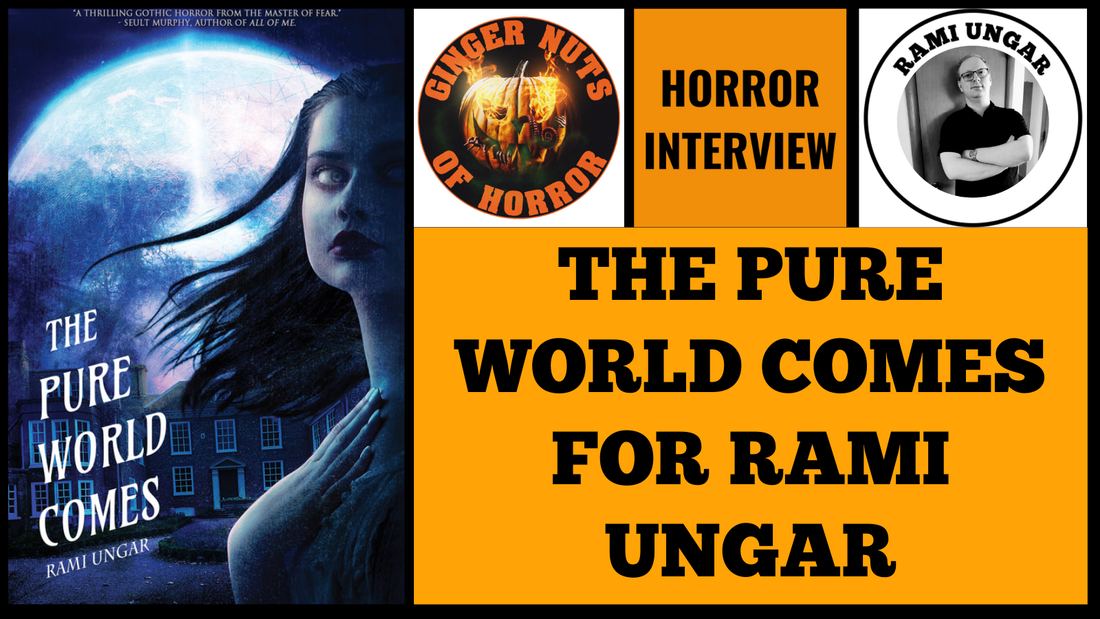
Could you tell the readers a little about yourself?
I am Rami Ungar. I’m a novelist in Ohio and I love writing stories that entertain me. The majority of those stories take place in the horror genre. At the time I’m writing this, I’m about to release my Victorian Gothic horror novel, The Pure World Comes, and I’m editing a collection of short stories, Hannah and Other Stories, which will be published in the near future by BSC Publishing Group.
Which one of your characters would you least like to meet in real life?
Oh, I doubt I would want to eat any of them! I’m not very nice to my characters. In fact, I can be downright cruel. From The Pure World Comes, there’s a few I would especially not want to run into. One in particular is Jack the Ripper, or the person I believe was Jack the Ripper. That was part of the fun of writing this book: I got to name whom I suspect to be the famous killer and make him part of the story. I might be wrong, but hey, no suspect is perfect in the Ripper case. And yeah, that’s one character I would hate to meet in real life.
Other than the horror genre, what else has been a major influence on your writing?
Manga and anime. I’ve been reading and watching since I was a kid and I still am. And it shows up all the time in my writing. Characters who are anime fans show up every now and then, and I incorporate ideas or tropes from those stories all the time. Hell, my novel Rose was partly a love letter to anime, and it shows!
By the way, my favorite manga series is Red River by Chie Shinohara and my favorite anime is Overlord, though my comfort series is Sailor Moon. Any fans here?
Given the dark, violent and at times grotesque nature of the horror genre, why do you think so many people enjoy reading it?
There are several reasons. For some, horror is an escape and therapeutic. After having to stay in our chaotic and often horrible world, following a story with fake horrors, even when they may be based on real things or events, can be healing. Sometimes, it can even help put things into perspective. For others, horror speaks to something in our souls. Might be an artistic urge, or a community, or just a feeling of being an outsider in a world full of average people, but horror draws us in. Helps that the community can be such a welcoming place.
As for me, I enjoy the thrill of being scared, and the magic of weaving fear and storytelling together. That’s the closest I’ll ever get to being an evil sorcerer, and I love it.
Can you tell us about your last book, and can you tell us about what you are working on next?
My last book was Rose, which follows a young woman who turns into a plant creature (and that’s just the start of her problems). Yeah, very anime-esque story, isn’t it? I’m glad to say it’s done okay for itself and even has some ardent fans. As for what’s coming up next, Hannah and Other Stories is a collection of seven original stories. I’m really proud of these stories, which I’ve been crafting over the years, and I’m very excited for people to read them once they’re all polished up. Ghosts, budding serial killers, and even man-eating horses! It’s going to be a blast.
I am Rami Ungar. I’m a novelist in Ohio and I love writing stories that entertain me. The majority of those stories take place in the horror genre. At the time I’m writing this, I’m about to release my Victorian Gothic horror novel, The Pure World Comes, and I’m editing a collection of short stories, Hannah and Other Stories, which will be published in the near future by BSC Publishing Group.
Which one of your characters would you least like to meet in real life?
Oh, I doubt I would want to eat any of them! I’m not very nice to my characters. In fact, I can be downright cruel. From The Pure World Comes, there’s a few I would especially not want to run into. One in particular is Jack the Ripper, or the person I believe was Jack the Ripper. That was part of the fun of writing this book: I got to name whom I suspect to be the famous killer and make him part of the story. I might be wrong, but hey, no suspect is perfect in the Ripper case. And yeah, that’s one character I would hate to meet in real life.
Other than the horror genre, what else has been a major influence on your writing?
Manga and anime. I’ve been reading and watching since I was a kid and I still am. And it shows up all the time in my writing. Characters who are anime fans show up every now and then, and I incorporate ideas or tropes from those stories all the time. Hell, my novel Rose was partly a love letter to anime, and it shows!
By the way, my favorite manga series is Red River by Chie Shinohara and my favorite anime is Overlord, though my comfort series is Sailor Moon. Any fans here?
Given the dark, violent and at times grotesque nature of the horror genre, why do you think so many people enjoy reading it?
There are several reasons. For some, horror is an escape and therapeutic. After having to stay in our chaotic and often horrible world, following a story with fake horrors, even when they may be based on real things or events, can be healing. Sometimes, it can even help put things into perspective. For others, horror speaks to something in our souls. Might be an artistic urge, or a community, or just a feeling of being an outsider in a world full of average people, but horror draws us in. Helps that the community can be such a welcoming place.
As for me, I enjoy the thrill of being scared, and the magic of weaving fear and storytelling together. That’s the closest I’ll ever get to being an evil sorcerer, and I love it.
Can you tell us about your last book, and can you tell us about what you are working on next?
My last book was Rose, which follows a young woman who turns into a plant creature (and that’s just the start of her problems). Yeah, very anime-esque story, isn’t it? I’m glad to say it’s done okay for itself and even has some ardent fans. As for what’s coming up next, Hannah and Other Stories is a collection of seven original stories. I’m really proud of these stories, which I’ve been crafting over the years, and I’m very excited for people to read them once they’re all polished up. Ghosts, budding serial killers, and even man-eating horses! It’s going to be a blast.
The Pure World Comes
by Rami Ungar
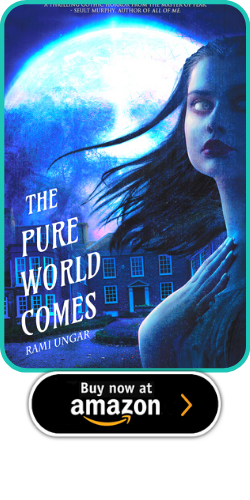
Shirley Dobbins wants nothing more than to live a quiet life and become a head housekeeper at a prestigious house. So when she is invited to come work for the mysterious baronet Sir Joseph Hunting at his estate, she thinks it is the chance of a lifetime. However, from the moment she arrives things are not what they seem. As she becomes wrapped up in more of the baronet's radical science, she realizes something dark and otherworldly is loose within the estate. And if left unchecked, it'll claim the lives of all she holds dear.
Bio
Rami Ungar is a novelist from Columbus, Ohio specializing in horror and dark fantasy. He has published three books and his fourth book, The Pure World Comes, releases May 10th, 2022. When not writing, Rami enjoys reading, following up on his many interests, and giving his readers the impression that he’s not entirely human.
Rami Ungar is a novelist from Columbus, Ohio specializing in horror and dark fantasy. He has published three books and his fourth book, The Pure World Comes, releases May 10th, 2022. When not writing, Rami enjoys reading, following up on his many interests, and giving his readers the impression that he’s not entirely human.
Links
Blog/website: https://ramiungarthewriter.com/
Facebook: https://www.facebook.com/RamiUngarWriter
Twitter: https://twitter.com/RamiUngarWriter
Instagram: https://www.instagram.com/rami_ungar_writer/?hl=en
YouTube: https://www.youtube.com/channel/UCP1kPr9_snmT5annJ55eYZQ
Amazon Author Page: https://www.amazon.com/Rami-Ungar/e/B00J8PLKDY?ref=sr_ntt_srch_lnk_1&qid=1651796870&sr=8-1
Q&A
Blog/website: https://ramiungarthewriter.com/
Facebook: https://www.facebook.com/RamiUngarWriter
Twitter: https://twitter.com/RamiUngarWriter
Instagram: https://www.instagram.com/rami_ungar_writer/?hl=en
YouTube: https://www.youtube.com/channel/UCP1kPr9_snmT5annJ55eYZQ
Amazon Author Page: https://www.amazon.com/Rami-Ungar/e/B00J8PLKDY?ref=sr_ntt_srch_lnk_1&qid=1651796870&sr=8-1
Q&A
The Heart and Soul of Horror

Ginger Nuts of Horror has been running a series of articles from Matt Blairstone and Alex Woodroe from Tenebrous Press to Ginger Nuts of Horror to discuss their new anthology Your Body is Not Your Body: A New Weird Anthology, an anthology where all proceeds from this anthology go to Equality Texas to combat the attempts of the Texas government to criminalize trans/GNC youth and their families. This week we bring you part three of our interview with the authors featured in this anthology
Rhiannon Rasmussen
Why did you submit to Your Body is Not Your Body?
As soon as I saw the call I answered it. I'm nonbinary and body horror has often spoken to my dysphoria and relationship with myself and my body in some positive ways and some negative. The rawness is human and the discomfort, the inability to understand or confirm to what the so-called majority says it wants, is queer.
And of course what's going on in Texas--and many other states--is dehumanizing, deliberately cruel, targeted hate. I can't talk about it without getting incandescently angry. I'm so glad to see so many members of the indie horror community stepping up to support trans people, and I'm incredibly honored to have this small piece I wrote on these themes which resonate so deeply with me go to such an important cause.
Tell us what your story is about, and the themes you chose to focus on.
My story, "The Lives of Scavengers," is about leaving behind the sorrows of others and leaving behind the burdens of your family that we are so often expected to carry and analyze and fret over. Leave them and be free.
What has your experience as a marginalized writer in the horror community been like?
I'm very lucky and the horror community has been overall welcoming to me. Of course there's going to be issues in any community but there's a real joy of acceptance and finding the unknown, and a huge interest in queer fiction, acknowledging queer/trans roots and readings, and exploration which I haven't found reflected in many other genre communities.
If someone wants to read more of your work, what would you recommend that they check out?
I have several short stories, some horror and some not, up as pay-what-you-want downloads on my itchio page https://charibdys.itch.io/ and my YA dark science-fiction coming-of-age novella The Wasp Child is out now through the lovely Vernacular Press.
As soon as I saw the call I answered it. I'm nonbinary and body horror has often spoken to my dysphoria and relationship with myself and my body in some positive ways and some negative. The rawness is human and the discomfort, the inability to understand or confirm to what the so-called majority says it wants, is queer.
And of course what's going on in Texas--and many other states--is dehumanizing, deliberately cruel, targeted hate. I can't talk about it without getting incandescently angry. I'm so glad to see so many members of the indie horror community stepping up to support trans people, and I'm incredibly honored to have this small piece I wrote on these themes which resonate so deeply with me go to such an important cause.
Tell us what your story is about, and the themes you chose to focus on.
My story, "The Lives of Scavengers," is about leaving behind the sorrows of others and leaving behind the burdens of your family that we are so often expected to carry and analyze and fret over. Leave them and be free.
What has your experience as a marginalized writer in the horror community been like?
I'm very lucky and the horror community has been overall welcoming to me. Of course there's going to be issues in any community but there's a real joy of acceptance and finding the unknown, and a huge interest in queer fiction, acknowledging queer/trans roots and readings, and exploration which I haven't found reflected in many other genre communities.
If someone wants to read more of your work, what would you recommend that they check out?
I have several short stories, some horror and some not, up as pay-what-you-want downloads on my itchio page https://charibdys.itch.io/ and my YA dark science-fiction coming-of-age novella The Wasp Child is out now through the lovely Vernacular Press.

Rhiannon Rasmussen is a horror author and illustrator interested in monstrosity and the persistence of hope. Rhiannon’s fiction has appeared in publications including Lightspeed Magazine, Evil in Technicolor, and Magic: the Gathering. Visit rhiannonrs.com for more.
Meagan Hotz
Why did you submit to Your Body is Not Your Body?
It was instinctive. I saw the call, I had a story, and I thought, alright. Let's do it. No questions asked. The cause was good and it felt like now was the time. Sometimes you get that feeling. I was just happy there was some way for me to help.
Tell us what your story is about, and the themes you chose to focus on.
Ten years ago I was living in an apartment that was infested with mice and may or may not have had a gas leak. You get weird feelings when you're living in that environment and some of those weird feelings came back during the pandemic, intensified by the way that everyone was expected to just... keep on going as normal. "Rat race" is the idiom but there's something about the humble mouse that resonates with me with our place in the world right now. Our presence is expected and disrespected; we exist to eat, reproduce and die. People are treated like parts to be replaced in the ever-operational money machine. It's hard to find your own humanity when you're so caught up in the cogs of that system, let alone that of the people around you. So I guess that's the theme. The weight of capitalism, of bigotry, and what it does to your sense of self.
What has your experience as a marginalized writer in the horror community been like?
In the actual community itself, it's been great. But I owe a lot of that fact to the fact that I came into the community alongside other LGBTQ+ horror writers/directors/etc. and that really helped. Being involved with other marginalized horror fans is actually what pushed me to really commit myself to my love of the genre. Horror comes with a special kind of passion and it's easy to channel our rage and fear and love through that passion. Obviously, I'm lucky to have these people who've been at my side all these years, and there's still a lot of work to do, but I'm forever grateful towards the weird little part of the community I've found myself in.
If someone wants to read more of your work, what would you recommend that they check out?
I've got a list of some notable things (and things upcoming!) on my carrd! https://meaganhotz.carrd.co/

Meagan Hotz is a Canadian writer and graduate of the Vancouver Film School's Writing for Film & Television program. Her short films have been screened internationally, with accolades including Best Short at the Screamfest Horror Film Festival. She lives in Vancouver with her pets and a potentially haunted couch.
Vincent Endwell
Why did you submit to Your Body is Not Your Body?
In the onslaught of anti-trans sentiment and state violence, it was nice to see a project for which the proceeds would go to help trans people impacted by the horror coming out of Texas. The fact that it was an anthology collection calling explicitly for the bizarre & gruesome that resonates with me was what inspired me personally to submit. That I had a story that I felt would be quite thematically appropriate certainly helped seal the deal. With a title like that? How could I not.
Tell us what your story is about, and the themes you chose to focus on.
In brief, my story is about how existing in a body is intrinsically horrifying, and even worse is how that repulsive meat (which you cannot escape) will be used to control and dehumanize you.
I'll admit, this story is not the most explicitly Trans(TM) story I've written, but upon coming across the title for this anthology collection, I knew it was the one I had to submit. And in a manner, I regard it as a trans story, in that it is a story very deeply about fear of one’s body, but more so fear of what other people will do to your body and the horrors you will be forced to endure because of what they feel is morally right.
The push by the right to criminalize both abortion and transgender existence is part of a broader white supremacist project of maintaining control over reproduction both to ensure white population growth, enforce cisheteropatriarchal gender norms as a means of social control, and to further genocidal aims against non-white people. Because of this, struggles for bodily autonomy are intimately linked. In both instances, trans people and/or pregnant people are forced into a horrifying bodily existence that is framed as something natural or right, and so it is those themes with which I am grappling.
Of course, I grapple with this through the lens of a woman in love with a dead Christian mommy blogger. You know, they did specify Weird Horror.
What has your experience as a marginalized writer in the horror community been like?
I think it would be a stretch to say I am part of a broader horror community. The friendships and acquaintances I have cultivated with other horror writers have been wonderful, and it is always a delight to find people who share one’s taste. I will say that my first experience with posting my horror writing was on Wattpad, where I was assumed to be a different gender by my acquaintances and readers, making that my first real affirming experience of the “no one knows who you are on the internet” variety.
If someone wants to read more of your work, what would you recommend that they check out?
I have few publishing credits to my name, but over the years I have posted a number of horror stories to my blog, virgilsbirds.wordpress.com. Out of those, the one most similar to my piece in this collection is “A Clean Cut in the Bloated Flesh” https://virgilsbirds.wordpress.com/2016/07/12/a-clean-cut-in-the-bloated-flesh/. Otherwise, I have a much more pleasant poem featured in As It Ought to Be Magazine (https://asitoughttobemagazine.com/2020/10/12/aster-perkins-ramps/). You can also follow my twitter (@endwellian) if you so choose, and stay tuned.
In the onslaught of anti-trans sentiment and state violence, it was nice to see a project for which the proceeds would go to help trans people impacted by the horror coming out of Texas. The fact that it was an anthology collection calling explicitly for the bizarre & gruesome that resonates with me was what inspired me personally to submit. That I had a story that I felt would be quite thematically appropriate certainly helped seal the deal. With a title like that? How could I not.
Tell us what your story is about, and the themes you chose to focus on.
In brief, my story is about how existing in a body is intrinsically horrifying, and even worse is how that repulsive meat (which you cannot escape) will be used to control and dehumanize you.
I'll admit, this story is not the most explicitly Trans(TM) story I've written, but upon coming across the title for this anthology collection, I knew it was the one I had to submit. And in a manner, I regard it as a trans story, in that it is a story very deeply about fear of one’s body, but more so fear of what other people will do to your body and the horrors you will be forced to endure because of what they feel is morally right.
The push by the right to criminalize both abortion and transgender existence is part of a broader white supremacist project of maintaining control over reproduction both to ensure white population growth, enforce cisheteropatriarchal gender norms as a means of social control, and to further genocidal aims against non-white people. Because of this, struggles for bodily autonomy are intimately linked. In both instances, trans people and/or pregnant people are forced into a horrifying bodily existence that is framed as something natural or right, and so it is those themes with which I am grappling.
Of course, I grapple with this through the lens of a woman in love with a dead Christian mommy blogger. You know, they did specify Weird Horror.
What has your experience as a marginalized writer in the horror community been like?
I think it would be a stretch to say I am part of a broader horror community. The friendships and acquaintances I have cultivated with other horror writers have been wonderful, and it is always a delight to find people who share one’s taste. I will say that my first experience with posting my horror writing was on Wattpad, where I was assumed to be a different gender by my acquaintances and readers, making that my first real affirming experience of the “no one knows who you are on the internet” variety.
If someone wants to read more of your work, what would you recommend that they check out?
I have few publishing credits to my name, but over the years I have posted a number of horror stories to my blog, virgilsbirds.wordpress.com. Out of those, the one most similar to my piece in this collection is “A Clean Cut in the Bloated Flesh” https://virgilsbirds.wordpress.com/2016/07/12/a-clean-cut-in-the-bloated-flesh/. Otherwise, I have a much more pleasant poem featured in As It Ought to Be Magazine (https://asitoughttobemagazine.com/2020/10/12/aster-perkins-ramps/). You can also follow my twitter (@endwellian) if you so choose, and stay tuned.

Vincent Endwell (they/them) is a third gender/androgyne writer, composer, neuroscience graduate student, and white settler located in Lenapehoking (New York City). Their work has been previously featured in As it Ought to Be Magazine and The Apothecary.
YOUR BODY IS NOT YOUR BODY: A NEW WEIRD ANTHOLOGY

This is a preorder item. Book will ship sometime in April...or as soon as we can get it off the presses.
All proceeds from this anthology go to Equality Texas to combat the attempts of the Texas government to criminalize trans/GNC youth and their families.
EXTREME CONDITIONS DEMAND EXTREME RESPONSES.
Twenty-seven writers and eight illustrators from the Trans/Gender Nonconforming communities come together to voice their rage, defiance and fearlessness in the decidedly nontraditional fashion of New Weird Horror that Tenebrous Press excels at!
Final Table of Contents coming soon. Featured writers include Hailey Piper, Joe Koch, LC von Hessen, M. Lopes da Silva, Bitter Karella and many more.
Cover art by Mx. Morgan G. Robles.
Further reading
YOUR BODY IS NOT YOUR BODY: A NEW WEIRD ANTHOLOGY, AN INTERVIEW WITH TENEBROUS PRESS
YOUR BODY IS NOT YOUR BODY: AN INTERVIEW WITH THE AUTHORS PART 1
YOUR BODY IS NOT YOUR BODY: AN INTERVIEW WITH THE AUTHORS PART 2
YOUR BODY IS NOT YOUR BODY: A NEW WEIRD ANTHOLOGY, AN INTERVIEW WITH TENEBROUS PRESS
YOUR BODY IS NOT YOUR BODY: AN INTERVIEW WITH THE AUTHORS PART 1
YOUR BODY IS NOT YOUR BODY: AN INTERVIEW WITH THE AUTHORS PART 2
CHECK OUT TODAY'S OTHER ARTICLES ON GINGER NUTS OF HORROR
 | |
THE HEART AND SOUL OF HORROR PROMOTION WEBSITES

Could you tell the readers a little bit about yourself?
I’m a fairly quiet person who lives with their husband Bill in a flat in Southend and enjoys listening to the conversations of people in the street below. I used to do too much partying and crying but yesterday I helped repot some chilli plants. I’m also running a subtle and increasingly surreal campaign to convince Bill he wants a cat.
Which one of your characters would you least like to meet in real life?
The book I’m currently writing, which isn’t yet finished, contains a man who’s abusive to his girlfriend and I definitely don’t want to meet him, unless it’s from behind reinforced glass so I can call him a bell end.
Other than the horror genre, what else has been a major influence on your writing?
Definitely surrealism and weird fiction. Alice in Wonderland was the first time I realized you could basically do what you wanted and make your story as weird as you liked, and I still remember the excitement I felt. Following that I’ve gotten into Leonora Carrington, Amos Tutuola and Thomas Ligotti and really appreciate the way they told stories that they wanted to tell, the way they wanted to tell it.
The term horror, especially when applied to fiction always carries such heavy connotations. What’s your feeling on the term “horror” and what do you think we can do to break past these assumptions?
Horror is a genre I’ve loved since I can remember so I can’t imagine it being negative, but I do think a lot of people have a slim view of what it’s about. I’d suggest checking out the wide variety of authors out today who use it in a myriad of ways, from horror infused weird fiction, horrific naturalistic storytelling, violent and in-your-face to subtle and gothic. So many people from all different backgrounds are exploring their own methods with more freedom than ever before.
A lot of good horror movements have arisen as a direct result of the socio/political climate, considering the current state of the world where do you see horror going in the next few years?
My own writing has become more apocalyptic recently and I’m sure I’m not the only one. You write to purge yourself of fear so I imagine there’ll be a lot of politically charged and pandemic focused stories. But, again, people cope in different ways, and the huge variety of writers out there will mean a huge variety of responses. Some might retreat into pure fantastical fun which is good too. It may seem fractured at first, but there’s something for whatever you’re into and you’ll find it.
Given the dark, violent and at times grotesque nature of the horror genre why do you think so many people enjoy reading it?
I think we like to have our worries confirmed, for one thing, to know that someone else thinks the way we do about the world. Also, it can be a good escape. You may be behind on your rent but at least your legs aren’t being eaten by a shuddering moon beast.
What, if anything, is currently missing from the horror genre?
Probably an easy index to find all these new great authors and genres
What new and upcoming authors do you think we should take notice off?
Zin E Rocklyn, Hayley Piper and Luke Kondor
Are there any reviews of your work, positive or negative that have stayed with you?
Someone pointed out a grammar mistake I was making a lot in my old stories and now I definitely avoid doing that. It was upsetting but really helpful.
What aspects of writing to do you find the most difficult?
Probably the planning out. It’s great when you get going but the structure part is boring and I’m glad when it’s over
Is there one subject you would never write about as an author?
I don’t think it’s healthy to say I’d never do something, I’ll just have to see how the mood takes me
Writing, is not a static process, how have you developed as a writer over the years?
I’ve learned to take time over stories, to let them unfold in their own time. I’m a lot less concerned with being amusing and I’m trying harder to tap into my fears
What is the best piece of advice you ever received with regards to your writing?
Trust yourself more
Which of your characters is your favourite?
I have a soft spot for the girl that loses it in the short story Seed Man, from my books Fortune Box and Sharp End of the Rainbow. Although we definitely wouldn’t be friends, her prolonged meltdown was the most fun I’ve had writing in ages.
Which of your books best represents you?
The Sharp End of the Rainbow, or the one I’m currently writing. I really feel like I’m starting to get it, you know.
Do you have a favorite line or passage from your work, and would you like to share it with us?
“We get extra money from advertisers if one of the spirits sings their jingle for five minutes, just ignore it.” – Invite Ghosts and Earn Pounds, The Sharp End of the Rainbow
Can you tell us about your last book, and can you tell us about what you are working on next?
My last book is a collection of short stories I’ve written over the years, a lot previously published and some new. It shows a progression and I’m pleased to see how I’ve improved.
My current book is the one I’m pouring my entire being into and I think it’ll represent who I am, how far I’ve come and what makes a person who’s been through a lot tick, though it’s definitely fictional and still very weird. It’s full of quite serious subject matters but I also want to fill it with joy, hope and a bit of silly.
If you could erase one horror cliché what would be your choice?
The idea that people are doing it wrong if they don’t follow a certain path
What was the last great book you read, and what was the last book that disappointed you?
I’m currently reading The Three Body Problem by Liu Cixin and, believe me, my head just falls right off and melts after a few pages. I normally couldn’t cope reading something so intensely scientific but the story just keeps you sucked in.
I can’t even remember the name of the book that disappointed me, I just know it was from a major publisher. Some literary works are brilliant, of course, but some are just so flat, promising so much and delivering just blandness. It was one of those.
What's the one question you wish you would get asked but never do? And what would be the answer?
Shall we get a cat? Yes!
I’m a fairly quiet person who lives with their husband Bill in a flat in Southend and enjoys listening to the conversations of people in the street below. I used to do too much partying and crying but yesterday I helped repot some chilli plants. I’m also running a subtle and increasingly surreal campaign to convince Bill he wants a cat.
Which one of your characters would you least like to meet in real life?
The book I’m currently writing, which isn’t yet finished, contains a man who’s abusive to his girlfriend and I definitely don’t want to meet him, unless it’s from behind reinforced glass so I can call him a bell end.
Other than the horror genre, what else has been a major influence on your writing?
Definitely surrealism and weird fiction. Alice in Wonderland was the first time I realized you could basically do what you wanted and make your story as weird as you liked, and I still remember the excitement I felt. Following that I’ve gotten into Leonora Carrington, Amos Tutuola and Thomas Ligotti and really appreciate the way they told stories that they wanted to tell, the way they wanted to tell it.
The term horror, especially when applied to fiction always carries such heavy connotations. What’s your feeling on the term “horror” and what do you think we can do to break past these assumptions?
Horror is a genre I’ve loved since I can remember so I can’t imagine it being negative, but I do think a lot of people have a slim view of what it’s about. I’d suggest checking out the wide variety of authors out today who use it in a myriad of ways, from horror infused weird fiction, horrific naturalistic storytelling, violent and in-your-face to subtle and gothic. So many people from all different backgrounds are exploring their own methods with more freedom than ever before.
A lot of good horror movements have arisen as a direct result of the socio/political climate, considering the current state of the world where do you see horror going in the next few years?
My own writing has become more apocalyptic recently and I’m sure I’m not the only one. You write to purge yourself of fear so I imagine there’ll be a lot of politically charged and pandemic focused stories. But, again, people cope in different ways, and the huge variety of writers out there will mean a huge variety of responses. Some might retreat into pure fantastical fun which is good too. It may seem fractured at first, but there’s something for whatever you’re into and you’ll find it.
Given the dark, violent and at times grotesque nature of the horror genre why do you think so many people enjoy reading it?
I think we like to have our worries confirmed, for one thing, to know that someone else thinks the way we do about the world. Also, it can be a good escape. You may be behind on your rent but at least your legs aren’t being eaten by a shuddering moon beast.
What, if anything, is currently missing from the horror genre?
Probably an easy index to find all these new great authors and genres
What new and upcoming authors do you think we should take notice off?
Zin E Rocklyn, Hayley Piper and Luke Kondor
Are there any reviews of your work, positive or negative that have stayed with you?
Someone pointed out a grammar mistake I was making a lot in my old stories and now I definitely avoid doing that. It was upsetting but really helpful.
What aspects of writing to do you find the most difficult?
Probably the planning out. It’s great when you get going but the structure part is boring and I’m glad when it’s over
Is there one subject you would never write about as an author?
I don’t think it’s healthy to say I’d never do something, I’ll just have to see how the mood takes me
Writing, is not a static process, how have you developed as a writer over the years?
I’ve learned to take time over stories, to let them unfold in their own time. I’m a lot less concerned with being amusing and I’m trying harder to tap into my fears
What is the best piece of advice you ever received with regards to your writing?
Trust yourself more
Which of your characters is your favourite?
I have a soft spot for the girl that loses it in the short story Seed Man, from my books Fortune Box and Sharp End of the Rainbow. Although we definitely wouldn’t be friends, her prolonged meltdown was the most fun I’ve had writing in ages.
Which of your books best represents you?
The Sharp End of the Rainbow, or the one I’m currently writing. I really feel like I’m starting to get it, you know.
Do you have a favorite line or passage from your work, and would you like to share it with us?
“We get extra money from advertisers if one of the spirits sings their jingle for five minutes, just ignore it.” – Invite Ghosts and Earn Pounds, The Sharp End of the Rainbow
Can you tell us about your last book, and can you tell us about what you are working on next?
My last book is a collection of short stories I’ve written over the years, a lot previously published and some new. It shows a progression and I’m pleased to see how I’ve improved.
My current book is the one I’m pouring my entire being into and I think it’ll represent who I am, how far I’ve come and what makes a person who’s been through a lot tick, though it’s definitely fictional and still very weird. It’s full of quite serious subject matters but I also want to fill it with joy, hope and a bit of silly.
If you could erase one horror cliché what would be your choice?
The idea that people are doing it wrong if they don’t follow a certain path
What was the last great book you read, and what was the last book that disappointed you?
I’m currently reading The Three Body Problem by Liu Cixin and, believe me, my head just falls right off and melts after a few pages. I normally couldn’t cope reading something so intensely scientific but the story just keeps you sucked in.
I can’t even remember the name of the book that disappointed me, I just know it was from a major publisher. Some literary works are brilliant, of course, but some are just so flat, promising so much and delivering just blandness. It was one of those.
What's the one question you wish you would get asked but never do? And what would be the answer?
Shall we get a cat? Yes!
THE SHARP END OF THE RAINBOW
BY MADELEINE SWANN

The stories you'll find at The Sharp End of the Rainbow will transport you to a dystopian wonderland full of bizarre characters who engage in even more bizarre antics. These stories will make you laugh, cry, and gag-but more importantly, they show humanity in the face of the truly absurd, and act as a mirror to the world around us.
Praise:
"Madeleine Swann writes the kinds of stories that expose the grotesqueries behind all the cute and cuddly Disneyfied facades. Punchy. Dark. Hilarious. Sharp End of the Rainbow will cut you like a scalpel. You'll bleed out while reading this and thank her for it in the end."
- Danger Slater, author of Puppet Skin
"The Sharp End of the Rainbow goes hard out of the gate and dives deep into nightmare territory. Swann's writing is flensing and wrathful--which is to say it perfectly suits the times."
- Laird Barron, author of Blood Standard
"A dazzling storm of bizarre daydreams and nightmares. Swann is an expert surrealist, and she yanks just the right cryptic nerves to check if they'll flinch. Sometimes playful, other times shocking, these are stories of worlds and people twisted in their odd logic, much like our own, much like us."
- Hailey Piper, author of The Worm and His Kings
"Wild and weird, these tales are a rollercoaster acid trip from the heights of absurd hilarity to the depths of surreal horror and you never know, from one moment to the next, whether you're on the ascent or the descent. Madeleine Swann gives you just the barest, most tantalizing glimpse of other worlds - worlds where our comforting laws of reality warp and fray but always populated with characters who are disturbing not in their strangeness but in their familiarity."
- Bitter Karella, creator of Midnight Pals
Praise:
"Madeleine Swann writes the kinds of stories that expose the grotesqueries behind all the cute and cuddly Disneyfied facades. Punchy. Dark. Hilarious. Sharp End of the Rainbow will cut you like a scalpel. You'll bleed out while reading this and thank her for it in the end."
- Danger Slater, author of Puppet Skin
"The Sharp End of the Rainbow goes hard out of the gate and dives deep into nightmare territory. Swann's writing is flensing and wrathful--which is to say it perfectly suits the times."
- Laird Barron, author of Blood Standard
"A dazzling storm of bizarre daydreams and nightmares. Swann is an expert surrealist, and she yanks just the right cryptic nerves to check if they'll flinch. Sometimes playful, other times shocking, these are stories of worlds and people twisted in their odd logic, much like our own, much like us."
- Hailey Piper, author of The Worm and His Kings
"Wild and weird, these tales are a rollercoaster acid trip from the heights of absurd hilarity to the depths of surreal horror and you never know, from one moment to the next, whether you're on the ascent or the descent. Madeleine Swann gives you just the barest, most tantalizing glimpse of other worlds - worlds where our comforting laws of reality warp and fray but always populated with characters who are disturbing not in their strangeness but in their familiarity."
- Bitter Karella, creator of Midnight Pals
MADELEINE SWANN

My new collection, The Sharp End of the Rainbow, was released recently by Heads Dance Press. My novella, The Vine That Ate The Starlet, was published by Filthy Loot. My collection, Fortune Box (Eraserhead Press), was nominated for a Wonderland Award. My short stories have appeared in various anthologies and podcasts including Splatterpunk Award nominated The New Flesh: A David Cronenberg Tribute.
WEBSITE LINKS
Website: http://madeleineswann.com
Twitter: https://twitter.com/MadeleineSwann
YouTube: https://www.youtube.com/channel/UC6wDXC7R4gDR9ZGDX5De3Ew
WEBSITE LINKS
Website: http://madeleineswann.com
Twitter: https://twitter.com/MadeleineSwann
YouTube: https://www.youtube.com/channel/UC6wDXC7R4gDR9ZGDX5De3Ew
CHECK OUT TODAY'S OTHER ARTICLES ON GINGER NUTS OF HORROR
 | |
the heart and soul of horror author interviews

Last week Ginger Nuts of Horror welcomed Matt Blairstone and Alex Woodroe from Tenebrous Press to Ginger Nuts of Horror to discuss their new anthology Your Body is Not Your Body: A New Weird Anthology, an anthology where all proceeds from this anthology go to Equality Texas to combat the attempts of the Texas government to criminalize trans/GNC youth and their families. This week we bring you part two of our interview with the authors featured in this anthology
Rose Sable
Why did you submit to YB=/=YB?
Body horror has been an important aspect of my life for as long as I can remember. I’ve been struggling with writing for a very long time, and this felt like the right opportunity to finally push myself to finish a story while contributing to something important.
Tell us what your story is about, and the themes you chose to focus on.
My story is about biological engineering, specifically the creation of a sentient weapon using human test subjects. While I think there’s a lot to be said about both the positives and negatives of bioengineering and body modification, I was really thinking about the terror of not being in control of your own body, and to see that struggle through the eyes of an apathetic observer. Ultimately I was aiming for pulp, with all the over-the-top evil caricatures and skin-boiling body horror I could fit into such a short piece.
What has your experience as a marginalized writer in the horror community been like?
My experience so far has been surprisingly positive, with the huge caveat that this is my first real publishing experience and I tend to only open up in circles where I feel I can fully trust everybody around me. I’ve been very closed-off until pretty recently and have a hard time connecting to people around me because of that.
If someone wants to read more of your work, what would you recommend that they check out?
Hybrid is the first writing of mine that I’ve shared anywhere, but I’m working on a whole lot of things right now. You can follow me on Twitter @anxietygothic for updates and also listen to my music at rosesable.bandcamp.com.

Rose Sable is a California-based horror/SFF author and experimental musician. You can follow her on Twitter @anxietygothic.
Dayna Ingram
Why did you submit to YB=/=YB?
I saw the call on Twitter (I follow a lot of indie authors and presses), and I immediately knew I wanted to sub something for it. It's super incredible to me how some folks can see atrocities happening, like the anti-trans legislation in Texas and other states, and say, "We need to do something about this," and then just go and friggin do it! I knew I wanted to be a part of that magic. I'd been sitting on this weird little story for a while ("Because My Mother Tells Me So"), and it just felt like fate to submit it for this project.
Tell us what your story is about, and the themes you chose to focus on.
"Because My Mother Tells Me So" is about a young woman whose trauma manifests as a proselytizing zombie who won't let her leave her house. I can't get enough zombie stories (obviously), and in grad school I read They Shoot Horses, Don't They by Horace McCoy, in which I learned about dance marathons. So my brain naturally said, "you gotta put these two things together." That was the seed of the idea, but writing it, it kind of blossomed into something else, something very visceral but also surreal. But I don't want to say too much; read the story, tell me what themes creep up on you!
What has your experience as a marginalized writer in the horror community been like?
I can't really speak to the horror community specifically, because I'm just sort of dipping my toe into that pond, but the indie publishing/author scene as a whole has been very welcoming and supportive. Lethe Press has been putting out my work for 10 years (god bless), and through them I've met so many amazing queer talents in this pocket of the publishing industry. Social media, especially Twitter, has opened up just this great space for indie authors, publishers, artists and readers alike to find each other. We all just want to lift each other up, and I think that's awesome.
If someone wants to read more of your work, what would you recommend that they check out?
If you want more horror, Eat Your Heart Out is my goofy grindhouse contribution to the genre. You can head to daynaingram.com for my complete bibliography, and of course follow me on Twitter @thedingram.
I saw the call on Twitter (I follow a lot of indie authors and presses), and I immediately knew I wanted to sub something for it. It's super incredible to me how some folks can see atrocities happening, like the anti-trans legislation in Texas and other states, and say, "We need to do something about this," and then just go and friggin do it! I knew I wanted to be a part of that magic. I'd been sitting on this weird little story for a while ("Because My Mother Tells Me So"), and it just felt like fate to submit it for this project.
Tell us what your story is about, and the themes you chose to focus on.
"Because My Mother Tells Me So" is about a young woman whose trauma manifests as a proselytizing zombie who won't let her leave her house. I can't get enough zombie stories (obviously), and in grad school I read They Shoot Horses, Don't They by Horace McCoy, in which I learned about dance marathons. So my brain naturally said, "you gotta put these two things together." That was the seed of the idea, but writing it, it kind of blossomed into something else, something very visceral but also surreal. But I don't want to say too much; read the story, tell me what themes creep up on you!
What has your experience as a marginalized writer in the horror community been like?
I can't really speak to the horror community specifically, because I'm just sort of dipping my toe into that pond, but the indie publishing/author scene as a whole has been very welcoming and supportive. Lethe Press has been putting out my work for 10 years (god bless), and through them I've met so many amazing queer talents in this pocket of the publishing industry. Social media, especially Twitter, has opened up just this great space for indie authors, publishers, artists and readers alike to find each other. We all just want to lift each other up, and I think that's awesome.
If someone wants to read more of your work, what would you recommend that they check out?
If you want more horror, Eat Your Heart Out is my goofy grindhouse contribution to the genre. You can head to daynaingram.com for my complete bibliography, and of course follow me on Twitter @thedingram.

Dayna Ingram is a trans+queer genre fiction writer from Ohio. His book ALL GOOD CHILDREN was chosen by both Publishers Weekly and Kirkus Reviews Indie as one of the best Science Fiction titles of 2016, and was a finalist for the 2017 Lambda Literary Awards. THE GOLDEN DAUGHTER, Book One of his bitesize epic fantasy trilogy, EMPIRE OF FLESH AND GOLD, is out now from Lethe Press. More info @ daynaingram.com.
Bri Crozier
Why did you submit to YB=/=YB?
Someone I was in a discord server with shared the call for submissions and I got really excited, especially when I saw it was focused on queer experience, identity, and was going to be benefiting queer youth. I love new weird fiction, especially horror. It’s the crossroads of genre fiction, and as a person of a lot of intersecting identities, I love how that can mimic the complexity of my experiences, that I can take them and twist them into something as beautiful as it is horrific. We’re living in strange and hostile times, and I think horror, especially strange and absurd horror, can help us to make sense of it in a really round about way.
Tell us what your story is about, and the themes you choose to focus on
My story is a dialogue between a vulture and the deer it’s about to eat. I wanted to focus on the idea that, no matter what you are, something has to give its life for you to live. Even if you’re vegan or a vegetarian, the plants you eat are alive and deserve respect, not to mention the humans who work to collect and produce it for you. I wanted to viscerally confront this idea, to bring understanding to that cycle we often don’t think about. I didn’t want the horror to be about the act of consumption though, because it’s natural, it’s part of life. For me, the horror comes from the disrespect and the lack of understanding about what consumption means, and how that ignorance can destroy us.
If someone wants to read more of your work, what would you recommend they check out?
This is my first time publishing something other than comics, but if you’re looking for more new weird horror, I actually have a new weird horror webcomic coming out in the beginning of April. You can find it on my website, bricrozierart.com along with some of my other comics.
Someone I was in a discord server with shared the call for submissions and I got really excited, especially when I saw it was focused on queer experience, identity, and was going to be benefiting queer youth. I love new weird fiction, especially horror. It’s the crossroads of genre fiction, and as a person of a lot of intersecting identities, I love how that can mimic the complexity of my experiences, that I can take them and twist them into something as beautiful as it is horrific. We’re living in strange and hostile times, and I think horror, especially strange and absurd horror, can help us to make sense of it in a really round about way.
Tell us what your story is about, and the themes you choose to focus on
My story is a dialogue between a vulture and the deer it’s about to eat. I wanted to focus on the idea that, no matter what you are, something has to give its life for you to live. Even if you’re vegan or a vegetarian, the plants you eat are alive and deserve respect, not to mention the humans who work to collect and produce it for you. I wanted to viscerally confront this idea, to bring understanding to that cycle we often don’t think about. I didn’t want the horror to be about the act of consumption though, because it’s natural, it’s part of life. For me, the horror comes from the disrespect and the lack of understanding about what consumption means, and how that ignorance can destroy us.
If someone wants to read more of your work, what would you recommend they check out?
This is my first time publishing something other than comics, but if you’re looking for more new weird horror, I actually have a new weird horror webcomic coming out in the beginning of April. You can find it on my website, bricrozierart.com along with some of my other comics.

Bri ‘Pi’ Crozier is well known for their deep adoration of horrific fiction. A writer and illustrator with a degree in both, Bri is passionate about the natural cycle of decay and death, finding beauty in how it relates to their experiences as a queer and disabled person. When not writing or painting, Bri can be found looking for dead things in Kansas City, where they are pursuing a MFA in creative writing.
Charles Maria Tor
Why did you submit to YB=/=YB?
YB≠YB had me so incredibly excited because I didn’t just want my horror to be read, I wanted it to directly benefit people, trans children doubly so.
Tell us what your story is about, and the themes you chose to focus on
My story is about an unreliable narrator descending into madness, first knowingly, then much less so, as ze is stalked across the Australian countryside by an inescapable ringing noise. I peppered in my fear of being coerced and hunted by authority figures. Then towards the end, I inseminated the story with my extreme fear of pregnancy.
What has your experience as a marginalized writer in the horror community been like?
I don’t yet have much of one, but from what little experience I do have, it’s hard to get published as someone just starting out. With so few opportunities for your niche, being overshadowed by incumbent writers who’ve had much more time with the craft is inevitable.
If someone wants to read more of your work, what would you recommend that they check out?
I’ve got the website charlestor.com, which has a few excerpts from novels I’m working on. This anthology is only my third time being published, the first time being a horror story I’ve reworked so much that I would feel a bit embarrassed linking to the original, and the second time being an autobiographical essay in Butch Is Not a Dirty Word issue 8.
YB≠YB had me so incredibly excited because I didn’t just want my horror to be read, I wanted it to directly benefit people, trans children doubly so.
Tell us what your story is about, and the themes you chose to focus on
My story is about an unreliable narrator descending into madness, first knowingly, then much less so, as ze is stalked across the Australian countryside by an inescapable ringing noise. I peppered in my fear of being coerced and hunted by authority figures. Then towards the end, I inseminated the story with my extreme fear of pregnancy.
What has your experience as a marginalized writer in the horror community been like?
I don’t yet have much of one, but from what little experience I do have, it’s hard to get published as someone just starting out. With so few opportunities for your niche, being overshadowed by incumbent writers who’ve had much more time with the craft is inevitable.
If someone wants to read more of your work, what would you recommend that they check out?
I’ve got the website charlestor.com, which has a few excerpts from novels I’m working on. This anthology is only my third time being published, the first time being a horror story I’ve reworked so much that I would feel a bit embarrassed linking to the original, and the second time being an autobiographical essay in Butch Is Not a Dirty Word issue 8.

Charles Maria Tor is an insane transexual butch from Warrang (Sydney) in so-called Australia. Born too smart for hirs own good, ze peeled back the layers of modern society and found The Void, before even reaching puberty. Charles Maria hopes to one day earn the title “A Queer Usurper to Vonnegut and Lovecraft's Thrones.”
M. Lopes Da Silva
Why did you submit to YB=/=YB?
After I heard about the rights that Greg Abbott was trying to deprive trans kids of I got very upset, very angry, and channeled my emotions into a few different things: I donated to the Transgender Education Network of Texas, I made soap that I sold in my Etsy store SaltCatSoap to also raise money for TENT, I signed petitions. Small tasks that I knew I could do. When I saw Tenebrous Press’s call for body horror fiction to raise money for this cause, I thought: yes. This was something else I could do.
Tell us what your story is about, and the themes you chose to focus on.
“The Same Thing That Happened to Sam” is about the horror of gay conversion therapy and trying to find a healthy way to survive it. When the people we love try to change who we are, and despite our best efforts their toxicity slips inside of us, how can we, as queer people, transcend that? That’s a question that doesn’t have one answer or solution, but here I offer a possible one.
What has your experience as a marginalized writer in the horror community been like?
I’m a non-binary and bisexual author so the horror community that I gravitate towards and seek out is largely queer, indie, and supportive as hell. I like that. We lift each other up whenever we can, whether it’s beta reading or offering consolation about rejections or celebrating the acceptances. That’s incredibly valuable. The friends that I’ve made in this community are so cool it would take me a novel’s worth of words to tell you how amazing they all are.
If someone wants to read more of your work, what would you recommend that they check out?
I wrote a thriller about a bisexual sex worker who hunts a serial killer through the streets of 1980s Los Angeles called HOOKER – it’s a sex worker-positive novella that makes for a fun, quick read. I also have short fiction coming out soon in Weirdpunk Book’s STORIES OF THE EYE.
After I heard about the rights that Greg Abbott was trying to deprive trans kids of I got very upset, very angry, and channeled my emotions into a few different things: I donated to the Transgender Education Network of Texas, I made soap that I sold in my Etsy store SaltCatSoap to also raise money for TENT, I signed petitions. Small tasks that I knew I could do. When I saw Tenebrous Press’s call for body horror fiction to raise money for this cause, I thought: yes. This was something else I could do.
Tell us what your story is about, and the themes you chose to focus on.
“The Same Thing That Happened to Sam” is about the horror of gay conversion therapy and trying to find a healthy way to survive it. When the people we love try to change who we are, and despite our best efforts their toxicity slips inside of us, how can we, as queer people, transcend that? That’s a question that doesn’t have one answer or solution, but here I offer a possible one.
What has your experience as a marginalized writer in the horror community been like?
I’m a non-binary and bisexual author so the horror community that I gravitate towards and seek out is largely queer, indie, and supportive as hell. I like that. We lift each other up whenever we can, whether it’s beta reading or offering consolation about rejections or celebrating the acceptances. That’s incredibly valuable. The friends that I’ve made in this community are so cool it would take me a novel’s worth of words to tell you how amazing they all are.
If someone wants to read more of your work, what would you recommend that they check out?
I wrote a thriller about a bisexual sex worker who hunts a serial killer through the streets of 1980s Los Angeles called HOOKER – it’s a sex worker-positive novella that makes for a fun, quick read. I also have short fiction coming out soon in Weirdpunk Book’s STORIES OF THE EYE.

M. Lopes da Silva (she/they) is a non-binary and bisexual author, artist, and poet from Los Angeles. They write queer California horror and everything else. Their horror fiction has been published or is forthcoming from In Somnio: A Collection of Modern Gothic Horror, Neon Horror: Queer Horror Anthology, and Nightscript Vol. IV and V. Unnerving Magazine recently published their novella Hooker: a pro-queer, pro-sex work, feminist retrowave pulp thriller about a bisexual sex worker hunting a serial killer in 1980s Los Angeles using hooks as her weapons of choice.
L. C. Von Hessen
Why did you submit to YB=/=YB?
I grew up in the suburbs of Middle America, a closeted nonbinary kid many years before I knew the term existed. And I still remember very clearly the Religious Right denunciations of the "homosexual agenda" both from sitting politicians and filtered into the minds and speech of my conservative Christian classmates: endless debates about whether it "was a choice," with the assumption that one could therefore make the "right choice" to be straight; whether queer adults should be allowed to work with or adopt children for fear they'd "seduce" kids into their "lifestyle"; that at least as much tolerance should be extended towards those who believe queer people are repulsive and/or hellbound as towards queer people themselves; that using homophobic insults against one's peers was just "free speech" and anyone who took offense was assumed not to be simply pissed off at the bigotry, but to be a sensitive snowflake who couldn't handle naughty language. Now, 20 years later, I'm seeing the exact same anti-gay strawmen and handwringing regurgitated against trans people.
I got out of the region as soon as I could, but I know not all young people can. And to see this same strain of evangelical moral panic fuckery regain traction in this country is honestly disgusting: not just in Texas but Idaho, Florida, etc. One of the states I grew up in is trying to pass a harsh anti-abortion bill that, until recently, including outlawing abortion for ectopic pregnancy, which is inherently unviable. These are all just different facets of the same far-right gender-essentialist horseshit.
Tell us what your story is about, and the themes you chose to focus on.
It's a very short piece, so I won't say too much. It concerns a search for perverse erotic transcendence through flesh and technology: a mix of Genet and Cronenberg in the long shadow of Clive Barker. It was written entirely to a soundtrack of Coil.
What has your experience as a marginalized writer in the horror community been like?
Honestly quite good! In the particular milieu I've found, I've actually encountered a pretty sizeable contingent of queer, trans, and/or nonbinary people. I'm aware of a certain reactionary "Old Guard" in horror and weird fiction who believe the genre ought to reflect the fears of straight white cis men, but it seems that they're increasingly being pushed to the margins themselves.
It's also worth noting that the first exposure I ever had to sympathetic portrayals of trans, nonbinary, and gender non-conforming people was in genre fiction, up through my discovery of authors like Poppy Z. Brite and Caitlin R. Kiernan in my early teens.
If someone wants to read more of your work, what would you recommend that they check out?
For more stories involving technology/creation/mad science, there's my short ebook collection Spiritus Ex Machina. For more weird horror with explicitly queer protagonists, there are my recent stories in The Book of Queer Saints, Hymns of Abomination, and Planet Scumm's Snake Eyes issue. Just generally, there are also my stories in two separate volumes each of Vastarien and Nightscript.
I grew up in the suburbs of Middle America, a closeted nonbinary kid many years before I knew the term existed. And I still remember very clearly the Religious Right denunciations of the "homosexual agenda" both from sitting politicians and filtered into the minds and speech of my conservative Christian classmates: endless debates about whether it "was a choice," with the assumption that one could therefore make the "right choice" to be straight; whether queer adults should be allowed to work with or adopt children for fear they'd "seduce" kids into their "lifestyle"; that at least as much tolerance should be extended towards those who believe queer people are repulsive and/or hellbound as towards queer people themselves; that using homophobic insults against one's peers was just "free speech" and anyone who took offense was assumed not to be simply pissed off at the bigotry, but to be a sensitive snowflake who couldn't handle naughty language. Now, 20 years later, I'm seeing the exact same anti-gay strawmen and handwringing regurgitated against trans people.
I got out of the region as soon as I could, but I know not all young people can. And to see this same strain of evangelical moral panic fuckery regain traction in this country is honestly disgusting: not just in Texas but Idaho, Florida, etc. One of the states I grew up in is trying to pass a harsh anti-abortion bill that, until recently, including outlawing abortion for ectopic pregnancy, which is inherently unviable. These are all just different facets of the same far-right gender-essentialist horseshit.
Tell us what your story is about, and the themes you chose to focus on.
It's a very short piece, so I won't say too much. It concerns a search for perverse erotic transcendence through flesh and technology: a mix of Genet and Cronenberg in the long shadow of Clive Barker. It was written entirely to a soundtrack of Coil.
What has your experience as a marginalized writer in the horror community been like?
Honestly quite good! In the particular milieu I've found, I've actually encountered a pretty sizeable contingent of queer, trans, and/or nonbinary people. I'm aware of a certain reactionary "Old Guard" in horror and weird fiction who believe the genre ought to reflect the fears of straight white cis men, but it seems that they're increasingly being pushed to the margins themselves.
It's also worth noting that the first exposure I ever had to sympathetic portrayals of trans, nonbinary, and gender non-conforming people was in genre fiction, up through my discovery of authors like Poppy Z. Brite and Caitlin R. Kiernan in my early teens.
If someone wants to read more of your work, what would you recommend that they check out?
For more stories involving technology/creation/mad science, there's my short ebook collection Spiritus Ex Machina. For more weird horror with explicitly queer protagonists, there are my recent stories in The Book of Queer Saints, Hymns of Abomination, and Planet Scumm's Snake Eyes issue. Just generally, there are also my stories in two separate volumes each of Vastarien and Nightscript.

LC von Hessen is a writer of horror, weird fiction, and various unpleasantness, as well as a noise musician, occasional actor, and former Morbid Anatomy Museum docent. Their work has previously appeared in such publications as Hymns of Abomination, The Book of Queer Saints, volumes of Nightscript and Vastarien, and the ebook collection Spiritus Ex Machina. An ex-Midwesterner, von Hessen lives in Brooklyn with a talkative orange cat.
Max Turner
Why did you submit to Your Body is Not Your Body?
It's one of those dream projects, where the theme sounds great, the publisher/editors are highly reputable AND it's for a cause close to my heart, so I was thrilled that my story was accepted.
Tell us what your story is about, and the themes you chose to focus on.
My story, The Simulacrum, is told through recovered written and voice recordings from the 1950s and 60s, detailing human experimentation that goes terribly wrong. It's Mary Shelly's Frankenstein meets 50s B-Movies, with a large helping of trans vengeance.
I wanted to focus on the idea of what would happen in an extreme situation when you deny someone's gender. And most importantly, a situation where the trans person has the power. A monstrous power.
If someone wants to read more of your work, what would you recommend that they check out?
For more trans horror, along side some amazing other uterus-owning writers, I'd definitely recommend Bodies Full of Burning: An Anthology of Menopause-Themed Horror from Sliced Up Press, edited by Nicole M. Wolverton. Which includes my story "This is Yours", about government mandated womb return.
I also write spec-fic, sci-fi, queer lit, queer romance and erotica, which you can find out more about on my website https://www.maxturneruk.com/
It's one of those dream projects, where the theme sounds great, the publisher/editors are highly reputable AND it's for a cause close to my heart, so I was thrilled that my story was accepted.
Tell us what your story is about, and the themes you chose to focus on.
My story, The Simulacrum, is told through recovered written and voice recordings from the 1950s and 60s, detailing human experimentation that goes terribly wrong. It's Mary Shelly's Frankenstein meets 50s B-Movies, with a large helping of trans vengeance.
I wanted to focus on the idea of what would happen in an extreme situation when you deny someone's gender. And most importantly, a situation where the trans person has the power. A monstrous power.
If someone wants to read more of your work, what would you recommend that they check out?
For more trans horror, along side some amazing other uterus-owning writers, I'd definitely recommend Bodies Full of Burning: An Anthology of Menopause-Themed Horror from Sliced Up Press, edited by Nicole M. Wolverton. Which includes my story "This is Yours", about government mandated womb return.
I also write spec-fic, sci-fi, queer lit, queer romance and erotica, which you can find out more about on my website https://www.maxturneruk.com/

Max Turner is a gay transgender man based in the United Kingdom. He is also a parent, nerd, intersectional feminist and coffee addict. Max writes speculative and science fiction, urban fantasy, furry fiction, horror, and LGBTQ+ romance and erotica. More often than not, he writes combinations thereof. https://www.maxturneruk.com/
YOUR BODY IS NOT YOUR BODY: A NEW WEIRD ANTHOLOGY
This is a preorder item. Book will ship sometime in April...or as soon as we can get it off the presses.
All proceeds from this anthology go to Equality Texas to combat the attempts of the Texas government to criminalize trans/GNC youth and their families.
EXTREME CONDITIONS DEMAND EXTREME RESPONSES.
Twenty-seven writers and eight illustrators from the Trans/Gender Nonconforming communities come together to voice their rage, defiance and fearlessness in the decidedly nontraditional fashion of New Weird Horror that Tenebrous Press excels at!
Final Table of Contents coming soon. Featured writers include Hailey Piper, Joe Koch, LC von Hessen, M. Lopes da Silva, Bitter Karella and many more.
Cover art by Mx. Morgan G. Robles.
All proceeds from this anthology go to Equality Texas to combat the attempts of the Texas government to criminalize trans/GNC youth and their families.
EXTREME CONDITIONS DEMAND EXTREME RESPONSES.
Twenty-seven writers and eight illustrators from the Trans/Gender Nonconforming communities come together to voice their rage, defiance and fearlessness in the decidedly nontraditional fashion of New Weird Horror that Tenebrous Press excels at!
Final Table of Contents coming soon. Featured writers include Hailey Piper, Joe Koch, LC von Hessen, M. Lopes da Silva, Bitter Karella and many more.
Cover art by Mx. Morgan G. Robles.
Further Reading
YOUR BODY IS NOT YOUR BODY: A NEW WEIRD ANTHOLOGY, AN INTERVIEW WITH TENEBROUS PRESS
YOUR BODY IS NOT YOUR BODY: AN INTERVIEW WITH THE AUTHORS PART 1
YOUR BODY IS NOT YOUR BODY: AN INTERVIEW WITH THE AUTHORS PART 1
CHECK OUT TODAY'S OTHER ARTICLES ON GINGER NUTS OF HORROR
 | |
THE HEART AND SOUL OF HORROR FICTION REVIEW WEBSITES

Ginger Snaps: Mini Interviews with Bite!
Ginger Snaps is a quick-fire “bite-sized” interview, where your answers relate to what you’ve been doing in the past month (30 days or so).
Tell us:
Who are you?
Robert P. Ottone, author of the cosmic-horror YA novel The Triangle, as well as the collection Her Infernal Name & Other Nightmares.
Your signature style:
I guess my signature style would be that I like to riff on urban legends, folklore and more while also adding a little humor and honesty to the work.
Toot your own horn:
My latest novel, The Triangle, is an attempt to introduce a younger audience to the basics of cosmic horror. I wanted to tell a story about a young girl facing impossible horror beyond human understanding, because I feel so often, that growing up feels exactly like that: impossible horror. Changes to one’s body. One’s mind. One’s emotions. It’s like were corrupted and forced into a new person during our formative years and it’s bonkers.
Books read:
My favorite book that I’ve read in the past year is A Cabin at the End of the World by Paul Tremblay. I had a fairly strong reaction to that one, which I didn’t expect to have going into it. I knew it was going to be good, but I didn’t expect it to hit me that hard.
I’m currently reading Amor Towles’ The Lincoln Highway and loving it. It’s like salve. That’s really the only way I can describe it. It hasn’t gone crazy yet. I don’t know if it does. But it’s beautiful and sad and I love the characters.
Movies watched:
I really enjoyed Hellbender, Slapface, Woodlands Dark and Days Bewitched from Shudder. Fresh on Hulu was great. The Manor on Amazon Prime might be the best horror movie of the year. I rented an entire movie theatre to see The Batman and it’s easily the best movie of the year.
Games and/or music played:
My favorite album of last year was probably Chemtrails Over the Country Club by Lana Del Rey. I listened to that on repeat for a while. This year, I’m really digging hard into some older stuff that I hadn’t listened to since I was a kid, because I’m working on something set in the early nineties.
Bands like R. E. M. and The Violent Femmes and stuff. They’re all creeping into my subconscious a lot.
On the videogame front, I’ve been playing too much Best Fiends, Bloons TD 6+ and GameDev Story.
Words written:
My collection Her Infernal Name & Other Nightmares was included as an “honourable mention” by Ellen Datlow, which was great.
Future stuff:
I have the follow-up novel in my YA series coming. It’s called The Deep and my goal with that was to expand the world while also telling a more intimate story, if that makes sense. I also have a novel called Nocturnal Creatures that’s coming soon(ish). Beyond that, I have a few short stories being published, one in Even in the Grave, another in The Call of Poohthulhu, and a reprint in Horror From the High Dive Vol. 2.
I have a non-fiction piece on the Silent Hill franchise in the first issue of Weird House Magazine, coming in April/May.
I may or may not have another novel on the horizon that I can’t talk about yet. It’s exceedingly dark and might upset some people.
Brain worms:
I’ll never really understand the thought process behind the modern Halloween trilogy. The folks behind the camera talk a big game about how much they love the original movie and then go as far away from that concept as humanly possible when given the reigns. Makes no sense to me.
When will the producers of the Scream franchise realize that Stephen Graham Jones is the guy to write the next entry? How is it not obvious to them?
I’ll never stop wondering what Hideo Kojima had in store for us with Silent Hills. That lives rent-free in my brain for all eternity.
Ginger Snaps is a quick-fire “bite-sized” interview, where your answers relate to what you’ve been doing in the past month (30 days or so).
Tell us:
Who are you?
Robert P. Ottone, author of the cosmic-horror YA novel The Triangle, as well as the collection Her Infernal Name & Other Nightmares.
Your signature style:
I guess my signature style would be that I like to riff on urban legends, folklore and more while also adding a little humor and honesty to the work.
Toot your own horn:
My latest novel, The Triangle, is an attempt to introduce a younger audience to the basics of cosmic horror. I wanted to tell a story about a young girl facing impossible horror beyond human understanding, because I feel so often, that growing up feels exactly like that: impossible horror. Changes to one’s body. One’s mind. One’s emotions. It’s like were corrupted and forced into a new person during our formative years and it’s bonkers.
Books read:
My favorite book that I’ve read in the past year is A Cabin at the End of the World by Paul Tremblay. I had a fairly strong reaction to that one, which I didn’t expect to have going into it. I knew it was going to be good, but I didn’t expect it to hit me that hard.
I’m currently reading Amor Towles’ The Lincoln Highway and loving it. It’s like salve. That’s really the only way I can describe it. It hasn’t gone crazy yet. I don’t know if it does. But it’s beautiful and sad and I love the characters.
Movies watched:
I really enjoyed Hellbender, Slapface, Woodlands Dark and Days Bewitched from Shudder. Fresh on Hulu was great. The Manor on Amazon Prime might be the best horror movie of the year. I rented an entire movie theatre to see The Batman and it’s easily the best movie of the year.
Games and/or music played:
My favorite album of last year was probably Chemtrails Over the Country Club by Lana Del Rey. I listened to that on repeat for a while. This year, I’m really digging hard into some older stuff that I hadn’t listened to since I was a kid, because I’m working on something set in the early nineties.
Bands like R. E. M. and The Violent Femmes and stuff. They’re all creeping into my subconscious a lot.
On the videogame front, I’ve been playing too much Best Fiends, Bloons TD 6+ and GameDev Story.
Words written:
My collection Her Infernal Name & Other Nightmares was included as an “honourable mention” by Ellen Datlow, which was great.
Future stuff:
I have the follow-up novel in my YA series coming. It’s called The Deep and my goal with that was to expand the world while also telling a more intimate story, if that makes sense. I also have a novel called Nocturnal Creatures that’s coming soon(ish). Beyond that, I have a few short stories being published, one in Even in the Grave, another in The Call of Poohthulhu, and a reprint in Horror From the High Dive Vol. 2.
I have a non-fiction piece on the Silent Hill franchise in the first issue of Weird House Magazine, coming in April/May.
I may or may not have another novel on the horizon that I can’t talk about yet. It’s exceedingly dark and might upset some people.
Brain worms:
I’ll never really understand the thought process behind the modern Halloween trilogy. The folks behind the camera talk a big game about how much they love the original movie and then go as far away from that concept as humanly possible when given the reigns. Makes no sense to me.
When will the producers of the Scream franchise realize that Stephen Graham Jones is the guy to write the next entry? How is it not obvious to them?
I’ll never stop wondering what Hideo Kojima had in store for us with Silent Hills. That lives rent-free in my brain for all eternity.
The Triangle (The Rise Trilogy Book 1)
by Robert P. Ottone

The world, as we know it, is over. Sea level rise has all but finished off life on Earth.
Born with a gift for engineering and technology, Azlynn and her father Merrill spend their days running a small shop in the flotilla community of Coral Cove. They scavenge shipwrecks, sunken vessels, and what precious little remains of the world before the planet drowned. With her best friend Ellis, they do their best to support their community, while struggling to survive.
When a group of scouts sent by The Order, a mysterious and powerful northeastern cabal, goes missing in the nearby Bermuda Triangle, Merrill is tasked with finding them. Unbeknownst to him, Azlynn and Ellis have snuck aboard to join in on the mission to find out what lurks within The Triangle. The ancient, cosmic truths they discover may be more terrifying than they ever imagined.
Born with a gift for engineering and technology, Azlynn and her father Merrill spend their days running a small shop in the flotilla community of Coral Cove. They scavenge shipwrecks, sunken vessels, and what precious little remains of the world before the planet drowned. With her best friend Ellis, they do their best to support their community, while struggling to survive.
When a group of scouts sent by The Order, a mysterious and powerful northeastern cabal, goes missing in the nearby Bermuda Triangle, Merrill is tasked with finding them. Unbeknownst to him, Azlynn and Ellis have snuck aboard to join in on the mission to find out what lurks within The Triangle. The ancient, cosmic truths they discover may be more terrifying than they ever imagined.
Robert P. Ottone

Robert P. Ottone is the author of the horror collection HER INFERNAL NAME & OTHER NIGHTMARES (an honorable mention in THE BEST HORROR OF THE YEAR VOLUME 13) as well as the young adult dystopian-cosmic horror trilogy THE RISE.
His short stories have appeared in various anthologies as well as online. He’s also the publisher and owner of Spooky House Press.
Robert is also an English as a New Language teacher, as well as a teacher of English Language Arts. He can be found online at SpookyHousePress.com or on Twitter/Instagram (@RobertOttone). He delights in the creepy and views bagels solely as a cream cheese delivery device.
His short stories have appeared in various anthologies as well as online. He’s also the publisher and owner of Spooky House Press.
Robert is also an English as a New Language teacher, as well as a teacher of English Language Arts. He can be found online at SpookyHousePress.com or on Twitter/Instagram (@RobertOttone). He delights in the creepy and views bagels solely as a cream cheese delivery device.
CHECK OUT TODAY'S OTHER ARTICLES ON GINGER NUTS OF HORROR
 | |
THE HEART AND SOUL OF HORROR promotion websites


 RSS Feed
Archives
May 2023
April 2023
March 2023
February 2023
January 2023
December 2022
November 2022
October 2022
September 2022
August 2022
July 2022
June 2022
May 2022
April 2022
March 2022
February 2022
January 2022
December 2021
November 2021
October 2021
September 2021
August 2021
July 2021
June 2021
May 2021
April 2021
March 2021
February 2021
January 2021
December 2020
November 2020
October 2020
September 2020
August 2020
July 2020
June 2020
May 2020
April 2020
March 2020
February 2020
January 2020
December 2019
November 2019
October 2019
September 2019
August 2019
July 2019
June 2019
May 2019
April 2019
March 2019
February 2019
January 2019
December 2018
November 2018
October 2018
September 2018
August 2018
July 2018
June 2018
May 2018
April 2018
March 2018
February 2018
January 2018
December 2017
November 2017
October 2017
September 2017
June 2017
April 2017
March 2017
February 2017
January 2017
December 2016
November 2016
October 2016
September 2016
August 2016
June 2016
May 2016
April 2016
March 2016
February 2016
January 2016
December 2015
November 2015
September 2015
August 2015
July 2015
June 2015
May 2015
April 2015
March 2015
February 2015
January 2015
December 2014
November 2014
October 2014
September 2014
August 2014
July 2014
June 2014
May 2014
April 2014
March 2014
February 2014
January 2014
December 2013
November 2013
October 2013
September 2013
August 2013
July 2013
June 2013
May 2013
April 2013
March 2013
June 2012

|

|