

 Last week Ginger Nuts of Horror welcomed Matt Blairstone and Alex Woodroe from Tenebrous Press to Ginger Nuts of Horror to discuss their new anthology Your Body is Not Your Body: A New Weird Anthology, an anthology where all proceeds from this anthology go to Equality Texas to combat the attempts of the Texas government to criminalize trans/GNC youth and their families. This week we bring you part one of our interview with the authors featured in this anthology G.E. Woods  Why did you submit to YB=/=YB? The anthology title stopped me cold. As a queer, nonbinary, disabled dancer, parent, volunteer sexuality educator, former child abuse prevention educator and rape victim advocate, and survivor of child abuse, I have A Lot of Feelings about Bodies, about the ways we approach and consider bodies, the agency an individual should have over their own, and often the lack thereof many of us have faced. It got me thinking about the ways those of us with marginalized experiences have had to pry the world’s fingers from our lives and bodies, how we can be deemed transgressive simply for existing, and how the world would love it if we didn’t try to claim ownership over ourselves. The title is this terrible dystopian dictum that’s playing out across the U.S. and the world, and then in response, the pages are flooded with trans/gnc writers creating whatever chaos we want, all in support of trans kids. Tell us what your story is about, and the themes you chose to focus on. I wrote “Tiny Magic” before the Texas guidance was released, and it was based off the trauma of my own life and of a lot of times when I’ve felt stuck in impossible circumstances (though most of the plot is quite different from my actual life.) At its core, “Tiny Magic” is about adults behaving badly and how kids try to make the best out of crummy circumstances. There’s also a point about being offered a false sense of security when the protagonist has the option to finally belong, but they’d have to engage with something that goes against their morality and we get to see what they do with that. What has your experience as a marginalized writer in the horror community been like? I’m just getting started in publishing as this is my first story acceptance, so it’s a humbling and phenomenal group to jump into the deep end with! I’ve been voraciously taking writing workshops for the past year, and the horror-specific ones are always the most freeing as I get to bring my whole queer self and geek out over horror. Hopefully I’ll be able to keep dwelling in these lgbtqia+ supportive spaces going forward. If someone wants to read more of your work, what would you recommend that they check out? Since this is my first publication, they can follow my socials, @gewoodswrites for both Twitter and Instagram (or my sometimes moldering website gewoods.com). I promise I’ll be screeching each time I get an acceptance (and when my friends do.) G.E. Woods first ran into the arms of horror as a 5-year-old working in haunted houses. Queer, nonbinary, and disabled, she writes fantastical novels where marginalized identities are normalized and short fiction and poetry filled with whimsical rage. Beyond writing, she’s a parent of goblin twins, dances under full moons, and talks to the trees near her home outside Chicago. Rain Corbyn  Why did you submit to YB=/=YB? I knew I wanted to write domestic cosmic horror around the conflict and grief that can surface in the clash between autistic visual thinking vs the limitations of verbal communication, but never really found a plot I liked for it. The submission call specifically asked for a sledgehammer approach to writing, and I was really full of anger at ableism and transphobic violence in all its big and small ways. So I just decided to run with rage itself as the plot, and the result is the story you find in the anthology. The prospect of helping an urgent cause in TX nudged me past my anxiety and impostor syndrome enough to hit send. Tell us what your story is about, and the themes you chose to focus on. In my story, an autistic trans person's partner is what's referred to as a tenderqueer: Someone who dodges accountability and manipulates others by co-opting and misusing the language of social justice and identity politics. After a conflict, this partner doxxes the protagonist, leading genuine fascists to show up. It doesn't go well for the fascists. Autistic people can have a strong sense of fairness, and that kind of manipulation upsets me deeply. I wanted to call out people who use radical language but whose behavior supports and entrenches existing violent systems. It's also about divergent minds, the limitations of communication, not being believed when we describe who and how we are, and when anger, meltdowns, and pushing back are tolerated as communication. What has your experience as a marginalized writer in the horror community been like? Overall pretty great! I'm new on the scene but I have seen and received a ton of empathy, support, and wisdom from this community. I've seen and participated in some brave, nuanced conversations that empowered me to write this story, one of the most honest things I have ever done. I am so grateful that Matt and Alex have chosen this story to be my writing debut, because now I can't go back to safer, smaller, straighter writing. If someone wants to read more of your work, what would you recommend that they check out? This is my first published horror story, but I have narrated the audiobooks for The Mud Ballad by Jo Quenell, Nightmare Yearnings by Eric Raglin, and, forthcoming, Meat Photo by C.V. Hunt and Andersen Prunty. Rain Corbyn is a queer, nonbinary, autistic voice actor and writer. This is their horror writing debut, and their narration work includes the audiobooks for The Mud Ballad by Jo Quenell, Nightmare Yearnings by Eric Raglin, the upcoming Meat Photo by C.V. Hunt and Andersen Prunty, and lots of pseudonymous smut. They live in sin and New York. Joe Koch  Why did you submit to YB=/=YB? Rage. Legislation that strips an individual's bodily autonomy is a step toward fascism. I don't think it's a good idea for the government to tell you how to rear your children. The interference of CPS will rend loving families like yours apart and overburden a system that already cannot house the youth in its care or prevent their abuse while in it. I've worked in social services. Child abuse makes me sick and angry. Helping children learn about their bodies and make decisions and experience bodily autonomy is not child abuse. It's what a loving parent does. It's something I was not able to experience, and it enrages me that the opportunity for kids growing up today to skip some of the useless pain I went through is being questioned and attacked. Just let people live. Tell us what your story is about, and the themes you chose to focus on. "Chironoplasty" is a nightmarish fantasy about a centaur seeking illicit alien top surgery. There's a lot of focus from anti-trans people on body parts, and in keeping with our culture's male gaze, specifically on what they refer to as "lopping off" or "mangling" the breast. And it's a tricky violent way to negatively frame surgical affirmation that I wanted to lean into rather than resist, to look at how this imaginary violence might match our worst dysphoria. Because so what? So what if someone changes their body? Our bodies are changing constantly with time. So in "Chironoplasty," there is a city with specific time boundaries that are also reshaped as the story and medical intervention progresses. I play with the concept of "queer time" and some physics that point towards a nonbinary, nonlinear, and fluid construction of the universe. The style is a very wild, dense, emotionally and mythologically charged approach to writing prose that I really enjoy. What has your experience as a marginalized writer in the horror community been like? Dare I say it's been wonderful so far? I don't want to jinx it. Trolls have not yet come for me. Fellow authors and editors have been kind, patient, and supportive as I've gone through changes over the past two years. I'm pretty much totally out and have been out through my transition process. This openness creates a bit of a built in defense. I'm not afraid of getting outed because I'm already right here. But that doesn't work for everybody. It's harder for authors who need to keep privacy for their own sense of peace. Personally, I'm happier when I can speak freely. If someone wants to read more of your work, what would you recommend that they check out? For more short horror stories, my new collection CONVULSIVE will be out in April. It's up for pre-order now at Apocalypse Party press here: https://www.apocalypse-party.com/convulsive.html For a longer work of cosmic body horror with roots in fairy tales and the Yellow King mythos, check out my novella THE WINGSPAN OF SEVERED HANDS from Weirdpunk Books: https://www.amazon.com/Wingspan-Severed-Hands-Joanna-Koch/dp/195165806X Joe Koch (he/they) writes literary horror and surrealist trash. Joe is a Shirley Jackson Award finalist and the author of The Wingspan of Severed Hands, The Couvade, and Convulsive. They’ve had over fifty short stories published in books and journals like Year's Best Hardcore Horror, The Big Book of Blasphemy, Not All Monsters, and Liminal Spaces. Find Joe online at horrorsong.blog and on Twitter @horrorsong. W.N. Derring-Judith  Why did you submit to YB=/=YB? I hate Greg Abbott and love subverting xtian "morality". Tell us what your story is about, and the themes you chose to focus on. The story is about how the American highway system (and by extension, capitalism) is a literal false god. The style is heavily influenced by the works of Natalie Terezi Rei Watts, and the concept was at least partially inspired by Ian Wright's fantastic Marx on Capital as a Real God essay. What has your experience as a marginalized writer in the horror community been like? Very welcoming for me, less welcoming for some of my friends. If someone wants to read more of your work, what would you recommend that they check out? This is my "debut" short story, but I also write under the handle "UraniumEmpire" in the "SCP Foundation" collaborative writing project. W. N. Derring-Judith was born and raised in Texas, and barely escaped with its life. You can contact xer at wnderringjudith@gmail.com. S. A. Chant  Why did you submit to YB=/=YB? Well, I wanted to unhinge my jaw and devour all transphobes, but barring that, I wanted to at least write something queer and nasty that would help get funds to trans folks in need. Love and rage, basically. Tell us what your story is about, and the themes you chose to focus on. My story, "High Maintenance", is about an android—the sexy kind—whose owner/lover is obsessed with fine-tuning his appearance and behavior. For obvious reasons, I wanted to write about bodily autonomy and the weird ways people will find to exercise agency when they have none. When you're told that you're less human than other people, that your rights matter less than the rights of your oppressors, and that your suffering is excusable because someone else thrives on it—what happens when you fully internalize that? If someone wants to read more of your work, what would you recommend that they check out? "High Maintenance" is my first foray into horror, but those who like creepy-romantic stories might enjoy Caroline's Heart, my Weird West novella about a witch trying to resurrect her dead lover. S. A. Chant (they/them) is a prize-winning pie baker and sci-fi/fantasy writer. Their debut novel, Peter Darling, was longlisted for the Otherwise Award (2018). They live in Seattle with a cat who was recently described as a 'gooey cryptid'. Cosmin Mihai Birsan  Why did you submit to YB=/=YB? Shortly after hearing the news out of Texas, a friend who's also part of the trans community liked the "submissions call" tweet, and it showed up on my feed. (If you're reading this, hi, Elliot!) I immediately knew I wanted to see if I could get involved, so I did in the best way I knew how! As a non-American, I guess I want to believe in the image drilled into the heads of every young consumer of American media, that being of America as a land that's a bit less blatantly authoritarian and that wouldn't threaten proper parenting in favour of oppressing a marginalised community for the sake of misguided "normalcy", and among southern states such as Texas my heart particular holds a lot of love for the rustic, and southern gothic aesthetics that captivate so much of the horror I enjoy. Tell us what your story is about, and the themes you chose to focus on. That's the fun part! I'd rather skirt around this one! I guess I'd say "Patterns and how we break them and abide by them, and in turn how they break and mold us." I wanted to write a story about disassociation, and play with tropes like an unreliable narrator, not in the sense of one that lies to the reader as much as one that can't be trusted to understand the world around them, and I don't think it's a complicated world either! It's the sort of thing where there are no "wrong" or "lesser" answers. According to sources such as the National Association of Mental Illness, up to 75% of people experience at least one depersonalization/derealization episode in their lives, so I feel confident in saying that this is a story about disassociation from the perspective of a well-doctored blank slate. How you engage with it should hopefully evoke your own feelings and experiences on the subject. Do let me know if I did or didn't hit the mark, I guess! What has your experience as a marginalized writer in the horror community been like? Funnily enough, my entrée into horror has been through the queer community, so it's been more of a "What has your experience as a horror nut been like within the queer community?" for me. But in all fairness, it's been great, although I'm kinda just dipping my toes into the pond here. I only started tapping into my own creative energy about two years back after a sheltered upbringing in which creative expression was frowned down upon if not downright prohibited, so this is the first time one of my stories is ever put out in front of an audience larger than a few hand-picked friends, and I'm as nervous as I am excited. If someone wants to read more of your work, what would you recommend that they check out? I hope people end up liking what I wrote and I'd love to hear ANY feedback on it, constructive or otherwise! Twitter's @CossTheImpaler and DMs are eternally open! (Alternatively on Discord @Cosmin#0451) Cosmin-Mihai Bîrsan: Nonbinary horror nut. Real life vampire. Cosmic entity that casually dabbles in a myriad of artforms. YOUR BODY IS NOT YOUR BODY: A NEW WEIRD ANTHOLOGY This is a preorder item. Book will ship sometime in April...or as soon as we can get it off the presses. All proceeds from this anthology go to Equality Texas to combat the attempts of the Texas government to criminalize trans/GNC youth and their families. EXTREME CONDITIONS DEMAND EXTREME RESPONSES. Twenty-seven writers and eight illustrators from the Trans/Gender Nonconforming communities come together to voice their rage, defiance and fearlessness in the decidedly nontraditional fashion of New Weird Horror that Tenebrous Press excels at! Final Table of Contents coming soon. Featured writers include Hailey Piper, Joe Koch, LC von Hessen, M. Lopes da Silva, Bitter Karella and many more. Cover art by Mx. Morgan G. Robles. Further reading YOUR BODY IS NOT YOUR BODY: A NEW WEIRD ANTHOLOGY, AN INTERVIEW WITH TENEBROUS PRESS  the heart and soul of horror author interviews My pen name is Peter Topside. I am an accomplished chef and baker, movie fanatic, a proud father and husband, and a Clinical Exercise Physiologist by trade. I had a rough upbringing, which bestowed many traumas on me, that remained in place for a long time. I spent years struggling with crippling anxiety and depression, but once I got to my lowest point, I made the difficult decision to fight for better mental health. I traveled to a lot of dark corners of my mind, confronting the deepest and scariest aspects of my PTSD, over many years, but I was able to make it through successfully. Throughout my recovery process, I was able to funnel all of the energy, thoughts and feelings into my writing. My books are the culmination of my own personal, life-changing journey.
Who are you? Peter Topside (Hold the applause) Your signature style: Psychological horror Toot your own horn: I wrote the Preternatural horror trilogy. I am a self-taught baker and cook, and a Clinical Exercise Physiologist by trade. I also have raging OCD, but no need to brag there. Or is there? Books read: Recent 5/5 start books that I’ve read;
Movies watched: I’m a horror movie fanatic. Most recently, I’ve gone through The Puppet Master Series, Werewolves Within, Antlers, Fido, Trick r’ Treat (Noticing a general trend here?!). Games and/or music played: Resident Evil, Tiddlywinks, and 70-80s rock. Words written: Preternatural Trilogy (Preternatural, Evolution, and the upcoming Reckoning (April 12th!). Future stuff: I’ve made it a mission of mine to help newer authors navigate the rocky road of self-publishing and getting themselves recognition. That’s the longest term goal I have right now in the literary world, once my trilogy is published and complete. I also hope to never put my socks on backwards ever again. Brain worms:
Reckoning: Preternatural Trilogy - Book Three |


 |  |
the Heart and soul of horror author interviews

Tim Mendees is a horror writer from Macclesfield in the North-West of England that specialises in cosmic horror and weird fiction. A lifelong fan of classic weird tales, Tim set out to bring the pulp horror of yesteryear into the 21st Century and give it a distinctly British flavour. His work has been described as the love-child of H.P. Lovecraft and P.G. Wodehouse and is often peppered with a wry sense of humour that acts as a counterpoint to the unnerving, and often disturbing, narratives.
Tim has had over eighty published short stories and novelettes along with five stand-alone novellas and a short story collection.
When he is not arguing with the spellchecker, Tim is a goth DJ, crustacean and cephalopod enthusiast, and the presenter of a popular web series of live video readings of his material and interviews with fellow authors. Tim is also a co-host of the Innsmouth Book Club podcast. He currently lives in Brighton & Hove with his pet crab, Gerald, and an army of stuffed octopods.
Tim has had over eighty published short stories and novelettes along with five stand-alone novellas and a short story collection.
When he is not arguing with the spellchecker, Tim is a goth DJ, crustacean and cephalopod enthusiast, and the presenter of a popular web series of live video readings of his material and interviews with fellow authors. Tim is also a co-host of the Innsmouth Book Club podcast. He currently lives in Brighton & Hove with his pet crab, Gerald, and an army of stuffed octopods.
WEBSITE LINKS
https://timmendeeswriter.wordpress.com/
https://tinyurl.com/timmendeesyoutube
https://www.facebook.com/goatinthemachine
https://twitter.com/@mendees_tim
Amazon - https://viewauthor.at/tim_mendees
https://timmendeeswriter.wordpress.com/
https://tinyurl.com/timmendeesyoutube
https://www.facebook.com/goatinthemachine
https://twitter.com/@mendees_tim
Amazon - https://viewauthor.at/tim_mendees
Could you tell the readers a little bit about yourself?
Hi, I'm a writer of weird fiction and cosmic horror originally from Macclesfield in the north-west of England. I'm now based down on the south-east coast. I've been writing properly since early 2019. I wrote a lot as a kid but I became a chef at 16 and a DJ in the little spare time I had which didn't leave a lot of time for it. I wrote the odd thing here and there but never did anything with it. I was convinced that nobody would be interested in my bizarre scribbling, it just goes to show how wrong you can be. I started writing again for the sake of my sanity. I developed a spinal condition that meant my career was over so I was going nuts. One afternoon while feeling sorry for myself, I decided to finally write that novel I'd been putting off for decades. After all, I had no excuse anymore, did I? It all came from there. Once I'd started, the floodgates opened and I haven't stopped. The novel was a complete disaster that I need to go back and rewrite at some point but it got me going.
Which one of your characters would you least like to meet in real life?
In a way, I feel like I already have met some of them. The character of Ivy Finch in “Miracle Growth” is an amalgamation of my gran and all of her Women's Institute pals. Also in that book, the character of Jerry the Janitor is an affectionate tribute to a friend of mine who passed away a few years ago. Tony Cash was Brighton's top Johnny Cash tribute act and a damn fine chap to boot. Such a character.
Aside from that, I'd like to meet Mr Eugene Angove, a character that appears in a series of short stories and novelettes. He's a drunken explorer. I reckon we would have a damn fine drinking session if we got together.
Other than the horror genre, what else has been a major influence on your writing?
I'm a huge fan of P.G. Wodehouse, Agatha Christie and Carry On movies. I guess that's where a lot of the humor and 'Britishness' of a lot of my stuff comes from. I like to use comedy as a counterpoint to all the horror. I like pulling the rug on the reader. Have them chuckling one minute then freaked out the next.
The term horror, especially when applied to fiction always carries such heavy connotations. What’s your feeling on the term “horror” and what do you think we can do to break past these assumptions?
It's not an issue to me at all. I'm very firmly of the opinion that if you enjoy what you do and are proud of what you do, who cares what anyone else thinks? The was I see it, there are people out there that like horror, I like writing horror, it's all good. It's just a label at the end of the day. A handy way to sort books out on the shelf. There are so many sub-genres that it's all got a bit muddled anyway which I think is great. Is it fantasy, is it horror, is it sci-fi? Does it matter as long as you enjoy it?
I know some people who get bothered by tags and labels, I'm just not one of them. Somebody I talked to online got upset by being labeled as a 'pulp' writer. I don't get it, I loved it when someone described my stuff as pulp. I'm pulp and proud!
The one assumption I would change, however is that us horror writers are all scary and moody, it's just not true. We are all lovely! Maybe we should start a 'hug a horror writer' campaign to change this?
A lot of good horror movements have arisen as a direct result of the socio/political climate, considering the current state of the world where do you see horror going in the next few years?
Good question. I can see a lot more eco-horror on the horizon. It's a genre that kind of peaked in the early 70s then petered out. With all the worry about climate-change, that kind of thing is in people's heads again. Also, with the state of the global political situation, I can see a rise in cyberpunk and dystopian fiction.
Before COVID there was a lot of zombie virus stuff coming out. I think that will die off for a bit. I think we are all pandemiced out!
Given the dark, violent and at times grotesque nature of the horror genre why do you think so many people enjoy reading it?
I think it's all about living vicariously. It's a way to experience the adrenaline of fear without being in any danger. Plus, who doesn't like a good monster every now and then. It's probably a primal thing. Some race memory of when we were being chased by bears and stuff like that. It gets us in touch with our savage side.
What, if anything, is currently missing from the horror genre?
More tentacles! Nah, just kidding. I don't know. I think there is something out there for every reader. There is just about every niche covered nowadays. That's the beauty about having such a healthy indie horror scene. Some publisher somewhere will have you covered.
What new and upcoming authors do you think we should take notice of?
I'm a big fan of so many of the current crop of horror writers that we'd be here all day if I was to list them all. Off the top of my head, David Green, Robert Poyton, E.L Giles, Neen Cohen, Callum Pearce, S.O Green, Holley Cornetto. The list goes on and on.
Are there any reviews of your work, positive or negative that have stayed with you?
My favorite positive review is from Sci-fi legend Piers Anthony. I had the pleasure of appearing in an anthology alongside him and he reviewed it on his blog. He said my story made him wince... my work is done.
My other favorite is a negative review. Somebody clearly didn't read the cover as they complained that it turned into “some kind of horror show.” The fact that this particular work is subtitled “a cosmic horror novella” should have given the game away.
What aspects of writing to do you find the most difficult?
Writing blurbs and synopsis. I absolutely suck at blurbs. I'm terrible at bigging up my work. My blurbs usually end up something like. “This bloke goes wandering about in the woods and then some tentacles appear and some other weird shit happens.”
Oh, and keeping to word counts. I couldn't keep under a word count with a gun to my head.
Is there one subject you would never write about as an author?
I don't think anything is off-limits as long as it's handled right. There are subjects I'd never touch, child abuse, bestiality, that kind of thing, but aside from that, everything else is fair game.
Writing, is not a static process, how have you developed as a writer over the years?
Tremendously. It's like night and day. I look back on some of my early stuff and cringe. I guess that's the case with most writers. I've been fortunate enough to work with some amazing editors and I've learned a lot from that process.
What is the best piece of advice you ever received with regards to your writing?
Don't let rejections get you down. Seriously, I see so many writers get crushed by rejections. They are going to happen, it's part of the process. Most rejections are less about the quality and more about it being a good fit. There are so many publishers out there. Just keep subbing, you'll find somewhere eventually. Being a writer and not expecting rejections is like being a boxer and not expecting to be punched.
Which of your characters is your favourite?
I like a lot of my characters for different reasons but I'd have to go with my Great Old One, Ger'igguthy. I wanted to add something to the Cthulhu mythos pantheon and I'm proud of my creation.
Which of your books best represents you?
The easy answer would be my short story collection “The Pseudopod That Rocks The Cradle” as it's 18 stories so there is a bit of everything in there.
In terms of single releases, I'd definitely say “Miracle Growth.” It's got the comedy, it's got the weirdness, it's got the gore. It's pretty much me condensed into one book.
Do you have a favorite line or passage from your work, and would you like to share it with us?
I like the silly lines. One of my favorite is from “The Creeping Void.” “A sharp thistle in the sporran region is a nightmare best avoided.” My current favorite is from “Miracle Growth.” “Something more humus than human.” I'm going to get More Humus Than Human on a t-shirt.
Can you tell us about your last book, and can you tell us about what you are working on next?
Miracle Growth is about the run-up to the flower and vegetable show at a small-town fete. Without giving too much away, let's just say that there is some dodgy compost going around and that things get quickly out of hand.
I have a couple of shorts to do then I'm going to work on the final novella in my Hollowhills Cycle and a sequel to Miracle Growth. I'm also editing a Cthulhu vs Musketeers mash-up anthology.
If you could erase one horror cliché what would be your choice?
I wouldn't. I like cliches. They are just there waiting to be subverted. Again, it's all about yanking the rug out from under the reader.
What was the last great book you read, and what was the last book that disappointed you?
The last book I loved was one I beta read for a publisher but I don't think I can talk about it yet. The one before that was the Arkham Horror novel “Mask of Silver.” I'm a sucker for a King in Yellow story and it didn't disappoint.
One that disappointed me was “Kraken” by China Mieville but it was all my own fault. I went in thinking it was a cosmic horror story but it turned out to be urban fantasy. It was well done, just not my cup of tea. Proof that you can't judge a book by the tentacles on the cover.
What's the one question you wish you would get asked but never do? And what would be the answer?
If you were a kind of squid, what squid would you be? As a self-respecting goth, I'd have to go for the vampire squid. Deep-sea Nosferatu!
Hi, I'm a writer of weird fiction and cosmic horror originally from Macclesfield in the north-west of England. I'm now based down on the south-east coast. I've been writing properly since early 2019. I wrote a lot as a kid but I became a chef at 16 and a DJ in the little spare time I had which didn't leave a lot of time for it. I wrote the odd thing here and there but never did anything with it. I was convinced that nobody would be interested in my bizarre scribbling, it just goes to show how wrong you can be. I started writing again for the sake of my sanity. I developed a spinal condition that meant my career was over so I was going nuts. One afternoon while feeling sorry for myself, I decided to finally write that novel I'd been putting off for decades. After all, I had no excuse anymore, did I? It all came from there. Once I'd started, the floodgates opened and I haven't stopped. The novel was a complete disaster that I need to go back and rewrite at some point but it got me going.
Which one of your characters would you least like to meet in real life?
In a way, I feel like I already have met some of them. The character of Ivy Finch in “Miracle Growth” is an amalgamation of my gran and all of her Women's Institute pals. Also in that book, the character of Jerry the Janitor is an affectionate tribute to a friend of mine who passed away a few years ago. Tony Cash was Brighton's top Johnny Cash tribute act and a damn fine chap to boot. Such a character.
Aside from that, I'd like to meet Mr Eugene Angove, a character that appears in a series of short stories and novelettes. He's a drunken explorer. I reckon we would have a damn fine drinking session if we got together.
Other than the horror genre, what else has been a major influence on your writing?
I'm a huge fan of P.G. Wodehouse, Agatha Christie and Carry On movies. I guess that's where a lot of the humor and 'Britishness' of a lot of my stuff comes from. I like to use comedy as a counterpoint to all the horror. I like pulling the rug on the reader. Have them chuckling one minute then freaked out the next.
The term horror, especially when applied to fiction always carries such heavy connotations. What’s your feeling on the term “horror” and what do you think we can do to break past these assumptions?
It's not an issue to me at all. I'm very firmly of the opinion that if you enjoy what you do and are proud of what you do, who cares what anyone else thinks? The was I see it, there are people out there that like horror, I like writing horror, it's all good. It's just a label at the end of the day. A handy way to sort books out on the shelf. There are so many sub-genres that it's all got a bit muddled anyway which I think is great. Is it fantasy, is it horror, is it sci-fi? Does it matter as long as you enjoy it?
I know some people who get bothered by tags and labels, I'm just not one of them. Somebody I talked to online got upset by being labeled as a 'pulp' writer. I don't get it, I loved it when someone described my stuff as pulp. I'm pulp and proud!
The one assumption I would change, however is that us horror writers are all scary and moody, it's just not true. We are all lovely! Maybe we should start a 'hug a horror writer' campaign to change this?
A lot of good horror movements have arisen as a direct result of the socio/political climate, considering the current state of the world where do you see horror going in the next few years?
Good question. I can see a lot more eco-horror on the horizon. It's a genre that kind of peaked in the early 70s then petered out. With all the worry about climate-change, that kind of thing is in people's heads again. Also, with the state of the global political situation, I can see a rise in cyberpunk and dystopian fiction.
Before COVID there was a lot of zombie virus stuff coming out. I think that will die off for a bit. I think we are all pandemiced out!
Given the dark, violent and at times grotesque nature of the horror genre why do you think so many people enjoy reading it?
I think it's all about living vicariously. It's a way to experience the adrenaline of fear without being in any danger. Plus, who doesn't like a good monster every now and then. It's probably a primal thing. Some race memory of when we were being chased by bears and stuff like that. It gets us in touch with our savage side.
What, if anything, is currently missing from the horror genre?
More tentacles! Nah, just kidding. I don't know. I think there is something out there for every reader. There is just about every niche covered nowadays. That's the beauty about having such a healthy indie horror scene. Some publisher somewhere will have you covered.
What new and upcoming authors do you think we should take notice of?
I'm a big fan of so many of the current crop of horror writers that we'd be here all day if I was to list them all. Off the top of my head, David Green, Robert Poyton, E.L Giles, Neen Cohen, Callum Pearce, S.O Green, Holley Cornetto. The list goes on and on.
Are there any reviews of your work, positive or negative that have stayed with you?
My favorite positive review is from Sci-fi legend Piers Anthony. I had the pleasure of appearing in an anthology alongside him and he reviewed it on his blog. He said my story made him wince... my work is done.
My other favorite is a negative review. Somebody clearly didn't read the cover as they complained that it turned into “some kind of horror show.” The fact that this particular work is subtitled “a cosmic horror novella” should have given the game away.
What aspects of writing to do you find the most difficult?
Writing blurbs and synopsis. I absolutely suck at blurbs. I'm terrible at bigging up my work. My blurbs usually end up something like. “This bloke goes wandering about in the woods and then some tentacles appear and some other weird shit happens.”
Oh, and keeping to word counts. I couldn't keep under a word count with a gun to my head.
Is there one subject you would never write about as an author?
I don't think anything is off-limits as long as it's handled right. There are subjects I'd never touch, child abuse, bestiality, that kind of thing, but aside from that, everything else is fair game.
Writing, is not a static process, how have you developed as a writer over the years?
Tremendously. It's like night and day. I look back on some of my early stuff and cringe. I guess that's the case with most writers. I've been fortunate enough to work with some amazing editors and I've learned a lot from that process.
What is the best piece of advice you ever received with regards to your writing?
Don't let rejections get you down. Seriously, I see so many writers get crushed by rejections. They are going to happen, it's part of the process. Most rejections are less about the quality and more about it being a good fit. There are so many publishers out there. Just keep subbing, you'll find somewhere eventually. Being a writer and not expecting rejections is like being a boxer and not expecting to be punched.
Which of your characters is your favourite?
I like a lot of my characters for different reasons but I'd have to go with my Great Old One, Ger'igguthy. I wanted to add something to the Cthulhu mythos pantheon and I'm proud of my creation.
Which of your books best represents you?
The easy answer would be my short story collection “The Pseudopod That Rocks The Cradle” as it's 18 stories so there is a bit of everything in there.
In terms of single releases, I'd definitely say “Miracle Growth.” It's got the comedy, it's got the weirdness, it's got the gore. It's pretty much me condensed into one book.
Do you have a favorite line or passage from your work, and would you like to share it with us?
I like the silly lines. One of my favorite is from “The Creeping Void.” “A sharp thistle in the sporran region is a nightmare best avoided.” My current favorite is from “Miracle Growth.” “Something more humus than human.” I'm going to get More Humus Than Human on a t-shirt.
Can you tell us about your last book, and can you tell us about what you are working on next?
Miracle Growth is about the run-up to the flower and vegetable show at a small-town fete. Without giving too much away, let's just say that there is some dodgy compost going around and that things get quickly out of hand.
I have a couple of shorts to do then I'm going to work on the final novella in my Hollowhills Cycle and a sequel to Miracle Growth. I'm also editing a Cthulhu vs Musketeers mash-up anthology.
If you could erase one horror cliché what would be your choice?
I wouldn't. I like cliches. They are just there waiting to be subverted. Again, it's all about yanking the rug out from under the reader.
What was the last great book you read, and what was the last book that disappointed you?
The last book I loved was one I beta read for a publisher but I don't think I can talk about it yet. The one before that was the Arkham Horror novel “Mask of Silver.” I'm a sucker for a King in Yellow story and it didn't disappoint.
One that disappointed me was “Kraken” by China Mieville but it was all my own fault. I went in thinking it was a cosmic horror story but it turned out to be urban fantasy. It was well done, just not my cup of tea. Proof that you can't judge a book by the tentacles on the cover.
What's the one question you wish you would get asked but never do? And what would be the answer?
If you were a kind of squid, what squid would you be? As a self-respecting goth, I'd have to go for the vampire squid. Deep-sea Nosferatu!
Miracle Growth: A Cosmic Horror Novella (The Ger'igguthy Cycle)
by Tim Mendees

More Humus than Human
Bizarre things are unfolding in a sleepy Cornish town right in the middle of the annual fruit and vegetable show.
What was once a fun and enjoyable affair of roots, assorted pies, and blue ribbon pickles, has rival green-fingered neighbours turning to an untested miracle fertilizer to win the coveted Rosette. But all hell is about to break loose and it’s up to a team of bumbling locals to put an end to the insidious horror that threatens not just the town, but the whole world.
Can they stop the contamination before it spreads or will the vegetation prove to be un-beet-able?
You won't find any bland veggies in this book. Man-eating marrows and vicious vines are just a few of the nightmares that lurk within the idyllic countryside in this novella of cosmic horror. Weird, disturbing, and brilliantly funny.
You haven't read anything like this before. Check out our updated page and let us know what you think. Buy links and pre-order coming soon.
Bizarre things are unfolding in a sleepy Cornish town right in the middle of the annual fruit and vegetable show.
What was once a fun and enjoyable affair of roots, assorted pies, and blue ribbon pickles, has rival green-fingered neighbours turning to an untested miracle fertilizer to win the coveted Rosette. But all hell is about to break loose and it’s up to a team of bumbling locals to put an end to the insidious horror that threatens not just the town, but the whole world.
Can they stop the contamination before it spreads or will the vegetation prove to be un-beet-able?
You won't find any bland veggies in this book. Man-eating marrows and vicious vines are just a few of the nightmares that lurk within the idyllic countryside in this novella of cosmic horror. Weird, disturbing, and brilliantly funny.
You haven't read anything like this before. Check out our updated page and let us know what you think. Buy links and pre-order coming soon.
CHECK OUT TODAY'S OTHER ARTICLES ON GINGER NUTS OF HORROR
 | |
the heart and soul of author interviews

Ginger Nuts of Horror welcomes Matt Blairstone and Alex Woodroe from Tenebrous Press to Ginger Nuts of Horror to discuss their new anthology Your Body is Not Your Body: A New Weird Anthology, an anthology where all proceeds from this anthology go to Equality Texas to combat the attempts of the Texas government to criminalize trans/GNC youth and their families
Who are Matt and Alex, can you tell us a little bit about yourselves?
Matt: I’ve poked around the fringes of the indie comics and Horror scenes for a number of years as both a writer and artist, but I’ve mostly made a living as a cook and restaurant Swiss army knife. Grew up in central Illinois; lived and went to film school in Chicago in the 90s/early ‘00s; and have made Portland, Oregon my home for closing in on two decades.
I’ve played guitar and bass in bands for most of my life. These days I’m severely out of practice, but I still sing in a Ramones tribute band and I generally make every effort to steer any conversation—about any subject—back to rock music. Death metal or goth or funeral doom or obscure punk; today I’m rediscovering my love for Bullet LaVolta, a criminally underrated hardcore punk/alternative rock/whatever-they-were band from Boston; tomorrow it’ll be someone different but equally life-changing.
Any day I discover a new band to obsess over is a good day.
Alex: I’m not nearly as cool! I was born in Romania and went pretty much everywhere in the EU with my former job as a project manager. I used to be an educator in prisons, and a beermaid in an Austrian-style brewery, and an English teacher, and a bunch of other things.
I always envied people who had like, a career they loved. I started writing and editing professionally when I was living in Italy because there just were no local jobs available, and it felt like the sky opened up and contentment rained all over me, and suddenly I was those people, too. Now my entire life feels like an ode to publishing, and I love it so much, frustrations and disasters and all.
Now that I live in Romania again, in the historical region of Transilvania, I intend to bring Romania onto the horror fiction map in a big way, writing our horror folklore and nurturing and publishing our authors. Hopefully there’s going to be a speculative fiction writing class in my future here, too.
Can you give us a potted history of Tenebrous Press? Why did you set it up and what are the main goals of the press?
Matt: Our first book, GREEN INFERNO, an anthology of Eco-Horror fiction and comics, was a reaction to the COVID pandemic, the climate crisis and the horrific forest fires that swept through the Pacific Northwest in September 2020. Initially I just wanted to gather folks from disparate locations and channel their rage and fear into something productive. Beyond just seeing if I could actually crowdfund the thing and pay the writers and artists for their work, it was really a first nebulous step with a big question mark at the end.
Those questions were resolved by Alex, a contributor to GREEN INFERNO who quickly became so much more; she was such a rambunctious, enthusiastic pleasure to work with, I knew I needed her to be involved with whatever came next. That ended up being IN SOMNIO, a collection of Modern Gothic Horror by women and non-binary creators, which Alex took editorial lead on. That collaboration was so seamless (or so my selective memory says) and successful that it was just a given that I would coerce her into becoming my other half in all things Tenebrous.
As to our goals? To delve into unexplored corners of the genre that we term New Weird Horror, from voices diverse and unsung all over the world.
Alex: To be rambunctious and enthusiastic. And to publish things that make our friends wonder whether we’re okay.
Your Body is Not Your Body was born out of frustration to say the least; what was the fire that set off this fuse?
Matt: The last two years have been fucking atrocious for everyone—for me too—but not nearly as bad for me as they have been for many others. I’m blessed to have remained at arm’s length from any major catastrophe befalling my family; my wife and I have been able to thrive creatively; our son is healthy and happy…so like, that in itself is a victory, right?
But still, we all agree: fucking hard, yeah? And on top of all that—specifically this fresh hell in Texas, first with the abortion laws and now with the attacks on trans and gender nonconforming individuals and their families—to feel like you live in a world where entire swaths of people refuse to recognize one’s sense of self, one’s sense of identity…eh, this is gonna sound corny as hell, but fuck it:
I think about the possibility that my child—who’s lived nearly half his life under COVID and nonetheless manages to be a delightful, absurd little ball of charisma and passion—could potentially grow up in a world that might treat him like less than, that might persecute him for his mere existence…and it fills me with the most bloody-eyed rage. Because the kids in Texas, and individuals everywhere: they’re somebody’s children too. This is happening to them.
Despite the overwhelming evidence to the contrary that humanity is even worth saving, as every tragedy upon tragedy piles up, whenever there’s a new level of depravity that huge swathes of the world’s population descend into…there’s always at least some decency and progression and defiance that arises as a counterbalance to the evil. It doesn’t often feel like it’s winning, but it’s still a loud voice. Someone protests. Someone says, “no”. Someone stands against.
And we have to keep fucking being that. And goddamn is that exhausting! And it doesn’t even directly impact me; I’m safe! And when I think of it in that perspective…maybe it’s not so exhausting after all. Maybe I can do something. And that’s where this was born. That’s what lights our fuse.
I think that was my superhero speech, just with a whole bunch more swearing.
The call was exclusively to trans and gender nonconforming authors; for those who might not “get it,” can you explain why own voices is such an important movement?
Alex: The “own voices” tag and movement in itself has its issues. Not everyone should be forced to represent their own marginalization just because they are marginalized, and we shouldn’t (and don’t intend to) ever force anyone into any position they’re uncomfortable with or unsafe in. But it is nice to sometimes make space for those people who do want to say something that relates to who they are, and how they’re being treated, and how they haven’t been listened to.
I can’t tell you what that means to anyone else, but I can tell you what it means to me—a woman horror editor who isn’t even a native English speaker, who comes from a dirt poor forgotten little country, who has no connections and no access. For all that the world pretends to be more open and inclusive, it’s all just a veneer of charm over the same old tricks. People like me get spoken over, forgotten in public spaces, and passed over even by those “big” horror sweethearts who claim to be advocates and supporters. People like me grow to be tougher and smarter and more resourceful than anyone else, and still have to sit on our hands and watch while others wield privilege and bias, and pretend it’s not.
So, even though our Tenebrous home will always be open to the marginalized in any regular call, for some submission calls, we specifically ask people who are marginalized AND want to talk about that particular experience. And that’s important, because the rest of the world needs to learn to sit on *their* hands and listen a little, too. It sure as shit built our character plenty.
I like the cover for the anthology, what is the significance of the image? Did you have an idea of what you wanted, or did Mx. Morgan G Robles come up with the concept on their own?
Matt: We knew we wanted Morgan for the cover the second we discovered their immaculate art, and we put no restrictions on how they might choose to pursue their vision. They came back with a pair of concepts. We chose to go with the option that held no risk of subtlety or misunderstanding; as I said at our initial submissions call: this project is not being guided by nuance, but by a sledgehammer. A swan is graceful, beautiful, affirming; the situation in Texas is anything but.
Do you have anything planned to celebrate the launch?
Matt: We’ve moved at such a breakneck pace—concept to submissions call took six hours; the call was one week; we read and selected everything over a long weekend, and we’re editing now. Circumstances didn’t really allow us any alternatives. I was pretty determined to act, and act now.
We’re releasing a novella on April 1st that we’ve been busting our collective asses to promote and do right by for months now, and attending Brian Keene’s Scares that Care AuthorCon charity event in Virginia at the same time. I think the celebration will involve collapsing into a gelatinous heap on the floor.
Alex: We are actively looking for anyone willing to support us with an interview, podcast moment, ad space, or anything else they can do to light a match under this project. Sending the money we’ve raised to the creators will totally feel like a little party, because that’s always a satisfying moment, and seeing those preorders roll in will be the icing.
A lot of people think editing an anthology is an easy job; what are some of the common pitfalls people fall into when creating an anthology?
Alex: There are two kinds of people; those who think it’s an easy job, and those who have done it. Especially if you’re doing it while trying to pay everyone a fair rate which can’t come out of your own pocket.
That’s tied to the most common pitfall: forgetting that anthologies are incredibly expensive. If you don’t make sure you have a connection to readers who are willing to pay for it ahead of time, it’s going to be a hard time getting it off the ground. We’ve always funded our anthologies before we published them, and likely always will.
Second most common: expecting that if you put good quality work in it, readers will flock. You do absolutely have to put good quality work in it, but readers will never flock. We have to be the ones to lead every person by the hand and form a relationship with them, so we can give the authors we publish access to those relationships.
Third most common: underestimating the time it takes. I say this currently 900 submissions deep into a thousand submission pile, while sat right next to a war zone, with a dog with a broken leg, and the legal wibbles of setting up a new business: no matter how much time I think I will need, I will always need way more. Every anthology is hundreds of collective hours backstage, and they’re unpaid way more often than not.
And what is the one thing you think that people must do?
Alex: This is only my view and doesn’t in any way represent an absolute objective truth. There are many ways in which many works of literature are meaningful that have nothing to do with this. But for me, as an editor, my job is making sure I actually connect these writers to someone who wants to read them. If I’ve failed to do that, I should not have bothered putting together an anthology. That means both respecting the author’s voice and vision and refraining from over-editing them, because I want readers to connect with them in as authentic a state as they can be. And it means always having one eye on the audience, making sure they’re paying attention and showing up.
What kind of stories were you specifically looking for; do these stories match your ethos of “New Weird Horror,” and what exactly is New Weird Horror?
Matt: Alex summed up what New Weird Horror means to us pretty succinctly, but for a while now it’s just been a gut call between the two of us. At least some aspect of the writing—be that theme, content or formal structure—needs to be unexpected, outside of tradition, unsettling. Simultaneously, we’re in the business of telling stories. Plot is key; just, make it a Weird plot!
Readers will see three novellas from Tenebrous Press in the coming months that are wildly different from one another…other than that they are all story-driven and propulsive. At the end of the day, an Indie Horror publisher is the creative vision of whoever is making the calls. You can see through-lines of identity and uniqueness at any publisher, if you look closely.
I can’t overstate how fortunate I am that Alex and I lucked into this unique hivemind; we don’t agree on a lot of things—we each have our own flavors, and Alex doesn’t like death metal or The Dark Tower, so even she has flaws—but there’s this big wide stretch of road running right down the middle of the superhighway where we get the same Weird creepy feels: our sweet spot. When we solicited novellas, we each had a short list of six or seven that mostly overlapped. We weighed them all over a matter of days, together and separately, arguing and discussing back and forth, and when we reconvened in the end it wasn’t really a surprise that our final decisions were identical.
Story selection for Your Body is Not Your Body progressed in more or less the same way. I think we “devil’s advocate” each other a lot, and the best work always comes out in the end.
Alex: New Weird Horror is very much my lovechild, riffing off the old New Weird that I grew up with; but it is New Weird’s successor in philosophy and goals, not necessarily in theme or aesthetic.
I sort of think of it like the progressive rock scene that’s musically my jam: prog rock in the seventies intended to be groundbreaking; technically complex and weird and wild and a little show-offy. And it was, at the time! But many in the audience ended up being stuck on those specific sounds and orchestrations, rather than on this more profound ethos, and want prog rock today to still use synthesizers and lines from the seventies.
I want prog rock today to be whatever it needs to be: to blend genres and surprise me and be complex and fun and *more*. To be today’s groundbreaking, cocky mess. And that’s what I want from New Weird Horror.
I like to think that the horror genre is one of the most progressive genres, in terms of inclusivity, and acceptance; what’s your view on this?
Matt: Honestly, I feel like the Horror scene is as catty and inclusive and gatekeeping and brilliant and excluding and tempestuous as any other scene. It’s exhausting and exhilarating.
The wonderful thing about Horror is this: there is a niche for you. Do you want tradition? It’s there in fucking bucketloads, both in classic form and from upcoming authors. Do you want new perspectives, underrepresented voices, skewed takes on the genre? It is such a fertile time for Horror, and so easy to indulge in both comfort food and riskier fare—each of which I love—and it’s pretty goddamn easy to find both. We are rich with Indie Horror options of every stripe. It’s lovely.
Alex: Seconded. It absolutely is one of the most progressive genres, and it is also the place where you will see some of the most horrible behavior. Both those realities are true, and neither cancels the other out.
We try to keep our heads down and do our jobs well. It might sound corny, but we genuinely do try to create more of the opportunities and attitudes we want to see in the horror world. Sometimes it’s harder and more painful than we let on, but I do believe people see the hard work and want to contribute and want to help. And the end result is that they’re here, and they helped us raise money to pay the contributors of Your Body is not Your body, and they’re listening.
What can people like myself do to help?
Alex: Every time someone talks about one of our books, shares it, shares a photo of an illustration, shares a link or an interview… every single time means someone who needs us in their life might be able to find us. That is everything to us.
I think it’s the same for every small press: the one thing we need is an open door to connect with more readers and more authors. It’s not like legacy publishing; for us, it’s never too late to share an ad or review of older titles, it’s never too little to just say you loved one author’s story, it’s never pointless to try to just nominate one thing for an award or some recognition. Every little thing matters so much.
This industry revolves around connections and open doors, and things that might not feel like a big deal to an already established author make a world of difference to a tiny press championing about five dozen new voices.
What would you like the readers to take away after reading Your Body is Not Your Body?
Matt: That there are amazing, valuable, Horrifying tales to be told by individuals whose voices are as valuable and worthy as any other. That a homogenized, purified world is fucking boring.
And if they also take away the fact that Governor Greg Abbott and all his likeminded ilk are bigoted, monstrous scum, that’s alright too.
Alex: And that Tenebrous is going to continue showing up in a big way. We’re not perfect, but we’re gonna be a home for so many amazing things.
Matt: I’ve poked around the fringes of the indie comics and Horror scenes for a number of years as both a writer and artist, but I’ve mostly made a living as a cook and restaurant Swiss army knife. Grew up in central Illinois; lived and went to film school in Chicago in the 90s/early ‘00s; and have made Portland, Oregon my home for closing in on two decades.
I’ve played guitar and bass in bands for most of my life. These days I’m severely out of practice, but I still sing in a Ramones tribute band and I generally make every effort to steer any conversation—about any subject—back to rock music. Death metal or goth or funeral doom or obscure punk; today I’m rediscovering my love for Bullet LaVolta, a criminally underrated hardcore punk/alternative rock/whatever-they-were band from Boston; tomorrow it’ll be someone different but equally life-changing.
Any day I discover a new band to obsess over is a good day.
Alex: I’m not nearly as cool! I was born in Romania and went pretty much everywhere in the EU with my former job as a project manager. I used to be an educator in prisons, and a beermaid in an Austrian-style brewery, and an English teacher, and a bunch of other things.
I always envied people who had like, a career they loved. I started writing and editing professionally when I was living in Italy because there just were no local jobs available, and it felt like the sky opened up and contentment rained all over me, and suddenly I was those people, too. Now my entire life feels like an ode to publishing, and I love it so much, frustrations and disasters and all.
Now that I live in Romania again, in the historical region of Transilvania, I intend to bring Romania onto the horror fiction map in a big way, writing our horror folklore and nurturing and publishing our authors. Hopefully there’s going to be a speculative fiction writing class in my future here, too.
Can you give us a potted history of Tenebrous Press? Why did you set it up and what are the main goals of the press?
Matt: Our first book, GREEN INFERNO, an anthology of Eco-Horror fiction and comics, was a reaction to the COVID pandemic, the climate crisis and the horrific forest fires that swept through the Pacific Northwest in September 2020. Initially I just wanted to gather folks from disparate locations and channel their rage and fear into something productive. Beyond just seeing if I could actually crowdfund the thing and pay the writers and artists for their work, it was really a first nebulous step with a big question mark at the end.
Those questions were resolved by Alex, a contributor to GREEN INFERNO who quickly became so much more; she was such a rambunctious, enthusiastic pleasure to work with, I knew I needed her to be involved with whatever came next. That ended up being IN SOMNIO, a collection of Modern Gothic Horror by women and non-binary creators, which Alex took editorial lead on. That collaboration was so seamless (or so my selective memory says) and successful that it was just a given that I would coerce her into becoming my other half in all things Tenebrous.
As to our goals? To delve into unexplored corners of the genre that we term New Weird Horror, from voices diverse and unsung all over the world.
Alex: To be rambunctious and enthusiastic. And to publish things that make our friends wonder whether we’re okay.
Your Body is Not Your Body was born out of frustration to say the least; what was the fire that set off this fuse?
Matt: The last two years have been fucking atrocious for everyone—for me too—but not nearly as bad for me as they have been for many others. I’m blessed to have remained at arm’s length from any major catastrophe befalling my family; my wife and I have been able to thrive creatively; our son is healthy and happy…so like, that in itself is a victory, right?
But still, we all agree: fucking hard, yeah? And on top of all that—specifically this fresh hell in Texas, first with the abortion laws and now with the attacks on trans and gender nonconforming individuals and their families—to feel like you live in a world where entire swaths of people refuse to recognize one’s sense of self, one’s sense of identity…eh, this is gonna sound corny as hell, but fuck it:
I think about the possibility that my child—who’s lived nearly half his life under COVID and nonetheless manages to be a delightful, absurd little ball of charisma and passion—could potentially grow up in a world that might treat him like less than, that might persecute him for his mere existence…and it fills me with the most bloody-eyed rage. Because the kids in Texas, and individuals everywhere: they’re somebody’s children too. This is happening to them.
Despite the overwhelming evidence to the contrary that humanity is even worth saving, as every tragedy upon tragedy piles up, whenever there’s a new level of depravity that huge swathes of the world’s population descend into…there’s always at least some decency and progression and defiance that arises as a counterbalance to the evil. It doesn’t often feel like it’s winning, but it’s still a loud voice. Someone protests. Someone says, “no”. Someone stands against.
And we have to keep fucking being that. And goddamn is that exhausting! And it doesn’t even directly impact me; I’m safe! And when I think of it in that perspective…maybe it’s not so exhausting after all. Maybe I can do something. And that’s where this was born. That’s what lights our fuse.
I think that was my superhero speech, just with a whole bunch more swearing.
The call was exclusively to trans and gender nonconforming authors; for those who might not “get it,” can you explain why own voices is such an important movement?
Alex: The “own voices” tag and movement in itself has its issues. Not everyone should be forced to represent their own marginalization just because they are marginalized, and we shouldn’t (and don’t intend to) ever force anyone into any position they’re uncomfortable with or unsafe in. But it is nice to sometimes make space for those people who do want to say something that relates to who they are, and how they’re being treated, and how they haven’t been listened to.
I can’t tell you what that means to anyone else, but I can tell you what it means to me—a woman horror editor who isn’t even a native English speaker, who comes from a dirt poor forgotten little country, who has no connections and no access. For all that the world pretends to be more open and inclusive, it’s all just a veneer of charm over the same old tricks. People like me get spoken over, forgotten in public spaces, and passed over even by those “big” horror sweethearts who claim to be advocates and supporters. People like me grow to be tougher and smarter and more resourceful than anyone else, and still have to sit on our hands and watch while others wield privilege and bias, and pretend it’s not.
So, even though our Tenebrous home will always be open to the marginalized in any regular call, for some submission calls, we specifically ask people who are marginalized AND want to talk about that particular experience. And that’s important, because the rest of the world needs to learn to sit on *their* hands and listen a little, too. It sure as shit built our character plenty.
I like the cover for the anthology, what is the significance of the image? Did you have an idea of what you wanted, or did Mx. Morgan G Robles come up with the concept on their own?
Matt: We knew we wanted Morgan for the cover the second we discovered their immaculate art, and we put no restrictions on how they might choose to pursue their vision. They came back with a pair of concepts. We chose to go with the option that held no risk of subtlety or misunderstanding; as I said at our initial submissions call: this project is not being guided by nuance, but by a sledgehammer. A swan is graceful, beautiful, affirming; the situation in Texas is anything but.
Do you have anything planned to celebrate the launch?
Matt: We’ve moved at such a breakneck pace—concept to submissions call took six hours; the call was one week; we read and selected everything over a long weekend, and we’re editing now. Circumstances didn’t really allow us any alternatives. I was pretty determined to act, and act now.
We’re releasing a novella on April 1st that we’ve been busting our collective asses to promote and do right by for months now, and attending Brian Keene’s Scares that Care AuthorCon charity event in Virginia at the same time. I think the celebration will involve collapsing into a gelatinous heap on the floor.
Alex: We are actively looking for anyone willing to support us with an interview, podcast moment, ad space, or anything else they can do to light a match under this project. Sending the money we’ve raised to the creators will totally feel like a little party, because that’s always a satisfying moment, and seeing those preorders roll in will be the icing.
A lot of people think editing an anthology is an easy job; what are some of the common pitfalls people fall into when creating an anthology?
Alex: There are two kinds of people; those who think it’s an easy job, and those who have done it. Especially if you’re doing it while trying to pay everyone a fair rate which can’t come out of your own pocket.
That’s tied to the most common pitfall: forgetting that anthologies are incredibly expensive. If you don’t make sure you have a connection to readers who are willing to pay for it ahead of time, it’s going to be a hard time getting it off the ground. We’ve always funded our anthologies before we published them, and likely always will.
Second most common: expecting that if you put good quality work in it, readers will flock. You do absolutely have to put good quality work in it, but readers will never flock. We have to be the ones to lead every person by the hand and form a relationship with them, so we can give the authors we publish access to those relationships.
Third most common: underestimating the time it takes. I say this currently 900 submissions deep into a thousand submission pile, while sat right next to a war zone, with a dog with a broken leg, and the legal wibbles of setting up a new business: no matter how much time I think I will need, I will always need way more. Every anthology is hundreds of collective hours backstage, and they’re unpaid way more often than not.
And what is the one thing you think that people must do?
Alex: This is only my view and doesn’t in any way represent an absolute objective truth. There are many ways in which many works of literature are meaningful that have nothing to do with this. But for me, as an editor, my job is making sure I actually connect these writers to someone who wants to read them. If I’ve failed to do that, I should not have bothered putting together an anthology. That means both respecting the author’s voice and vision and refraining from over-editing them, because I want readers to connect with them in as authentic a state as they can be. And it means always having one eye on the audience, making sure they’re paying attention and showing up.
What kind of stories were you specifically looking for; do these stories match your ethos of “New Weird Horror,” and what exactly is New Weird Horror?
Matt: Alex summed up what New Weird Horror means to us pretty succinctly, but for a while now it’s just been a gut call between the two of us. At least some aspect of the writing—be that theme, content or formal structure—needs to be unexpected, outside of tradition, unsettling. Simultaneously, we’re in the business of telling stories. Plot is key; just, make it a Weird plot!
Readers will see three novellas from Tenebrous Press in the coming months that are wildly different from one another…other than that they are all story-driven and propulsive. At the end of the day, an Indie Horror publisher is the creative vision of whoever is making the calls. You can see through-lines of identity and uniqueness at any publisher, if you look closely.
I can’t overstate how fortunate I am that Alex and I lucked into this unique hivemind; we don’t agree on a lot of things—we each have our own flavors, and Alex doesn’t like death metal or The Dark Tower, so even she has flaws—but there’s this big wide stretch of road running right down the middle of the superhighway where we get the same Weird creepy feels: our sweet spot. When we solicited novellas, we each had a short list of six or seven that mostly overlapped. We weighed them all over a matter of days, together and separately, arguing and discussing back and forth, and when we reconvened in the end it wasn’t really a surprise that our final decisions were identical.
Story selection for Your Body is Not Your Body progressed in more or less the same way. I think we “devil’s advocate” each other a lot, and the best work always comes out in the end.
Alex: New Weird Horror is very much my lovechild, riffing off the old New Weird that I grew up with; but it is New Weird’s successor in philosophy and goals, not necessarily in theme or aesthetic.
I sort of think of it like the progressive rock scene that’s musically my jam: prog rock in the seventies intended to be groundbreaking; technically complex and weird and wild and a little show-offy. And it was, at the time! But many in the audience ended up being stuck on those specific sounds and orchestrations, rather than on this more profound ethos, and want prog rock today to still use synthesizers and lines from the seventies.
I want prog rock today to be whatever it needs to be: to blend genres and surprise me and be complex and fun and *more*. To be today’s groundbreaking, cocky mess. And that’s what I want from New Weird Horror.
I like to think that the horror genre is one of the most progressive genres, in terms of inclusivity, and acceptance; what’s your view on this?
Matt: Honestly, I feel like the Horror scene is as catty and inclusive and gatekeeping and brilliant and excluding and tempestuous as any other scene. It’s exhausting and exhilarating.
The wonderful thing about Horror is this: there is a niche for you. Do you want tradition? It’s there in fucking bucketloads, both in classic form and from upcoming authors. Do you want new perspectives, underrepresented voices, skewed takes on the genre? It is such a fertile time for Horror, and so easy to indulge in both comfort food and riskier fare—each of which I love—and it’s pretty goddamn easy to find both. We are rich with Indie Horror options of every stripe. It’s lovely.
Alex: Seconded. It absolutely is one of the most progressive genres, and it is also the place where you will see some of the most horrible behavior. Both those realities are true, and neither cancels the other out.
We try to keep our heads down and do our jobs well. It might sound corny, but we genuinely do try to create more of the opportunities and attitudes we want to see in the horror world. Sometimes it’s harder and more painful than we let on, but I do believe people see the hard work and want to contribute and want to help. And the end result is that they’re here, and they helped us raise money to pay the contributors of Your Body is not Your body, and they’re listening.
What can people like myself do to help?
Alex: Every time someone talks about one of our books, shares it, shares a photo of an illustration, shares a link or an interview… every single time means someone who needs us in their life might be able to find us. That is everything to us.
I think it’s the same for every small press: the one thing we need is an open door to connect with more readers and more authors. It’s not like legacy publishing; for us, it’s never too late to share an ad or review of older titles, it’s never too little to just say you loved one author’s story, it’s never pointless to try to just nominate one thing for an award or some recognition. Every little thing matters so much.
This industry revolves around connections and open doors, and things that might not feel like a big deal to an already established author make a world of difference to a tiny press championing about five dozen new voices.
What would you like the readers to take away after reading Your Body is Not Your Body?
Matt: That there are amazing, valuable, Horrifying tales to be told by individuals whose voices are as valuable and worthy as any other. That a homogenized, purified world is fucking boring.
And if they also take away the fact that Governor Greg Abbott and all his likeminded ilk are bigoted, monstrous scum, that’s alright too.
Alex: And that Tenebrous is going to continue showing up in a big way. We’re not perfect, but we’re gonna be a home for so many amazing things.
Your Body is Not Your Body: A New Weird Anthology

This is a preorder item. Book will ship sometime in April...or as soon as we can get it off the presses.
All proceeds from this anthology go to Equality Texas to combat the attempts of the Texas government to criminalize trans/GNC youth and their families.
EXTREME CONDITIONS DEMAND EXTREME RESPONSES.
Twenty-seven writers and eight illustrators from the Trans/Gender Nonconforming communities come together to voice their rage, defiance and fearlessness in the decidedly nontraditional fashion of New Weird Horror that Tenebrous Press excels at!
Final Table of Contents coming soon. Featured writers include Hailey Piper, Joe Koch, LC von Hessen, M. Lopes da Silva, Bitter Karella and many more.
Cover art by Mx. Morgan G. Robles.
All proceeds from this anthology go to Equality Texas to combat the attempts of the Texas government to criminalize trans/GNC youth and their families.
EXTREME CONDITIONS DEMAND EXTREME RESPONSES.
Twenty-seven writers and eight illustrators from the Trans/Gender Nonconforming communities come together to voice their rage, defiance and fearlessness in the decidedly nontraditional fashion of New Weird Horror that Tenebrous Press excels at!
Final Table of Contents coming soon. Featured writers include Hailey Piper, Joe Koch, LC von Hessen, M. Lopes da Silva, Bitter Karella and many more.
Cover art by Mx. Morgan G. Robles.
CHECK OUT TODAY'S OTHER ARTICLES ON GINGER NUTS OF HORROR
| | |
the heart and soul of horror promotion

We welcome Mae Murray to Ginger Nuts of Horror to discuss the brand new anthology The Book of Queer Saints. And be sure to check back in on Wednesday when we will be running a feature where some of the authors in the anthology discuss their individual stories.
The Book of Queer Saints features 13 short stories and a lineup that includes renowned authors Eric LaRocca, Hailey Piper, and Joe Koch. Joining them are the innovative visions of Briar Ripley Page, Nikki R. Leigh, Joshua R. Pangborn, Eric Raglin, Belle Tolls, Perry Ruhland, James Bennett, LC von Hessen, K.S. Walker, and George Daniel Lea. A fresh blend of transformative body horror, crimson-coated romance, and monstrous eroticism, this anthology is sure to satisfy your every depraved itch. Foreword by Sam Richard of Weirdpunk Books.
The Book of Queer Saints features 13 short stories and a lineup that includes renowned authors Eric LaRocca, Hailey Piper, and Joe Koch. Joining them are the innovative visions of Briar Ripley Page, Nikki R. Leigh, Joshua R. Pangborn, Eric Raglin, Belle Tolls, Perry Ruhland, James Bennett, LC von Hessen, K.S. Walker, and George Daniel Lea. A fresh blend of transformative body horror, crimson-coated romance, and monstrous eroticism, this anthology is sure to satisfy your every depraved itch. Foreword by Sam Richard of Weirdpunk Books.
Hello Mae, congratulations on the forthcoming release of The Book of Queer Saints. How are you feeling in the lead up got its publication?
Thank you! I definitely have this sense of mounting anticipation. I'm exhausted and restless and excited and everything in between. A lot of work has gone into this moment, and my sincere hope is it's everything readers thought it'd be and more.
Who is Mae Murray? Can you tell us a little bit about yourself?
I'm still trying to figure that out myself! I talk a lot about being from small-town Arkansas and growing up in poverty because that's what informs my work and ambition the most. I'm driven by an incessant need to assign myself insurmountable tasks because I have a chronic illness (systemic lupus erythematosus) that has the potential to significantly reduce my lifespan. I'm only 29, but I think about my own mortality a lot. Sorry, I don't know if that's the kind of answer you're looking for! I always get too dark too fast! I think it's fair to say I do a little bit of everything; I got my start in screenwriting and journalism, which I studied in college as a first-generation graduate. For a few years, I worked in the mental health field as a Certified Peer Specialist. Then over the course of the pandemic, I realized that, while serving teens and families was something I loved, it wasn't what I wanted long-term and I returned to writing.
You write for two of the biggest genre outlets Dread Central and Fangoria, how did that come about, and how did you feel when you got the call to write for them?
Well, first of all, I have to say I didn't get a call to write for them. It was more the other way around, where I was begging for attention, as writers are wont to do. I just got lucky that Mary Beth McAndrews [EIC of Dread Central] was interested in hearing me pitch, and through that I was able to get my foot in the door at Fangoria for an article about indie publishing that I'm really proud of. If I'm lucky, both publications will keep having me back!
You have years of experience as a journalist, screenwriter and editor, how did these experiences help you when you decide to put The Book of Queer Saints together?
Even with my experience as a writer, I don't think I could have done this book had I not had roughly 4.5 years of experience working in the mental health field. I learned how to navigate relationships with people I don't know very well over the course of that time, and worked with a lot of big personalities (myself included), both as colleagues and as clients. I think that being able to approach writers with compassion, having a finger on the pulse of what a community needs or wants at the right time; that's the biggest asset a person can have when they set out to do a project like this. As for my experiences as a writer, I think it ties back to the compassion piece, the empathy piece; I know what it's like to be nervous about a submission call, to receive a rejection. I know what kinds of rejections sting and the kinds that encourage writers to keep trying. So from that angle, I was able to form strong relationships with many writers who didn't make it in, but still believed in the mission of the book and continued to support it even after rejection.
A lot of people think editing an anthology is an easy job, what are some of he common pitfalls people fall into when creating an anthology?
Maybe the answer is in the question itself, because editing an anthology is an incredibly difficult job, especially one to take on solo, as I did. I had guidance and advice, but the work over the course of the past 8 months or so has been all mine. I have never been more tired! I think another pitfall might be underestimating what they need budget-wise. It's not uncommon for folks to lose money or barely break even on a project like this, and I would want ambitious editors like myself to know that going in. Having a business strategy and a general idea of how to generate buzz and get people on board with the mission, and therefore willing to fundraise, is so important.
And what is the one thing you think that people must do?
Be kind. I really mean it. Be kinder than you even want to be sometimes. And always have the mission of the project at the forefront of your mind. You can't do this if you don't. It can't ever be about making money, because the truth is that you likely won't. So it has to mean something.
Why did you decide to create this anthology?
I didn't like seeing the backlash queer horror writers were receiving for writing villainous or morally dubious characters, especially from their own community. It seemed to be coming mostly from Gen Z, the TikTok generation, and I suppose my intention with this was two-fold. First, I wanted to bring awareness to the context in which Gen X and Y queer folk write; we didn't grow up with the same kind of open representation as Gen Z, and I think our queer characters embody that in a way. And two, I wanted to provide an outlet for queers who were becoming too afraid to write their experience through the lens of horror. I wanted a book that not only welcomed it, but would accept nothing less.
Did you have a “dream list” of authors that you wanted to work with or did you go for the open call approach?
I definitely knew right away that I wanted Eric LaRocca and Hailey Piper on board. I'm such a fan of their work and who they are as people. Joe Koch was actually recommended to me, and I was so grateful that he was game to come on and contribute a beautifully rich story as well. So I guess I took a route in the middle; I wanted authors who were already working, had a fan base, and would understand the mission, and then the rest of the stories were gathered through an open call.
What kind of stories were you specifically looking for, did you have a deeper theme in mind other than promoting “Queer” authors?
Oh yes. The more villainous the better. I wanted the dirty, the erotic, the boundary-pushing—and I believe what I've included in the book really delivered that with authenticity.
I’ve got to admit I felt uncomfortable typing “Queer” there, do you think it’s time to take back that term?
I'm not sure why anyone would feel uncomfortable typing the word queer, because for me it's been my identity for a very long time. It encapsulates who I am, how I feel, the lens through which I see the world and my relationships with family, friends, and my partner. It might be bold of me to say, but I think a lot of us in the community have already taken back that term, and it might be the straight community that still struggles with it. It's not a bad word; it's a beautiful word and it means everything to me.
I like to think that the horror genre is one of the most progressive genres, in terms of inclusivity, and acceptance, what’s your view, as someone who isn’t a Cis white male like myself?
I think the horror genre is getting there. I wouldn't say it's close to being on an even playing field; we'll see that more when agents are no longer turning down BIPOC, queer, disabled manuscripts because they "don't know how to sell them," and when people from vulnerable communities are no longer subjected to attacks and doxxing for simply existing, sharing their work, and wanting to make a living off it.
What can people like myself do to help?
Promote books like this! Promote the next projects of the authors included in the anthology. Look for every opportunity to promote and review work outside of your comfort zone. Practice saying queer in the mirror and do it with a loving heart.
The line up of authors for the anthology has some brilliant writers, how did you feel when they subbed a story to you?
Oh, I was thrilled every single time I got a story in my inbox, regardless who it was.
What was the biggest mistake that authors made when subbing to you?
I got a few stories that were from non-queer authors (at least, it feels safe to assume) and did not feature any queer characters. They were only subbed because the writers were throwing their story at every call and hoping it would eventually stick. That was annoying!
How did you decide on the running order of the anthology, and do you think of people like me who have a habit of reading their favourite authors first before reading an anthology in order?
Having grown up making CD mixes for my crushes, I took a very similar approach when it came to this anthology. I wanted every story to lead into the next in a way that made the transition less bumpy, while also keeping themes fresh. I considered the pacing, the density of the prose—all of it. So it is very much made to be read in order. However, I can't keep anyone from reading their favorite authors first! An album is always made to be listened to in order, but sometimes I skip to my favorite songs too!
Two of the Ginger Nuts of Horror family appear in the anthology, were George and James as wonderful to work with as I find them to be?
Oh yes, they are both wonderful to work with and just amazing writers. I love them, and their work, to pieces!
Obviously you can’t name your favourite story, or you can if you want, but how did your favourite story make you feel?
I don't have a favorite story; they're all my babies and they're all my favorites. But I can say that the one that spoke to me and my queer history was James Bennett's MORTA. It had a little bit of everything; a high school crush and all the yearning that entails, the fear around making that move as a young queer, and it plays into one of my personal fears about ruining relationships (or quite literally destroying everything I touch!) So I always come back to that one on a personal level. It's the exact story I would have wanted to read as a queer teenager/young adult, and it will take adults back to that place, I think.
Sadly there are still horror fans who won’t read this anthology because of the “Queer” tag, how do we change their mind, and did you have any idea on how to break past this barrier off acceptance by the wider reading world?
Honestly, I'm not looking to change anyone's mind. I don't think I have that kind of power. At the end of the day, this is a book made by and for queer people, and if it connects with a wider audience, that's great! And if it doesn't, that's also fine because it was never my goal to begin with.
What would you like the readers to take away after reading Queer Saints?
That messy queer stories are valuable stories. They can say a lot more about the world and the queer experience than the sanitized versions we get in widely-released films and from most major publishers.
If you had to pick three books to give to someone like that what would the three books be and why?
The Hellbound Heart by Clive Barker, Come Closer by Sara Gran, and Things Have Gotten Worse Since We Last Spoke by Eric LaRocca.
What’s missing in the horror genre in terms of representation and diversity?
There's a lot to be desired, but I think we need to lean hard into disabled voices. I don't see enough representation in that regard, and I'd like to as a disabled person myself.
And what do you think is the best part of the horror genre?
The community. The acceptance and support. A lot of these folks are the kindest people you'll ever meet. Some are also real stinkers!
The book launches tomorrow , do you have anything planned to celebrate it launch?
I'm going to sleep for a week.
What’s next for Mae Murray, and how can we support you and the The Book of Queer Saints?
Next, I'm going to be working on my first novel and hopefully a couple of screenplays—I think I'll always return to screenwriting because I just love the medium. And to support Queer Saints, please just read, review, shout about it on Twitter, Instagram, and TikTok. Get your friends to buy it. Purchase it, and then purchase it again as gifts for your queer friends. Put them in libraries. If you love it, if you believe in it, make sure you get as many eyes on it as possible!
Thank you! I definitely have this sense of mounting anticipation. I'm exhausted and restless and excited and everything in between. A lot of work has gone into this moment, and my sincere hope is it's everything readers thought it'd be and more.
Who is Mae Murray? Can you tell us a little bit about yourself?
I'm still trying to figure that out myself! I talk a lot about being from small-town Arkansas and growing up in poverty because that's what informs my work and ambition the most. I'm driven by an incessant need to assign myself insurmountable tasks because I have a chronic illness (systemic lupus erythematosus) that has the potential to significantly reduce my lifespan. I'm only 29, but I think about my own mortality a lot. Sorry, I don't know if that's the kind of answer you're looking for! I always get too dark too fast! I think it's fair to say I do a little bit of everything; I got my start in screenwriting and journalism, which I studied in college as a first-generation graduate. For a few years, I worked in the mental health field as a Certified Peer Specialist. Then over the course of the pandemic, I realized that, while serving teens and families was something I loved, it wasn't what I wanted long-term and I returned to writing.
You write for two of the biggest genre outlets Dread Central and Fangoria, how did that come about, and how did you feel when you got the call to write for them?
Well, first of all, I have to say I didn't get a call to write for them. It was more the other way around, where I was begging for attention, as writers are wont to do. I just got lucky that Mary Beth McAndrews [EIC of Dread Central] was interested in hearing me pitch, and through that I was able to get my foot in the door at Fangoria for an article about indie publishing that I'm really proud of. If I'm lucky, both publications will keep having me back!
You have years of experience as a journalist, screenwriter and editor, how did these experiences help you when you decide to put The Book of Queer Saints together?
Even with my experience as a writer, I don't think I could have done this book had I not had roughly 4.5 years of experience working in the mental health field. I learned how to navigate relationships with people I don't know very well over the course of that time, and worked with a lot of big personalities (myself included), both as colleagues and as clients. I think that being able to approach writers with compassion, having a finger on the pulse of what a community needs or wants at the right time; that's the biggest asset a person can have when they set out to do a project like this. As for my experiences as a writer, I think it ties back to the compassion piece, the empathy piece; I know what it's like to be nervous about a submission call, to receive a rejection. I know what kinds of rejections sting and the kinds that encourage writers to keep trying. So from that angle, I was able to form strong relationships with many writers who didn't make it in, but still believed in the mission of the book and continued to support it even after rejection.
A lot of people think editing an anthology is an easy job, what are some of he common pitfalls people fall into when creating an anthology?
Maybe the answer is in the question itself, because editing an anthology is an incredibly difficult job, especially one to take on solo, as I did. I had guidance and advice, but the work over the course of the past 8 months or so has been all mine. I have never been more tired! I think another pitfall might be underestimating what they need budget-wise. It's not uncommon for folks to lose money or barely break even on a project like this, and I would want ambitious editors like myself to know that going in. Having a business strategy and a general idea of how to generate buzz and get people on board with the mission, and therefore willing to fundraise, is so important.
And what is the one thing you think that people must do?
Be kind. I really mean it. Be kinder than you even want to be sometimes. And always have the mission of the project at the forefront of your mind. You can't do this if you don't. It can't ever be about making money, because the truth is that you likely won't. So it has to mean something.
Why did you decide to create this anthology?
I didn't like seeing the backlash queer horror writers were receiving for writing villainous or morally dubious characters, especially from their own community. It seemed to be coming mostly from Gen Z, the TikTok generation, and I suppose my intention with this was two-fold. First, I wanted to bring awareness to the context in which Gen X and Y queer folk write; we didn't grow up with the same kind of open representation as Gen Z, and I think our queer characters embody that in a way. And two, I wanted to provide an outlet for queers who were becoming too afraid to write their experience through the lens of horror. I wanted a book that not only welcomed it, but would accept nothing less.
Did you have a “dream list” of authors that you wanted to work with or did you go for the open call approach?
I definitely knew right away that I wanted Eric LaRocca and Hailey Piper on board. I'm such a fan of their work and who they are as people. Joe Koch was actually recommended to me, and I was so grateful that he was game to come on and contribute a beautifully rich story as well. So I guess I took a route in the middle; I wanted authors who were already working, had a fan base, and would understand the mission, and then the rest of the stories were gathered through an open call.
What kind of stories were you specifically looking for, did you have a deeper theme in mind other than promoting “Queer” authors?
Oh yes. The more villainous the better. I wanted the dirty, the erotic, the boundary-pushing—and I believe what I've included in the book really delivered that with authenticity.
I’ve got to admit I felt uncomfortable typing “Queer” there, do you think it’s time to take back that term?
I'm not sure why anyone would feel uncomfortable typing the word queer, because for me it's been my identity for a very long time. It encapsulates who I am, how I feel, the lens through which I see the world and my relationships with family, friends, and my partner. It might be bold of me to say, but I think a lot of us in the community have already taken back that term, and it might be the straight community that still struggles with it. It's not a bad word; it's a beautiful word and it means everything to me.
I like to think that the horror genre is one of the most progressive genres, in terms of inclusivity, and acceptance, what’s your view, as someone who isn’t a Cis white male like myself?
I think the horror genre is getting there. I wouldn't say it's close to being on an even playing field; we'll see that more when agents are no longer turning down BIPOC, queer, disabled manuscripts because they "don't know how to sell them," and when people from vulnerable communities are no longer subjected to attacks and doxxing for simply existing, sharing their work, and wanting to make a living off it.
What can people like myself do to help?
Promote books like this! Promote the next projects of the authors included in the anthology. Look for every opportunity to promote and review work outside of your comfort zone. Practice saying queer in the mirror and do it with a loving heart.
The line up of authors for the anthology has some brilliant writers, how did you feel when they subbed a story to you?
Oh, I was thrilled every single time I got a story in my inbox, regardless who it was.
What was the biggest mistake that authors made when subbing to you?
I got a few stories that were from non-queer authors (at least, it feels safe to assume) and did not feature any queer characters. They were only subbed because the writers were throwing their story at every call and hoping it would eventually stick. That was annoying!
How did you decide on the running order of the anthology, and do you think of people like me who have a habit of reading their favourite authors first before reading an anthology in order?
Having grown up making CD mixes for my crushes, I took a very similar approach when it came to this anthology. I wanted every story to lead into the next in a way that made the transition less bumpy, while also keeping themes fresh. I considered the pacing, the density of the prose—all of it. So it is very much made to be read in order. However, I can't keep anyone from reading their favorite authors first! An album is always made to be listened to in order, but sometimes I skip to my favorite songs too!
Two of the Ginger Nuts of Horror family appear in the anthology, were George and James as wonderful to work with as I find them to be?
Oh yes, they are both wonderful to work with and just amazing writers. I love them, and their work, to pieces!
Obviously you can’t name your favourite story, or you can if you want, but how did your favourite story make you feel?
I don't have a favorite story; they're all my babies and they're all my favorites. But I can say that the one that spoke to me and my queer history was James Bennett's MORTA. It had a little bit of everything; a high school crush and all the yearning that entails, the fear around making that move as a young queer, and it plays into one of my personal fears about ruining relationships (or quite literally destroying everything I touch!) So I always come back to that one on a personal level. It's the exact story I would have wanted to read as a queer teenager/young adult, and it will take adults back to that place, I think.
Sadly there are still horror fans who won’t read this anthology because of the “Queer” tag, how do we change their mind, and did you have any idea on how to break past this barrier off acceptance by the wider reading world?
Honestly, I'm not looking to change anyone's mind. I don't think I have that kind of power. At the end of the day, this is a book made by and for queer people, and if it connects with a wider audience, that's great! And if it doesn't, that's also fine because it was never my goal to begin with.
What would you like the readers to take away after reading Queer Saints?
That messy queer stories are valuable stories. They can say a lot more about the world and the queer experience than the sanitized versions we get in widely-released films and from most major publishers.
If you had to pick three books to give to someone like that what would the three books be and why?
The Hellbound Heart by Clive Barker, Come Closer by Sara Gran, and Things Have Gotten Worse Since We Last Spoke by Eric LaRocca.
What’s missing in the horror genre in terms of representation and diversity?
There's a lot to be desired, but I think we need to lean hard into disabled voices. I don't see enough representation in that regard, and I'd like to as a disabled person myself.
And what do you think is the best part of the horror genre?
The community. The acceptance and support. A lot of these folks are the kindest people you'll ever meet. Some are also real stinkers!
The book launches tomorrow , do you have anything planned to celebrate it launch?
I'm going to sleep for a week.
What’s next for Mae Murray, and how can we support you and the The Book of Queer Saints?
Next, I'm going to be working on my first novel and hopefully a couple of screenplays—I think I'll always return to screenwriting because I just love the medium. And to support Queer Saints, please just read, review, shout about it on Twitter, Instagram, and TikTok. Get your friends to buy it. Purchase it, and then purchase it again as gifts for your queer friends. Put them in libraries. If you love it, if you believe in it, make sure you get as many eyes on it as possible!
The Book of Queer Saints
by Mae Murray

In this debut horror anthology by editor Mae Murray, queer villains reign supreme. The Book of Queer Saints features 13 short stories and a lineup that includes renowned authors Eric LaRocca, Hailey Piper, and Joe Koch. Joining them are the innovative visions of Briar Ripley Page, Nikki R. Leigh, Joshua R. Pangborn, Eric Raglin, Belle Tolls, Perry Ruhland, James Bennett, LC von Hessen, K.S. Walker, and George Daniel Lea. A fresh blend of transformative body horror, crimson-coated romance, and monstrous eroticism, this anthology is sure to satisfy your every depraved itch. Foreword by Sam Richard of Weirdpunk Books.
mae murray
Mae Murray is a writer and editor hailing from Arkansas, now living in eerie New England. She contributes essays and criticism to horror-centric websites, including Dread Central, Ghouls Magazine, and Moving Pictures Film Club. She is the Founder of the Horror Writers Support Group, a therapeutic group grounded in the principles of peer support, and writes its accompanying newsletter. Her editing debut THE BOOK OF QUEER SAINTS: HORROR ANTHOLOGY is set to be released March 29, 2022.
CHECK OUT TODAY'S OTHER ARTICLES ON GINGER NUTS OF HORROR
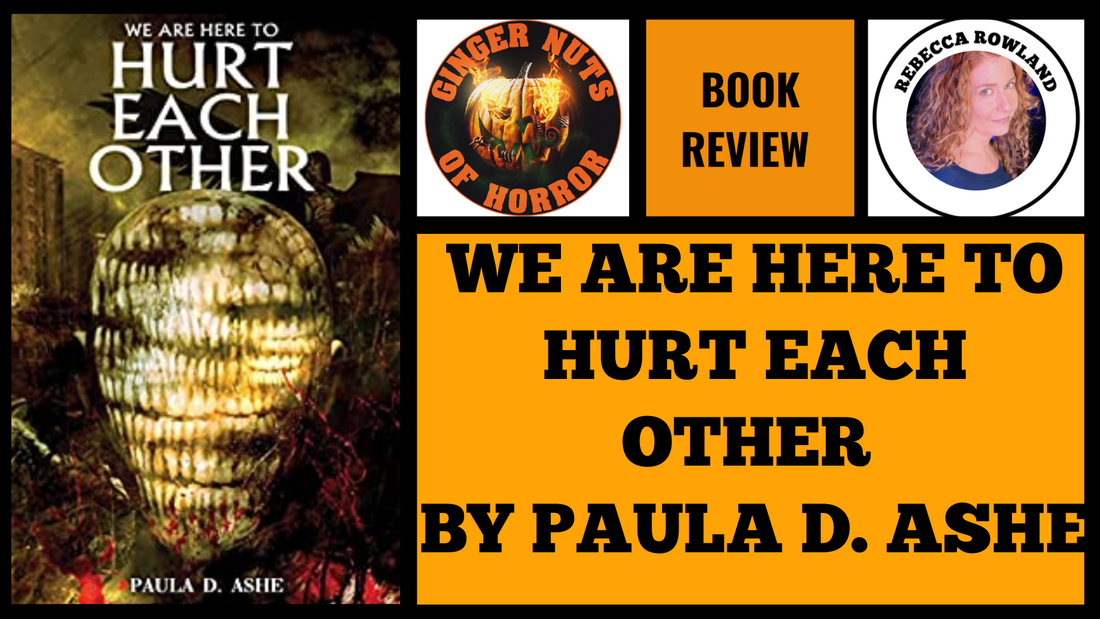 | |
THE HEART AND SOUL OF HORROR PROMOTION WEBSITES
JOHN TRAVIS AND HIS ELOQUENCE OF SILENCE
23/3/2022

Could you tell the readers a little bit about yourself?
Hmm… the only important thing is that I write – what I can, when I can. I’d call it weird fiction but with a very strong leaning towards horror. I live mostly in my head but occasionally venture beyond it. I like spicy food, long walks and music. I don’t believe in god. People baffle me. And I’m not very good about telling people about myself.
Which one of your characters would you least like to meet in real life?
I don’t think I’d mind meeting any of them, as awful as some of them are. They’d probably make more sense to me than real people because I created them.
Other than the horror genre, what else has been a major influence on your writing?
Music (dozens of artists, but the group the Pixies have influenced me more than anything); Surrealism (in general but the works of Jan Svankmajer in particular); Comedy (again a lot to pick from but the sitcom One Foot in the Grave stands head and shoulders above the rest).
The term horror, especially when applied to fiction always carries such heavy connotations. What’s your feeling on the term “horror” and what do you think we can do to break past these assumptions?
Personally, I think the term should be as broad as possible, as horror itself can be/is a very broad genre. Generally I prefer ‘Weird Fiction’ as it encompasses horror, sci-fi, fantasy and quite a bit of crime fiction. But even then some people would balk at it, the same as they might with any genre. But horror, even as its most genteel, is still an extreme genre. Maybe we should just accept that, instead of trying to repackage it as something that everyone can get into?
A lot of good horror movements have arisen as a direct result of the socio/political climate, considering the current state of the world where do you see horror going in the next few years?
I have no idea. I’m not really up on trends in the genre. But it’s hard to imagine anything in fiction matching what’s going on in the world at present. You couldn’t make up something as vile as Donald Trump, for instance – no-one would believe it. My own response would be to just go weirder. To quote Victor Meldrew, ‘What’s the point in being sane when the rest of the world is completely mad?’
Given the dark, violent and at times grotesque nature of the horror genre why do you think so many people enjoy reading it?
I know a lot of people don’t like this term, but I always thought Thomas Ligotti had it about right when he called it ‘Confrontational Escapism’. From a personal point of view I’d also add that I’ve never found horror fiction particularly frightening – the thing that’s always attracted me to it is that at its best it’s incredibly imaginative.
What, if anything, is currently missing from the horror genre?
Easy – humour. How many horror stories and novels out there have humour in them? Not nearly enough. I think the two things work together extremely well, although I’ve never met many who’ve agreed with me on that.
What new and upcoming authors do you think we should take notice off?
I’m not that up on new and upcoming authors, but over the past few years I’ve been very impressed by Priya Sharma – I think she’s a hell of a writer.
Are there any reviews of your work, positive or negative that have stayed with you?
Des Lewis’s Real-Time Reviews of Mostly Monochrome Stories and The Terror and the Tortoiseshell stick out, along with the one he’s currently doing for Gaseous Clay and Other Ambivalent Tales. They feel like short stories in themselves!
What aspects of writing to do you find the most difficult?
Finding a way into a story, the angle that’s the best way in to tell it. That can take me years. And endings for short stories sometimes.
Is there one subject you would never write about as an author?
I’m quite squeamish, so various forms of cruelty. I think just suggesting things sometimes can be at least as powerful as spelling them out.
Writing, is not a static process, how have you developed as a writer over the years?
I’ve got slower, which I don’t like. I’m trying to learn how to trust myself again, to let the sentences flow without stopping every farts’ end to change words around. But maybe in that it means I get to the real heart of what I want to say – it’s just that it takes an eternity.
What is the best piece of advice you ever received with regards to your writing?
A couple. One directly from fellow writer Marni Scofidio, who reminded me to use all my senses when writing, not just what’s seen, but also what’s smelled, touched, heard and tasted. Another I got from an article about Kate Bush, which said that she often mixed the personal with the fictional. I was about eighteen at the time and it had never occurred to me you were allowed to do that!
Which of your characters is your favourite?
Harvey ‘The Teeth’ O’keefe, my rabbit informer in the second and third Benji Spriteman novels. He’s turning into an interesting couple of guys.
Which of your books best represents you?
Of my novels, I’d say The Terror and the Tortoiseshell. Of my collections Gaseous Clay – I think there’s a decent sweep of material in that one.
Do you have a favorite line or passage from your work, and would you like to share it with us?
Years ago I wrote a story called ‘The Arse of Dracula’, about a vampire with piles. I managed to crowbar a line in there suggesting that when dealing with such a creature “The onus is on the anus”. People seemed to like that.
Can you tell us about your last book, and can you tell us about what you are working on next?
My last/newest book is called Eloquent Years of Silence, published by Vulpine Press. It’s a haunted house/haunted person story. It was influenced in part by the film The Changeling, Oliver Onions’ masterly novella, The Beckoning Fair One and the works of Robert Aickman. Also by the house I grew up in until I was three years old. It’s the most traditional thing I’ve ever written.
Next book – a novella centred around two surrealists, Jan Svankmajer and Erik Satie, a permanently tired middle-aged student and the strange little old man who lives next door to her. This one most definitely isn’t traditional.
If you could erase one horror cliché what would be your choice?
That one in horror films where someone looks in a bathroom cabinet mirror and there’s nobody there, but when they look again there is. Tedious.
What was the last great book you read, and what was the last book that disappointed you?
The last great book was a very peculiar crime novel called The Red Right Hand by Joel Townsley Rogers. Imagine David Lynch writing a crime novel in 1945. Then make it ten times weirder. Disappointing novel – Kiss Me, Deadly by Mickey Spillane. I found that one bewilderingly bad.
What's the one question you wish you would get asked but never do? And what would be the answer?
‘Well, Mr Travis, we’ve read your novel and we’d love to make a film of it. How about selling us the rights for, say, quarter of a million pounds?’
To which my answer would be, ‘Yes, I think I can live with that.’
Hmm… the only important thing is that I write – what I can, when I can. I’d call it weird fiction but with a very strong leaning towards horror. I live mostly in my head but occasionally venture beyond it. I like spicy food, long walks and music. I don’t believe in god. People baffle me. And I’m not very good about telling people about myself.
Which one of your characters would you least like to meet in real life?
I don’t think I’d mind meeting any of them, as awful as some of them are. They’d probably make more sense to me than real people because I created them.
Other than the horror genre, what else has been a major influence on your writing?
Music (dozens of artists, but the group the Pixies have influenced me more than anything); Surrealism (in general but the works of Jan Svankmajer in particular); Comedy (again a lot to pick from but the sitcom One Foot in the Grave stands head and shoulders above the rest).
The term horror, especially when applied to fiction always carries such heavy connotations. What’s your feeling on the term “horror” and what do you think we can do to break past these assumptions?
Personally, I think the term should be as broad as possible, as horror itself can be/is a very broad genre. Generally I prefer ‘Weird Fiction’ as it encompasses horror, sci-fi, fantasy and quite a bit of crime fiction. But even then some people would balk at it, the same as they might with any genre. But horror, even as its most genteel, is still an extreme genre. Maybe we should just accept that, instead of trying to repackage it as something that everyone can get into?
A lot of good horror movements have arisen as a direct result of the socio/political climate, considering the current state of the world where do you see horror going in the next few years?
I have no idea. I’m not really up on trends in the genre. But it’s hard to imagine anything in fiction matching what’s going on in the world at present. You couldn’t make up something as vile as Donald Trump, for instance – no-one would believe it. My own response would be to just go weirder. To quote Victor Meldrew, ‘What’s the point in being sane when the rest of the world is completely mad?’
Given the dark, violent and at times grotesque nature of the horror genre why do you think so many people enjoy reading it?
I know a lot of people don’t like this term, but I always thought Thomas Ligotti had it about right when he called it ‘Confrontational Escapism’. From a personal point of view I’d also add that I’ve never found horror fiction particularly frightening – the thing that’s always attracted me to it is that at its best it’s incredibly imaginative.
What, if anything, is currently missing from the horror genre?
Easy – humour. How many horror stories and novels out there have humour in them? Not nearly enough. I think the two things work together extremely well, although I’ve never met many who’ve agreed with me on that.
What new and upcoming authors do you think we should take notice off?
I’m not that up on new and upcoming authors, but over the past few years I’ve been very impressed by Priya Sharma – I think she’s a hell of a writer.
Are there any reviews of your work, positive or negative that have stayed with you?
Des Lewis’s Real-Time Reviews of Mostly Monochrome Stories and The Terror and the Tortoiseshell stick out, along with the one he’s currently doing for Gaseous Clay and Other Ambivalent Tales. They feel like short stories in themselves!
What aspects of writing to do you find the most difficult?
Finding a way into a story, the angle that’s the best way in to tell it. That can take me years. And endings for short stories sometimes.
Is there one subject you would never write about as an author?
I’m quite squeamish, so various forms of cruelty. I think just suggesting things sometimes can be at least as powerful as spelling them out.
Writing, is not a static process, how have you developed as a writer over the years?
I’ve got slower, which I don’t like. I’m trying to learn how to trust myself again, to let the sentences flow without stopping every farts’ end to change words around. But maybe in that it means I get to the real heart of what I want to say – it’s just that it takes an eternity.
What is the best piece of advice you ever received with regards to your writing?
A couple. One directly from fellow writer Marni Scofidio, who reminded me to use all my senses when writing, not just what’s seen, but also what’s smelled, touched, heard and tasted. Another I got from an article about Kate Bush, which said that she often mixed the personal with the fictional. I was about eighteen at the time and it had never occurred to me you were allowed to do that!
Which of your characters is your favourite?
Harvey ‘The Teeth’ O’keefe, my rabbit informer in the second and third Benji Spriteman novels. He’s turning into an interesting couple of guys.
Which of your books best represents you?
Of my novels, I’d say The Terror and the Tortoiseshell. Of my collections Gaseous Clay – I think there’s a decent sweep of material in that one.
Do you have a favorite line or passage from your work, and would you like to share it with us?
Years ago I wrote a story called ‘The Arse of Dracula’, about a vampire with piles. I managed to crowbar a line in there suggesting that when dealing with such a creature “The onus is on the anus”. People seemed to like that.
Can you tell us about your last book, and can you tell us about what you are working on next?
My last/newest book is called Eloquent Years of Silence, published by Vulpine Press. It’s a haunted house/haunted person story. It was influenced in part by the film The Changeling, Oliver Onions’ masterly novella, The Beckoning Fair One and the works of Robert Aickman. Also by the house I grew up in until I was three years old. It’s the most traditional thing I’ve ever written.
Next book – a novella centred around two surrealists, Jan Svankmajer and Erik Satie, a permanently tired middle-aged student and the strange little old man who lives next door to her. This one most definitely isn’t traditional.
If you could erase one horror cliché what would be your choice?
That one in horror films where someone looks in a bathroom cabinet mirror and there’s nobody there, but when they look again there is. Tedious.
What was the last great book you read, and what was the last book that disappointed you?
The last great book was a very peculiar crime novel called The Red Right Hand by Joel Townsley Rogers. Imagine David Lynch writing a crime novel in 1945. Then make it ten times weirder. Disappointing novel – Kiss Me, Deadly by Mickey Spillane. I found that one bewilderingly bad.
What's the one question you wish you would get asked but never do? And what would be the answer?
‘Well, Mr Travis, we’ve read your novel and we’d love to make a film of it. How about selling us the rights for, say, quarter of a million pounds?’
To which my answer would be, ‘Yes, I think I can live with that.’
john travis
BIO
Called ‘a writer of considerable energy’ in The Encyclopedia of Science Fiction, John Travis is the author of six books—two short story collections, Mostly Monochrome Stories and Gaseous Clay and Other Ambivalent Tales; two weird crime novels, The Terror and the Tortoiseshell and The Designated Coconut (the former attracting the attention of several Hollywood film companies); and two chapbooks – Greenbeard and Eloquent Years of Silence. His many short stories and novellas have appeared in anthologies and journals such as Nemonymous, The Urbanite, At Ease with the Dead, All Hallows, Supernatural Tales, British Invasion, The Monster Book for Girls, Horror Without Victims, Terror Tales of Northwest England and in both volumes of The Humdrumming Books of Horror Stories, his story from the second volume, ‘The Tobacconist’s Concession’ appearing on the 2009 shortlist for a British Fantasy Award. A third crime novel and a further collection of short stories remained unpublished, looking for homes.
WEBSITE LINKS
https://www.facebook.com/JohnTravisWriter
https://www.amazon.co.uk/John-Travis/e/B0043BAOAS?ref=sr_ntt_srch_lnk_1&qid=1644263896&sr=1-1
Called ‘a writer of considerable energy’ in The Encyclopedia of Science Fiction, John Travis is the author of six books—two short story collections, Mostly Monochrome Stories and Gaseous Clay and Other Ambivalent Tales; two weird crime novels, The Terror and the Tortoiseshell and The Designated Coconut (the former attracting the attention of several Hollywood film companies); and two chapbooks – Greenbeard and Eloquent Years of Silence. His many short stories and novellas have appeared in anthologies and journals such as Nemonymous, The Urbanite, At Ease with the Dead, All Hallows, Supernatural Tales, British Invasion, The Monster Book for Girls, Horror Without Victims, Terror Tales of Northwest England and in both volumes of The Humdrumming Books of Horror Stories, his story from the second volume, ‘The Tobacconist’s Concession’ appearing on the 2009 shortlist for a British Fantasy Award. A third crime novel and a further collection of short stories remained unpublished, looking for homes.
WEBSITE LINKS
https://www.facebook.com/JohnTravisWriter
https://www.amazon.co.uk/John-Travis/e/B0043BAOAS?ref=sr_ntt_srch_lnk_1&qid=1644263896&sr=1-1
Eloquent Years of Silence
by John Travis
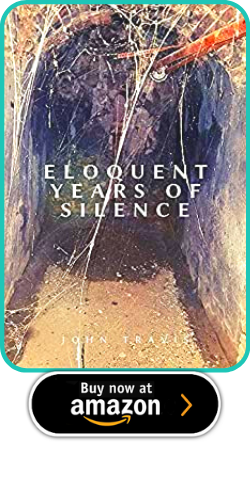
It seemed like an ideal situation to Bundrick: a couple of months house-sitting for friends just as he was about to become homeless. He was even okay with the fact that the house next door had been the scene of a strange death a few months earlier - because, for the first time in his life, Bundrick, however briefly, would have his own place.
But when strange noises start coming from that house, noises that shouldn't exist, that simply couldn't have been heard, Bundrick's curiosity leads him down into the dark cellar. Discovering the wall separating his house and the empty house has collapsed, it's almost as if it were inviting him in...
But when strange noises start coming from that house, noises that shouldn't exist, that simply couldn't have been heard, Bundrick's curiosity leads him down into the dark cellar. Discovering the wall separating his house and the empty house has collapsed, it's almost as if it were inviting him in...
CHECK OUT TODAY'S OTHER ARTICLES ON GINGER NUTS OF HORROR
 | |
THE HEART AND SOUL OF HORROR PROMOTION
YOU WANT TO GROW UP TO PAINT HOUSES LIKE ME, DAVID TALLERMAN DISCUSSES HIS NEW NOVEL THE OUTFIT.
8/3/2022

To celebrate the recent release of The Outfit, we ast down with author David Tallerman for an exclusive interview, taking in historical fiction, bank robberies, Revolution, and Young Stalin, and much more. Enjoy!
Gingernuts of Horror: I remember when you first told me about this project, thinking it was simply one of the best ideas for a historical novel I’d ever heard of. How on earth did you come across this story? And how did you come to write it?
David Tallerman: It was actually my editor on the project, David Thomas Moore, who came across the incident in question and decided the world badly needed a fictionalised account of it, and so far as I know, that was simply the product of some random Wikipedia-diving! But when he approached me and asked if I might be interested, my reaction was just the same as yours, I couldn’t believe I’d never heard about the Tiflis bank heist and that nobody had jumped on the opportunity to novelise it. The subject matter fed into my personal interests so much that it was uncanny, but that aside, coming to the topic with some years of novel-writing experience, it was astonishing the extent to which there was a book sitting there in plain sight.
GoH: One of the things that struck me as a reader was that it’s very much a heist story, but also very much a story about espionage and conspiracy (I kept finding echoes of Ellroy’s American Tabloid series). Did you find yourself wrestling with tone or approach to begin with, or did you instinctively grasp how the story needed to be told?
DT: Well, the pitch when the project was suggested to me was very much for a light-hearted heist story, something in the vein of Ocean’s 11. But the more I dug into it, the more it became clear that wasn’t really where the material led. Without giving too much away, this wasn’t the most well thought through of crimes, and most of the problems the gang encountered were the logistical ones of laying hands on weapons and the difficulties of keeping under the radar in what amounted to an occupied country. But then, on top of that, these people were professional revolutionaries, with their own allegiances and agendas, and they were all at the mercy of the Okhrana, the Tsarist secret police … so once you have all that together, it immediately begins to look more like The Manchurian Candidate or Three Days of the Condor than Ocean’s 11! Thankfully, I love that stuff, and I love writing books that play around with genre and sometimes abruptly switch gears, as this one does at least a couple of times, so I was more than happy to lean into that.
GoH: I definitely detected a tonal shift when you came to describing the events of the day of the heist - can you talk a bit about your approach to writing action, and what techniques you employ to achieve that sense of immediacy?
DT: I don’t know that I have a blanket approach, aside from technical stuff like trying to keep the sentence short and the pace fast … if you ever want to kill your action scene stone dead, long sentences are the way to go! But for The Outfit, the crucial aspect was keeping everything tethered to the characters. The book jumps between protagonists a lot, there was no way to get in all the vital events without doing so, and so I tried to make that subjectivity work to my advantage. I’m ultimately more of a film nerd than a book nerd, so I guess I automatically view it in terms of using a lot of first-person camera. But you could also see it in terms of what Lévi-Strauss called bricolage; throughout the book generally, but especially so in the action sequences, the goal was to present a collage of moments and scraps of individual experience rather than a single grand picture and then let the audience go about piecing that together.
GoH: Stalin is a central character in the narrative; a man about whom many millions of words have been written. What was your approach, both in research and technique, to finding your version of Stalin for this book?
DT: I did read a lot about the older Stalin, the one history remembers so much more clearly; but the person he was at the time of the Tiflis robbery, though obviously already containing the seeds of one of history’s bloodiest tyrants, was at the same time, in many ways, a drastically different person. He was a poet, a gangster, an agitator, sometimes a bully but also capable of being a loyal friend, and charming and handsome in a way you don’t tend to associate with Uncle Joe … I came to that youthful version of him mostly through Simon Montefiore’s superb biography Young Stalin, which gave me the core of my fictionalised version. From there, it was a case of taking what I found fascinating about him and figuring out how to utilise that in a way that got the plot from A to B in the way I needed it to. And although we know quite a bit about his younger years, there are still plenty of holes and controversies that left room for me to get a bit speculative without bending the known facts too far.
GoH: The poetry was news to me, I have to say! You mention in the afterword that you’d found through your research that his poetry was actually a key component in how the robbery was achieved; was that the most surprising thing you uncovered in the research phase? And what was your process for working out what historical detail to keep and what to discard?
DT: Stalin’s youthful poetry was certainly up there! And especially the fact that his work was genuinely well-regarded; that was somehow harder to get my head around than the notion that Stalin might have been a lousy poet! My favourite historical snippets, though, were those surrounding Stalin’s friend and lieutenant Kamo, particularly some of the stuff that happened to him later in his life, after the robbery. That material gets alluded to in the epilogue, but doing it justice would have meant an entire other book, and as much as I expect people to be incredulous about some of the details in The Outfit, that one I suspect they flat-out wouldn’t have believed.
GoH: Anything you’d care to share? Or is there a possible follow-up on the cards? I found Kamo a fascinating character…
DT: I’d better not share any details for fear of spoilers, but I’d urge anyone who gets to the end of The Outfit wanting to know more to dig into the history; Young Stalin, which I mentioned above, is a fantastic read. I’d like to come back to Kamo, and there’s a part of me that regrets not trying to nudge Rebellion towards a bigger, more expansive book that could have really dug into the events outside the robbery, but then I guess you have to draw the line somewhere, right? There’s so much great material around these people that you could go on forever. Still, if there was enough call for The Further Adventures of Kamo and Rebellion wanted me to write it, I can’t imagine I’d say no.
GoH: The story belongs at least as much to Stalin’s co-conspirators as to the man himself; how did you find researching the rest of the gang? And how did you approach fictionalising characters about whom, presumably, much less is known?
DT: I’d say the most research per time on the page actually went into Lenin, who makes a brief cameo at the very start. But then, after Stalin, it would be Kamo, who we know quite a bit about, but of course nowhere near as much as with the people who’d go on to be two of the most significant figures of the twentieth century. That was actually a major advantage, because it meant I could make Kamo more of a protagonist and use him to move the plot along in ways that were harder to do with Stalin. Actually, the working title of the book was the much less catchy “Kamo Dies At Tiflis”!
One thing that was true of both of them, though, and of the revolutionaries in general, was that I realised pretty quickly the extent to which these folks were pretty much rock stars; they were cool, and they knew it. Kamo and Stalin especially, you can see that they viewed themselves as the heroes in their own stories, and that made it easy to use them in that capacity, while also stepping back at times to acknowledge that they were simultaneously terrifying, deeply unbalanced individuals.
GoH: That part fascinated me; there seems to be a perpetual moral panic in the UK (especially our gutter press) about the power/cult of celebrity, and it’s always couched as some frightfully (and frightening) modern phenomena… and yet here we are, over a century ago, and as you say, these figures are rock stars… Did discovering that in the research surprise you? How did it feed into your approach to the narrative beyond the character notes?
DT: Yeah, the extent of it definitely surprised me. In the same way that you don’t tend to think of someone like Stalin as writing poetry, you don’t tend to imagine that they were cool in their younger years! And Kamo, too … by the midpoint of the book, he’s sporting an eyepatch and going everywhere with these three beautiful gunslinging girls that he recruited, and his contribution to the robbery is more Errol Flynn than Karl Marx. From a writing point of view, it was a license to make these people exciting and charismatic and witty, and to get away from that idea that somehow everyone in the past was boring and straightlaced and spoke very formally, knowing that by doing so I was actually veering closer to what the reality would likely have been. Really, it felt like I’d been given permission to have fun with them as characters and let them be fun to be around for the reader.
GoH: It strikes me that they’re also quite psychologically complex people - of necessity ruthless, and with a need to be highly compartmentalized in their thinking. Did you ever find yourself struggling with that, as a writer, in terms of keeping all the competing motives and desires straight?
DT: Yeah, it’s easy to look at historical figures and suppose that they must have been quite single-minded, but of course that’s not necessarily true. One of the things you see with Stalin in his younger years is that he goes through these drastically different phases in his life, and that was something I found fascinating and wanted to work in. I suppose the difficulty was that, having read so many details of these bizarre, tumultuous personalities, there was the urge to try and include as many of them as possible and really delve into those psychological rabbit holes, but that wasn’t the book I’d been hired to write and ultimately it probably wouldn’t have done much justice to the material. After all, as much as in some ways Stalin and many of the other revolutionaries were what we’d regard as intellectuals, they were also the sorts of people who went out and committed massive bank robberies using guns and explosives!
GoH: The town of Tiflis is central to the story - how was the research process for bringing the town to life?
DT: If you really dig into it, there’s not that much description of Tiflis in the book; I’ve never been the sort of writer that likes to set out a lot of physical detail when the reader’s always going to imagine things their own way. So while there was quite a bit of research - with historical writing, even figuring out how long a cart journey might take becomes a rabbit hole of poring over old maps written in a language you can’t read! - what I was much more interested in was capturing the vibe of Tiflis that was coming out of my research, this intriguing, exciting, kind-of renegade border town energy of a city that belonged as much to Asia as to Europe. I’m a big believer in place as character, and that was the character of Tiflis that fit perfectly with the story I was telling.
GoH: I noted in my review that there were parts of the story that verged on tropes typical to Westerns - was that deliberate on your part, or just a case of themes emerging naturally from the subject matter?
DT: I love me a good Western, particularly the Spaghetti variety, so I wouldn’t say that wasn’t anywhere in the back of my mind, but yeah, I do think it arose out of the material. The way Tiflis is described, it definitely has that vibe, and as the book illustrates, it was certainly brimming with outlaws and gunslingers. Of course, we think of the Wild West as something distantly historical, but actually, the events in the book are contemporaneous with the last years of that period, so in terms of the technologies and stuff, it’s not a big stretch to be imagining the scenes through that lens.
GoH: One of the things the story made me think about was the inherent violence in both repressive and revolutionary ideologies; the Tzar’s secret police play a pivotal role in the story, and the robbery itself contains some shockingly violent scenes. What are your considerations/approaches to depicting violence in fiction? And did this piece present any particular challenges in this regard?
DT: It varies by project, obviously, but my general feeling is that violence should be off-putting and have realistic consequences; that’s always seemed like the most responsible course. And that was especially true here, because, though politically I’d very much place myself on the side of the revolutionaries, there’s no getting around the fact that they showed an appalling disregard for human life. It was important not to give the impression that they were just a pack of robbers - some revolutionary gangs often kept part of the money they stole for their own purposes, but Stalin’s wasn’t one of them - but also important to make clear that they were a long way from being heroic.
In the end, though, I mostly just stuck to the known facts, and all the violence in the robbery scene is based on actual testimony. Funnily enough, the only thing I’ve been taken to task on by early readers so far was the particularly gruesome death of one poor horse. But sadly, that’s how it happened, so they’ll have to blame history, not me.
GoH: I wondered about that; do you think that speaks to a more callous disregard for human life then compared to now (thinking about the carnage of The Great War that’s still eight years away when the novel starts)? Or do you think it speaks to something in the psychology of both the revolutionaries and the regime they fought?
DT: That callousness is certainly hard to get your head around. It’s something I’ve explored quite a lot in my writing, having written about WW1 in my recent novel To End All Wars as well, but I don’t know that I’m any closer to understanding it. I’m not convinced it’s necessarily a historical phenomenon, since there are similar situations all around the world to this day, but reading about that period of Russian history, you definitely get this sense that, once the level of violence in society has escalated beyond a certain point, it’s very hard for anyone to back down from that. In the context of The Outfit, for example, the events of the book come directly on the back of brutal reprisals on the part of the Tsarist authorities, and you can understand why the revolutionaries would feel that only extreme actions would stand a chance of bringing about change; but how did they get from there to showing such disregard to casualties from among the civilian population on whose behalf they were expressly fighting for? Ultimately, I suppose it’s an unanswerable question, but for me anyway, it’s one that informs the whole book.
The Outfit is out NOW from Rebellion publishing.
heck out our review of The Outfit here
Gingernuts of Horror: I remember when you first told me about this project, thinking it was simply one of the best ideas for a historical novel I’d ever heard of. How on earth did you come across this story? And how did you come to write it?
David Tallerman: It was actually my editor on the project, David Thomas Moore, who came across the incident in question and decided the world badly needed a fictionalised account of it, and so far as I know, that was simply the product of some random Wikipedia-diving! But when he approached me and asked if I might be interested, my reaction was just the same as yours, I couldn’t believe I’d never heard about the Tiflis bank heist and that nobody had jumped on the opportunity to novelise it. The subject matter fed into my personal interests so much that it was uncanny, but that aside, coming to the topic with some years of novel-writing experience, it was astonishing the extent to which there was a book sitting there in plain sight.
GoH: One of the things that struck me as a reader was that it’s very much a heist story, but also very much a story about espionage and conspiracy (I kept finding echoes of Ellroy’s American Tabloid series). Did you find yourself wrestling with tone or approach to begin with, or did you instinctively grasp how the story needed to be told?
DT: Well, the pitch when the project was suggested to me was very much for a light-hearted heist story, something in the vein of Ocean’s 11. But the more I dug into it, the more it became clear that wasn’t really where the material led. Without giving too much away, this wasn’t the most well thought through of crimes, and most of the problems the gang encountered were the logistical ones of laying hands on weapons and the difficulties of keeping under the radar in what amounted to an occupied country. But then, on top of that, these people were professional revolutionaries, with their own allegiances and agendas, and they were all at the mercy of the Okhrana, the Tsarist secret police … so once you have all that together, it immediately begins to look more like The Manchurian Candidate or Three Days of the Condor than Ocean’s 11! Thankfully, I love that stuff, and I love writing books that play around with genre and sometimes abruptly switch gears, as this one does at least a couple of times, so I was more than happy to lean into that.
GoH: I definitely detected a tonal shift when you came to describing the events of the day of the heist - can you talk a bit about your approach to writing action, and what techniques you employ to achieve that sense of immediacy?
DT: I don’t know that I have a blanket approach, aside from technical stuff like trying to keep the sentence short and the pace fast … if you ever want to kill your action scene stone dead, long sentences are the way to go! But for The Outfit, the crucial aspect was keeping everything tethered to the characters. The book jumps between protagonists a lot, there was no way to get in all the vital events without doing so, and so I tried to make that subjectivity work to my advantage. I’m ultimately more of a film nerd than a book nerd, so I guess I automatically view it in terms of using a lot of first-person camera. But you could also see it in terms of what Lévi-Strauss called bricolage; throughout the book generally, but especially so in the action sequences, the goal was to present a collage of moments and scraps of individual experience rather than a single grand picture and then let the audience go about piecing that together.
GoH: Stalin is a central character in the narrative; a man about whom many millions of words have been written. What was your approach, both in research and technique, to finding your version of Stalin for this book?
DT: I did read a lot about the older Stalin, the one history remembers so much more clearly; but the person he was at the time of the Tiflis robbery, though obviously already containing the seeds of one of history’s bloodiest tyrants, was at the same time, in many ways, a drastically different person. He was a poet, a gangster, an agitator, sometimes a bully but also capable of being a loyal friend, and charming and handsome in a way you don’t tend to associate with Uncle Joe … I came to that youthful version of him mostly through Simon Montefiore’s superb biography Young Stalin, which gave me the core of my fictionalised version. From there, it was a case of taking what I found fascinating about him and figuring out how to utilise that in a way that got the plot from A to B in the way I needed it to. And although we know quite a bit about his younger years, there are still plenty of holes and controversies that left room for me to get a bit speculative without bending the known facts too far.
GoH: The poetry was news to me, I have to say! You mention in the afterword that you’d found through your research that his poetry was actually a key component in how the robbery was achieved; was that the most surprising thing you uncovered in the research phase? And what was your process for working out what historical detail to keep and what to discard?
DT: Stalin’s youthful poetry was certainly up there! And especially the fact that his work was genuinely well-regarded; that was somehow harder to get my head around than the notion that Stalin might have been a lousy poet! My favourite historical snippets, though, were those surrounding Stalin’s friend and lieutenant Kamo, particularly some of the stuff that happened to him later in his life, after the robbery. That material gets alluded to in the epilogue, but doing it justice would have meant an entire other book, and as much as I expect people to be incredulous about some of the details in The Outfit, that one I suspect they flat-out wouldn’t have believed.
GoH: Anything you’d care to share? Or is there a possible follow-up on the cards? I found Kamo a fascinating character…
DT: I’d better not share any details for fear of spoilers, but I’d urge anyone who gets to the end of The Outfit wanting to know more to dig into the history; Young Stalin, which I mentioned above, is a fantastic read. I’d like to come back to Kamo, and there’s a part of me that regrets not trying to nudge Rebellion towards a bigger, more expansive book that could have really dug into the events outside the robbery, but then I guess you have to draw the line somewhere, right? There’s so much great material around these people that you could go on forever. Still, if there was enough call for The Further Adventures of Kamo and Rebellion wanted me to write it, I can’t imagine I’d say no.
GoH: The story belongs at least as much to Stalin’s co-conspirators as to the man himself; how did you find researching the rest of the gang? And how did you approach fictionalising characters about whom, presumably, much less is known?
DT: I’d say the most research per time on the page actually went into Lenin, who makes a brief cameo at the very start. But then, after Stalin, it would be Kamo, who we know quite a bit about, but of course nowhere near as much as with the people who’d go on to be two of the most significant figures of the twentieth century. That was actually a major advantage, because it meant I could make Kamo more of a protagonist and use him to move the plot along in ways that were harder to do with Stalin. Actually, the working title of the book was the much less catchy “Kamo Dies At Tiflis”!
One thing that was true of both of them, though, and of the revolutionaries in general, was that I realised pretty quickly the extent to which these folks were pretty much rock stars; they were cool, and they knew it. Kamo and Stalin especially, you can see that they viewed themselves as the heroes in their own stories, and that made it easy to use them in that capacity, while also stepping back at times to acknowledge that they were simultaneously terrifying, deeply unbalanced individuals.
GoH: That part fascinated me; there seems to be a perpetual moral panic in the UK (especially our gutter press) about the power/cult of celebrity, and it’s always couched as some frightfully (and frightening) modern phenomena… and yet here we are, over a century ago, and as you say, these figures are rock stars… Did discovering that in the research surprise you? How did it feed into your approach to the narrative beyond the character notes?
DT: Yeah, the extent of it definitely surprised me. In the same way that you don’t tend to think of someone like Stalin as writing poetry, you don’t tend to imagine that they were cool in their younger years! And Kamo, too … by the midpoint of the book, he’s sporting an eyepatch and going everywhere with these three beautiful gunslinging girls that he recruited, and his contribution to the robbery is more Errol Flynn than Karl Marx. From a writing point of view, it was a license to make these people exciting and charismatic and witty, and to get away from that idea that somehow everyone in the past was boring and straightlaced and spoke very formally, knowing that by doing so I was actually veering closer to what the reality would likely have been. Really, it felt like I’d been given permission to have fun with them as characters and let them be fun to be around for the reader.
GoH: It strikes me that they’re also quite psychologically complex people - of necessity ruthless, and with a need to be highly compartmentalized in their thinking. Did you ever find yourself struggling with that, as a writer, in terms of keeping all the competing motives and desires straight?
DT: Yeah, it’s easy to look at historical figures and suppose that they must have been quite single-minded, but of course that’s not necessarily true. One of the things you see with Stalin in his younger years is that he goes through these drastically different phases in his life, and that was something I found fascinating and wanted to work in. I suppose the difficulty was that, having read so many details of these bizarre, tumultuous personalities, there was the urge to try and include as many of them as possible and really delve into those psychological rabbit holes, but that wasn’t the book I’d been hired to write and ultimately it probably wouldn’t have done much justice to the material. After all, as much as in some ways Stalin and many of the other revolutionaries were what we’d regard as intellectuals, they were also the sorts of people who went out and committed massive bank robberies using guns and explosives!
GoH: The town of Tiflis is central to the story - how was the research process for bringing the town to life?
DT: If you really dig into it, there’s not that much description of Tiflis in the book; I’ve never been the sort of writer that likes to set out a lot of physical detail when the reader’s always going to imagine things their own way. So while there was quite a bit of research - with historical writing, even figuring out how long a cart journey might take becomes a rabbit hole of poring over old maps written in a language you can’t read! - what I was much more interested in was capturing the vibe of Tiflis that was coming out of my research, this intriguing, exciting, kind-of renegade border town energy of a city that belonged as much to Asia as to Europe. I’m a big believer in place as character, and that was the character of Tiflis that fit perfectly with the story I was telling.
GoH: I noted in my review that there were parts of the story that verged on tropes typical to Westerns - was that deliberate on your part, or just a case of themes emerging naturally from the subject matter?
DT: I love me a good Western, particularly the Spaghetti variety, so I wouldn’t say that wasn’t anywhere in the back of my mind, but yeah, I do think it arose out of the material. The way Tiflis is described, it definitely has that vibe, and as the book illustrates, it was certainly brimming with outlaws and gunslingers. Of course, we think of the Wild West as something distantly historical, but actually, the events in the book are contemporaneous with the last years of that period, so in terms of the technologies and stuff, it’s not a big stretch to be imagining the scenes through that lens.
GoH: One of the things the story made me think about was the inherent violence in both repressive and revolutionary ideologies; the Tzar’s secret police play a pivotal role in the story, and the robbery itself contains some shockingly violent scenes. What are your considerations/approaches to depicting violence in fiction? And did this piece present any particular challenges in this regard?
DT: It varies by project, obviously, but my general feeling is that violence should be off-putting and have realistic consequences; that’s always seemed like the most responsible course. And that was especially true here, because, though politically I’d very much place myself on the side of the revolutionaries, there’s no getting around the fact that they showed an appalling disregard for human life. It was important not to give the impression that they were just a pack of robbers - some revolutionary gangs often kept part of the money they stole for their own purposes, but Stalin’s wasn’t one of them - but also important to make clear that they were a long way from being heroic.
In the end, though, I mostly just stuck to the known facts, and all the violence in the robbery scene is based on actual testimony. Funnily enough, the only thing I’ve been taken to task on by early readers so far was the particularly gruesome death of one poor horse. But sadly, that’s how it happened, so they’ll have to blame history, not me.
GoH: I wondered about that; do you think that speaks to a more callous disregard for human life then compared to now (thinking about the carnage of The Great War that’s still eight years away when the novel starts)? Or do you think it speaks to something in the psychology of both the revolutionaries and the regime they fought?
DT: That callousness is certainly hard to get your head around. It’s something I’ve explored quite a lot in my writing, having written about WW1 in my recent novel To End All Wars as well, but I don’t know that I’m any closer to understanding it. I’m not convinced it’s necessarily a historical phenomenon, since there are similar situations all around the world to this day, but reading about that period of Russian history, you definitely get this sense that, once the level of violence in society has escalated beyond a certain point, it’s very hard for anyone to back down from that. In the context of The Outfit, for example, the events of the book come directly on the back of brutal reprisals on the part of the Tsarist authorities, and you can understand why the revolutionaries would feel that only extreme actions would stand a chance of bringing about change; but how did they get from there to showing such disregard to casualties from among the civilian population on whose behalf they were expressly fighting for? Ultimately, I suppose it’s an unanswerable question, but for me anyway, it’s one that informs the whole book.
The Outfit is out NOW from Rebellion publishing.
heck out our review of The Outfit here
The Outfit: The Absolutely True Story of the Time Joseph Stalin Robbed a Bank for Lenin's Revolution
by David Tallerman
Lies and double-crosses, secret police and explosions, a carriage chase, a mattress stuffed with cash and a one-eyed master of disguise…
In 1907, the revolutionary Joseph Djugashvili – who would later take the name Joseph Stalin – met with an old friend, a clerk at the Tiflis branch of the State Bank of the Russian Empire, for a glass of milk. Over talk of national pride, the spirit of the new century and Djugashvili’s poetry, they agreed the beginnings of a plan.
With the aid of the Outfit, Djugashvili’s hardened crew of “expropriators,” they would pull off the biggest, bloodiest and most daring robbery in Georgia’s history, and ruthlessly change the direction of the Bolshevik revolution forever...
In 1907, the revolutionary Joseph Djugashvili – who would later take the name Joseph Stalin – met with an old friend, a clerk at the Tiflis branch of the State Bank of the Russian Empire, for a glass of milk. Over talk of national pride, the spirit of the new century and Djugashvili’s poetry, they agreed the beginnings of a plan.
With the aid of the Outfit, Djugashvili’s hardened crew of “expropriators,” they would pull off the biggest, bloodiest and most daring robbery in Georgia’s history, and ruthlessly change the direction of the Bolshevik revolution forever...
TODAY ON THE GINGER NUTS OF HORROR WEBSITE
 | |
THE HEART AND SOUL OF HORROR FEATURES

Could you tell the readers a little bit about yourself?
I’m all sorts of nerdy. A Dungeons and Dragons nerd, a Star Trek nerd, a sports nerd, a Gilligan’s Island nerd, a horror nerd. You name anything except mathematics and daytime talk shows and I’m probably a nerd of it.
I grew up on a farm outside a town of 800 people, worked at newspapers until I decided it was time to return to school, and I’ve taught college journalism ever since. I’ve never outgrown my fascination for monsters.
Which one of your characters would you least like to meet in real life?
That’s easy, Robert Garrett from The Girl in the Corn. What a creepy little bastard. He gave me the willies just writing him.
Other than the horror genre, what else has been a major influence on your writing?
Science fiction and fantasy. As a kid, I read the classics from H.G. Welles, Jules Verne, etc., but also fell in love with Ray Bradbury and Arthur C. Clarke early on. On the fantasy side it was J.R.R. Tolkien, of course, Michael Moorcock and Robert E. Howard. What brought these together with my love of horror (I devoured H.P. Lovecraft and Arthur Machen) occurred when I realized Mary Shelly’s Frankenstein was really a science fiction novel, and in 1979 when I saw Ridley Scott’s Alien as a freshman in high school. Alien is a straight-up horror movie, it’s just set in space.
The term horror, especially when applied to fiction always carries such heavy connotations. What’s your feeling on the term “horror” and what do you think we can do to break past these assumptions?
“Horror” is a catch-all word to mean anything shocking, although it’s often misused. I believe true horror is in the suspense, which is in a different literary category. Today, anything with a monster is horror, slasher is horror, creepy is horror, gross-out is horror. There are plenty of titles marketed as horror that probably have no business in that category. So, how can we break past these assumptions? Slasher, jump scare, creepy, and gross-out should be put in a category together and leave the works that are truly gut-wrenchingly scary to have horror to themselves.
A lot of good horror movements have arisen as a direct result of the socio/political climate, considering the current state of the world where do you see horror going in the next few years?
Wow. Yes. Writing is a product of the times. What I’m NOT expecting is pandemic horror. It’s too real. When the world gets tense (wartime, economic crisis, health crises), we tend to turn to monsters defeated by people as escapism. I hope we find new monsters to scare us. Vampires, werewolves, and zombies aren’t scary anymore.
Given the dark, violent and at times grotesque nature of the horror genre why do you think so many people enjoy reading it?
For the same reason we like roller coasters. We all love the unknown, the spine-chilling, the blood pumping, all the while knowing it’s not real. We’re not really going to get hurt. Why would someone read a novel that sounds too much like reality? We’re already scared of that.
What, if anything, is currently missing from the horror genre?
Truth and originality. Regurgitating the same vampire, zombie, serial killer, evil doppelgänger from another dimension tropes, there’s a lot of repetition. We need something fresh. A lot of that can be done with characters. Characters make or break the book. Sympathy for the Devil, and all.
What new and upcoming authors do you think we should take notice of?
That’s a great question. I read a lot during each year, but I don’t pay enough attention to know if the author is new, or established and I haven’t heard of them. I pick books by jacket copy and recommendations. That may sound like I’m an ignorant reader, and it may be true, but I’ve read some excellent books in and out of the horror genre that way.
Are there any reviews of your work, positive or negative, that have stayed with you?
Man, I love and hate reviews. I can get a bad review saying my novel’s pacing was slow and there were no memorable characters right next to a review of the same novel praising the pace and the memorable characters. So, I tend to brush them off as best I can. Getting too wrapped up in reviews can drive an author nuts. That said, I guess a recent review of The Girl in the Corn will stay with me for a while. “The Girl in the Corn is one of the first great horror novels of 2022.” Yeah, I like that.
What aspects of writing do you find the most difficult?
On the writing end, none. I’m a pantser, so there’s no outline. I simply sit down and write, discovering the story as the reader will when I’m finished. However, revisions are painfully hard. I had so much fun with these 100,000 words, now I have to %@$& with it for the next six months? That part’s work.
Is there one subject you would never write about as an author?
Any form of sexual abuse. Not acceptable.
Writing is not a static process, how have you developed as a writer over the years?
I hope I have. The Girl in the Corn is my fifth novel and sixteenth overall book. I think I’ve gotten better through all that practice. My first four novels were humorous sci-fi and I believe I firmly found my humor voice. Now I switched things up and wrote a horror novel and, by the review I mentioned, and a few other ones, it looks like I was able to quickly capture a way to make that voice work with horror.
What is the best piece of advice you ever received with regards to your writing?
Keep at it. I began my writing career in my early twenties in the newspaper industry, and once wrote a letter to Pulitzer Prize-winning humor columnist Dave Barry. I asked for advice, and to sum it up, he said if I have faith in my writing, don’t let rejection stand in my way. Rejections may be something as simple as an editor having a crappy day. When asked about my writing from writers who have yet to sell their first book, I give them that same advice. I tell them I’m not a better writer than any of them. I just never gave up.
Which of your characters is your favourite?
That’s tough. I’ll give you two, the good and the bad. The good: from my novel, So You Had to Build a Time Machine, there’s Brick, a huge lumberjack of a man who runs a muffin shop and nerds out to Dungeons and Dragons. The bad: from The Girl in the Corn, there’s Robert Garrett, the flunky of the monster set to destroy humanity. Bobby is wickedly creepy. Honestly, that was fun to write.
Which of your books best represents you?
My first, A Funeral Story. This is the story of a normal thirty-something guy who works IT, still hangs out with his high school friends to play D&D on Fridays (D&D seems to be a theme with me), and he lives with his mother to financially support her. However, this seemingly normal man has an unusual hobby; he goes to strangers’ funerals to pick up girls. I think it best represents me because I put more of myself in him than I have any of my other characters. Well, except the picking up strangers at funerals. I’ve never done that. I did watch my uncle attempt to do that—at his mother’s funeral. That’s where I got the idea.
Do you have a favorite line or passage from your work, and would you like to share it with us?
“When you leave a window open, you never know what may come in.” From The Girl in the Corn.
Can you tell us about your last book, and can you tell us about what you are working on next?
My last book was So You Had to Build a Time Machine. A small number of people in Kansas City, Missouri begin to notice some things they were certain of are now suddenly wrong. Street names, muffin flavors, and the fact that when the main character, Skid, punches a jerk trying to flirt with her in a dance club, the man disappears before he hits the floor. The man is a theoretical physicist who helped a government lab create a device that could intersect with different dimensions and times. All sorts of crazy things happen while a collection of four oddball characters try to find the machine to shut it off before something horrible happens.
My next book is a horror novel about a man who successfully left his small town, but years later, something evil happens there to bring him home. I can’t say any more. I’m not that far into it.
If you could erase one horror cliché what would be your choice?
Hollywood rules. This is one of the reasons I don’t like vampires and werewolves in fiction. The creation/behaviors/how to kill these monsters is what Hollywood told us they were, and Hollywood, for the most part, was wrong. If you’re going to write a beast with a history as a character, make sure you do your homework.
What was the last great book you read, and what was the last book that disappointed you?
I read Disorder by Amy Crider a couple of weeks ago and quite enjoyed it. Characters, pacing, setting, etc., were all top notch.
Disappointed is tougher. If I can’t get into a book, I put it down. People shouldn’t waste their time on books they can’t get into. I was like that with Cormac McCarthy’s The Road. It’s one of my wife’s favorite books, but I thought the writing was pretentious and put it down after a couple of chapters. I guess the last one I was disappointed in was Stephen King’s Billy Summers. I’ve loved King’s writing since I was in middle school, but some of his books just don’t click with me. This was one of them. I mean, it wasn’t bad, but there were problems with it his earlier novels didn’t have.
What's the one question you wish you would get asked but never do? And what would be the answer?
Q. What do you like to write best, fiction or nonfiction?
A. Fiction, because getting angry and killing a character is frowned upon in nonfiction.
I’m all sorts of nerdy. A Dungeons and Dragons nerd, a Star Trek nerd, a sports nerd, a Gilligan’s Island nerd, a horror nerd. You name anything except mathematics and daytime talk shows and I’m probably a nerd of it.
I grew up on a farm outside a town of 800 people, worked at newspapers until I decided it was time to return to school, and I’ve taught college journalism ever since. I’ve never outgrown my fascination for monsters.
Which one of your characters would you least like to meet in real life?
That’s easy, Robert Garrett from The Girl in the Corn. What a creepy little bastard. He gave me the willies just writing him.
Other than the horror genre, what else has been a major influence on your writing?
Science fiction and fantasy. As a kid, I read the classics from H.G. Welles, Jules Verne, etc., but also fell in love with Ray Bradbury and Arthur C. Clarke early on. On the fantasy side it was J.R.R. Tolkien, of course, Michael Moorcock and Robert E. Howard. What brought these together with my love of horror (I devoured H.P. Lovecraft and Arthur Machen) occurred when I realized Mary Shelly’s Frankenstein was really a science fiction novel, and in 1979 when I saw Ridley Scott’s Alien as a freshman in high school. Alien is a straight-up horror movie, it’s just set in space.
The term horror, especially when applied to fiction always carries such heavy connotations. What’s your feeling on the term “horror” and what do you think we can do to break past these assumptions?
“Horror” is a catch-all word to mean anything shocking, although it’s often misused. I believe true horror is in the suspense, which is in a different literary category. Today, anything with a monster is horror, slasher is horror, creepy is horror, gross-out is horror. There are plenty of titles marketed as horror that probably have no business in that category. So, how can we break past these assumptions? Slasher, jump scare, creepy, and gross-out should be put in a category together and leave the works that are truly gut-wrenchingly scary to have horror to themselves.
A lot of good horror movements have arisen as a direct result of the socio/political climate, considering the current state of the world where do you see horror going in the next few years?
Wow. Yes. Writing is a product of the times. What I’m NOT expecting is pandemic horror. It’s too real. When the world gets tense (wartime, economic crisis, health crises), we tend to turn to monsters defeated by people as escapism. I hope we find new monsters to scare us. Vampires, werewolves, and zombies aren’t scary anymore.
Given the dark, violent and at times grotesque nature of the horror genre why do you think so many people enjoy reading it?
For the same reason we like roller coasters. We all love the unknown, the spine-chilling, the blood pumping, all the while knowing it’s not real. We’re not really going to get hurt. Why would someone read a novel that sounds too much like reality? We’re already scared of that.
What, if anything, is currently missing from the horror genre?
Truth and originality. Regurgitating the same vampire, zombie, serial killer, evil doppelgänger from another dimension tropes, there’s a lot of repetition. We need something fresh. A lot of that can be done with characters. Characters make or break the book. Sympathy for the Devil, and all.
What new and upcoming authors do you think we should take notice of?
That’s a great question. I read a lot during each year, but I don’t pay enough attention to know if the author is new, or established and I haven’t heard of them. I pick books by jacket copy and recommendations. That may sound like I’m an ignorant reader, and it may be true, but I’ve read some excellent books in and out of the horror genre that way.
Are there any reviews of your work, positive or negative, that have stayed with you?
Man, I love and hate reviews. I can get a bad review saying my novel’s pacing was slow and there were no memorable characters right next to a review of the same novel praising the pace and the memorable characters. So, I tend to brush them off as best I can. Getting too wrapped up in reviews can drive an author nuts. That said, I guess a recent review of The Girl in the Corn will stay with me for a while. “The Girl in the Corn is one of the first great horror novels of 2022.” Yeah, I like that.
What aspects of writing do you find the most difficult?
On the writing end, none. I’m a pantser, so there’s no outline. I simply sit down and write, discovering the story as the reader will when I’m finished. However, revisions are painfully hard. I had so much fun with these 100,000 words, now I have to %@$& with it for the next six months? That part’s work.
Is there one subject you would never write about as an author?
Any form of sexual abuse. Not acceptable.
Writing is not a static process, how have you developed as a writer over the years?
I hope I have. The Girl in the Corn is my fifth novel and sixteenth overall book. I think I’ve gotten better through all that practice. My first four novels were humorous sci-fi and I believe I firmly found my humor voice. Now I switched things up and wrote a horror novel and, by the review I mentioned, and a few other ones, it looks like I was able to quickly capture a way to make that voice work with horror.
What is the best piece of advice you ever received with regards to your writing?
Keep at it. I began my writing career in my early twenties in the newspaper industry, and once wrote a letter to Pulitzer Prize-winning humor columnist Dave Barry. I asked for advice, and to sum it up, he said if I have faith in my writing, don’t let rejection stand in my way. Rejections may be something as simple as an editor having a crappy day. When asked about my writing from writers who have yet to sell their first book, I give them that same advice. I tell them I’m not a better writer than any of them. I just never gave up.
Which of your characters is your favourite?
That’s tough. I’ll give you two, the good and the bad. The good: from my novel, So You Had to Build a Time Machine, there’s Brick, a huge lumberjack of a man who runs a muffin shop and nerds out to Dungeons and Dragons. The bad: from The Girl in the Corn, there’s Robert Garrett, the flunky of the monster set to destroy humanity. Bobby is wickedly creepy. Honestly, that was fun to write.
Which of your books best represents you?
My first, A Funeral Story. This is the story of a normal thirty-something guy who works IT, still hangs out with his high school friends to play D&D on Fridays (D&D seems to be a theme with me), and he lives with his mother to financially support her. However, this seemingly normal man has an unusual hobby; he goes to strangers’ funerals to pick up girls. I think it best represents me because I put more of myself in him than I have any of my other characters. Well, except the picking up strangers at funerals. I’ve never done that. I did watch my uncle attempt to do that—at his mother’s funeral. That’s where I got the idea.
Do you have a favorite line or passage from your work, and would you like to share it with us?
“When you leave a window open, you never know what may come in.” From The Girl in the Corn.
Can you tell us about your last book, and can you tell us about what you are working on next?
My last book was So You Had to Build a Time Machine. A small number of people in Kansas City, Missouri begin to notice some things they were certain of are now suddenly wrong. Street names, muffin flavors, and the fact that when the main character, Skid, punches a jerk trying to flirt with her in a dance club, the man disappears before he hits the floor. The man is a theoretical physicist who helped a government lab create a device that could intersect with different dimensions and times. All sorts of crazy things happen while a collection of four oddball characters try to find the machine to shut it off before something horrible happens.
My next book is a horror novel about a man who successfully left his small town, but years later, something evil happens there to bring him home. I can’t say any more. I’m not that far into it.
If you could erase one horror cliché what would be your choice?
Hollywood rules. This is one of the reasons I don’t like vampires and werewolves in fiction. The creation/behaviors/how to kill these monsters is what Hollywood told us they were, and Hollywood, for the most part, was wrong. If you’re going to write a beast with a history as a character, make sure you do your homework.
What was the last great book you read, and what was the last book that disappointed you?
I read Disorder by Amy Crider a couple of weeks ago and quite enjoyed it. Characters, pacing, setting, etc., were all top notch.
Disappointed is tougher. If I can’t get into a book, I put it down. People shouldn’t waste their time on books they can’t get into. I was like that with Cormac McCarthy’s The Road. It’s one of my wife’s favorite books, but I thought the writing was pretentious and put it down after a couple of chapters. I guess the last one I was disappointed in was Stephen King’s Billy Summers. I’ve loved King’s writing since I was in middle school, but some of his books just don’t click with me. This was one of them. I mean, it wasn’t bad, but there were problems with it his earlier novels didn’t have.
What's the one question you wish you would get asked but never do? And what would be the answer?
Q. What do you like to write best, fiction or nonfiction?
A. Fiction, because getting angry and killing a character is frowned upon in nonfiction.
THE GIRL IN THE CORN
BY JASON OFFUTT

Beware of what lurks in the corn.
Fairies don’t exist. At least that’s what Thomas Cavanaugh’s parents say. But the events of that one night, when he follows a fairy into the cornfield on his parents’ farm, prove them wrong. What seems like a destructive explosion was, Thomas knows, an encounter with Dauðr, a force that threatens to destroy the fairy’s world and his sanity.
Years later, after a troubled childhood and a series of dead-end jobs, he is still haunted by what he saw that night. One day he crosses paths with a beautiful young woman and a troubled young man, soon realizing that he first met them as a kid while under psychiatric care after his encounters in the cornfield. Has fate brought them together? Are they meant to join forces to save the fairy’s world and their own? Or is one of them not who they claim to be?
[An] unholy mash-up of creepy, high-body-count paranormal thrills. —Publishers Weekly
[A] haunting, unsettling, gripping novel [with] such original, disturbing beasts—I was hypnotized by their presence on the page.—Richard Thomas, Bram Stoker and Shirley Jackson nominee
Norse mythology gives this story . . . a unique touch [with] an exhilarating conclusion.—Booklist
Or Purchase a copy of The Girl in the Corn direct from CamCat Publishing here
https://camcatbooks.com/Books/T/The-Girl-in-the-Corn
Fairies don’t exist. At least that’s what Thomas Cavanaugh’s parents say. But the events of that one night, when he follows a fairy into the cornfield on his parents’ farm, prove them wrong. What seems like a destructive explosion was, Thomas knows, an encounter with Dauðr, a force that threatens to destroy the fairy’s world and his sanity.
Years later, after a troubled childhood and a series of dead-end jobs, he is still haunted by what he saw that night. One day he crosses paths with a beautiful young woman and a troubled young man, soon realizing that he first met them as a kid while under psychiatric care after his encounters in the cornfield. Has fate brought them together? Are they meant to join forces to save the fairy’s world and their own? Or is one of them not who they claim to be?
[An] unholy mash-up of creepy, high-body-count paranormal thrills. —Publishers Weekly
[A] haunting, unsettling, gripping novel [with] such original, disturbing beasts—I was hypnotized by their presence on the page.—Richard Thomas, Bram Stoker and Shirley Jackson nominee
Norse mythology gives this story . . . a unique touch [with] an exhilarating conclusion.—Booklist
Or Purchase a copy of The Girl in the Corn direct from CamCat Publishing here
https://camcatbooks.com/Books/T/The-Girl-in-the-Corn
Jason Offutt

BIO
Jason Offutt grew up in a haunted farmhouse in rural Missouri. Not that the rest of the family knew (or would admit) the ghost of a little boy haunted the house; he was the only one who saw the full-bodied apparition, after all. Over the years Jason’s fascination grew for horror and dark fantasy where things never are what they seem.The Girl in the Corn is Jason’s first horror/dark fantasy novel. He is best known for science fiction, such as So You Had to Build a Time Machine, Bad Day for the Apocalypse, and How to Kill Monsters Using Common Household Objects. Jason teaches university journalism and cooks for his family.
Jason Offutt grew up in a haunted farmhouse in rural Missouri. Not that the rest of the family knew (or would admit) the ghost of a little boy haunted the house; he was the only one who saw the full-bodied apparition, after all. Over the years Jason’s fascination grew for horror and dark fantasy where things never are what they seem.The Girl in the Corn is Jason’s first horror/dark fantasy novel. He is best known for science fiction, such as So You Had to Build a Time Machine, Bad Day for the Apocalypse, and How to Kill Monsters Using Common Household Objects. Jason teaches university journalism and cooks for his family.
WEBSITE LINKS
Website: www.jasonoffutt.com
Goodreads: https://www.goodreads.com/search?utf8=✓&query=Jason+offutt
Amazon: https://www.amazon.com/Jason-Offutt/e/B001JP3IQS?ref=sr_ntt_srch_lnk_11&qid=1641595867&sr=8-11
Twitter: @TheJasonOffutt
Instagram: TheJasonOffutt
Website: www.jasonoffutt.com
Goodreads: https://www.goodreads.com/search?utf8=✓&query=Jason+offutt
Amazon: https://www.amazon.com/Jason-Offutt/e/B001JP3IQS?ref=sr_ntt_srch_lnk_11&qid=1641595867&sr=8-11
Twitter: @TheJasonOffutt
Instagram: TheJasonOffutt
TODAY ON THE GINGER NUTS OF HORROR WEBSITE
WHERE DECAY SLEEPS, THE CHILDHOOD FEARS OF ANNA CHEUNG

the heart and soul of horror author interviews


David Sodergren lives in Scotland with his wife Heather and his best friend, Boris the Pug. Growing up, he was the kind of kid who collected rubber skeletons and lived for horror movies. Not much has changed since then.
David has published six horror novels, including The Forgotten Island and Maggie’s Grave. His latest book, the comedic and violent thriller The Perfect Victim, is out now.
David has published six horror novels, including The Forgotten Island and Maggie’s Grave. His latest book, the comedic and violent thriller The Perfect Victim, is out now.
WEBSITE LINKS
Twitter: @paperbacksnpugs
Instagram: @ paperbacksandpugs
Linktree: https://linktr.ee/paperbacksandpugs
Twitter: @paperbacksnpugs
Instagram: @ paperbacksandpugs
Linktree: https://linktr.ee/paperbacksandpugs
Could you tell the readers a little bit about yourself?
I’m a Scottish author with six published horror novels, ranging from cosmic horror to slasher to western to comedic thriller. I’ve been obsessed with horror in all its many varied forms since I was a small child remaking The Evil Dead with my friends and a camcorder in my granny’s living room at the tender age of ten. And yes, I still have the finished film, cleverly titled The Unholy Dead to avoid those pesky lawsuits.
I would be remiss to not mention Boris the Pug, my best friend and writing companion, always ready and willing to lick my ears and snore loudly when I’m at a key moment in the writing process.
Which one of your characters would you least like to meet in real life?
Well, I tend to populate the supporting cast of my books with dreadfully unlikeable jerks and assholes, so there are quite a few to choose from. I have a tremendous fondness for my actual ‘villains.’ For example, Maggie from Maggie’s Grave may well be a terrifying and unstoppable supernatural killing machine, but it’s for a good cause, and I couldn’t stay mad at her, the poor wee thing. But someone like — and I had to look up his name because I have such a terrible memory, and I wrote the book four years ago — Ricky from The Forgotten Island, who is just a sleazy, repulsive scumbag masquerading behind a tired ‘nice guy’ persona. Sadly, I’ve met many, many people like him in real life.
Other than the horror genre, what else has been a major influence on your writing?
Music. It plays an enormous part in my writing. Sometimes even a single song or piece of music can suggest an idea, and when I’m plotting or outlining I listen to music and see the images in my head like a film. When it comes time to actually write, I will curate a playlist that has to be at least five or six hours long, as I’ll be hearing it a lot over the coming weeks. The type of music depends entirely on the story being told, but it can range from classical and film score to jazz, pop, or rock. It also generally has to be era-specific, so nothing from the 90s while I’m writing a book set in the 70s. I know it doesn’t really matter, but also… it does matter.
The term horror, especially when applied to fiction always carries such heavy connotations. What’s your feeling on the term “horror” and what do you think we can do to break past these assumptions?
It’s not something I consider when writing and publishing. I’ve been a fan of horror for close to forty years, and have long since made peace with any negative connotations from people less familiar with the genre. I’ve no great interest in changing their mind, either. If someone wants to tell me that Jaws or Silence of the Lambs isn’t horror, then go ahead. I’m not gonna lose any sleep over it. I have my understanding of horror, and other people will have theirs. My definition tends to be pretty broad, anyway.
A lot of good horror movements have arisen as a direct result of the socio/political climate, considering the current state of the world where do you see horror going in the next few years?
We’re at an exciting moment when more and more diverse authors are publishing, so for the first time in a long time it’s hard to say where the genre is heading. I do believe that horror should be political and tackle important, current issues, so I think there’ll definitely be an increase in stories tackling issues like climate change and the (mis)handling of the pandemic. I know some people think that it’s too soon and possibly tasteless to do so, but I have no interest in the concept of good and bad taste. It would be odd to me to live through arguably the most horrifying time in most people’s living memory and not be influenced by it.
Given the dark, violent and at times grotesque nature of the horror genre why do you think so many people enjoy reading it?
Because we’re living in dark, violent, and grotesque times? Who knows. I can only speak for myself, and I have always been drawn to the darkness. I still find it difficult to pass by a cemetery without popping in for a stroll. It’s just in my blood, I guess.
What, if anything, is currently missing from the horror genre?
It’s not necessarily missing per se, because there are plenty of authors still writing this kind of story, but I would like to see more wildly outrageous horror with a sense of unhinged, anything-goes fun about them. I kinda feel like every second book coming out these days is ‘a haunting meditation on grief and loss,’ which is all well and good, but oftentimes it feels like a book striving for unearned literary greatness and can make for a tiresome slog for the reader. That said, there have been some terrific books in this mould recently, for example Crossroads by Laurel Hightower and Dear Laura by Gemma Amor, among others.
What new and upcoming authors do you think we should take notice off?
One who recently caught my attention is LJ Dougherty. His book Beasts of the Caliber Lodge is an old-school 60s spy thriller, but with added Bigfoot, and was tremendous fun. Aside from the aforementioned Gemma Amor and Laurel Hightower, I’ve really enjoyed the slasher novels of Cameron Roubique and the 80s-splatter-meets-found-footage-J-horror of Bradley Freeman’s REEK. Then there’s Steve Stred of course, with whom I recently co-authored a horror western. Steve is a tremendous writer going from strength-to-strength. Finally, one of my favourite stories I read last year was Ready or Not by Cassie Daly. It was her first short story, and it blew me away with the raw, unflinching nature of the prose.
Are there any reviews of your work, positive or negative that have stayed with you?
I stopped reading my reviews last year, and it has been massively beneficial to my mental health. Of course I still read a review if someone has specifically tagged me in it, but I don’t seek them out. I do remember a few people saying there was too much sex in my books, which always made me laugh, because there’s not enough sex in them, frankly.
What aspects of writing to do you find the most difficult?
Maintaining my discipline. Finishing the damn story and not getting distracted by the shiny new idea undressing seductively in the corner. My current tactic is to get the cover art made way in advance. That way I have to finish the story, because I’ve already paid for the cover and need to make my money so I can afford to eat and keep the pug living the luxurious lifestyle he’s become accustomed to.
Is there one subject you would never write about as an author?
I don’t believe so. I’d never say never, and perhaps there is something out there I wouldn’t write about, but I haven’t found it yet.
Writing, is not a static process, how have you developed as a writer over the years?
I think that’s for the reader to judge and not me. I never reread my own books. Once I hit publish, that’s it, I move onto the next one. I know I’ve become more confident in my style, which is to pare things down to the bone and keep the story moving without distractions like long, dull stretches of exposition or descriptions of clothing and rooms and weather. You can tell by the fact that my books keep getting shorter. Give it a few years and I’ll probably be publishing my stories as eight-page pamphlets.
What is the best piece of advice you ever received with regards to your writing?
This book needs more pugs, a piece of advice I wholeheartedly embraced. Now, every one of my books features at least a cameo by my favourite curly-tailed goofballs.
Which of your characters is your favourite?
Grub from The Forgotten Island. See my answer to the previous question for more details. If, however, you’re going to insist it’s a human character, then I enjoy Elspeth from Night Shoot, who goes through an absolute hell of a time in that book, and Charles from The Navajo Nightmare, because I always enjoy writing people who try to do good but consistently make bad decisions.
Which of your books best represents you?
I have absolutely no idea. Either Night Shoot or Maggie’s Grave, maybe? All my books are fast-paced thrill-rides with brutal violence and lashings of humour, so I don’t think any particular one stands out as most representative of my writing.
Do you have a favorite line or passage from your work, and would you like to share it with us?
It would be any time I manage to ruthlessly shoehorn the title of the book into the text, because I know how much it really winds some people up.
Can you tell us about your last book, and can you tell us about what you are working on next?
My last book was The Perfect Victim, a slight sideways step from horror into the violent thriller category. It’s the story of a kidnapping that spirals out of control, because I love anything that spirals out of control. I’m currently working on three very different novels at the moment, so I have no idea which one will be out first. There’s a slasher, a revenge thriller, and a supernatural love story.
If you could erase one horror cliché what would be your choice?
Right now I’m rather fed up of the crass ‘parents who’ve lost a child and move somewhere new’ storyline. It ties back into my previous griping about every story being about grief. Unless it’s handled well and important to the story and the themes, that particular plot can feel like easy shorthand for engendering reader empathy with the characters.
What was the last great book you read, and what was the last book that disappointed you?
The last great book I read was A Matter of Life and Death by Andy Marr, a fellow Scottish author. Though it opens with the main character watching Texas Chain Saw Massacre, it’s the furthest thing from horror, a gut-wrenching but hilarious family drama that covers everything from cancer and divorce to friendship and enraged peacocks. It’s melancholy, funny, and very moving.
What's the one question you wish you would get asked but never do? And what would be the answer?
Funnily enough, that is the question I wish I would get asked, and this would be the answer.
Satan's Burnouts Must Die!
by David Sodergren

"You're a killer, baby."
Out of the desert they rode, 400lbs of hot steel throbbing between their legs.
Satan's Burnouts... twelve sex-crazed sadists with murder on their minds.
Sam West lives on the outskirts of Dennyville. His granddaughter Angel is coming to visit to celebrate his 70th birthday. But this year, the party will be a psychotic rampage of vengeance, as Sam and Angel face a wild gang of devil-worshipping degenerates who live for one thing... kicks.
Tonight, on Sam West's 70th birthday...
SATAN'S BURNOUTS MUST DIE!
“Bikes, babes, blood and brutality… Satan's Burnouts Must Die! reads like Rob Zombie meets Easy Rider."
Steve Stred, author of Ritual and Incarnate
"Titillating, truly violent, and guaranteed to freak the squares, SATAN'S BURNOUTS MUST DIE! is like something you'd distill from a filthy old crankcase. Hail Satan!"
John Bender, author of Chainsaw
Out of the desert they rode, 400lbs of hot steel throbbing between their legs.
Satan's Burnouts... twelve sex-crazed sadists with murder on their minds.
Sam West lives on the outskirts of Dennyville. His granddaughter Angel is coming to visit to celebrate his 70th birthday. But this year, the party will be a psychotic rampage of vengeance, as Sam and Angel face a wild gang of devil-worshipping degenerates who live for one thing... kicks.
Tonight, on Sam West's 70th birthday...
SATAN'S BURNOUTS MUST DIE!
“Bikes, babes, blood and brutality… Satan's Burnouts Must Die! reads like Rob Zombie meets Easy Rider."
Steve Stred, author of Ritual and Incarnate
"Titillating, truly violent, and guaranteed to freak the squares, SATAN'S BURNOUTS MUST DIE! is like something you'd distill from a filthy old crankcase. Hail Satan!"
John Bender, author of Chainsaw
TODAY ON THE GINGER NUTS OF HORROR WEBSITE
BOOK REVIEW: THOSE WE LEFT BEHIND BY BRANDON APPLEGATE
the heart and soul of horror author interviews
D. T. NEAL IS FAR FROM THE NORM
12/1/2022
 | Underrepresented groups running with horror should offer some good avenues for exploration into less-apparent corners than might otherwise be known by mainstream audiences. New faces mean new horrors, which is for the best. |

BIO
D. T. Neal is a fiction writer and editor living in Chicago. He won second place in the 2008 Aeon Award for his short story, “Aegis,” and has been published in Albedo One, Ireland’s premier magazine of science fiction, horror, and fantasy. He is the author of Saamaanthaa, The Happening, and Norm, known as The Wolfshadow Trilogy. He’s also written a vampire novel, Suckage, as well as the Lovecraftian cosmic horror-thriller, Chosen. He has written three creature feature/eco-horror novellas, Relict, Summerville, and The Day of the Nightfish. He edits for and is co-publisher of Nosetouch Press, an independent publisher tandemly based in Chicago and Pittsburgh.
WEBSITE LINKS
http://www.dtneal.com/
D. T. Neal is a fiction writer and editor living in Chicago. He won second place in the 2008 Aeon Award for his short story, “Aegis,” and has been published in Albedo One, Ireland’s premier magazine of science fiction, horror, and fantasy. He is the author of Saamaanthaa, The Happening, and Norm, known as The Wolfshadow Trilogy. He’s also written a vampire novel, Suckage, as well as the Lovecraftian cosmic horror-thriller, Chosen. He has written three creature feature/eco-horror novellas, Relict, Summerville, and The Day of the Nightfish. He edits for and is co-publisher of Nosetouch Press, an independent publisher tandemly based in Chicago and Pittsburgh.
WEBSITE LINKS
http://www.dtneal.com/
Could you tell the readers a little bit about yourself?
I’m a writer and editor by profession and a father of two. Born in St. Louis, I grew up in Youngstown, Ohio. I’ve lived in Chicago since 1993. My Rust Belt aesthetic populates all of my fiction, which I sometimes call “Northern Gothic”—there’s a certain Rust Belt edge that soaks into anyone from that region, and into their fiction if they happen to write. I’m also a longtime diehard music fan (favorite bands include the Who, Black Flag, Mudhoney, Soundgarden, Swervedriver, Suede, the Horrors, and many others). I’m an enthusiastic cook, and greatly enjoy conjuring up new dishes.
Which one of your characters would you least like to meet in real life?
Probably Mal Lazarus from my novel, Chosen. He’s relentlessly horrible in an undead cult leader sort of way. I would definitely not like him. Even when I created him, I was like “Yeesh.” He’s just not somebody I’d ever want to associate with, which is weird because I created him.
Other than the horror genre, what else has been a major influence on your writing?
Weirdly enough, my sense of humor. I have always had a strong comedic instinct, even as a kid. I studied improv in the 90s and can find the funny (or at least the absurd) in any situation. I think I deal with horrible things through humor, as a kind of defense mechanism. My humor creeps into everything I write in horror and thriller fiction. Nearly all of my horror writing has varying degrees of dark humor in it, and I tend to like horror that makes me laugh as well as be terrified. Not to say I haven’t written dead-serious fiction—only that my “undeadpan” sense of humor sneaks into so much of it when it can, served up with a bloody smirk.
The term horror, especially when applied to fiction always carries such heavy connotations. What’s your feeling on the term “horror” and what do you think we can do to break past these assumptions?
As a kid, I loved seeing the “Horror” category on the bookshelves. I thought it was cool, like a forbidden secret. I’m okay with the term, am glad to see it return to the surviving big bookstores. It’s a big tent with an assortment of freakshows contained within it. I prefer offense to defense in approaching horror—people will haul their own perceptions of horror to the tent, the things that’ll get to them, the things they bring with them. They enter the horror tent at their own risk, and the demons they bring with them will terrorize and horrify them. Horror doesn’t begin with the writers; all we are doing is creating a lens that magnifies something in daily life. If people don’t like being horrified, they should definitely not be reading horror fiction.
I always liked how in Danse Macabre, Stephen King broke down horror, terror, and what he called “the gross-out”—those are like the three rings of the horror circus. Terror is the big show, what he’d optimally strive for. If he couldn’t get that, he’d opt for horror, and if he couldn’t get that, he’d go for the gross-out.
That’s always had resonance for me. Horror’s gonna horror, but I aspire toward infusions of pure terror in my fiction, moments of genuine adrenaline-soaked, hyperventilating dread. I prefer terrifying atmosphere to gross-out stuff. I’ve attained some horrifying scenes in some of my books. I know this because readers will tell me they’ve been haunted by some of the things I’ve written. I take satisfaction in that, like I’ve done my job.
A lot of good horror movements have arisen as a direct result of the socio/political climate, considering the current state of the world where do you see horror going in the next few years?
There’s a lot of horrifying stuff going on. People are wrestling with so much right now—climate catastrophe, a global pandemic, political fanaticism, mindless rage, brazen injustice, willful ignorance, and persistent hate. It’s a challenge for anyone writing horror because people are, in many ways, benumbed to continuous outrage.
For example, in the US, the combination of the pandemic madness and the ongoing gun violence, people fall into a fatalistic sense that it’s somehow normal. Not that good people are happy about it, but the horror of it recedes in the face of the brute force of repetition: “Oh, another mass shooting. Oh, some maniacs are getting air rage because they were told to wear their masks. Oh, some people are lobbing death threats at health workers for suggesting they get vaccinated against a deadly virus. Oh, people are driving their cars over peaceful protesters because they’re angry at them” And so on….
The Folk Horror trend is curious and interesting. We’ll see where it goes—whether it’ll expand, endure, or just remain in its feverish little enclave is an open question as I see it.
Underrepresented groups running with horror should offer some good avenues for exploration into less-apparent corners than might otherwise be known by mainstream audiences. New faces mean new horrors, which is for the best.
Given the dark, violent and at times grotesque nature of the horror genre why do you think so many people enjoy reading it?
The manageable and often ridiculous nature of fictional horror can be cathartic. Unlike real-world horror, which can hit you in the face, you can always stop reading (or watching) fictional horror. You’re in control with fictional horror, which allows for some of the appeal: it’s a safe transgression. You can look away without consequence. Reading about a pretend monster is infinitely better than having to deal with real-life monstrosity. There’s no looking away from real-life horror without losing some of your humanity in the process. But fictional horror is a great release of tension and can be weirdly life-affirming.
What, if anything, is currently missing from the horror genre?
Horror has always walked close behind and sometimes beside humanity—in good times, it’s hiding somewhere over your shoulder. In bad times, it’s shambling right next to you, impossible to ignore. We’re all human beings, and on some level, can relate to horror once we become aware of it. Especially as more people gain agency in the fuller expression of their life experience, in sharing what horrifies them. I think horror has it covered in terms of humanity—whatever you value, there is a tailor-made horror waiting for you in the shadows, grinning, showing its teeth, eager to take a bite out of you.
If I had to name something I personally miss in horror, I’d like to see more political horror. There are plenty of horrifying things out there tied to politics—like certain lawmakers in the US writing laws that say it’s okay for people to drive over protestors with their cars. I mean, what the hell? Horrifying. These and other areas are ripe for literary exploration.
Horror is a fairly conservative genre—again referencing Stephen King in Danse Macabre, he invokes the severe moral code inherent in the genre—transgress and bad things will happen to you. The caveat that the unfamiliar is inherently threatening, and everyday “good people” going up against supernatural bad things. I think liberal perspectives of horror should get more attention.
The challenge for a writer is that the liberal frame of mind is rooted in the notion of optimistic progress—that if you put your mind to it, even terrible things can (eventually) get better and everything has a rational explanation if you really think it through. Which is contrary to the conservative idea that if you’re not careful, or if you go too far, things can always get worse—a pessimistic regression—and that hope is the root of ruin, or at best delusional and naïve.
Progressive values and horror are like oil and water, so it would be interesting to see what literary alchemists out there can mix them effectively.
What new and upcoming authors do you think we should take notice of?
I really love Coy Hall’s work. He’s a stellar writer. I also like CW Blackwell’s evocative fiction. Tiff Morris is a really good writer, too, and Tracy Fahey has a marvelous way with words.
Are there any reviews of your work, positive or negative that have stayed with you?
I almost never pay attention to reviews. My focus is on getting stories written. I feel like reviews can be like the scenery rushing past you as you drive. As a writer, if you turn your gaze off of where you’re going, you’ll veer right off the road.
A good review is a wonderful thing, a bad review is a painful thing—both can be perilous, either hobbling your self-confidence if bad or giving you a hubristic and unearned sense of your own success if good. Best to keep your writer’s eyes on the road ahead, if the goal is to get stories written.
What aspects of writing to do you find the most difficult?
Oh, probably networking and self-promotion. I truly love writing, the process itself. People either engage with my work or they don’t, but I keep working while I can.
Part of me doesn’t want to interfere in that process of discovery by readers. I understand that it’s not really interference, but as a writer, it can be hard to push myself in the area of marketing. Find the work, enjoy the work (or don’t), and I’ll just keep creating it. Raising the marketing bullhorn is a necessary part of it, but I’m always reluctant to do it. These days, even trad-published writers are largely left on their own to do this. Given the amount of introversion inherent to writing, that’s a big hill to climb.
Is there one subject you would never write about as an author?
I’m no fan of anything that hurts children. I love kids. I’m also not a fan of cruelty, which might sound odd from a horror-writing perspective. Stories that wallow in cruelty bother me, and I try to avoid narrative cruelty, even as I write about horrible things.
I also have an aversion to horror stories that identify with the killer(s). There is a vein of horror writing that seems to identify with the force of evil as the protagonist in many ways, and I find that dehumanizing. I might have sympathy for some of the monsters I create, but I don’t identify with them.
Writing is not a static process, how have you developed as a writer over the years?
I’m far more disciplined than I was when I first started sending short stories out when I was a teenager. I could never have written novels back then. Nowadays, I write far more novels than shorter works. Novellas have been working their way into my rotation, too. Longer fiction is my baseline, after doing mostly short stories in the ‘90s and early ‘00s.
What is the best piece of advice you ever received with regards to your writing?
“Keep going.”
Which of your characters is your favourite?
I like Paige from Relict a lot. She’s got a lot of determination to survive, and I respect that. Paige didn’t ask to be in the situation she was in, but she rose to the occasion.
I also dig Sonia Gorski from Norm, my latest book. She’s a badass, a lethal librarian werewolf hunter, which I respect. Sonia’s hardcore, knows the stakes of the game she’s in, and never flinches from it.
Which of your books best represents you?
They all have parts of me, obviously, since I wrote them. But I suppose my novel, Suckage, is one of the more personal ones I’ve written. I’m not actually like Nate (the protagonist), but the general smart-assed nature of that story is very me. There is a lot of my attitude in that book. And dealing with challenging relationships.
Do you have a favorite line or passage from your work, and would you like to share it with us?
I don’t really have a favorite line or passage. There are moments when I’m writing them where I am very satisfied with a scene, but when I’m done with a story, I’m done with it. For me, the focus is always on the work-in-progress and/or the next work, trying to get it just right. That’s where my attention’s at.
The Epilogue in Norm really got to me when writing it, but I don’t want to divulge that because there are spoilers in it. I didn’t expect to be hit as hard by it, but I was.
Can you tell us about your last book, and can you tell us about what you are working on next?
I just finished final revisions for Norm, the third book of The Wolfshadow Trilogy. I am really pleased how it turned out, feel like it nicely caps the series.
I wanted to give werewolves a nice series, and I feel like I accomplished that with this trilogy. Of course, while wrapping that up, my brain was already conjuring up several spinoff stories, so I feel like maybe I’ll be getting to those in the next decade or so. I wrote those books as kind of a rebuttal to all the vampire fiction out there at that time. I wanted werewolves to have their day.
Also, I’ve got some nautical horror novellas lurking around in my head, which I will give life to likely in ’23 and/or ’24. For whatever reason, people really seem to enjoy my nautical horror stories. Probably my own fear of the ocean fuels that. I love the ocean, but only a fool isn’t terrified by it, too. That terror fuels my nautical fiction.
If you could erase one horror cliché what would be your choice?
Anything with screwdrivers, hooks, or hammers, and mad scientists. I hate the idea of a mad scientist, which reeks of anti-intellectualism. I mean, what’s the opposite of a mad scientist?
What was the last great book you read, and what was the last book that disappointed you?
Taste is always so subjective. What I like always seems to be stuff that most people don’t like (and vice versa). Much of my reading is writerly research. A few of them include: Cunning Folk by Adam Nevill, The Great Mortality by John Kelly, Foucault’s Pendulum by Umberto Eco. I try to triage between books I want to read, books I need to read, and books I should read.
What's the one question you wish you would get asked but never do? And what would be the answer?
Q: “Would you be interested in your book being turned into a television series?”
A: “Hell, yes!”
Many years ago, I would have wanted various stories to be movies, but these days, I think a television series would be better!
I’m a writer and editor by profession and a father of two. Born in St. Louis, I grew up in Youngstown, Ohio. I’ve lived in Chicago since 1993. My Rust Belt aesthetic populates all of my fiction, which I sometimes call “Northern Gothic”—there’s a certain Rust Belt edge that soaks into anyone from that region, and into their fiction if they happen to write. I’m also a longtime diehard music fan (favorite bands include the Who, Black Flag, Mudhoney, Soundgarden, Swervedriver, Suede, the Horrors, and many others). I’m an enthusiastic cook, and greatly enjoy conjuring up new dishes.
Which one of your characters would you least like to meet in real life?
Probably Mal Lazarus from my novel, Chosen. He’s relentlessly horrible in an undead cult leader sort of way. I would definitely not like him. Even when I created him, I was like “Yeesh.” He’s just not somebody I’d ever want to associate with, which is weird because I created him.
Other than the horror genre, what else has been a major influence on your writing?
Weirdly enough, my sense of humor. I have always had a strong comedic instinct, even as a kid. I studied improv in the 90s and can find the funny (or at least the absurd) in any situation. I think I deal with horrible things through humor, as a kind of defense mechanism. My humor creeps into everything I write in horror and thriller fiction. Nearly all of my horror writing has varying degrees of dark humor in it, and I tend to like horror that makes me laugh as well as be terrified. Not to say I haven’t written dead-serious fiction—only that my “undeadpan” sense of humor sneaks into so much of it when it can, served up with a bloody smirk.
The term horror, especially when applied to fiction always carries such heavy connotations. What’s your feeling on the term “horror” and what do you think we can do to break past these assumptions?
As a kid, I loved seeing the “Horror” category on the bookshelves. I thought it was cool, like a forbidden secret. I’m okay with the term, am glad to see it return to the surviving big bookstores. It’s a big tent with an assortment of freakshows contained within it. I prefer offense to defense in approaching horror—people will haul their own perceptions of horror to the tent, the things that’ll get to them, the things they bring with them. They enter the horror tent at their own risk, and the demons they bring with them will terrorize and horrify them. Horror doesn’t begin with the writers; all we are doing is creating a lens that magnifies something in daily life. If people don’t like being horrified, they should definitely not be reading horror fiction.
I always liked how in Danse Macabre, Stephen King broke down horror, terror, and what he called “the gross-out”—those are like the three rings of the horror circus. Terror is the big show, what he’d optimally strive for. If he couldn’t get that, he’d opt for horror, and if he couldn’t get that, he’d go for the gross-out.
That’s always had resonance for me. Horror’s gonna horror, but I aspire toward infusions of pure terror in my fiction, moments of genuine adrenaline-soaked, hyperventilating dread. I prefer terrifying atmosphere to gross-out stuff. I’ve attained some horrifying scenes in some of my books. I know this because readers will tell me they’ve been haunted by some of the things I’ve written. I take satisfaction in that, like I’ve done my job.
A lot of good horror movements have arisen as a direct result of the socio/political climate, considering the current state of the world where do you see horror going in the next few years?
There’s a lot of horrifying stuff going on. People are wrestling with so much right now—climate catastrophe, a global pandemic, political fanaticism, mindless rage, brazen injustice, willful ignorance, and persistent hate. It’s a challenge for anyone writing horror because people are, in many ways, benumbed to continuous outrage.
For example, in the US, the combination of the pandemic madness and the ongoing gun violence, people fall into a fatalistic sense that it’s somehow normal. Not that good people are happy about it, but the horror of it recedes in the face of the brute force of repetition: “Oh, another mass shooting. Oh, some maniacs are getting air rage because they were told to wear their masks. Oh, some people are lobbing death threats at health workers for suggesting they get vaccinated against a deadly virus. Oh, people are driving their cars over peaceful protesters because they’re angry at them” And so on….
The Folk Horror trend is curious and interesting. We’ll see where it goes—whether it’ll expand, endure, or just remain in its feverish little enclave is an open question as I see it.
Underrepresented groups running with horror should offer some good avenues for exploration into less-apparent corners than might otherwise be known by mainstream audiences. New faces mean new horrors, which is for the best.
Given the dark, violent and at times grotesque nature of the horror genre why do you think so many people enjoy reading it?
The manageable and often ridiculous nature of fictional horror can be cathartic. Unlike real-world horror, which can hit you in the face, you can always stop reading (or watching) fictional horror. You’re in control with fictional horror, which allows for some of the appeal: it’s a safe transgression. You can look away without consequence. Reading about a pretend monster is infinitely better than having to deal with real-life monstrosity. There’s no looking away from real-life horror without losing some of your humanity in the process. But fictional horror is a great release of tension and can be weirdly life-affirming.
What, if anything, is currently missing from the horror genre?
Horror has always walked close behind and sometimes beside humanity—in good times, it’s hiding somewhere over your shoulder. In bad times, it’s shambling right next to you, impossible to ignore. We’re all human beings, and on some level, can relate to horror once we become aware of it. Especially as more people gain agency in the fuller expression of their life experience, in sharing what horrifies them. I think horror has it covered in terms of humanity—whatever you value, there is a tailor-made horror waiting for you in the shadows, grinning, showing its teeth, eager to take a bite out of you.
If I had to name something I personally miss in horror, I’d like to see more political horror. There are plenty of horrifying things out there tied to politics—like certain lawmakers in the US writing laws that say it’s okay for people to drive over protestors with their cars. I mean, what the hell? Horrifying. These and other areas are ripe for literary exploration.
Horror is a fairly conservative genre—again referencing Stephen King in Danse Macabre, he invokes the severe moral code inherent in the genre—transgress and bad things will happen to you. The caveat that the unfamiliar is inherently threatening, and everyday “good people” going up against supernatural bad things. I think liberal perspectives of horror should get more attention.
The challenge for a writer is that the liberal frame of mind is rooted in the notion of optimistic progress—that if you put your mind to it, even terrible things can (eventually) get better and everything has a rational explanation if you really think it through. Which is contrary to the conservative idea that if you’re not careful, or if you go too far, things can always get worse—a pessimistic regression—and that hope is the root of ruin, or at best delusional and naïve.
Progressive values and horror are like oil and water, so it would be interesting to see what literary alchemists out there can mix them effectively.
What new and upcoming authors do you think we should take notice of?
I really love Coy Hall’s work. He’s a stellar writer. I also like CW Blackwell’s evocative fiction. Tiff Morris is a really good writer, too, and Tracy Fahey has a marvelous way with words.
Are there any reviews of your work, positive or negative that have stayed with you?
I almost never pay attention to reviews. My focus is on getting stories written. I feel like reviews can be like the scenery rushing past you as you drive. As a writer, if you turn your gaze off of where you’re going, you’ll veer right off the road.
A good review is a wonderful thing, a bad review is a painful thing—both can be perilous, either hobbling your self-confidence if bad or giving you a hubristic and unearned sense of your own success if good. Best to keep your writer’s eyes on the road ahead, if the goal is to get stories written.
What aspects of writing to do you find the most difficult?
Oh, probably networking and self-promotion. I truly love writing, the process itself. People either engage with my work or they don’t, but I keep working while I can.
Part of me doesn’t want to interfere in that process of discovery by readers. I understand that it’s not really interference, but as a writer, it can be hard to push myself in the area of marketing. Find the work, enjoy the work (or don’t), and I’ll just keep creating it. Raising the marketing bullhorn is a necessary part of it, but I’m always reluctant to do it. These days, even trad-published writers are largely left on their own to do this. Given the amount of introversion inherent to writing, that’s a big hill to climb.
Is there one subject you would never write about as an author?
I’m no fan of anything that hurts children. I love kids. I’m also not a fan of cruelty, which might sound odd from a horror-writing perspective. Stories that wallow in cruelty bother me, and I try to avoid narrative cruelty, even as I write about horrible things.
I also have an aversion to horror stories that identify with the killer(s). There is a vein of horror writing that seems to identify with the force of evil as the protagonist in many ways, and I find that dehumanizing. I might have sympathy for some of the monsters I create, but I don’t identify with them.
Writing is not a static process, how have you developed as a writer over the years?
I’m far more disciplined than I was when I first started sending short stories out when I was a teenager. I could never have written novels back then. Nowadays, I write far more novels than shorter works. Novellas have been working their way into my rotation, too. Longer fiction is my baseline, after doing mostly short stories in the ‘90s and early ‘00s.
What is the best piece of advice you ever received with regards to your writing?
“Keep going.”
Which of your characters is your favourite?
I like Paige from Relict a lot. She’s got a lot of determination to survive, and I respect that. Paige didn’t ask to be in the situation she was in, but she rose to the occasion.
I also dig Sonia Gorski from Norm, my latest book. She’s a badass, a lethal librarian werewolf hunter, which I respect. Sonia’s hardcore, knows the stakes of the game she’s in, and never flinches from it.
Which of your books best represents you?
They all have parts of me, obviously, since I wrote them. But I suppose my novel, Suckage, is one of the more personal ones I’ve written. I’m not actually like Nate (the protagonist), but the general smart-assed nature of that story is very me. There is a lot of my attitude in that book. And dealing with challenging relationships.
Do you have a favorite line or passage from your work, and would you like to share it with us?
I don’t really have a favorite line or passage. There are moments when I’m writing them where I am very satisfied with a scene, but when I’m done with a story, I’m done with it. For me, the focus is always on the work-in-progress and/or the next work, trying to get it just right. That’s where my attention’s at.
The Epilogue in Norm really got to me when writing it, but I don’t want to divulge that because there are spoilers in it. I didn’t expect to be hit as hard by it, but I was.
Can you tell us about your last book, and can you tell us about what you are working on next?
I just finished final revisions for Norm, the third book of The Wolfshadow Trilogy. I am really pleased how it turned out, feel like it nicely caps the series.
I wanted to give werewolves a nice series, and I feel like I accomplished that with this trilogy. Of course, while wrapping that up, my brain was already conjuring up several spinoff stories, so I feel like maybe I’ll be getting to those in the next decade or so. I wrote those books as kind of a rebuttal to all the vampire fiction out there at that time. I wanted werewolves to have their day.
Also, I’ve got some nautical horror novellas lurking around in my head, which I will give life to likely in ’23 and/or ’24. For whatever reason, people really seem to enjoy my nautical horror stories. Probably my own fear of the ocean fuels that. I love the ocean, but only a fool isn’t terrified by it, too. That terror fuels my nautical fiction.
If you could erase one horror cliché what would be your choice?
Anything with screwdrivers, hooks, or hammers, and mad scientists. I hate the idea of a mad scientist, which reeks of anti-intellectualism. I mean, what’s the opposite of a mad scientist?
What was the last great book you read, and what was the last book that disappointed you?
Taste is always so subjective. What I like always seems to be stuff that most people don’t like (and vice versa). Much of my reading is writerly research. A few of them include: Cunning Folk by Adam Nevill, The Great Mortality by John Kelly, Foucault’s Pendulum by Umberto Eco. I try to triage between books I want to read, books I need to read, and books I should read.
What's the one question you wish you would get asked but never do? And what would be the answer?
Q: “Would you be interested in your book being turned into a television series?”
A: “Hell, yes!”
Many years ago, I would have wanted various stories to be movies, but these days, I think a television series would be better!
Norm (The Wolfshadow Trilogy Book 3)
by D.T. Neal

It’s been eight years since Zooey’s lycanthropic insurrection—known as the Happening—broke out across the country. Werewolves are everywhere and nowhere at once, ignored and disregarded by the media and officially denied by the government. Norm Stockwell, an elite, paranormal counterinsurgency agent, is desperate to reclaim his former life in the face of the ongoing lycanthropic epidemic. Working with members of the secret society of the Synowie Srebra, Norm hunts down the ever-elusive Ansel Rupino in an effort to put an end to the Happening once and for all. All that stands in his way are highly organized pack-gangs of Lupines who prowl the bloody streets of Chicago by the light of the moon, in their relentless, instinctive search for prey.
TODAY ON THE GINGER NUTS OF HORROR WEBSITE
EATERS OF THE DEAD BY KEVIN J. WETMORE
THE HEART AND SOUL OF AUTHOR INTERVIEWS


 RSS Feed
Archives
May 2023
April 2023
March 2023
February 2023
January 2023
December 2022
November 2022
October 2022
September 2022
August 2022
July 2022
June 2022
May 2022
April 2022
March 2022
February 2022
January 2022
December 2021
November 2021
October 2021
September 2021
August 2021
July 2021
June 2021
May 2021
April 2021
March 2021
February 2021
January 2021
December 2020
November 2020
October 2020
September 2020
August 2020
July 2020
June 2020
May 2020
April 2020
March 2020
February 2020
January 2020
December 2019
November 2019
October 2019
September 2019
August 2019
July 2019
June 2019
May 2019
April 2019
March 2019
February 2019
January 2019
December 2018
November 2018
October 2018
September 2018
August 2018
July 2018
June 2018
May 2018
April 2018
March 2018
February 2018
January 2018
December 2017
November 2017
October 2017
September 2017
June 2017
April 2017
March 2017
February 2017
January 2017
December 2016
November 2016
October 2016
September 2016
August 2016
June 2016
May 2016
April 2016
March 2016
February 2016
January 2016
December 2015
November 2015
September 2015
August 2015
July 2015
June 2015
May 2015
April 2015
March 2015
February 2015
January 2015
December 2014
November 2014
October 2014
September 2014
August 2014
July 2014
June 2014
May 2014
April 2014
March 2014
February 2014
January 2014
December 2013
November 2013
October 2013
September 2013
August 2013
July 2013
June 2013
May 2013
April 2013
March 2013
June 2012

|

|