

YOU WANT TO GROW UP TO PAINT HOUSES LIKE ME, DAVID TALLERMAN DISCUSSES HIS NEW NOVEL THE OUTFIT.
8/3/2022
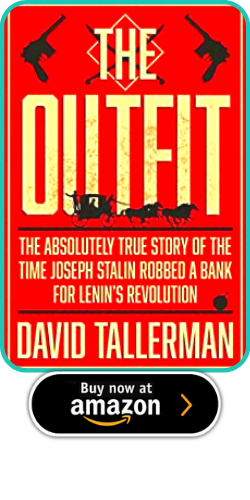
 To celebrate the recent release of The Outfit, we ast down with author David Tallerman for an exclusive interview, taking in historical fiction, bank robberies, Revolution, and Young Stalin, and much more. Enjoy! Gingernuts of Horror: I remember when you first told me about this project, thinking it was simply one of the best ideas for a historical novel I’d ever heard of. How on earth did you come across this story? And how did you come to write it? David Tallerman: It was actually my editor on the project, David Thomas Moore, who came across the incident in question and decided the world badly needed a fictionalised account of it, and so far as I know, that was simply the product of some random Wikipedia-diving! But when he approached me and asked if I might be interested, my reaction was just the same as yours, I couldn’t believe I’d never heard about the Tiflis bank heist and that nobody had jumped on the opportunity to novelise it. The subject matter fed into my personal interests so much that it was uncanny, but that aside, coming to the topic with some years of novel-writing experience, it was astonishing the extent to which there was a book sitting there in plain sight. GoH: One of the things that struck me as a reader was that it’s very much a heist story, but also very much a story about espionage and conspiracy (I kept finding echoes of Ellroy’s American Tabloid series). Did you find yourself wrestling with tone or approach to begin with, or did you instinctively grasp how the story needed to be told? DT: Well, the pitch when the project was suggested to me was very much for a light-hearted heist story, something in the vein of Ocean’s 11. But the more I dug into it, the more it became clear that wasn’t really where the material led. Without giving too much away, this wasn’t the most well thought through of crimes, and most of the problems the gang encountered were the logistical ones of laying hands on weapons and the difficulties of keeping under the radar in what amounted to an occupied country. But then, on top of that, these people were professional revolutionaries, with their own allegiances and agendas, and they were all at the mercy of the Okhrana, the Tsarist secret police … so once you have all that together, it immediately begins to look more like The Manchurian Candidate or Three Days of the Condor than Ocean’s 11! Thankfully, I love that stuff, and I love writing books that play around with genre and sometimes abruptly switch gears, as this one does at least a couple of times, so I was more than happy to lean into that. GoH: I definitely detected a tonal shift when you came to describing the events of the day of the heist - can you talk a bit about your approach to writing action, and what techniques you employ to achieve that sense of immediacy? DT: I don’t know that I have a blanket approach, aside from technical stuff like trying to keep the sentence short and the pace fast … if you ever want to kill your action scene stone dead, long sentences are the way to go! But for The Outfit, the crucial aspect was keeping everything tethered to the characters. The book jumps between protagonists a lot, there was no way to get in all the vital events without doing so, and so I tried to make that subjectivity work to my advantage. I’m ultimately more of a film nerd than a book nerd, so I guess I automatically view it in terms of using a lot of first-person camera. But you could also see it in terms of what Lévi-Strauss called bricolage; throughout the book generally, but especially so in the action sequences, the goal was to present a collage of moments and scraps of individual experience rather than a single grand picture and then let the audience go about piecing that together. GoH: Stalin is a central character in the narrative; a man about whom many millions of words have been written. What was your approach, both in research and technique, to finding your version of Stalin for this book? DT: I did read a lot about the older Stalin, the one history remembers so much more clearly; but the person he was at the time of the Tiflis robbery, though obviously already containing the seeds of one of history’s bloodiest tyrants, was at the same time, in many ways, a drastically different person. He was a poet, a gangster, an agitator, sometimes a bully but also capable of being a loyal friend, and charming and handsome in a way you don’t tend to associate with Uncle Joe … I came to that youthful version of him mostly through Simon Montefiore’s superb biography Young Stalin, which gave me the core of my fictionalised version. From there, it was a case of taking what I found fascinating about him and figuring out how to utilise that in a way that got the plot from A to B in the way I needed it to. And although we know quite a bit about his younger years, there are still plenty of holes and controversies that left room for me to get a bit speculative without bending the known facts too far. GoH: The poetry was news to me, I have to say! You mention in the afterword that you’d found through your research that his poetry was actually a key component in how the robbery was achieved; was that the most surprising thing you uncovered in the research phase? And what was your process for working out what historical detail to keep and what to discard? DT: Stalin’s youthful poetry was certainly up there! And especially the fact that his work was genuinely well-regarded; that was somehow harder to get my head around than the notion that Stalin might have been a lousy poet! My favourite historical snippets, though, were those surrounding Stalin’s friend and lieutenant Kamo, particularly some of the stuff that happened to him later in his life, after the robbery. That material gets alluded to in the epilogue, but doing it justice would have meant an entire other book, and as much as I expect people to be incredulous about some of the details in The Outfit, that one I suspect they flat-out wouldn’t have believed. GoH: Anything you’d care to share? Or is there a possible follow-up on the cards? I found Kamo a fascinating character… DT: I’d better not share any details for fear of spoilers, but I’d urge anyone who gets to the end of The Outfit wanting to know more to dig into the history; Young Stalin, which I mentioned above, is a fantastic read. I’d like to come back to Kamo, and there’s a part of me that regrets not trying to nudge Rebellion towards a bigger, more expansive book that could have really dug into the events outside the robbery, but then I guess you have to draw the line somewhere, right? There’s so much great material around these people that you could go on forever. Still, if there was enough call for The Further Adventures of Kamo and Rebellion wanted me to write it, I can’t imagine I’d say no. GoH: The story belongs at least as much to Stalin’s co-conspirators as to the man himself; how did you find researching the rest of the gang? And how did you approach fictionalising characters about whom, presumably, much less is known? DT: I’d say the most research per time on the page actually went into Lenin, who makes a brief cameo at the very start. But then, after Stalin, it would be Kamo, who we know quite a bit about, but of course nowhere near as much as with the people who’d go on to be two of the most significant figures of the twentieth century. That was actually a major advantage, because it meant I could make Kamo more of a protagonist and use him to move the plot along in ways that were harder to do with Stalin. Actually, the working title of the book was the much less catchy “Kamo Dies At Tiflis”! One thing that was true of both of them, though, and of the revolutionaries in general, was that I realised pretty quickly the extent to which these folks were pretty much rock stars; they were cool, and they knew it. Kamo and Stalin especially, you can see that they viewed themselves as the heroes in their own stories, and that made it easy to use them in that capacity, while also stepping back at times to acknowledge that they were simultaneously terrifying, deeply unbalanced individuals. GoH: That part fascinated me; there seems to be a perpetual moral panic in the UK (especially our gutter press) about the power/cult of celebrity, and it’s always couched as some frightfully (and frightening) modern phenomena… and yet here we are, over a century ago, and as you say, these figures are rock stars… Did discovering that in the research surprise you? How did it feed into your approach to the narrative beyond the character notes? DT: Yeah, the extent of it definitely surprised me. In the same way that you don’t tend to think of someone like Stalin as writing poetry, you don’t tend to imagine that they were cool in their younger years! And Kamo, too … by the midpoint of the book, he’s sporting an eyepatch and going everywhere with these three beautiful gunslinging girls that he recruited, and his contribution to the robbery is more Errol Flynn than Karl Marx. From a writing point of view, it was a license to make these people exciting and charismatic and witty, and to get away from that idea that somehow everyone in the past was boring and straightlaced and spoke very formally, knowing that by doing so I was actually veering closer to what the reality would likely have been. Really, it felt like I’d been given permission to have fun with them as characters and let them be fun to be around for the reader. GoH: It strikes me that they’re also quite psychologically complex people - of necessity ruthless, and with a need to be highly compartmentalized in their thinking. Did you ever find yourself struggling with that, as a writer, in terms of keeping all the competing motives and desires straight? DT: Yeah, it’s easy to look at historical figures and suppose that they must have been quite single-minded, but of course that’s not necessarily true. One of the things you see with Stalin in his younger years is that he goes through these drastically different phases in his life, and that was something I found fascinating and wanted to work in. I suppose the difficulty was that, having read so many details of these bizarre, tumultuous personalities, there was the urge to try and include as many of them as possible and really delve into those psychological rabbit holes, but that wasn’t the book I’d been hired to write and ultimately it probably wouldn’t have done much justice to the material. After all, as much as in some ways Stalin and many of the other revolutionaries were what we’d regard as intellectuals, they were also the sorts of people who went out and committed massive bank robberies using guns and explosives! GoH: The town of Tiflis is central to the story - how was the research process for bringing the town to life? DT: If you really dig into it, there’s not that much description of Tiflis in the book; I’ve never been the sort of writer that likes to set out a lot of physical detail when the reader’s always going to imagine things their own way. So while there was quite a bit of research - with historical writing, even figuring out how long a cart journey might take becomes a rabbit hole of poring over old maps written in a language you can’t read! - what I was much more interested in was capturing the vibe of Tiflis that was coming out of my research, this intriguing, exciting, kind-of renegade border town energy of a city that belonged as much to Asia as to Europe. I’m a big believer in place as character, and that was the character of Tiflis that fit perfectly with the story I was telling. GoH: I noted in my review that there were parts of the story that verged on tropes typical to Westerns - was that deliberate on your part, or just a case of themes emerging naturally from the subject matter? DT: I love me a good Western, particularly the Spaghetti variety, so I wouldn’t say that wasn’t anywhere in the back of my mind, but yeah, I do think it arose out of the material. The way Tiflis is described, it definitely has that vibe, and as the book illustrates, it was certainly brimming with outlaws and gunslingers. Of course, we think of the Wild West as something distantly historical, but actually, the events in the book are contemporaneous with the last years of that period, so in terms of the technologies and stuff, it’s not a big stretch to be imagining the scenes through that lens. GoH: One of the things the story made me think about was the inherent violence in both repressive and revolutionary ideologies; the Tzar’s secret police play a pivotal role in the story, and the robbery itself contains some shockingly violent scenes. What are your considerations/approaches to depicting violence in fiction? And did this piece present any particular challenges in this regard? DT: It varies by project, obviously, but my general feeling is that violence should be off-putting and have realistic consequences; that’s always seemed like the most responsible course. And that was especially true here, because, though politically I’d very much place myself on the side of the revolutionaries, there’s no getting around the fact that they showed an appalling disregard for human life. It was important not to give the impression that they were just a pack of robbers - some revolutionary gangs often kept part of the money they stole for their own purposes, but Stalin’s wasn’t one of them - but also important to make clear that they were a long way from being heroic. In the end, though, I mostly just stuck to the known facts, and all the violence in the robbery scene is based on actual testimony. Funnily enough, the only thing I’ve been taken to task on by early readers so far was the particularly gruesome death of one poor horse. But sadly, that’s how it happened, so they’ll have to blame history, not me. GoH: I wondered about that; do you think that speaks to a more callous disregard for human life then compared to now (thinking about the carnage of The Great War that’s still eight years away when the novel starts)? Or do you think it speaks to something in the psychology of both the revolutionaries and the regime they fought? DT: That callousness is certainly hard to get your head around. It’s something I’ve explored quite a lot in my writing, having written about WW1 in my recent novel To End All Wars as well, but I don’t know that I’m any closer to understanding it. I’m not convinced it’s necessarily a historical phenomenon, since there are similar situations all around the world to this day, but reading about that period of Russian history, you definitely get this sense that, once the level of violence in society has escalated beyond a certain point, it’s very hard for anyone to back down from that. In the context of The Outfit, for example, the events of the book come directly on the back of brutal reprisals on the part of the Tsarist authorities, and you can understand why the revolutionaries would feel that only extreme actions would stand a chance of bringing about change; but how did they get from there to showing such disregard to casualties from among the civilian population on whose behalf they were expressly fighting for? Ultimately, I suppose it’s an unanswerable question, but for me anyway, it’s one that informs the whole book. The Outfit is out NOW from Rebellion publishing. heck out our review of The Outfit here The Outfit: The Absolutely True Story of the Time Joseph Stalin Robbed a Bank for Lenin's Revolution |
 |  |
THE HEART AND SOUL OF HORROR FEATURES
Comments are closed.


 RSS Feed
Archives
May 2023
April 2023
March 2023
February 2023
January 2023
December 2022
November 2022
October 2022
September 2022
August 2022
July 2022
June 2022
May 2022
April 2022
March 2022
February 2022
January 2022
December 2021
November 2021
October 2021
September 2021
August 2021
July 2021
June 2021
May 2021
April 2021
March 2021
February 2021
January 2021
December 2020
November 2020
October 2020
September 2020
August 2020
July 2020
June 2020
May 2020
April 2020
March 2020
February 2020
January 2020
December 2019
November 2019
October 2019
September 2019
August 2019
July 2019
June 2019
May 2019
April 2019
March 2019
February 2019
January 2019
December 2018
November 2018
October 2018
September 2018
August 2018
July 2018
June 2018
May 2018
April 2018
March 2018
February 2018
January 2018
December 2017
November 2017
October 2017
September 2017
June 2017
April 2017
March 2017
February 2017
January 2017
December 2016
November 2016
October 2016
September 2016
August 2016
June 2016
May 2016
April 2016
March 2016
February 2016
January 2016
December 2015
November 2015
September 2015
August 2015
July 2015
June 2015
May 2015
April 2015
March 2015
February 2015
January 2015
December 2014
November 2014
October 2014
September 2014
August 2014
July 2014
June 2014
May 2014
April 2014
March 2014
February 2014
January 2014
December 2013
November 2013
October 2013
September 2013
August 2013
July 2013
June 2013
May 2013
April 2013
March 2013
June 2012

|

|