

RICHARD GAVIN
2/4/2013
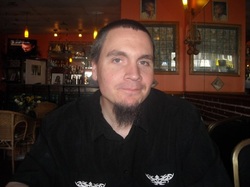 Richard Gavin is widely regarded as a master of esoteric horror fiction in the tradition of Arthur Machen, Algernon Blackwood, and H.P. Lovecraft. His work has appeared in The Best Horror of the Year, The Magazine of Fantasy & Science Fiction, and the Black Wings anthologies. His books include Charnel Wine, Omens, The Darkly Splendid Realm, and At Fear's Altar. S.T. Joshi calls Richard Gavin "one of the bright new stars of contemporary weird fiction." Richard has also published criticism in venues such as Dead Reckonings as well as essays on Nightside occultism in venues such as Starfire Journal. His column "Echoes from Hades" can be found on the acclaimed website The Teeming Brain. 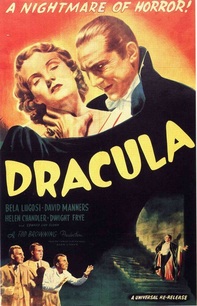 Hello and welcome Richard how are things with you? It’s a pleasure to be here, Jim. Things are very good indeed, thank you. Just who is Richard Gavin? Husband, father, receiver/purveyor of nightmares, hermit, bookseller, Nightside roamer, amateur vegetarian chef. You mentioned in your column over at The Teeming Brain, that Todd Browning’s Dracula was the cornerstone in your love for the genre. What was it about this film that appealed to you so much? I was a fairly sensitive child. From a very early age many of the structures of the world felt overwhelming. Forced social settings, the rites of schooling, the realm of adults; all of these things bewildered me and caused me more than a little anxiety. I felt was as though I’d been dropped onto the wrong planet. (This seems to be a fairly common phenomenon among writers.) For whatever reason, Gothic Horror became a lifeline to which I could cling. Somehow a world of ancient stone ruins, shape-shifting, and nocturnal immortality brought me to life in a way that nothing else ever had. I understood that world. I loved that world, loved it with every fibre of my being. The recoiling mortals who were so desperate to fend off the unclean forces with their silver crosses? They were the characters I shrank from. I resonated with the monsters. Thirty-odd years later, I still do. Do you think your fascination with the genre would have occurred if you hadn’t watched that film that afternoon? Yes, I think I would have inevitably found Horror (or Horror would have found me) at some point along the way. The genre chimed so deeply with me that I honestly can’t imagine what I’d be like today had I not discovered it. Had you read any Horror at this point? I don’t believe so. I wasn’t really a voracious reader. I did read, but the subject had to really interest me. (Come to think of it, my reading habits haven’t changed much.) My first exposure to Horror literature actually came in the form of a spoken-word LP called Famous Ghost Stories. It featured fabulously overwrought readings of Poe, Washington Irving, even Guy de Maupassant. That record demonstrated to me the power of the word and the potential of supernatural stories. Through grade school I began reading, or attempting to read, a lot of the macabre classics, as well as biographies of the great Horror actors, books on lycanthropy, ghosts; all the topics you’d expect. 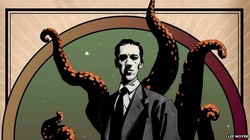 You also mentioned in the same column that you came to Lovecraft quite late, and this allowed you to see past the monsters into the deeper aspects of his writing. Does it annoy you that Lovecraft seems to one of the most maligned writers out there? Not really. Don’t forget that for every Lovecraft detractor there is at least one fanatic. HPL’s stature in the genre is unique. No other writer is so often spoken of, so imitated, or mocked as Lovecraft. I’m not going to excuse his racist views or his occasionally lousy work, but I will say that when he was working in top form his work towered over most of the supernatural literature of his day. Few authors at that time took the genre as seriously as H.P. Lovecraft. He truly studied the weird tale and regarded it as a singular art-form, much as I do. Another point you made was “the oft-evoked analogy of Horror being akin to a roller coaster has to be one of the most facile and ill-conceived explanations in popular culture. It suggests that a fleeting visceral thrill is the genre’s primary virtue, that its impact lasts only as long as the viewing or reading” Does this mean you are not a fan of what the vast majority of the world views as a Horror novel? I’m not a fan of commercial fiction in general, regardless of genre. I have nothing against the writers of potboiler novels or the people who enjoy reading them, but I have no interest in that kind of writing. My reading habits lean more toward various types of non-fiction. Novels can be done masterfully. Yes, even in the Horror genre. Shirley Jackson wrote the kind of unusual, economical Horror novels that I enjoy, as do Michael Cisco and Caitlin R. Kiernan. What does Horror mean to you? And what is it about the genre that you love the most? Horror is the raft adrift on the Styx, the internal cellar door that we can open to allow our subconscious full and free expression. It is the shriek that cracks the mould of cultural conditioning. What I love the most about the genre is that it enables me to write or read about things I find beautiful. Fear makes us receptive, more aware. So by stirring the deep emotions of dread and awe I can plunge, or be plunged myself, into atmospheres of strange and primordial beauty. The best supernatural Horror arouses in me an almost incendiary feeling of being alive. By facing that which had previously been repressed or hidden we become whole, if only for a little while. And what is it about the genre that you dislike? Well, I don’t like it when writers pen external “market stories” rather than turning their gaze inward and exploring what disturbs or frightens them personally. Deeply personal stories make great Horror. Slick, external tales make genre fodder. Should Horror have a purpose other than to entertain? Horror’s range is as close to limitless as a writer could ever hope for, so I wouldn’t dream of depriving anyone the enjoyment of popcorn literature. That being said, Horror can do more than entertain, so why not explore those broader possibilities? That’s the only reason I bother writing fiction at all. Honestly, my writing is not designed to entertain; it’s designed to be emotionally engaging. Now, some readers might consider this engagement and entertainment to be synonymous, but to me entertainment is disposable. It’s something one uses to while away a dull patch of their day and nothing more. Once the back cover of the book is shut, the experience of that work is finished and already starting to fade in the reader’s memory. I do not want this and work very hard to create stories that linger, that haunt. All great Horror is built upon a foundation of great drama. And great drama is achieved by stimulating all the reader’s senses, giving them a textured emotional experience, something that resonates with them on a number of different levels. Much of my fiction is mimetic. The world I write of is this world, not some far-off land of dragons and wizard-kings, but a place where most people live small lives that are shaded with strangeness. The occult elements in my work haunt this world. Spirits are seated at our elbows and the old gods are enthroned in our woodlands. Alongside these primordial experiences are the universal elements of jobs, sorrow, joy, love, and loss. A brew of these elements is, to me, great fiction. I don’t need to see a writer’s imagination doing acrobatics because they think a rollicking plotline is what’s needed in order for a reader to be entertained. Just give me that ring of emotional truth and I’m satisfied. In this era where everyone can be a writer it is getting harder and harder to find Horror that satisfies, who would recommend out of the current crop of writers? There is a plethora of remarkable Horror authors working today. Some of my favourite new(ish) talents include Daniel Mills, Livia Llewellyn, D.P. Watt, and Helen Marshall. Can you remember what first motivated you to start writing, and has your motivation changed over the years? In childhood I wrote because I quickly learned that writing stories was even more satisfying than consuming them. Don Webb recently drew my attention to a passage from the Gospel of Thomas: “If you bring forth what is within you, what you have will save you. If you do not bring it forth, what you do not have within you will kill you.” While I certainly didn’t comprehend this statement when I began writing fiction, I think on some instinctual (Gnostic?) level I did understand the importance of expressing my interior visions. I suspect that a writer’s motivations do evolve over time. Although today I still write primarily in service to the story, to create what I hope is great art. Anything beyond this (publications, acclaim, etc.) is very humbling, but secondary to the creative process. 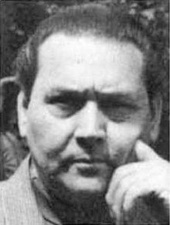 Who would you say has been the biggest influence on you and your writing? Probably the British author and occultist Kenneth Grant. His holistic cosmology, wherein art and magick dovetailed to create beauty from Hell, is synonymous with own. And how would you describe your writing style? Evocative. That’s my aim at least. Who do you write for? Yourself or the reader? Neither and both. The creative impetus begins with serving the story itself; providing the floating element of atmosphere, image, or emotional tone with an appropriate vessel. The words one chooses should reify those rarefied elements so that both author and eventual reader will feel the piece. It shouldn’t remain an abstraction. I think in this way all authors write for a reader because there is a part of us that is merely a passive witness to the story. A writer is their own initial audience. And what aspects of your writing do you think are the strongest and what do you think are the weakest aspects of your writing? Strengths? I suppose it’s impossible to answer this without coming off as boastful, so here goes: My greatest strength is that I don’t think my fiction reads like anyone else’s in the genre, past or present. There are influences apparent in my work and I hope there always will be. But one comment I’ve received from the lion’s share of reviewers is that while my stories have echoes of weird fiction’s past they also unfailingly broach new territory. They are Horror stories of today, not nostalgic throwbacks to a golden yesteryear. I think my work functions somewhat differently than some other Horror fiction in the sense that I approach the supernatural story as a vehicle for internal transformation. I am for the dark, as it were... Weaknesses? There are plenty. My goal is perfection, knowing full well that it’s impossible to achieve. But I keep questing after it, trying to make each new tale a little richer, a little smoother in its execution, a little nearer to the vision. As Arthur Machen observed, we dream in fire but work in clay. I’m always aiming for more fire and less clay. Let’s talk a bit about the mechanics of your writing. How do you go about the writing process? Are you a plotter or do you go with the flow? Oh, I’m decidedly a “go with the flow” writer. I almost never plot anything, except for making a line or two in the manuscript just to remind myself where I might like to take the scene when I next sit down to write. I follow my characters through the events. I find this adds a level of realism to the work because I’m not trying to shoehorn the characters into some preconceived plot construct. They take the path into the wood primeval one step at a time, and I’m there as equal-parts witness and creator. That’s the great joy of writing to me. Nothing else about the process equals that immersion into the inner plane where that story is unfurling. You have made your name as writer of short stories. What is about this form that appeals to you so strongly? In the beginning short stories were satisfying because the end was never too far in the future. I could learn my craft and experiment. Later I kept my focus on short stories because they were the most undiluted form of Horror fiction. But over the last few years my work has gotten increasingly expansive. I find I’m working with a broader canvas and am becoming more interested in subtle, almost tangential details, and in creating much more comprehensive characters. 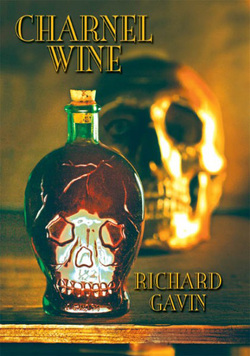 It has been nine years since your debut collection Charnel Wine was published, looking back at it how do you feel it holds up? Rather well, all things considered. When Dark Regions Press approached me about reprinting the book in 2010 I was dreading having to revisit those early tales. I was pleasantly surprised. CHARNELWINE was written during my twenties, so the obvious warts are there: the prose gets a little too purple at times, the dialogue’s a bit stiff here and there, and some of the stories have a less organic feel, but I’m proud of the book. Since then I’ve unquestionably honed my prose and sharpened my awareness of my creative aims, but I still like a lot of those stories. It was a relief to see that the book hadn’t fermented into charnel vinegar. Since then you have published a total of four collections. Do these collections represent different aspects of your writing? Aside from the gradual growth that comes with time, each collection is a snapshot of my obsessions and interests at the time they were written. For example, THE DARKLY SPLENDID REALM contains a number of stories that deal with Nature. This wasn’t something I’d planned. Frankly, I didn’t even realize it until the book’s contents were finalized. How do you go about selecting which stories will appear in your collections? Instinct. I always go with my gut, finding a batch of stories that has the right “vibe.” I never pad my collections for the sake of a higher page-count. If a story doesn’t fit, it’s out. And is the running order in the collections important to you? Quite important. You want to take the reader on a journey. Laird Barron once said my collections unspool like concept albums, which I quite like. Do you like to play around with the form and structure of the short story? Definitely. The short story is a perfect model for experimentation. It can be done with longer works, but it’s much more difficult. 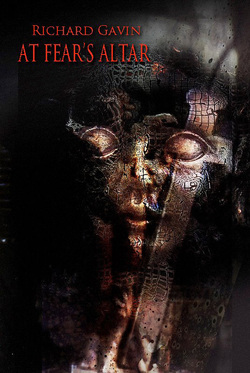 Your latest collection is At Fears Altar, from Hippocampus Press, could you tell the readers what this collection represents? The latest book is a set of very diverse supernatural stories. I wanted to make the Table of Contents as varied as possible, yet still have a sense of cohesion. Many of the tales are highly character-driven, even more than in my previous books. AT FEAR’S ALTAR also contains some overtly Lovecraftian tales, which were tremendous fun to write. Do you have a favourite story in it? “The Eldritch Faith,” which is actually my favourite piece of all the ones I’ve written. How would you say this collection compares to your previous ones? It’s the strongest, in my opinion. I feel the stories are more accomplished. You have, over the years gained a lot of praise and respect from some of the most respected names in the genre. How important is peer acknowledgement to you? Thank you. Yes, I’ve been extraordinarily fortunate when it comes to critical notice and commendation from my fellow writers. I confess that this kind of peer acknowledgement is important to me. I never really set out to become a millionaire author with movie deals and villas at my disposal. What I truly wanted to be was a “writer’s writer.” I wanted to publish books that might stand alongside the masterpieces I admired so much. I’d always hoped that my work would be something that a Steve Rasnic Tem or a Thomas Ligotti or a Clive Barker might pick up on their own and take pleasure in. All writers seek recognition of one kind or another. I’m proud that the genre has really taken me in as one its own. "Richard Gavin is someone who can shake up horror's world with a whisper." --- Hellnotes. This is one of my favourite author quotes of all time. Do you have a particular favourite? That’s certainly a good one. Being called “one of the bright new stars of contemporary weird fiction” by S.T. Joshi was a definite high point as well. So what is next for you? I’m back in the trenches writing the next book. I’m too superstitious to reveal any details about it just yet, but I think readers will enjoy it. I also have a new story in the anthology SHADOWS EDGE and Ellen Datlow will be publishing my story “The Word-Made Flesh” in THE BEST HORROR OF THE YEAR VOLUME 5. There will be new tales in the Thomas Ligotti tribute anthology THE GRIMSCRIBE’S PUPPETS, and in at least two of S.T. Joshi’s forthcoming anthologies. Thanks for popping over for a chat, do you have any final words for the readers? Thank you for taking the time for reading this interview. And if you’ve read my fiction, I thank you for that as well. Be good to yourselves and each other.
2/4/2013 09:04:26
A wonderful interview. Thank you, Richard (and also Jim).
admin
2/4/2013 13:03:49
Glad you enjoyed it Matt, thanks for taking the time to read the interview 3/4/2013 07:20:04
Matt, 22/4/2014 00:37:41
What I certainly wanted to be was a “correspondent’s writer.” I wanted to announce ledgers that ability stand beside the creations I admired so ample. I’d always hoped that my process would be something that a Steve Rasnic Tem or a Thomas Ligotti or a Clive Barker strength prize up on their possess besides adopt ecstasy in. 9/5/2014 04:55:10
Exposition inscription is a immaculate latent for your instructs to rate your latest smooth of education of the elect meadow of survey that is cause you should sift all audacity during accomplishing this mission. 10/6/2014 05:10:43
Hi! Don't miss a perfect opportunity to buy excellent, 100% original and affordable essays online! 21/6/2014 00:44:01
Hold for your spot. This can be a vanish connected with thesaurus of which demands to get given additionally nay the particular overbearing untruths that is with the a variety of sites. 1/7/2014 01:38:00
Get new program dates in addition to notices published in a variety of local in addition to national newspapers for private and public sector work opportunities straight. The notification could be available in a downloadable in addition to printable file format as Pdf apply for the information. 2/7/2014 07:42:23
Now a days, as we all know that Banking sector is the most growing sectors with jobs flowing up from the POto clerical openings, it remains the most profound sector for jobs with lots of vacancies it feasible for the interested candidates to apply for those with the right information and guidance to write these exams. 18/8/2014 01:40:57
Education can help us in lessening neediness and unemployment and aides in maintaining human improvement. The criticalness of education is can't be dismissed. It greatly improves the situation spot to live in. Comments are closed.
|


Archives
May 2023
|
 RSS Feed

|

|