

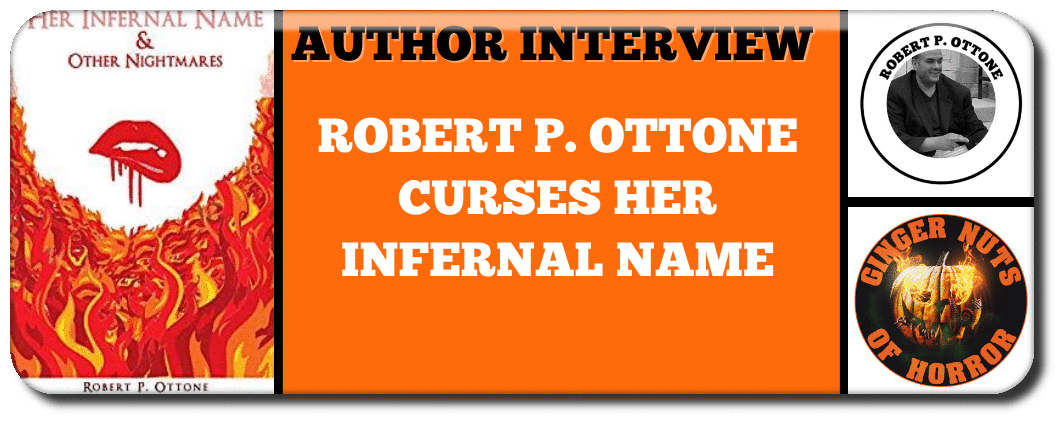
 Robert P. Ottone is an author, teacher, and cigar enthusiast from East Islip, NY. He delights in the creepy. He can be found online at www.SpookyHousePress.com, or on Instagram (@RobertOttone). His collections Her Infernal Name & Other Nightmares and People: A Horror Anthology about Love, Loss, Life & Things That Go Bump in the Night are available now wherever books are sold. WEBSITE LINKS https://www.amazon.com/Robert-P.-Ottone/e/B07Y5FGHQK%3Fref=dbs_a_mng_rwt_scns_share https://www.instagram.com/robertottone/ https://www.instagram.com/spookyhousepress/ Could you tell the readers a little bit about yourself? I’m Robert P. Ottone, horror and YA author from New York. Which one of your characters would you least like to meet in real life and have them complain at you about they way you treated them in your work. I would say the character Royce in my collection Her Infernal Name & Other Nightmares. She’s entirely too manic and intense, not to mention, the fact that she has a dark side might be problematic. Other than the horror genre, what else has been a major influence on your writing? Growing up in the 80’s and 90’s, and having parents who believed in me watching and exploring a wide variety of film and art. I didn’t know many other kids my age who grew up watching The Shining, reading Jurassic Park, or enjoying Toho’s Godzilla movies. The term horror, especially when applied to fiction always carries such heavy connotations. What’s your feeling on the term “horror” and what do you think we can do to break past these assumptions? I love when people think a show like NCIS or CSI is horror. It is, in some respects, gory, but these are cop stories, not horror stories, so, it’s interesting to see so many other genres lift from horror for their storytelling. I don’t know how we can break past these assumptions. I think mainstreaming more names in horror might help, so that the first and only person people have to reference isn’t Stephen King? There are plenty of other authors who could use the love, too, so, pushing new authors, which I think is what folks are trying to do with Josh Malerman, with Birdbox being everyone’s favorite Netflix movie a couple years ago, is key. A lot of good horror movements have arisen as a direct result of the socio/political climate, considering the current state of the world where do you see horror going in the next few years? I was in this great children’s literature conference over the summer, and they referenced the idea of ignoring the pandemic in your writing. There’s been discussion about that in the horror community, too, and I know, personally, outside of a comedy story I wrote that has absolutely nothing to do with horror, I won’t be writing about it. Unfortunately, I think this means more pandemic stuff in the immediate wake, followed by potentially tone-deaf adaptations of said material. Given the dark, violent and at times grotesque nature of the horror genre why do you think so many people enjoy reading it? Do they, though? I know folks who run away from spiders yet love true crime nonsense, where there’s never any payoff, unless the person is already in jail. George Romero used to call his fans “trolls” in the nicest way possible, and I think that remains true today. There are trolls like us, people who seek out horror, whether it’s an escape or a doorway into a world more interesting than our everyday, and there are the normies who like their true crime stories of dead people where the offender is safely tucked away behind bars. The hardcore will always seek out the next big thing. If we’re lucky, there’s some crossover to the commercial world giving the work some love, like in the case of Birdbox or the works of Stephen King. What, if anything, is currently missing from the horror genre? I think there’s more than enough room to get a little weirder. Where’s the Clive Barker resurgence? Is that going to happen with the reimagining of Candyman? Can it, please? There’s more than enough room to get a little weirder with crossover horror lit. Let’s shine a brighter light on folks taking horror into stranger, darker places, because that’s where the fun is. In the past authors were able to write about almost anything with a far lesser degree of the fear of backlash, but this has all changed in recent years. These days authors must be more aware of representation an the depiction of things such as race and gender in their works, how aware are you of these things and what steps have you taken to ensure that your writing can’t be viewed as being offensive to a minority group? There’s certainly value in seeking the attention and aid of sensitivity readers. I, personally, love and adore the First Nations belief system, even though I’m a boring white guy from New York. To that end, if I want to write a story or novel that incorporates concepts from the tribal nations here in the United States, I’m going to do exactly that, but with the guidance and watchful eye of those I’m writing about. It’s always been important to write correctly when writing a character of a different gender or race. I asked for two women of very different backgrounds to read a story about a character I didn’t want defined by her femininity for Her Infernal Name & Other Nightmares, and the feedback was different but helpful. Does horror fiction perpetuate it’s own ghettoization? For sure. It’s unfair to say it doesn’t, because this happens to every genre. For every beautiful, honest, thought-provoking romance novel, there’s the counter. For every brilliant spy thriller, there’s the cheesy knock-off. Just as there are garbage-tier B-level horror movies, there are garbage-tier B-level horror novels, and mine are probably there, too, but there’s an audience for all of it, which I think counters the notion of “ghettoization” to a point. Who doesn’t love a direct-to-video schlockfest from time to time? It can’t be all A24-level horror all the time, we need The Asylum once in a while. What new and upcoming authors do you think we should take notice off? Michael Jess Alexander is an amazing horror author whose collection I just published via my indie label Spooky House Press. I’m biased, but his work reminds me of Brian Evenson, an author I adore. What are the books and films that helped to define you as an author? I’ve been waiting my entire life for this question. Mark Z. Danielewski’s House of Leaves is probably my favorite horror novel of all-time. I’d have to list Brian Evenson’s Songs for the Unraveling of the World on there, too, along with Stephen King/Richard Bachman’s Thinner. John Saul’s Suffer the Children is a close second to House of Leaves, too. Movie-wise, Jaws is top-five horror for me. Zodiac, Halloween, The Thing (both/all three), Dogs Don’t Wear Pants, The Droving, Black Christmas. Blue Velvet is the movie that made me want to try to write in the first place. Same goes for Day of the Dead. Are there any reviews of your work, positive or negative that have stayed with you? Not so much with me, in terms of negative, but my editor, Louis, was angry at a 3.5 rating on Goodreads. I’ve been very happy with the reactions to my work, so, I have no complaints. What a boring answer that is. What aspects of writing to do you find the most difficult? Nothing, I enjoy every second of it. Writing YA is more daunting than horror, because I have to worry about getting too weird or too dark, because you don’t want to lose the audience. Is there one subject you would never write about as an author? I wouldn’t want to limit myself in any way, so, no. The novel I’m working on goes into some very uncomfortable places, for example, and I thrive in that space. How important are names to you in your books? Do you choose the names based on liking the way it sounds or the meaning? Not very important. In a lot of cases, I forget the names of my characters once the story is done. Maybe that’ll change as I get older, but overall, I choose names that I like, in that moment, or choose them as an homage to something or someone else. The lead in my story “Elevator of the Dead” for example is named after a character in one of the Silent Hill games. Writing, is not a static process, how have you developed as a writer over the years? I think by absorbing so much from mentor texts has been invaluable. Bret Easton Ellis is my hero. I worship the ground he walks on, and by reading his work, that started my thirst for reading when I returned to the written word in high school. I think by trying my hand at writing like him, taking in more from other genres, and exploring the power of word choice, I feel like I’m developing into something better than when I was just stealing Ellis’ style in my younger days in college. What is the best piece of advice you ever received with regards to your writing? I attended a reading of Imperial Bedrooms in the Hamptons when it came out and Ellis talked about dialogue. His words of wisdom were essentially to listen to how people talk and converse with one-another. This has changed so much these days, due to shorter attention spans and the constant allure of our phones, but it remains true, we can gain a lot by eavesdropping on conversations. To many writers, the characters they write become like children, who is your favorite child, and who is your least favorite to write for and why? My favorite is probably Ebba, this dreamlike pixie-goddess character I’ve featured in one of my novellas and in a follow-up story. She’s just interesting because of her background being more or less a void, and her future remains wildly uncertain. For those who haven’t read any of your books, which of your books do you think best represents your work and why? My latest work, Her Infernal Name & Other Nightmares is a good cross-section of the sandboxes I like to play in. I’ll say that, until the next one comes out. Do you have a favorite line or passage from your work, and would you like to share it with us? “Eventually, Royce’s face emerged fully from beneath a sheet of thick meat.” Pretty gross. Pretty creepy. Can you tell us about your last book, and can you tell us about what you are working on next? My last book is a collection of short horror fiction called Her Infernal Name & Other Nightmares and plays with a lot of fears I have as an everyday person. It was written at a stressful time in my life, and served as an outlet for those stressors, in many ways. The next thing I’m working on is a horror-mystery young adult novel influenced by tensions on Long Island, where I’m from. If you could erase one horror cliché what would be your choice? I like all the clichés, but I’d love to see some more “final boys” in horror. What was the last great book you read, and what was the last book that disappointed you? The last book that disappointed me was The Thousandth Floor, and the last one that knocked my socks off was The Girl in the Video. What's the one question you wish you would get asked but never do? And what would be the answer? “Hi, I’m Guillermo Del Toro, would you like to spend the next ten years building an At the Mountains of Madness franchise with other talented writers and filmmakers, a la Avatar?” Fuck yes, I would.  From waking fears to heart-breaking nightmares, this collection of short fiction is a glimpse into the terrors we face every day from the mind of Robert P. Ottone. In “The Arborist,” a woman hears the mysterious call of the forest. Five friends exploring an archipelago find themselves set upon by the island’s hungry inhabitants in “The Monitors.” A young woman confronts the mystery of her infertility in “Kelly Watch the Stars.” These works are joined by the title novella, Her Infernal Name, about the cruel intersection of desire and desperation, and many other stories crafted in the hopes of keeping you up at night. the heart and soul of horror promotion websitesComments are closed.
|


Archives
May 2023
|
 RSS Feed

|

|