

STEPHEN VOLK IS IN GREAT SPIRITS
18/11/2015
 Fresh from the recent broadcast of the critically acclaimed ITV mini-series Midwinter of the Spirit (which he adapted from the best-selling novel by Phil Rickman), and his Best Novella win at the British Fantasy Awards, Stephen Volk very kindly agreed to another in-depth interview, this time about the process of writing Midwinter for TV, the importance of the British Fantasy Awards and FantasyCon as an event, and a little about what the future has in store. But be warned! What follows contains substantial spoilers for Midwinter of the Spirit - so if for some unfathomable reason you missed it on transmission, I’d advise you to treat yourself to a copy of the DVD (available now) before reading further... Firstly, congratulations on the British Fantasy Award win for Newspaper Heart as Best Novella this year! You must be delighted! Thank you, and thank you for that interview you did with me about it. I was over the moon. I wasn’t expecting it. It was a great weekend, it always is, but the icing on the cake was getting the award against very stiff competition from some of my favourite writers. Overall, how was your FantasyCon experience? How did you feel about the rest of the awards and nominees? I’m not one of those writers who says they don’t care about awards. I think awards are a marvellous things. So much of our time as writers is spent alone in a room or alone in our heads with only our itchy-scratchy self-doubt for company, and that bony finger ready to tap our shoulder and tell us we’re not really a writer after all. The thing that is valuable beyond measure is someone without any vested interest saying, you know, that was good gear. You carry that around with you from that point on. I know we carry positive remarks for, like, two seconds and negative ones for a lifetime – but applauding others whose work you admire is crucially important. I think otherwise you work in a vacuum, and the danger is, all that matters is the deal and the money, and you’d go insane because if you’re a decent writer that is not the reason you do it. The reason to do it is you want to put something out there that moves or excites people or makes them think. And FantasyCon itself is this peculiar, miraculous thing – this confluence of individuals, misfits, wanderers, hermits, weirdos and fellow travellers. In some ways it is the one place we go to be our true selves: certainly where we go to meet others of like minds, where we don’t have to apologise for the daft, dark things we love and cherish. And the astonishing thing for me as a horror writer (of sorts) is that for all our reputation as dubious and ghastly reprobates of shocking taste, vile habits and sadistic inclinations, you have never met a bunch of more loving, huggy, silly, joking, sentimental, genuine, and deeply supportive people in your life. And here’s the thing – you need them in your life. Writers need other writers. Normal people don’t understand. The neighbour doesn’t understand. Your mate in the pub doesn’t understand that you’re down in the dumps because one scene in Act Two isn’t cutting the mustard or Channel 4 has said your idea isn’t much good. Your wife doesn’t understand that you’re pissing around like a hovering vulture before you can face Page One of a new project because if you start it you might finally face failure. Other writers do. And that is such a blessing. I’m proud of being a part of that community now and you try keeping me away. 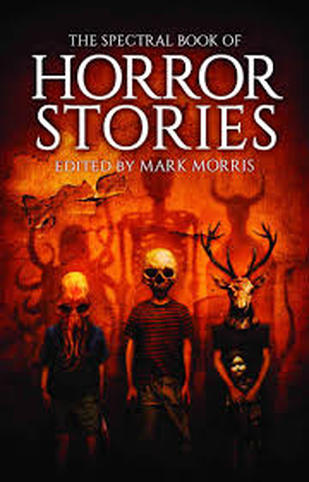 I have to say, as an FantasyCon newbie, I found it to be an extraordinarily welcoming place - a real sense of community, in fact. Is that typical of this type of convention, or is there something particular about FCon, do you think? I’ve only been to a couple of conventions in North America, in Canada actually – in Toronto and in Calgary. Both were wonderful but with a bit of a different vibe to them. However I must say the last two FantasyCons (last year in York, and this year in a new venue in Nottingham) have been by far my favourite: not so much to do with the organizers, who are always superb, but more to do with my feeling relaxed and pleased to be with old friends, less duty-bound to attend every panel or do readings or to network. Moving on to the recently broadcast ITV drama Midwinter of the Spirit, I'd like to start by asking how you go about approaching the process of adapting an existing work for the screen? What are the pleasures and pitfalls of this kind of work? Where do I start? The obvious pleasure is that when things go pear-shaped, you are not suffering in the way that you do when it is a story hewn from your own heart. It doesn’t hurt as much. That’s the theory going in. The other delusion is that it is going to be easier because there is something substantial to start with. Both of these things turn out to be illusions, because by the time I’ve worked on it for two years, with some inevitability Merrily feels like a character I have created, I feel just as possessive of the piece as I would if it was an original creation. This isn’t to denigrate Phil Rickman, the author, in any way – but that is the way the process works. The director also has to “own it” at a later stage. We all own it in our different ways. And you think intellectual distance will protect you from brickbats but it won’t. You will still feel pain. The extra pain comes from the fact some people know the source material. There have been a dozen Merrily books now and there’s a substantial fan base who are in some ways more particular about the do’s and don’ts than the novelist himself! When we cast Anna Maxwell Martin – one of the best actresses of her generation, and a gigantic coup – the fans started to say, no, she has to have dark curly hair. I mean, please. What were we supposed to do? Give her a ridiculous wig? Would they have thanked us for that? Of course not! Then there were ructions because we chose a black guy to play Lol Robinson, and some fans had an embolism. The irony is, I talked to Phil Rickman yesterday and not only did he think that Ben Bailey Smith was superb as Lol, he actually thought making him a black guy worked perfectly! The major pitfall in an adaptation, though, is not to feel the novelist hovering over your shoulder. I always say, my duty is to the book, not the writer of the book – and it was hard enough to think about how the heck to do a 550-page book in 3 x 45 minutes of air time, in “playable” scenes with a clear through line for a modern TV audience, and negotiate all the opinions and ideas coming in from the producer, execs, ITV, actors, all with strong ideas of their own, the logistics of filming and narrative structure, without thinking “is Mr Rickman going to like this?” You have to just say: “If I do the adaptation as well as I can, he will like it.” (“And if he doesn’t, there isn’t much I can do about it!”) The major thing of course at the outset is structure, the “beat sheet” of each episode, and each act of each episode to each commercial break (which I like to work to, like chapter breaks: not everyone does). So there are turning points and hooks, and you don’t work out that in isolation, there is a producer and script editor there in a room with you, back and forth, back and forth, you go home, work it out a bit, try it out on them, back and forth, over weeks and months. Way before you are thinking about dialogue. And in a book with a complicated plot (or plots) some of those plots have to fall by the wayside because you have to find the through-line, the spine of the thing, and know where it is heading, know what the motivation of the baddies is, what they want, really nail that in concrete terms because you can’t be vague in TV, and it has to have thematic and emotional clarity all along or you are lost. And that’s what takes long days round the table, talking and drinking coffee. And that’s as much writing as sitting at the keyboard is, in terms of television writing. As for my approach to the material, I suppose you’re asking my “take” on it, which is what they ask when you come in to pitch. I came in after ITV Studios (the production company based in Manchester, that used to be called Granada) sent me the book and I loved it. It was a case of talking about how I thought I’d do it. I think the major thing they asked was “How would you do the supernatural?” I was a bit confused. It’s a strange question to me, because I’ve written supernatural stories for over thirty years. I think they worried it might be silly, or OTT. Luckily, I could say I’d do it just like I did in Afterlife: anything paranormal would be couched in psychology – it was all about the person who sees the ghost, not the ghost. As for the book overall, I don’t remember what I said apart from that it was an embarrassment of riches but some of it had to go. And that I felt it was important to lift the back story about Merrily’s husband from the first book (The Wine of Angels). I think I said the key for me is how do you make Midwinter relevant to 2015? I know the book was written fifteen years ago, but why should we do it now? And I said that to me it was this metaphor for the crisis of faith in Britain and I thought the threat of the Satanists could be a symbol for the threat of other religions in this terrifying world today, symbolic of terrorism, of something without humanistic value like the Taliban or Isis, and what is Christianity today, what does it stand for any more? And for me it stands for love – and that was Merrily’s story with Jane. So for me at the outset it was about Christian love and human connection. That interested me and that was the theme and subtext for the whole drama, as far as I was concerned. The other thing was, I said I’ve had a teenage daughter, so – “been there, done that,” kind of thing! I thought I could write those scenes with some, let’s say, realism. I wanted to talk about that directly, actually - those rows between Merrily and her daughter were stand out for me, as I highlighted in my reviews. How directly do you ‘borrow’ from life when scripting scenes like that? Well first of all you borrow from the book. That is the start point. You absorb exactly where everyone is coming from, and I love writing scenes where two characters lock horns and there isn’t a right or wrong and you just see it escalate. When my daughter was nineteen she fell in with a bad set of people, and actually at one point she disappeared and my wife and I had to call the police. (It’s slightly humorous looking back at it because when the local police sergeant came to talk to us he gave me his card and his name was “Evill” and he looked at me and said his name and pronounced it to rhyme with Nevill because he could tell what I was thinking.) We had a horrendous few days of not knowing where she was or who she was with, and I had this vivid image in my mind: this is what happens when kids go missing – they’re sliding down a slope and you try to reach down and grasp their hand and if you are lucky you do but sometimes, through no fault of yourself as a parent, you don’t. And that is a horrific thing to think about. We soon discovered she was staying with a friend. It wasn’t resolved overnight, but a few things from the experience filtered into the Midwinter script. We wrote a letter to our daughter saying she could come home anytime, no questions asked, just as I have Merrily doing. That is something that wasn’t in the book. But when you are thinking “What exactly can this mother do?” you inevitably think of things like that, if that has happened to you. In a more general sense, I knew what it was like for my daughter (step-daughter, technically) when her mum divorced and she was young enough to hero-worship her biological father even though he was the one who left her. The parent who stays is the one who gets it in the neck. That’s a well-known part of the psychology and one I could completely see would happen from the storyline about Merrily and Sean that we imported from the first book, The Wine of Angels. The mother/daughter relationship was the key thing all along for me. 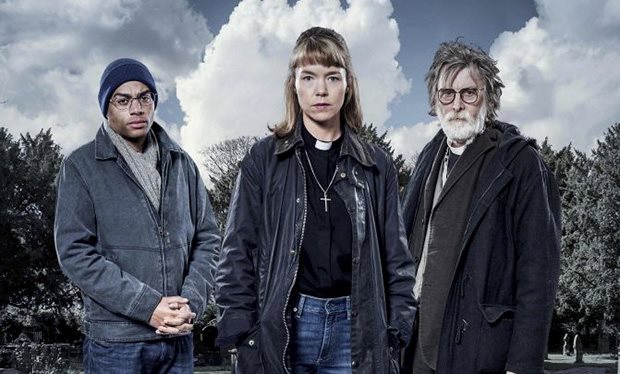 You talked above about about Christianity standing for love. As an atheist, how do you approach writing characters of faith? What are the particular challenges associated with a narrative that has such strong religious themes? Good question. First thing to say is, I was a little trepidatious in reading the books: was this going to be a soap box for the Christian faith? Was this Merrily going to be a character who wears her faith on her sleeve and might be a bit un-relatable in that she is a person separate from the rest of us? And to my delight she isn’t – what Rickman does on the page superbly well is that she’s a normal, modern woman. In point of fact she is beset by flaws and doubts and she is given huge responsibility and doesn’t know how to deal with it – with any of it. And she’s not an “expert” – that is the whole point, and that’s what made me feel I could write her. She’s quite a skeptical person, paradoxically, struggling in a world of spiritual polarities, of warring polarities and she’s kind of a pawn in this massive Manichean struggle. So it’s like one of the Hammer classics like The Devil Rides Out, except this age-old battle is acted out in present-day Hereford with a single parent and a teenager with an i-phone and a husband who was screwing another woman behind her back – it’s not the Duke de Richlieu and his pals: it’s the dynamic contrast between the mundane present and the arcane past, as in The Exorcist. But without all that Catholic blarney, which has been done to death in recent films. This was C of E. This was our back yard. So that wasn’t the problem I thought it might be. Secondly, I thought it would be a problem if we tried to describe where Merrily’s faith comes from. I wanted to avoid giving the audience that in case they don’t buy it or in case it might come across as cheesy. Isn’t how somebody finds Jesus bound to sound cheesy? Anyway it doesn’t really matter. Some things it’s better not to know. Anyone who watches might imagine what happened to put her on that path. Phil Rickman gives us her back story in that regard , and I think I could write that scene at a push, even though I’m not religious and not a Christian, because I’m a writer and it’s my job to make things beyond my life experience believable. But my decision was it’s better not to, to leave it open for the audience to fill in. But the theme of belief has always been a real draw to me because it’s so potent in a supernatural story. In the end, what do we believe about ourselves? It’s always a good question to ask. My series Afterlife, and the movie I wrote starring Rebecca Hall, The Awakening, both had skeptical characters who have their skepticism challenged. It’s about characters having their certainties undermined, and tested. Their sense of security and reality, rather than the obstacles being how they get from plot point A to plot point Z to get their goal. If your belief system is shaken it’s often your sense of self that is shaken too, so that’s why it is interesting to me. Ghostwatch, too, was about belief, of course – do you believe what you see? Do you believe what you are being told? Another thing I noted in my reviews was that I found the handling of the supernatural/psychological to be exquisite. Is that in line with the source material, or an element you added or magnified? And were you ever worried that people wouldn’t ‘get it’? You can’t really worry what other people will “get”. You can only think “What will make this work?” And I felt – all of us felt – it was in keeping with the tone of the books that the supernatural is never outright inexplicable. Denzil could be a phantasm of Merrily’s mind, and what Huw says to her about her dead husband Sean making her vulnerable, all that is equally true whether you think of it as a spiritual haunting or as a psychological state of mind. Apart from anything, if you have something out-and-out supernatural (e.g. a ghost more than one person sees) there is no element of doubt and it becomes flaky very quickly – especially in an ongoing series. I don’t think the paranormal is very convincing or fearful unless it has doubt as part of the mix, to be honest. It’s the kind of engine of a supernatural story, to me. I loved the idea that the only truly “supernatural” event in the whole 3-part series is the wound on Merrily’s hand that miraculously disappears at the end – which is really inspired by the Neil Jordan film of The End of the Affair, where the little boy’s birthmark is gone and you think, that can only be an act of God, can’t it? The festering wound in the palm of Merrily’s hand, like the stigmata of Christ, is such a powerful visual idea that was something I made more of that than is present in the novel – and actually Phil Rickman said he wished he’d thought of that! 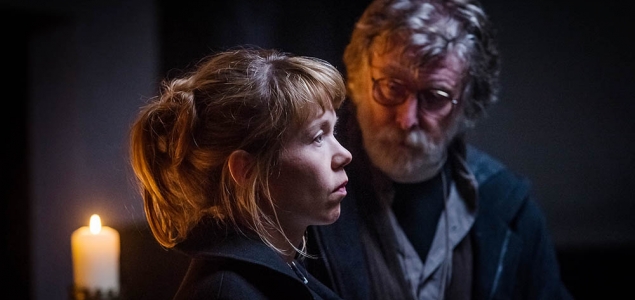 Forgive my ignorance of process, but how locked down is the script by the time casting is done? Did you find the fact of who you got cast led you to make any changes to the script? Listen, on this one it wasn’t locked down until it was in the can. Honestly! I had probably done five or six drafts (maybe more) of each episode by the time we had the read-through, but the scripts were already in flux – especially episode three as ITV had only seen the previous draft, so they had notes (which were very smart, luckily). We had a wobble with one of the actors, in that with the next draft a lot of scenes were different and they thought it was kind of butchered (which is always a danger, giving actors drafts that are changing), but it all worked out with some hard work and TLC to explain our thinking (and that notes we had to fix were coming from On High). Then, as they start to film, the actors are actually getting into character, so there are lots of questions, especially in this as they are researching as they go along. There was only one point where one of the cast wanted a change I thought was wrong and I fought for it – and I sort of lost: I thought it was a silly, pedantic change that lost the overall logic of the scene but I won’t tell you what it is and it probably doesn’t matter. I didn’t go off and make changes to the script based on the casting as such – it was more that the script editor and I got day-to-day feedback from the set as to whether the actors thought upcoming scenes needed tweaking, so we’d set about that and the script editor would send out blue, pink pages and all the rest of it. It sounds grueling, and it was, but sometimes those blue pages have the best lines. You just have to keep your nerve and not put in a lousy line because it solves the note. You have to remember, no, this is the one they’re shooting. (SPOILER ALERT) As an example we changed the first line of the last scene because Bishop Mick had fallen from the roof, so I gave Huw Owen (David Thelfall) a line from the Bible about falling. The way he says it in that laconic, throwaway fashion is just brilliant. You just quietly go “Yes!” to yourself when you hear an actor do that with one of your lines. That’s what it’s all about. You mentioned getting notes from ITV, above. How onerous was the notes process compared to other projects you’ve worked on? More generally, how do you as a writer respond to notes? That is a gigantic question! First though, don’t get the impression we had loads of notes from ITV. We didn’t. I had one meeting where they asked questions, gave some very good ideas, and we implemented them by the read through and they were absolutely delighted. (Which is just as well, since I’ve heard horror stories of episodes that crash and burn at the read-through stage.) Instead, one ITV exec said to me: “You see all these great actors here? That’s down to your brilliant script.” And I thought, “Oh God. Kill me now,” because you don’t hear that from execs – ever! So no, we not only got really good notes from ITV but they were also fantastically supportive of this project all the way through – which is why they switched it from ITV Encore to the main channel. At the outset their two notes were 1) “Keep it real” and 2) “Don’t hold back on the horror” – so on both counts, that was music to my ears. Writers are all different but after a few decades doing this I’ve realised I hate getting written notes, but you often can’t avoid it. It is so like getting your homework marked! If I can I prefer to hand in my draft and set up a time to meet, or talk on the phone – that way it feels collaborative rather than a direct order. The process is more or less the same, always, but the chemistry with the people you work with is markedly different. Because this was an adaptation, right from the get-go there were opinions at the table, before I’d written page one. A lot of discussion was had about how to break down the story, what aspects we’d have to lose, what we would like to focus more on, but mainly what was the spine or through line to the climax – also, what was the climax (since the book is a bit vague). Notes and ideas are a constant flow all the way through, but the main thing for me is to feel really secure with the script editor (Kathryn O’Connor) and producer (Phil Collinson), which I really did. You have to feel you can say something really stupid in a meeting because often the stupid idea will lead to someone else’s clever idea. Also, it is entirely different working on a script that you know is going to be made – the thing is suddenly real and you know everyone is working towards that moment, that specific date when the cameras start to roll, and however you might be tearing your hair out right now, you know on that date that is circled in your year planner on the wall, the pain will cease because the actors will be saying the lines! So, as you probably suspect, the rewriting is fairly relentless and sometimes puzzling and sometimes aggravating and disappointing. That’s just the way it goes. No script ever written was so good that the producer said “You know what? I have no notes!” Impossible! In this one they faced the fact that my scripts were all 10 pages over-long for the 45 minute (45 page) slot. We knew that going in. They were shot that way, which meant during shooting and post production some really good scenes ended up torn from the script or on the cutting room floor, which was agony for all of us. But you have to accept at that stage “shorter is always better”. Besides which, apart from a minute or two, ITV aren’t giving you any leeway. They have commercials to show, after all! Mainly I’d say if you have a terrific producer as I did in Phil C., one who is open, who isn’t manipulative, covers your back, keeps the network at bay, has great ideas but also respects yours, and acts as a safety net, I find I’m in the perfect position to do my best work. (Having sung the praises of collaboration, though, after eighteen months of it I don’t half feel like taking the phone off the hook and writing a short story!) Maxwell Martin and David Thelfall had an incredible chemistry. You must have been thrilled to see the way they played off each other... The casting was just brilliant, wasn’t it? We couldn’t have got anyone better for the part than Anna as Merrily. She absolutely knocks it out of the park in a way that is just a gift for a writer. Even Phil Rickman reckons that he can’t see anybody else in his mind’s eye now. What is so remarkable and different is that she brings total realism to a show that could so easily tip the other way into the hokey or melodramatic. She keeps it grounded because she refuses to do “horror film” acting or the obvious ways to play a scene: she insists on it being believable and I’m sure that upped everyone’s game. Plus I’ve honestly never seen David Thelfall better. He’s spot on, and he really did his homework, emailing our friendly Deliverance Minister advisor in the wee small hours over details of ritual or background research, and even getting a voice coach because (stealing from the book) I described Huw Owen as having “a voice like David Hockney on downers”. He watched two documentaries on Hockney because of that one line in the script! Anna consulted with a female vicar friend, too. And she made an interesting choice which was to wear the dog collar at all times, because “It’s who she is. Merrily is always on show and it’s always clear who she is and what her job is. She has to be available to everyone. That’s the point. When you are a vicar in a parish in a dog collar you’re available to your parish. So, on the one hand it’s very exposing. And on the other it’s a barrier to her daughter.” That’s wonderful stuff, and so exciting when actors of intelligence and with good instinct elevate your script to a new level. 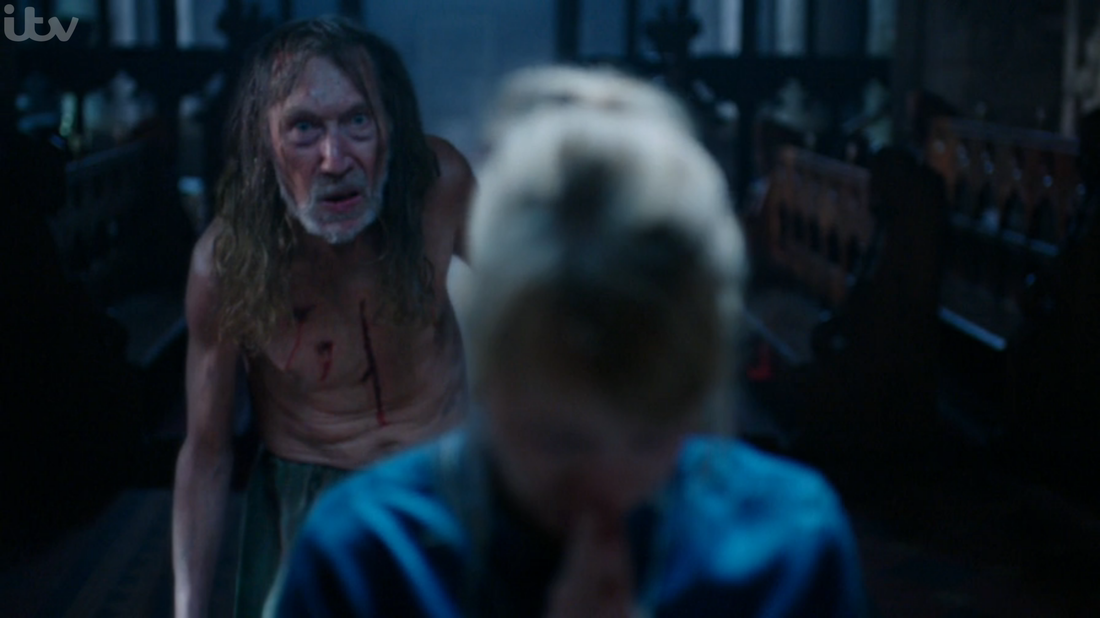 Going back to that notion that the horror had to read as either supernatural or psychological, how much of the content of the spookier scenes was ‘on the page’ and how much came from the direction? I’m in particular thinking of the scene in Episode 1 in the hospital, and that incredible episode 2 closer… The hospital scene where Merrily prays for Denzil Joy as he is dying: first of all I have to say that is all in the book. Of all the scenes or sequences, apart from the necessary cutting and shaping, it is exactly as in the novel. I think the scene works as a non-supernatural scene just about a clearly evil man facing death – the added suspense for the audience being that we have already seen Canon Dobbs in the hospital looking pretty fretful and Merrily is going into the lion’s den so to speak. It’s hard to say what comes from direction but all the description is on the page in terms of how the scene is visually structured, but of course on the day the director may only take that as a guide when you factor in the physical location and what the performers want to do. For instance, I had Merrily jump up and the chair fall over – I can’t remember whether that’s in but you take it as given that things like that might work or not work on the day. The episode 2 closing scene, in which Denzil appears in Merrily’s church. That was tricky. I wanted a punch line to the episode to show that Denzil was winning, that evil was winning at this point. I actually described it as Merrily kneeling to pray and she opens her eyes and looks up and Denzil is standing there, laughing. (As I said about the chair, maybe the laughing wouldn’t have worked.) But, back to your main point, there was always a discussion – whose point of view is it when we show something supernatural? Now you could say, because this is how I justified it, it has to be someone’s POV because I’m saying a ghost is psychologically subjective. However some people in the production team wanted us to be almost fetishistic about that. Make it literally Merrily’s POV shot every time, and I thought that would be wrong and schematic and dull. Anyone who watches scary movies knows that if a person is alone in a room and a ghost is there it could still be interpreted as “internal” – it doesn’t literally have to be a POV shot and as it happened Richard Clark (the director) knew instinctively my scene would be much better if the audience sees what Merrily doesn’t: it doesn’t any less feel that the creeping dread of Denzil is in Merrily’s mind. So he made that scene brilliant. Actually, Richard asked me at an early stage about doing that Jacob’s Ladder type shuddery camera effect on Denzil’s apparition to mirror the “scritch scratch” line – I thought that was terrific. He was very open and collaborative but also brought a very strong point of view to the project. For a start, straight away he didn’t shy away from calling it “horror”, whereas others in the team wanted to call it “crime with a twist” (I really don’t mind what you call it, to be fair, as long as it works in its own terms.) Richard was exceptionally strong and rigorous visually – he told ITV up front that he wanted to shoot wide compositions, kind of like in The Shining or a David Lynch film, but that wouldn’t give them a massive amount of coverage to cut around, and they were cool with that. Also in pre-production he compiled a whole wall full of images (three walls, actually) with different categories: pagan images, witchcraft symbols, religious iconography and a whole range of photographic reference, movie stills and paintings and people and places and this way he started to piece together the colour palette and visual vocabulary of the piece, working alongside our wonderful DoP Matt Gray (who shot Broadchurch). Not all of it was used, but I think all that hard work up front does seep into the process, inevitably, and gives it depth and integrity. (One thing that was used, that I loved, was the neon cross outside Merrily’s church in Ledwardine.) Richard was also pretty interrogative of the scripts. In television directors come in late compared to in movies, so they are usually only involved once you get a green light and the scripts are written and more or less agreed. You can see why TV directors are always miffed because they are always late to the table. So it was a case of bringing him up to speed on our ideas and also listening to his thoughts as he was coming to it afresh. For instance he was worried about how we could pull off the climactic scenes dramatically, so we went through lots of versions of that and much discussion. 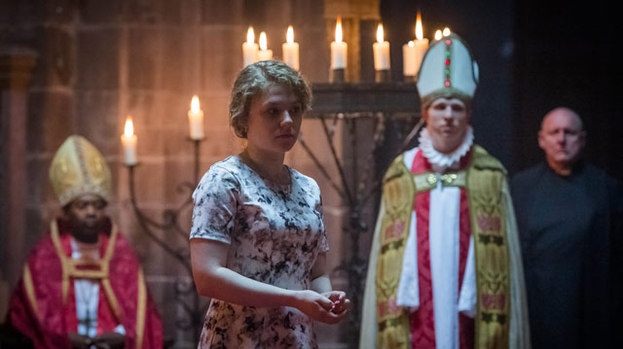 You mentioned that there was a vagueness surrounding the climax in the source material. Again, how much of the decisions in the finale were on the page and how much was directorial input? I found the moment when the congregation vanished just breathtaking, a really exciting decision… I think in the novel there’s a lack of clarity about what the Satanists want to achieve in a concrete, practical sense. As I said above, we were talking about it right from the word go. I always thought the climax had to be the essence of the book (as I saw it) and in the cathedral and, symbolically, the cathedral is at stake. Faith is at stake but love is at stake at the same time, in the same moment in fact, and Merrily is fighting for both, an external goal and an internal goal (as screenwriting books might say!). Then Richard came into the discussion and our first meeting was a long day-long talk about where we were with the script for Episode Three. That was a long, tough, exhausting day but really worthwhile once I got my head round everyone’s input. Richard always had questions about what Jane does and what Rowenna does and whether it was going to be visually impactful. In the end we upped it from a mere knife (the knife Rowenna used for the crow sacrifice) to a machete! Other ideas came and went but Phil, the producer, and I were keen that this is a terrorism/ISIS moment. Not to be insensitive in saying this, but a potential “Lee Rigby” type brutal murder. That’s how I saw it. But I have to say it was Richard’s idea for the scene to suddenly become “internal” to Merrily – to focus on her and Jane and Rowenna and cut everybody else out (because otherwise what do you do with them?) so his thought was that we go inside Merrily’s head space at that moment (like they do with Will Graham in Hannibal). I confess I was worried that the vanishing congregation might look weird, but I think Anna’s reaction sells it. Anyway, it was a formally bold decision by Richard, and so much of British television drama isn’t formally bold and doesn’t take that kind of risk, so I’m proud of that. It was disappointing to hear that the show won’t be picked up for another run, and you won’t get to adapt another of the Merrily Watkins novels, especially after the critical notices for Midwinter were so favourable. As a professional writer, what have you learned about dealing with setbacks like this when they arise? There isn’t anything you can learn. I don’t think it gets easier to pick yourself up and dust yourself down as you get older. The truth you have to remember is, you have done your job and the rest is out of your control. The success of something is out of your hands and the decisions are out of your hands. ITV were incredibly supportive all the way along, they loved what we were doing, but the overnight ratings just didn’t cut the mustard. To the broadcaster’s perception it “didn’t find its audience” in that slot for whatever reason. I could beat myself up asking the question why, but after a while, hand-wringing is counter-productive and for the good of your soul you have to focus on the next thing. The main thing I have to take away is that I’m really proud of the show we made and it’s a shame because there is the potential to adapt more of the books but, hey, ITV let us make one, so all credit to them. Generally a writing career is full of setbacks and a successful writer isn’t one who has no setbacks, it’s someone who has failure after failure and a litany of setbacks and carries on regardless. That’s another reason – to return to your very first question – why we need the company of other writers. So we can display our wounds to each other like in that scene in Jaws, and hopefully realise it isn’t just us. That helps enormously in getting some self-worth back and plugging away. But just because I have my name on the TV screen please don’t think I don’t have box files of rejection ships going back to the year dot. And they don’t suddenly stop, either, I can tell you! Finally, what does the rest of 2015 and 2016 hold for Stephen Volk? What should we be looking out for? Next year I have a new short story collection coming out from PS Publishing, called The Parts We Play, with a supplementary small volume called Supporting Roles. That will be a biggie and is bound to be a gorgeous volume because they always are. In TV terms I’m developing a new paranormal series but it’s too early to give away exact details, and a dark historical drama again in the early stages. In the movie world I’ve written a script with Tim Lebbon called Playtime and that is under option with a director attached, and my screenplay Extrasensory is at the casting stage so that is very exciting, but of course you can never count your chickens. And there a few more irons in the fire. You never quite know which will come to fruition first, or at all, so it’s a question of faith, always. Faith in the impossible made flesh, you could say. Back to the miraculous. Which is what happens whenever anything gets made, really. A minor miracle, every time. KIT POWERTHE HEART AND SOUL OF HORROR INTERVIEWSComments are closed.
|


Archives
May 2023
|
 RSS Feed

|

|