

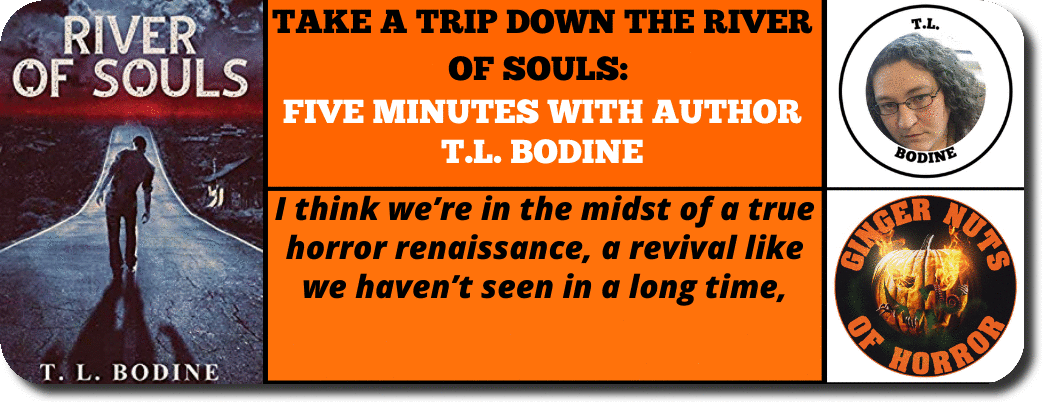
 BIO T.L. Bodine is a horror author living and working in the Albuquerque area. She’s best known as a member of the Wattpad Stars and won a 2018 award in the Watty’s, the internet’s largest writing contest. She is the author of River of Souls, out August 23 from Trepidatio Publishing, and the Wattpad-exclusive LGBT gothic, The Hound. Could you tell the readers a little bit about yourself? I started publishing short stories in 2007 but only really got my feet under me when I gave up on the “literary” stuff I tried so valiantly to write in college and turned instead to writing horror like I’ve always loved to read and watch. I’ve self-published four titles – two novels and two short story collections – and am working with the awesome people at Trepidatio Publishing to release my novel River of Souls. I’ve lived all over the U.S. but chose to settle in New Mexico after attending New Mexico State University, and a pet ambition of mine is to do for New Mexico what Stephen King has done for Maine. To get the ball rolling and get everyone relaxed, here is a hopefully lighthearted question to break the ice, which one of your characters would you least like to meet in real life and have them complain at you about they way you treated them in your work. I think any of my characters would be pretty justified in beating down my door and demanding an explanation for what I’ve put them through, to be honest. Maybe if I offered to pay their therapy bills? Other than the horror genre, what else has been a major influence on your writing? I play a lot of story-heavy video games, and I really enjoy the way interactive fiction can spool out a narrative, laying crumbs and pieces for the audience to piece together. I like incorporating a similar approach in my own world-building. The term horror, especially when applied to fiction always carries such heavy connotations. What’s your feeling on the term “horror” and what do you think we can do to break past these assumptions? I think there’s this idea a lot of people have that horror is all teenagers getting killed in cabins, or over-the-top violence. It doesn’t help that any time there’s a really thoughtful or well-made horror story that goes mainstream, it gets rebranded along the way as a thriller or a “dark drama” or whatever else. On the bright side, I think we’re reaching a point where horror is coming into its own in a new way, and laypeople are starting to appreciate how much more can be done with it, so we might be turning the corner on some of the more irritating assumptions. A lot of good horror movements have arisen as a direct result of the socio/political climate, considering the current state of the world where do you see horror going in the next few years? I think we’re in the midst of a true horror renaissance, a revival like we haven’t seen in a long time, and the stories spearheading it have been of exceptional quality and thoughtfulness. I think more politically charged stories and dark satires are going to be taking center stage. I think we’re going to be seeing a lot more cosmic horror soon, as people try to grapple with the overwhelming feelings of dread and powerlessness that kind of pervade the popular consciousness right now – the success of Malerman’s Bird Box is a good example. Given the dark, violent and at times grotesque nature of the horror genre why do you think so many people enjoy reading it? For me at least, horror has always been a bit of a comfort because so much of my real life is pervaded with anxiety – so there’s something really gratifying and validating in being told, “No, you’re not crazy, the world really is frightening sometimes.” I think it’s nice too to have an escape, somewhere you can let go of some of that tension and fear in a safe environment. A big part of horror that I think a lot of people miss, though, is the empathy element. A lot of times we indulge in these stories because we want to understand our world. Why do people do awful things? What must it feel like to be a victim of something terrible? Why do bad things happen to good people? Horror might not have the answers to these big questions, but it gives us a chance to at least try to grapple with them and try to understand, and I think that can bring about a better side of humanity. What, if anything, is currently missing from the horror genre? One of the things I’ve always appreciated about horror is its diversity when compared to other genres, but I want to see even more. Horror is frequently about the disenfranchised – women and the disabled and minorities and all the rest. I’d like to see that explored even further. What new and upcoming authors do you think we should take notice off? Gwendolyn Kiste has been absolutely knocking it out of the park this year, and I anticipate an upward trajectory there – keep an eye on this space, ya know? I’m also keeping an eye on Daniel Barnett, who I know from Wattpad and who’s a real sleeper agent; I’m looking forward to the day when he blows up and I can say I discovered him first. What are the books and films that helped to define you as an author? Oh jeez. That’s tough. I mean, I don’t think I’d have ended up where I am if not for a childhood infatuation with R.L. Stine and Alvin Schwartz, right? That’s the 90’s kid horror starter kit. I think some of my biggest creative influences are probably Neil Gaiman, Kurt Vonnegut and Chuck Palahniuk – I was big into all of them in college, when I was really starting to figure out who I might want to be as a writer. Guillermo Del Toro’s filmmaking has also been hugely influential. What I like best about him is the way every movie he makes is like a love letter to its genre. He makes movies with a lot of heart, which I think takes a kind of fearlessness that I really admire. Are there any reviews of your work, positive or negative that have stayed with you? I have a short story collection called The Beast in the Bedchamber that’s fairytale retellings of beastly bridegroom type stories – things like Reynardine and Bluebeard. It got an early review from someone who was very disappointed that they weren’t happy ending romances. It was a negative review, but I actually really appreciate it because I think it’s a ringing endorsement: If you like dark, disturbing, unhappy fairytales, have I got a book for you! I still chuckle about it. What aspects of writing to do you find the most difficult? Most people complain about editing, but I’m the exact opposite. I love editing. Once I get a draft in my hands that I can work with, it’s all sculpting and refining and shaping. For me, the toughest part is always just getting the words out for the first draft. I’ve tried repeatedly over the years to outline and become a planner, and it’s always failed; the only way I can ever actually make it through a story is just by feeling my way in the dark. Is there one subject you would never write about as an author? I don’t know that I have any particular subject taboos. I write about things that scare me, and that means nothing is really off limits. I will say that I just don’t have the skill set or interest for “extreme” horror. I’ve written about some really messed up things – I have a WIP about suicide and rape, my Wattpad novel The Hound is partly about domestic violence, River of Souls touches on police brutality – but I tend to prefer skirting the edges of the monster, catching glimpses of the awful things rather than charging at them head-on. How important are names to you in your books? Do you choose the names based on liking the way it sounds or the meaning? I tend to choose names based on their aesthetics – mouth feel, if you will. How it sounds, and what vague images it might evoke for me. A name just slides into place and clicks when it’s right. I don’t put a whole lot of thought into it, honestly. I probably should. Writing, is not a static process, how have you developed as a writer over the years? I think the biggest change is when I gave myself permission to write horror. I’d always been writing dark stories, of course, but I never thought of myself as a horror writer – mostly because I didn’t think my writing was all that scary. In hindsight this is pretty ridiculous. I wrote a book about a social worker rescuing a kid from an alternate world of literal nightmares and never once thought it was horror, even when I had readers telling me, “Hey, this reminds me of Clive Barker!” Perceptiveness is maybe not my strongest quality. What is the best piece of advice you ever received with regards to your writing? “Fix it in post.” For real. Drafting is hard, and the only thing that gets me through a story sometimes is the promise that I can fix it later. Otherwise I’ll get caught up agonizing over how awful something is and get hopelessly mired in uncertainty instead of just pushing through. Problems are usually easier to fix once you’re on the other side of them, so giving myself the permission to suck now and then helps a lot in the long run. To many writers, the characters they write become like children, who is your favorite child, and who is your least favorite to write for and why? I don’t know that I have a parental relationship with any of my characters, or even with any of my books. I think I view them more like very interesting lab specimens, with me taking a sort of “mad doctor” role. What happens if I manipulate these conditions? How do they react if I do this awful thing? I’m not very nice to them, really. For those who haven’t read any of your books, which of your books do you think best represents your work and why? Start with River of Souls. I don’t just say that because it’s the new release, but because it’s had a lot of loving attention. It touches on some of my favorite tropes – found family, sibling dynamics, New Mexico gothic – and keeps a pretty brisk pace. Do you have a favorite line or passage from your work, and would you like to share it with us? Here’s a bit from early in River of Souls that I like a lot just because it very succinctly captures what kind of story it is: Here in a few hours, once we've passed through the quiet time, the sun will come up and people will awaken and the lights will come on. Everyone will get back to their jobs, and life will keep on going. Because we've missed our apocalypse; the zombies are here, but instead of tearing down civilization, they're standing in line at the Social Security Office waiting for their checks like everyone else. Can you tell us about your last book, and can you tell us about what you are working on next? So River of Souls is the thing I’ve had published most recently. It’s a new spin on zombie tropes, putting the Undead in the driver’s seat. It takes place in the fictional town of Los Ojos, NM, a sleepy wide spot in the highway bordered by reservations and swaths of desert – a town that also happens to be home to the Lazarus House, a “treatment facility” for the Undead – and a whole underground society of walking dead who are trying their best to pass for the living. I’ve got more books planned in that universe, so I’ll be working on those for the foreseeable future. I also have a Wattpad-exclusive called Ashes, Ashes, which is about suicide and revenge and friendships that have gone sour. It’s still being updated, so be sure to add it to your Wattpad library if you want to be notified when new chapters go up! If you could erase one horror cliché what would be your choice? I’m not a fan of the “crazed maniac whose only motivation is being crazy” trope. It was fine for a while, but it’s a bit lazy. What was the last great book you read, and what was the last book that disappointed you? I recently read Rin Chupeco’s The Girl From the Well and it blew me away with its creative spin on Japanese mythology. Although I like some of his other books, I just can’t get into Joe Hill’s Heart-Shaped Box. I don’t really know why, but it’s failed to catch my interest both times I’ve tried reading it. What's the one question you wish you would get asked but never do? And what would be the answer? Years of reading memoirs from writers led me to believe that I would frequently have to answer the question, “Where do you get your ideas?” and I spent a lot of time thinking up various different responses to it…but I don’t think anyone has ever really asked me that, ever. Which is probably for the best. I wouldn’t want to disclose my elusive idea-getting ritual sacrifice to just anyone.  Undeath is a manageable condition.That's what the media says, anyway: with the help of the miracle life-extension drug, Lazarus, the Undead can retain their humanity and live normal, happy lives. Without it, they become violent, mindless walking corpses. Davin Montoya was eager to believe all of that. Forced to drop out of college to take care of his teenage sister, Zoe, after their father drank himself to death, he was more than happy to sign the no-good alcoholic over to the government's Lazarus House for treatment. That was one less thing for him to worry about.Until an accident left him joining the ranks of the freshly deceased himself.Now, keeping his death a secret is the only way to keep his sister out of foster care. But to do so, he must venture into the underground society of Unregistered Undead - a dangerous world of drug deals and government resistance. But when their access to Lazarus begins to run dry, the truth starts to unravel...and it's not what anyone expected.
Comments are closed.
|


Archives
May 2023
|
 RSS Feed

|

|