

 Keith Knapp is the best-selling author of the novels "Coda," "Moonlight" and numerous short stories including "Battalion" and "The Cat on Alpine Road." Between the day he discovered writing and now, he has played the drums in more bands than he can remember, went to film school in Chicago and has taken up residence in Hawai’i, Missouri, California and Illinois. He loves cats, and if there isn’t always one around he starts to go a little crazy. Could you tell the readers a little bit about yourself? I grew up an avid reader thanks to my parents, and that hobby continues to this day. They also installed a love of music and all art in me. I’ve ended up with huge book, music and movie collections. And I still have a ton of comic books. I just can’t bring myself to throw any of that stuff away, or sell it. Man, why would you want to? What do you like to do when you're not writing? My previous answer kind of sheds some light on this answer. I’m a huge movie buff; I even went to film school. So I watch a lot of movies. Then there’s music, which is my second love (after the written word). I play the drums (although not as well as I like to think I used to) and will always have some form of music on somewhere in the house, except when I’m writing. If I had a drum set around, I’d be hitting that when not hitting the keyboard. Other than the horror genre, what else has been a major influence on your writing? I love sci-fi and the Hero’s Journey stuff. Anything with the words “Star” and “Wars” in it means I love it and it’s influenced my life in some way. Not a day goes by that I don’t mention it at least once. It’s probably pretty annoying to those around me, but I haven’t had any complaints. Yet. The term horror, especially when applied to fiction always carries such heavy connotations. What’s your feeling on the term “horror” and what do you think we can do to break past these assumptions? Horror, to me, is anything that scares us. That can be the scary monster under the bed or losing a loved one and being all alone in the universe. I think when a lot of people think of horror novels, they think of Clive Barker and Stephen King and H.P. Lovecraft (as they should), but Trump’s “Art of the Deal” is also a horrifying book. People like what they like; there’s an organic, primordial draw to horror because we all share fear in common. Some people don’t like to be reminded of that, or don’t want to explore that, and that’s fine…to each their own. I don’t mean that in a condescending way. Quite the opposite, as a matter of fact. For example: I can’t tell you why Metallica is my favorite band other than they thunder-rock my heart and soul. There are many people who think they suck. I don’t particularly care for romantic comedies, but I know many people who do. In art, what speaks to us is what speaks to us. If someone has a certain assumption about horror, that’s part of them, part of their journey in life. “The Shining” might not scare someone as much as, say, “Moby Dick.” A lot of good horror movements have arisen as a direct result of the socio/political climate, considering the current state of the world where do you see horror going in the next few years? I think we’re living the horror right now. But the thing is horror doesn’t really change. Writing styles do, certain tropes come and go with the times (vampires, zombies, werewolves, etc.), but at the end of the day a horror story is usually just a metaphor for something else, and can be applied to whatever situation you want it to. A zombie novel could be a metaphor for the Trump Administration or the AIDS epidemic. Or it could just be a zombie novel. Sometimes a monster is just a monster. What are the books and films that helped to define you as an author? Anything by Stephen King or H.P. Lovecraft has influenced me. I read and wrote a lot of screenplays in my younger years, and that style has naturally found itself into my novel prose, for better or worse. Shane Black (Lethal Weapon, Kiss Kiss, Bang Bang, Iron Man 3) is an outstanding screenwriter. His writing is very concise, to the point and quick, and I’ve kind of stolen some of that. The fewer words you can use, the better. I’m not much for flowery writing unless I come up with something really, really good. And I usually don’t. I just like to tell the story that wants to be told. What new and upcoming authors do you think we should take notice off? You know, there are so many I wouldn’t know where to begin. I usually end up “discovering” authors well after everyone else has; most of what I read is either recommended to me or by an author I’m already familiar with. So you tell me who to take notice of so I can go buy some more books. How would you describe your writing style? Quick, concise and to the point. I don’t like to waste words or time. Are there any reviews of your work, positive or negative that have stayed with you? There was more than one review of my first novel, Moonlight, that mentioned the less-than-wonderful grammar issues. I took that to heart because, as a writer (and a reader) there really shouldn’t be any grammar issues at all. But it happens, it happens in big-time books as well as indie books. I think about that every time I write because it’s a pet peeve of mine, so I hate it when I find out I’m guilty of it. I’m sure I’m guilty of it here somewhere, too. What aspects of writing to do you find the most difficult? The mental energy one has to exude can be exhausting at times. I usually need to take a break after about two hours, and usually end up taking a nap. Then there’s the flipside to that: the fact that I’m always thinking about my story, or the next story, or a certain idea, and something will click within my brain and I can’t get it all out fast enough. Enter exhaustion. Rinse and repeat. Is there one subject you would never write about as an author? Anything involving the injury or abuse of an animal. I’ll kill characters and put them through tons of shit, but not an animal. How important are names to you in your books? Do you choose the names based on liking the way it sounds or the meaning? It all depends. Sometimes a name is just a name: everyone’s got to have one. Other times a name will be based on someone I know in real life. Coda has a lot of that going on in it. Most of the first names in Coda are from people I know. And sometimes I just look up a list of names and pick what sounds or looks the best. Writing, is not a static process, how have you developed as a writer over the years? I like to think I’ve matured a lot. Most of my early stories really had no plot at all. Just little character pieces that went nowhere and told nothing. I used to fret a lot over what words to use and when to use them, but as I’ve gotten older I realize the important thing is to just tell your story. What tools do you feel are must-haves for writers? Access to as many books as possible. And a computer, because these things catch a lot of mistakes. What is the best piece of advice you ever received with regards to your writing? I can’t remember who it was, but in high school I showed a friend a story of mine and they asked me if I had ever thought of publishing. I had not, it never even crossed my mind. I thought that was for, you know, professional writers and not me. That opened up the entire world to me. Getting your work noticed is one of the hardest things for a writer to achieve, how have you tried to approach this subject? These days, hitting as many websites as I can, doing as many of these interviews as I can, and remembering that there are tons of other writers out there, most of them more talented than me. I’m not a very social guy. The only social media I’m on is Goodreads. But I hear Twitter and Facebook or whatever the kids are into these days are great sources. Writing a really good book helps, too. To many writers, the characters they write become like children, who is your favorite child, and who is your least favorite to write for and why? My favorite is John Whitley from Moonlight, because he’s basically me. He’s also my least favorite because, well, he’s basically me. Did I just call myself my own child? That’s got to mean something. Besides him, I love Brett Nickson from Coda. He just exudes pure innocence. It’s how he rolls, as he likes to say. What piece of your own work are you most proud of? Right now it’s Coda. In a year or two it will probably be whatever novel I have just finished. Usually my newest work tends to be what I’m most proud of because it (hopefully) shows growth and gives me an idea of where I’m at mentally in the world. And are there any that you would like to forget about? Many, and I have. There’s one story in particular I wrote called “NSFW” about a guy who gets a cursed email at work, then kills everyone in his office. It was really a displeasure to read. I don’t even remember reading anything in the news that week about work- or school-related shootings or killings, but I’d love to forget I ever wrote that. I can’t, though. All I can do is be happy those little evil gremlins got out of my system. For those who haven’t read any of your books, which of your books do you think best represents your work and why? Either Coda or Moonlight. They’re both similar in structure, with a large-ish cast of characters, normal people in extraordinary circumstances. My favorite kind of story. Do you have a favorite line or passage from your work, and would you like to share it with us? I know I do, but I don’t really remember my stuff all that well. A lot of times when I read something back, after it’s been released to the wild, I cringe. Because there are so many great books out there and I chose to structure a sentence like that?!? However, there are occasions during rewrites where I’ll say to myself “Okay, that’s some pro writing there, buddy,” but it’s forgotten by the time I get to the next cringe-inducing sentence. I’m not selling myself too well with this answer. Can you tell us about your last book, and can you tell us about what you are working on next? My last, most recent book is Coda. It finds a group of earthquake survivors whisked away to a land known only as The Town. The Town seems to know anything and everything about these people, and kind of tortures them with this knowledge. The book plays with the idea that we all have regrets, things in the past which we wish went a different way, and how we deal with them. There are also monsters. I’m currently working on a story about a man trapped in one location, more of an exercise to get into the nitty-gritty of what goes through someone’s mind when all hope is lost. I also thought it’d be challenging to have a story with one character instead of the 10-20 I usually end up with. If you could erase one horror cliché what would be your choice? Oh man, I love clichés. They’re there for a reason. Sure, some of them are over-used, but if used well, no cliché should be erased. Take a cliché and turn it on its head, I say. What was the last great book you read, and what was the last book that disappointed you? I absolutely adored Stephen King’s 11/22/63. It was like if King wrote an episode of Quantum Leap, one of my all-time favorite shows. The last book that disappointed me will remain a secret, as just writing one of these things is a success in my mind. But it was by a well-known author, and it made me a little sad. I kind of think it was ghost-written by an insane dog, but that’s just a guess. What's the one question you wish you would get asked but never do? And what would be the answer? “Would you like to be a part of the next Star Wars movie?” My answer would be a resounding YES. I’ll mop the floors in the production offices, I don’t care. CODA BY KEITH KNAPP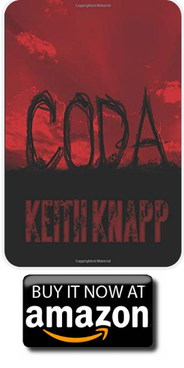 THERE ARE NIGHTMARES HERE After a devastating earthquake hits Los Angeles, a group of survivors find themselves whisked away to a place known only as The Town. It is there that they will face their inner-most demons and relics of the past as they try to find a way out and back to reality.But an evil presence awaits them there. It knows their fears, their sins and their lies and will do anything to keep them right where they are.   Comments are closed.
|


Archives
May 2023
|
 RSS Feed

|

|