

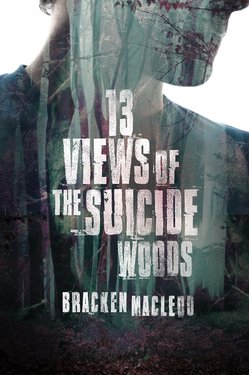
 Bracken MacLeod is the author of three novels, a novella, and a short story collection from ChiZine Publications titled, 13 Views of the Suicide Woods (read our review of 13 Views here) . His novel, Stranded released last year by Tor Books was just nominated for a Bram Stoker Award for Superior Achievement in a Novel. "Bracken MacLeod writes dark, human stories of horror and modern noir. Absolutely one of the brightest stars of the next generation!" Christopher Golden, New York Times bestselling author of Snowblind and Ararat Q: Could you tell the readers a little bit about yourself? A: In my past life I was a martial arts teacher, a university philosophy instructor, and a lawyer in non-profit, public service, and private practice. Until publishing, my resume reads like a guy who just can’t get along with others. I’m not always combative, but being oppositional comes very naturally to me. Q: What do you like to do when you're not writing? A: I’m a stay at home dad, so when I’m not writing, I’m enjoying time with my son. He’s a creative kid, and loves drawing, painting, and sculpting. He’s a huge fan of art museums and the Lego store, so I spend a considerable amount of time coloring and playing with Legos. I know. Not very scary unless you have to walk through the house at night in bare feet. My life is whimsical, suckers! Q: Other than the horror genre, what else has been a major influence on your writing? A: As pretentious as it sounds, existential philosophy. I studied it in college and grad school, and I keep coming back to those ideas when I sit down to write. Stranded is a very existential novel. Sure, it’s a fun book with people being awful to each other and things blowing up, but I also wanted it to be about identity, who we are versus who we want to be, and about directly confronting one’s own self in a very hostile way. I’m pretty sure my mind is forever warped by my philosophical training. Q: The term horror, especially when applied to fiction always carries such heavy connotations. What’s your feeling on the term “horror” and what do you think we can do to break past these assumptions? A: I think the term is often unfairly maligned, but it is a fault of our own, really. A significant part of our problem is language. It’s just like politics. People outside the genre frame the debate about horror using their language, and then we embrace it like they’ve done us a favor setting the goal posts out. Every time someone uses the phrase “gratuitous” to refer to a subjective threshold of taste instead of the essentiality of violence to the story, we diminish the genre. Every single god damned time we refer to some form or another of horror story-telling as “torture porn” we cut ourselves off at the knees. That’s not our phrase. We didn’t coin it. Someone else did so they could broadly dismiss what we do as prurient and lacking social value. Yeah, there are a lot of shitty books and movies out there in genre that rest on inessential violence and are meant to be titillating for their own sake. But we only have ourselves to blame for horror’s reputation if we just accept the outsiders’ definitions of our faults and use them as a shorthand instead of actually debating in accurate and honest words why something succeeds or fails as a narrative. My apologies for that outburst. I will step off my soapbox now. Fuckin’ “torture porn.” *spits* Q: A lot of good horror movements have arisen as a direct result of the socio/political climate, considering the current state of the world where do you see horror going in the next few years? A: I was on a panel recently where a couple of my colleagues were speculating that we were about to see a big resurgence in post-apocalyptic and dystopian stories. I respectfully disagree. Those markets have been glutted in the last decade and I think people are tired of them. If you want to see what’s coming down the road, you don’t need to look any further than the success of Jordan Peele's “Get Out.” Social horror is the thing looming on the horizon. Between the cultural climate in the Mother Country and here in the States stirred by the successes of Brexit and Trump, I think people are (rightfully) afraid of what is going to happen as a result of the resurgence in nationalist-identity politics and social isolationism. What’s the next bug-eyed monster hiding in the dark. WE are the next bug-eyed monster hiding in the dark. Q: What are the books and films that helped to define you as an author? A: How much space have I got? The short answer is among books, I’d say The Damnation Game by Clive Barker, Off Season by Jack Ketchum, The Plague and The Stranger by Albert Camus, Beasts by Joyce Carol Oates, and The Informers by Bret Easton Ellis are some of the most influential on me. Among recent influences, I’d have to say that The Road by Cormac McCarthy has shaped my aesthetic and style as much as anything I read as a younger person. Concerning movies, anyone who’s read Stranded knows that John Carpenter’s The Thing and Ridley Scott’s Alien are a part of my DNA. All of David Cronenberg’s early work and Tobe Hooper’s Texas Chainsaw Massacre were also hugely formative for me. Today, I feel inspired by the recent trend in horror films like The VVitch, It Follows, The Invitation, and House of the Devil. I keep going back to these new movies because they’re tickling a spot in my imagination that I want to scratch hard. Q: What new and upcoming authors do you think we should take notice off? A: I think people need to be paying attention to Phillip Fracassi, Michael Wehunt, Michael Griffin, Livia Llewellyn, John Darnielle, Mercedes M. Yardley, and Damien Angelica Walters. There are so many more I could list. This is really an incredible time to be a fan of dark genre writers, but off the top of my head, these are the ones who’ve been blowing me away lately. Q: How would you describe your writing style? A: Character-driven and emotional. I like plot, but what keeps me interested in a story is not how many car chases or chainsaws there are, but what those encounters do to the people involved in them. It’s why I’m such a devoted outliner. I like to have the plot mapped out from start to finish before I begin so I can focus on the emotional lives of the characters while I write. I want to know where they’re going before we start out. What they feel about what’s happening to them is what I discover along the way. Q: Are there any reviews of your work, positive or negative that have stayed with you? A: I prefer to keep a healthy distance from reader reviews. Don’t misunderstand, I appreciate them, and they’re good for sales, but I suspect that if I’m going to put a lot of weight behind the five star reviews on Amazon or Goodreads, I have to take the one star reviews as seriously. The most interesting critical review I got recently was from someone who said that, although they enjoyed the book, since I didn’t answer every question in overt detail, they’d “basically read the book for nothing.” I feel for that reader, but I don’t believe that every single thing in a book needs to be dissected and laid bare. I like ambiguity in story telling. I like to leave some things up to the reader to decide for themselves. At the same time, I think I leave pretty well staked sign posts along the way. Read for theme and subtext and you’ll get all the answers you’re looking for. Q: What aspects of writing to do you find the most difficult? A: I second guess myself a lot when it comes to plot. I hate deus ex machina solutions and ascribe to Bradbury’s rule that any coincidence that gets characters into trouble is fine, but coincidences that get them out of trouble are unacceptable. I spend a lot of time making sure that the way out of any problem is set up believably and well enough that a reader won’t ever say, “Well, that was fucking convenient.” Q: Is there one subject you would never write about as an author? A: I don’t think there’s a subject I’d never write about, but there are perspectives I wouldn’t. By way of example, my books have diverse casts because I want them to honestly reflect the world I live in. While I want to include well-drawn Black and LGBT+ characters in my work, I would never write a book about the experience of being Black or LGBT+. Those aren’t my stories to tell. I have an obligation as a writer to depict the world as it really is (even when it’s about things that don’t really exist), and that means writing with diversity when that reflected the reality of the setting, but I also think I have an obligation to know when to talk and when to listen. Q: How important are names to you in your books? Do you choose the names based on liking the way it sounds or the meaning? A: Names are pretty important to me. I tend to pick them either based on a personal relevance or some kind of implication that can be drawn from the name itself. The protagonist in my first novel, Mountain Home , is named Lynnea Lowry, after my two favorite scream queens, Lynnea Quigley and Lyn Lowry. Nothing too deep there, but it made the character feel right to me. Made her come alive. By contrast, the child at the center of my latest novel, Come To Dust is named Sophie because of the etymological implication of her name. “Sofía” is Greek word for “wisdom.” Philosofía/philosophy is the love or pursuit of wisdom. And Sophie in the book is a catalyst for other characters’ self-realization and changing views of the world and their place in it. She is a wellspring of personal wisdom for them. If the reader catches that, great. If they don’t, I hope they name at least has a rhythm in the prose that isn’t distracting. I don’t think I’d ever name a character Balthazar or Gertrude just because those names are clunky. (All apologies to every last Balthazar or Gertrude reading this now. Shit. I guess I just named the protagonists of my next novel.) Q: Writing, is not a static process, how have you developed as a writer over the years? A: Length is my big victory. I think I’ve learned how to tell a longer story so that it remains engaging, but doesn’t feel padded. My first couple of works were short and propulsive, but that didn’t make them terribly marketable. I’m not writing Stephen King sized doorstops by any stretch of the imagination, but I have learned how to sit a little longer with the story and let it breathe when it needs to instead of just jamming down the pedal until the finish line. Q: What tools do you feel are must-haves for writers? A: FOCUS! Keep your eye on the goal. I struggle with distraction and over-extension. I’d say focus is one of the tools that writers must hone and keep sharp. It’s really tempting to follow that shiny new idea down a garden path while you’re in the middle of this story or that novel. Don’t. Make notes for that shiny new idea, write the outline, and then go back and finish the first thing you started. If the idea that’s teasing you is good enough, it’ll wait. Having a half dozen unfinished things isn’t as good for growth or success as a writer as having finished one thing that’s really good. Q: What is the best piece of advice you ever received with regards to your writing? A: The best piece of advice I got as a writer was from Adrian Van Young and KL Pereria, both formerly of the Grub Street writers’ workshops in Boston, telling me not to flinch. Linger in that moment. They encouraged me to sit in uncomfortable scenes, to let them set in for the reader so they have real impact. Until then, I was always second guessing whether I was going too far with a piece of violence or something scary. I’d look away too soon and undercut what I was trying to do. They are the ones who convinced me that, like comedy, horror is all about timing. You don’t just have to hit the beats before the punch line just right, you have to give the audience time to get the joke, and let it set in. Pause for applause. Of course, you can sit too long. Again, it’s about knowing the beats of the story. How long to wait with the aftermath of something awful, and just when to move on. Q: Getting your worked noticed is one of the hardest things for a writer to achieve, how have you tried to approach this subject? A: Marketing is super hard for me. In person, people say I can charm a rock. But that takes a lot of will and booze to accomplish. Elsewhere, I’m not so capable. Nietzsche wrote a book called Ecce Homo (“Behold the Man”), with chapters titled, "Why I Am So Wise", "Why I Am So Clever", "Why I Write Such Good Books" and "Why I Am a Destiny." I wish I had that kind of confidence (ironic or not). Trying to get noticed for me is a battle of strangling false modesty, trying to adequately express honest confidence, and not sound like an arrogant fuckface the rest of the time. I think the way I approach getting noticed is to try to make my social media (at the least) about something other than the writing. I hope that people will keep coming back to the Facebook or Twitter pages to see what I post about the real me. And then, hopefully, on the occasion I plug a book, they’ll be willing to take a look because I haven’t been hustling them the whole time. So the TL;DR version is: be yourself. Don’t always be closing. People want to enjoy things, and I think that’s enhanced when they know you’re interested in more than just getting them to buy a book. Q: To many writers, the characters they write become like children, who is your favourite child, and who is your least favourite to write for and why? A: SO HARD! I think my favorite is a tie between Lyn in Mountain Home and Mitch in the forthcoming novel, Come To Dust. Both are people at points in their lives where they have to learn how to shake off the armor they’ve strapped themselves into and take real risks. They’re vulnerable in a way that The Prosecutor in White Knight and Noah in Stranded aren’t, which is more fun to write. Characters who don’t know how to break down the doors are more interesting to me. Getting them through that obstacle is the point of the story. What’s on the other side (usually something very fucking scary) is the icing. My least favorite character to write was probably Beau from Mountain Home . He’s such an amazing prick, I wanted to kill him early in the book. But he is the embodiment of everything wrong in Lyn’s world at that time. Of course, he needs to last until the final chapter, just so that there’s a challenge for her to rise to meet inside the diner as well as outside! It made me feel like shit to try to get into his head, though. Q: What piece of your own work are you most proud of? A: Another difficult question. I am proud of all my work, but at the moment, the one I’m most satisfied with is Come to Dust. That book almost never happened (for reasons I discuss in the Afterword to the novel), and the fact that I was able to finish it makes me incredibly happy. Of course, Stranded being nominated for a Bram Stoker Award makes me super proud as well. I love that book for all the reasons that are obvious on its face. It’s a love letter to my biggest influences from John Carpenter’s the Thing and Ridley Scott’s Alien, to Yukio Mishima and Albert Camus. There’s a ton of me in that book. Q: And are there any that you would like to forget about? A: No. There are a couple of stories I don’t think reflect who I am as a writer any more, and a couple that I wish had been published better than they were. But I don’t have anything I wish didn’t exist. I like who I was at the time I wrote any given piece. That’s more important than liking the piece forever. Q: For those who haven’t read any of your books, which of your books do you think best represents your work and why? A: At this point, I think Stranded and Come to Dust are my signature pieces. I’ve got the rights back to Mountain Home and revised it a little for republication, but Stranded and Dust are the ones that I don’t think I’d massage even a little if given the chance. They’re the ones who reflect how I want to be seen as a writer. Of course, if you want to sample my short work before trying on a novel, 13 Views of the Suicide Woods is the collection of what I think of as most of my best work in the short form. Q: Do you have a favorite line or passage from your work, and would you like to share it with us? A: I love opening lines. I think they’re the promise a book makes. A personal favorite of mine is the first two lines of my novel, Stranded. The void churned and swelled, reaching up to pull them down into frigid darkness, clamoring to embrace them, every one. A cold womb inviting them to return to the lightless source of all life, and die, each man alone in its black silence. |
 |  |
Comments are closed.


 RSS Feed
Archives
May 2023
April 2023
March 2023
February 2023
January 2023
December 2022
November 2022
October 2022
September 2022
August 2022
July 2022
June 2022
May 2022
April 2022
March 2022
February 2022
January 2022
December 2021
November 2021
October 2021
September 2021
August 2021
July 2021
June 2021
May 2021
April 2021
March 2021
February 2021
January 2021
December 2020
November 2020
October 2020
September 2020
August 2020
July 2020
June 2020
May 2020
April 2020
March 2020
February 2020
January 2020
December 2019
November 2019
October 2019
September 2019
August 2019
July 2019
June 2019
May 2019
April 2019
March 2019
February 2019
January 2019
December 2018
November 2018
October 2018
September 2018
August 2018
July 2018
June 2018
May 2018
April 2018
March 2018
February 2018
January 2018
December 2017
November 2017
October 2017
September 2017
June 2017
April 2017
March 2017
February 2017
January 2017
December 2016
November 2016
October 2016
September 2016
August 2016
June 2016
May 2016
April 2016
March 2016
February 2016
January 2016
December 2015
November 2015
September 2015
August 2015
July 2015
June 2015
May 2015
April 2015
March 2015
February 2015
January 2015
December 2014
November 2014
October 2014
September 2014
August 2014
July 2014
June 2014
May 2014
April 2014
March 2014
February 2014
January 2014
December 2013
November 2013
October 2013
September 2013
August 2013
July 2013
June 2013
May 2013
April 2013
March 2013
June 2012

|

|