

 Arthur Meursault is a long-term Asia expat who served his time in China and now writes about the country and translates works from Chinese into English. His first book Party Members, published by Camphor Press in 2016, is a dark satire on modern Chinese life. His second book is The Flock of Ba-Hui and Other Stories and is a translation of Lovecraftian tales taken from the Chinese Internet and presented to a wider audience. Could you tell the readers a little bit about yourself? There isn’t much to say! I left my native England as a teenager, throwing myself into the zeitgeist of China in the 2000s, and have remained internationally-based ever since. I started writing with my 2016 book Party Members which was a hybrid of dark-comedy and office-horror that followed a mid-level Chinese government official led astray by greed and corruption. In hindsight, it was too niche a hybrid, but horror is where my true passion lies which led to this current project. To get the ball rolling and get everyone relaxed, here is a hopefully lighthearted question to break the ice, which one of your characters would you least like to meet in real life and have them complain at you about they way you treated them in your work. The protagonist of my first book Party Members is a about a mediocre and venal Chinese government official who gradually transforms into a ruthless psychopath determined to bribe, rob, and murder his way into a promotion. For obvious reasons, I wouldn’t wish to work in the same office. Other than the horror genre, what else has been a major influence on your writing? My pseudonym is taken from the main character in the French existential novel L’etranger by Camus and that feeling of emptiness and the perpetual outsider characterizes a lot of my work. This nihilistic malaise is featured in a lot of French literature, and it was actually the despairing works of Michel Houellebecq that led me to Lovecraft after reading his essay on Lovecraft’s loathing for humanity. The term horror, especially when applied to fiction always carries such heavy connotations. What’s your feeling on the term “horror” and what do you think we can do to break past these assumptions? Horror really cuts to the heart of the human psyche, just as much as comedy and tragedy. I’ve always thought that an additional mask should be added to the original smiling and weeping Greek duo; one of outright terror. Tragedy and comedy are our oldest conceptual terms for fiction, but if you think about it both are reactions to horror – we can either laugh at the futility of it all when we realise there is no escape, or we can succomb to despair. Horror, true horror, is something that threatens not just your personal wellbeing, but your essential conception of the universe and the self. We can choose to either laugh or cry when confronted with it. A lot of good horror movements have arisen as a direct result of the socio/political climate, considering the current state of the world where do you see horror going in the next few years? Corporate horror is woefully under-represented. Thomas Ligotti has written some marvellous works of corporate horror like My Work Is Not Yet Done which handles the horror of repetition and corporate drudgery in a sophisticated manner. The problem is that for a lot of people their work is an important ingredient of their identity so they dislike corporate horror because it feels like a personal attack on how they have chosen to live their lives and the choices they have made. This is why I think that the most obvious example of where modern-horror could lead hasn’t really taken off. Given the dark, violent and at times grotesque nature of the horror genre why do you think so many people enjoy reading it? Good horror is a metaphor for real-life fears that people experience and they can see the parallels and analogies within the horror and apply it to their own situation and views. Excellent horror is a metaphor for real-life fears that people aren’t even aware they possess. They feel uneasy when reading or watching such horror but can’t quite explain why. What, if anything, is currently missing from the horror genre? The changes wrought by new technologies are some of the biggest things to happen to us, yet I feel there isn’t much horror fiction addressing it. Of course, there are schlocky movies which will re-use old tired tropes in the setting of video calls or social media, but they don’t address the fundamental issue of how these technologies themselves might be working against us… or even changing us into something else. What new and upcoming authors do you think we should take notice off? There are many unknown writers online who pump out content that goes unnoticed by the vast majority, but there are some truly unique gems out there which will never see the light of day in mainstream publishing. One example I can think of is a story called The Gig Economy that is an excellent example of taking the core of existential and cosmic horror but making it relevant to modern-day concerns. What are the books and films that helped to define you as an author? I think that great horror films and books and those that are not explicitly classified as “horror” but nonetheless leave you with a sense of shock or emptiness after viewing/reading that is unexplainable. The Terry Gilliam film Brazil has continued to be an influence on me as you are never quite sure if Gilliam is concluding the film as a happy or sad ending for the protagonist Sam Lowry or whether you are meant to laugh or cringe in fear. Another great example is the hugely complex House of Leaves by Mark Z. Danielewski. How much horror that book contains for you depends on how deeply you choose to read into its analogies and rabbit holes… and some of those rabbit holes run DEEP. What new and upcoming authors do you think we should take notice off? As mentioned above, I like the largely unknown and anonymous work that is being produced on obscure corners of the internet. The Gig Economy by Zero HP Lovecraft is one such example. Another fantastic horror experiment was the story created by a bizarre character called _9MOTHER9HORSE9EYES9 that was posted in excerpts over random subreddits. There is an explanation of it here: https://en.wikipedia.org/wiki/9MOTHER9HORSE9EYES9 Are there any reviews of your work, positive or negative that have stayed with you? One hilarious one-star reviewer of Party Members proclaimed that after reading the book she was “going to spend January taking long, hot showers, focusing on my yoga, and putting as many good books as I can between me and this nightmare. The penultimate scene probably fundamentally altered a part of my brain and left me with mild PTSD”. I was quite happy with that. What aspects of writing to do you find the most difficult? Editing. Editing is what remains when the exciting part of creating a story and delivering it to the world is done, but all that awaits you afterwards is a tedious clean-up of semi-colons and apostrophes. How important are names to you in your books? Do you choose the names based on liking the way it sounds or the meaning? Names are very important. One of the many strengths of Charles Dickens was the talent he had for creating memorable names for his characters that summarized their entire personality like Ebenezer Scrooge, Uriah Heep and Wackford Squeers. All of the names in my book Party Members have dual meanings in Chinese in order to provide little Easter Eggs for the Mandarin speaker. Writing, is not a static process, how have you developed as a writer over the years? Well, I don’t really classify myself as a writer. I’m a man with a full-time day-job that takes up 90% of my time and writing is just something I do when I have a little bit extra precious free time. The key is finding that free time and using it correctly. What is the best piece of advice you ever received with regards to your writing? Never use a long word when a shorter one will do. This obviously doesn’t apply when translating Lovecraftian pastiches. For those who haven’t read any of your books, which of your books do you think best represents your work and why? I would give The Flock of Ba-Hui a go for readers of this blog who are interested in Lovecraft and how others in other countries have viewed and interpreted his world. As far as I know there is nothing like it out there right now – a Chinese work based on English-language stories and translated back into English. Do you have a favorite line or passage from your work, and would you like to share it with us? Tekeli-li! If you could erase one horror cliché what would be your choice? The psycho who goes on a killing rampage has not only killed his victims but also the reputations of otherwise great films. Event Horizon and Sunshine were both perfect examples of this: 2/3 of both films were a wonderful masterclass in building atmosphere and transplanting old-fashioned cosmic horror to a space station, then the last one third was someone running round killing off the crew members. Ruined! What was the last great book you read, and what was the last book that disappointed you? I recently read the original Sherlock Holmes stories for the first time and I was blown away by the excellence of them. Conan Doyle knew how to craft a story and Holmes passed into the rare realm of legend for a reason. Disappointment? Easy – The City and the City by China Mieville. A book with fantastic concepts and imagination that just fell apart at the end. I find this true of most of Mieville’s books. What's the one question you wish you would get asked but never do? And what would be the answer? Can I get you a drink? The Flock of Ba-Hui and Other Stories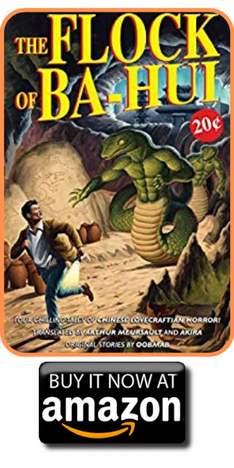 A researcher disappears while exploring the deep caverns of mountainous Sichuan, where folklore speaks of primeval reptilian gods sleeping beneath the earth. An artist dreams of a mysterious black tower stretching skyward for infinity, and glimpses the cold truth of the universe when he decides to climb it. Strange bubbling and decomposed corpses are discovered in the tunnels beneath an old mansion in the city of Qingdao, and an ancient temple in Tibet terrifies all who dare approach. Meanwhile, in an abandoned house, a stranger gathers together a group of bewildered scholars to whisper in the darkness of eldritch abominations and even weirder phantasms. From the stygian depths of the Chinese internet, we proudly present four wholly original tales of cosmic horror based on the works of H.P. Lovecraft and translated into English for the very first time. These ghoulish short stories take their inspiration from some of Lovecraft’s choicest nightmares and offer a different perspective on those things best left unseen. Follow us on a dream-quest as we explore what fresh terrors the Cthulhu Mythos has to offer from the other side of the Great Wall. Written in the authentic style of the pulp magazines of the 1930s, this unique offering of twisted tales will leave Lovecraft fans terrified and astounded by the stories’ breadth of imagination. The Flock of Ba-Hui takes Lovecraft’s world in a new direction and is essential reading for the true horror aficionado and an ideal accompaniment to the Seven Cryptical Books of Hsan.   Comments are closed.
|


Archives
May 2023
|
 RSS Feed

|

|