

 Author S.L. Edwards is kind of like the mayonnaise of the horror fiction community. You can put him in anything and it will automatically make that thing better. Like mayo on a sandwich, an Edwards story in an anthology makes it all the more appetizing. FYI: If you’re gagging right now because you hate mayo, congratulations. You and Mr. Edwards have something in common. And, yes, I only wrote that first paragraph to annoy him. Whatever your condiment preference, though, the truth remains the same: S.L. Edwards has become a genre mainstay, contributing original tales to such periodicals as Vastarien, Occult Detective Quarterly, and Weirdbook Magazine, and to anthologies published by Silent Motorist Media, Muzzleland Press, and Planet X Publications. Now, Edwards is getting a book all to himself. Set for release on July 15th from Gehenna & Hinnom Press, Whiskey and Other Unusual Ghosts is the author’s first collection. The author recently sat down with The Ginger Nuts of Horror to dish about the upcoming release, as well as the place of politics in horror fiction, the possibility of life after death, and his contentious relationship with Hellmann’s most famous product. First of all, I wanted to say thank you for taking the time to speak with me. You’ve been busy making the rounds, doing a lot of interviews in the lead-up to the release of Whiskey and Other Unusual Ghosts. So let’s start off with something a little different: I challenge you to ask yourself a question that no one else has asked, and to answer it. “You’ve published a lot of fiction in a remarkable amount of time. We might say that this is some degree of success. But, as we know from our own experience, writing isn’t always easy. Can you think of a time when writing was hard, or when it seemed too difficult? You joke a lot about story rejections online, but have their been moments where that stung more than others? How did you deal with them?” You know, I joke a lot about my advice for new writers. I think it’s sort of silly, this idea that I am by any stretch of a definition the authority on writing or getting published. But I’m glad you asked this question, as just now I received a rejection from a market that I have wanted to be a part of for some time. Furthermore, this rejection was for a story that was well-received by writers whose opinions I respect and I know to be honest. So, just to have a frank conversation with writers discouraged by a slow down or a lack of progress in their work: It’s okay. Rejections are not the end of your story. For years I had given up writing, for years. And all it took was one acceptance to get me back in the game. Persistence is the key to all of this, more than thick skin. I know a few writers who I consider to be extremely talented, more than me. Writers who have been in this game way longer than I have. Rejection bothers them. But they don’t quit. I know other writers who have gotten a few rejections and they just stop. And it kills me. It’s very sad to me, because I think they’re denying the world their stories. Their good stories. The stories that only they can tell. It’s okay to hurt for a while, but the way you recognize you have become a “real writer” is that you cannot suppress your desire to tell stories. And you owe it to yourself to keep telling those stories. And if anyone enjoys those stories, you owe it to them too. And, a rejection does not always mean your story was bad. You could have a very good story, but it simply does not work or fit for the publication you so want to be a part of. I do joke about rejections, mostly with editors who I have become good friends with. But the truth is that when they rejected me, they have been very honest in their reasons for doing so. And I respect and believe them. So in terms of “dealing” with these hard moments, just believe people. Try to believe them anyway. If they say they enjoyed as story they mean it. So how about a little background for new readers? What are the roots of your interest in genre fiction? How long have you been writing it? When and what was your first published work? And from there, how did things build up to where they are now, with the imminent release of your first short story collection? I’ve blamed my mom for this in past interviews. I still blame my mom. Great lady. She was out here this weekend and we went to Phantom Carriage Brewing. It’s this little outfit out in the outskirts of the LA area, horror themed, and we happened to be screening the Shining when we stopped in. And it was kind of funny, me as an adult, to be watching scary movies with my mom like I was when I was a little kid. Mom encouraged a love of horror very early on. I was watching movies I wasn’t supposed to be way before I was supposed to. Mom herself is an unashamed fan. She went crazy for Halloween, lined our house with Stephen King books. She has all these first editions but mom is a reader, not a collector. So those books are well loved and well-read. From mom’s house it went to the Goosebumps books at school. Around fourteen years old I found Lovecraft and never quite recovered. Lovecraft to Poe to Bloch to modern weird fiction. A victory lap for Shirley Jackson, Richard Matheson, Machen, Blackwood and Hodgson. Then of course my favorite, Clark Ashton Smith. I honestly can’t recall how long I’ve been writing this stuff. I don’t have a definitive date. The earliest story in Whiskey was first written my Senior year of high school. It’s since gone through several waves of revisions, but at it’s core is still the same story written by someone who was terrified that alcohol would completely subsume their personality. In high school I was unfit, awkward. I put so much stock in my grades, because that’s what I had control of. And I thought any slip in my self-discipline would be disastrous. After I got a bit more comfortable with myself, my horror stories started to mellow out. I think I wrote “We Will Take Half,” my last year of college. Then a slew of stories while I was studying abroad in Costa Rica. For a period of about a year and a half, I gave up trying to get published completely. “Movie Magic” and “I’ve Been Here a Very Long Time” were written in that time period. So were “The Case of Yuri Zaystev” and “Golden Girl.” So you’re starting to see, part of my “success” was that I came into the field with a lot of things already written. At that time I was mainly writing for me, and my friends. “Movie Magic” and “I’ve Been Here a Very Long Time,” were both published within a month of each other, much to my disbelief. My long poem “The Owl,” followed shortly after. From there it was a sort of deluge. My stories were getting picked up quite quickly, all over the place. It left me a little out of breath, and disoriented me. I had a lot of trouble determining what, if anything I wrote was good at that point. As a consequence, to be frank: I wrote a lot of crap. I sent out some stories, thinking they were good because I had some success, and as a consequence I was pretty quickly put back in my place. And that sent me into a period of self-reflection. Intensified my writing. Came up with “Cabras” and “Volver Al Monte,” then revised “We Will Take Half,” which I sent to Charles P. Dunphy. And I’ll tell you, I was pretty sure “We Will Take Half,” was going to get rejected. I wasn’t sure it fit with what CP was looking for. But he not only liked it, he liked it so much he inquired me about a potential collection. And that’s the long version. Many of the stories in this collection have a heavy political or historical component to them. Where does that come from? What do you feel is the benefit of marrying such weighty real-world issues with the weird and the supernatural? Are there any stories in Whiskey that stand out to you as being particularly challenging because of their political/historical subjects? Do you feel any special responsibility when dealing so directly with these kinds of themes in your fiction? I’ve long been a student of history and political science. I double majored in college, then got my Masters not too long ago. I’m furthering my education to that next big degree, so I’ve pretty intensely studied politics and history. Particularly the Americas. My overall writing philosophy, what I try to do, is make a story where you could remove the supernatural element and still be left with a horror story. “Volver Al Monte,” is a good example. I could remove the strangeness of that story, and I would still be left with a story about political violence destroying a country and family. So these things, these real world terrors, are pretty well-supplemented by more cosmic and supernatural horrors. I, in fact, find the fact that these terrors are real makes them more scary. Who needs Cthulhu when you have Sendero Luminoso? Or Tiger Force? Or Abu Grahib? People are capable enough of their own horror, and reflecting that against a more supernatural element amplifies the profundity of that terror. In regards to challenging stories, “Volver” was particularly difficult. Alfonsín Santos was a hard character to write. I had some people who thought he was this tragic hero, and in one sense, he was. But he also admits to sponsoring more than his fair share of ruthless political violence. And this was my protagonist. So I had to really think about what sort of human qualities, what sympathetic qualities we all have. Santos was inspired, in part, by stories about Stalin. Stalin was notoriously at the mercy of his young daughter, who would interrupt his meetings and issue him “orders.” “Daddy must take me to the movies.” And he would obey, much to the dismay of the men who had been threatening with death only moments ago. So people are messy. They’re capable of horrifying acts of violence, but they also tend to go home and love their families. Raise their kids. Retire and die. I think I finally have a handle on that type of character, but they’re still characters who are difficult to write. I’m glad you bring up responsibility. A lot of my stories are set in places that are pretty clearly inspired by Latin American history. A lot of my characters have Spanish-language names. I’ve been changing that recently, because I worry about contributing to a cultural understanding of Latin America as an exceptionally violent place. The truth of it is that we (my North American audience and I) are fortunate in that we benefit from something of a historical accident. Every town in the United States has a police force. The state is present in virtually every area. But that’s not the case in a lot of other countries across the world. And because of that, it’s led to more than a few conflicts. But we’re no different. Conflict could happen here. It has happened here. Not only in the form of the Civil War, but the genocide against Native Americans. Slavery. So I’ve been trying to make clear, in interviews such as this, that Latin America is not a place of exceptional violence. It is a wonderful, incredibly diverse place. Countries like Guatemala, Colombia, Chile, Brazil and Argentina. We shouldn’t think of them as this monolithic cultural unit, or as places of violence. They’re full of great people, wonderful moments, and great food. These nations, quite frankly, have managed to innovate in a few ways the United States and Europe have not been able to. Moving away from serious discussion for a minute, let’s talk about something a bit more fun: booze! The title of your collection is Whiskey and Other Unusual Ghosts. Are you a big whiskey drinker? A little birdy told me you like IPAs, too. So what’s your poison? Foreign or domestic? Brand name or locally brewed? If your collection was a meal, what would you recommend as an accompanying beverage? I am a big Whiskey drinker. I’m a bourbon guy. Bulleit and Elijah Craig are my staples. I do like IPAs, but I like a wide variety of beers. It’s really dependent on the weather for me. On colder days, nothing much beats an imperial stout. But they keep flavoring stouts. “Pastry stouts,” they call them. And I can’t stand that. On hot days, give me your keller lagers, your pilsners. And yes, your IPAs. I consider it my patriotic duty to buy beer that’s made in America. I’m a “drink local” guy, which is fortunate given that I’m in Southern California now. With all due respect to Portland and Colorado, I’ve had a difficult time finding beer that rivals that from San Diego. Or for that matter, the LA area. You can’t sling a cat without hitting a phenomenal brewery in Southern California. Now the collection being a meal…I suppose that would depend on the type of meal it was. And that requires me making a bit of a judgement for potential readers. I’d say a steak (or mushrooms, for my vegetarian and vegan friends). Cooked rare, some grilled green beans, tomatoes and potatoes. And I’d pair that with whiskey. Neat. Here’s another not-so-serious question. We already dealt with the “Whiskey” part of the collection’s title, but what about the other part? The “Ghosts” of the title appear more to reference your characters’ inner demons than any spoopy chair-stacking poltergeists. Fiction and allegory aside, though, do you believe in ghosts? Why or why not? You’re absolutely correct in that first part. To bring back my story philosophy, the supernatural elements are supposed to amplify the very real “ghosts” in the stories. So many things can haunt us. Violence, cyclical, familial and political. Falling in love, that can haunt us just as any other morbid fascination. “Do I believe in ghosts?” You know…I’ve had my experiences. After my parents divorced my dad moved into a house where the woman who owned it previously died shortly before. The doors used to slam very loudly. Objects would move when I left the room. Eventually I got fed up and shouted “REALLY?” when I found the remote on top of our fridge. Despite that though, I’m not sure I believe in ghosts. Maybe not in the sense that horror fiction portrays them. And perhaps because I never saw anything. I heard stuff. But I never saw anything! No apparitions, no wraiths. And now that I say that, I hope I never do. I can’t honestly know how I would handle it. Alongside your prose, Whiskey and Other Unusual Ghosts features illustrations by artist Yves Tourigny. This is hardly the first time you’ve worked with Yves, as you and he have also collaborated on the Borkchito: Occult Doggo Detective comic strips. How did your working relationship with him first come about and how has it evolved? How do you feel Yves’ art complements the stories in Whiskey? Are there any illustrations that stand out to you as being particularly striking? I’m always interested in what authors think when they first see their words realized as images. Hah! You know, it was Yves’ birthday recently and it will be mine in a few days. I have to come clean, Borkchito was almost entirely Yves. The story goes like this: John Linwood Grant was taking his sweet editorial time getting back to me on a series of stories involving my other occult detective, Joe Bartred. And then I saw a meme about a chihuahua being “the littlest paranormal investigator I’ve ever seen.” So, I came up with a way to threaten John. I would write a story about an occult doggo detective, almost entirely in meme lingo. The idea took off far faster than I expected. Yves posted on one that he’d love to make a comic about it. And I’ll be honest, I didn’t respond. The attention overwhelmed me at the time, and I was such a fan of his art. I sort of just hoped that it would be the end of it. Because this was someone I had never dreamed of working with. But then he made the first comic based off some dialog I posted. First I offered a bit of dialog, some general direction for the stories. But Yves had a vision in mind that was at once funnier and more heartfelt than my original idea of Borkchito as a spoof of John Constantine. So I became more a general story direction guy and less a hands-on writer. Yves has been nothing but a Saint with me. Looking at Whiskey I can’t help but feel that he really wanted to do right by my debut collection. Seeing these illustrations as they developed made me feel incredibly lucky. Yves has a knack for really, really capturing the spirit of a scene. I was shocked at how well he captured the spirit of “Cabras.” That illustration is one of my favorites, as is the one for “Movie Magic.” I don’t want to give away that illustration, but I need to get it made into a print. Or a tshirt, something to scare normies away when I need to be particularly spooky. He visualized “We Will Take Half” far better than I did. And his work on “When the Trees Sing” is particularly haunting. I think about that illustration a lot. I feel incredibly fortunate to have had such a partner in Yves. He’s gone the extra mile for me, and I can’t say enough nice things about him. He is one of the definitive artists of our genre, along with folks like Luke Spooner, Dave Felton, Murtatis Boswell and Dan Sauer. To work with someone who worked with writers like Laird Barron, S.P. Miskowski, Matthew M. Bartlett, and Kristi DeMeester always makes me feel like I’m out of my league. In short, Yves is too pretty for me but still seems to like me okay. And I can’t thank him enough for that. After Whiskey, you already have two more collections in the pipeline, is that right? What can you tell us about those and when we can expect to see them? From what I’ve heard, it sounds like some of the material in them offers a look at a different side of you than what’s in Whiskey. How do you compare the different tones and styles, and what do you get from bouncing between them? When you sit down to write a story, do you already have a specific tone or style in mind, or is that something that evolves as you’re writing? Despite the first-glance differences, do you feel there are commonalities that tie these pieces together despite their differences? I am afraid I cannot offer a definitive “when” on either collection. There are so many balls in the air. I can only hope to promise that they will see the light of day when they are ready. I have a publisher for the first post-Whiskey collection, and have my sights on another for the second. The Death of An Author, will be more pulpy stories. It will have vampires, zombies, action-adventure cowboys, and my Congressman Marsh character. And while I like those stories, they just didn’t fit with what I wanted to do in Whiskey. While Whiskey is a sort of sampling of everything I do, and unified by this theme of emotional hauntings, these stories are more my unabashed fun side. The other collection, Monsters of the Sea and Sky is built around the theme of “conspiracies.” Not like the illuminati (I would actually be a lot more comfortable if I believed something like the illumaniti existed). Or Lizard people (save us, Lizard people). More like family secrets. Or political secrets. Something like Grupo Colina in Peru, a paramilitary unit which killed university students and professors during President Fujimori’s counter-insurgency against Sendero Luminoso. When the parents of these kids realized they were gone, they first took their case to the government. But the government hid their birth records. So, the official response for a few days (as I understand) was that these missing kids simply never existed. That’s the kind of conspiracy I mean. Of course, it will have monsters. Sea monsters. Tree monsters. But very human monsters as well, particularly the lingering ghosts of totalitarianism. Aside from all these collections you’ve got on the way, anything else in the works at the ol’ Edward estate? Any particular plans for the future? And how best can readers follow any new developments in the burgeoning Sleddyverse? Right now I’m working on a story for Camden Park Press’s Yearning to Be Free. The anthology is going to benefit RAICES, a non-profit that provides legal aid to immigrants in detention facilities. I tell you, man…the Political Science 101 definition of government is “Who gets what, where and how?” In that sense, I guess the situation at the border is “political.” But the way these kids are treated…that should be non-partisan. We should be able to agree that kids deserve toothpaste, soap and blankets. That they should be with their parents whenever possible. We shouldn’t be having a partisan debate on that. But we are. I encountered someone not to long ago who told me every asylum seeker should be killed. That’s…that’s not acceptable. And it scares me. So, hopefully Yearning to Be Free can help people in need. I’m also hoping to get a story with Nightscape Press’ Horror for RAICES. Beyond that, I’m working on some stuff with my character “John Armitage.” John’s a Warlock sheriff, a freed slave who’s currently the sheriff of “Freedomtown.” He’s meeting racist shapeshifters, secret societies of cave-dwelling vampires, necromancer samurais and even an honest-to-God kaiju. It’s been a bit of a palette cleanser from the heavier stuff I write. I sort of want to be done with the heavier stuff for as long as I can help myself. It affects my mood and sleep patterns. Finally, let’s address the controversy that everyone is whispering it about behind-the-scenes. I know it’s unpleasant but it can’t be ignored. Here at The Ginger Nuts of Horror, we’re very serious journalists. You are well-known for being a vocal opponent of mayonnaise, but an insider source has leaked to me that in private conversations you’ve admitted to enjoying the condiment in tuna salad. How do you respond to these damning allegations? These allegations are true. I’ve let down my friends. I’ve let down the country. I’ve let down our genre, the dreams of all those young people who ought to get involved in Weird Fiction but think it’s too corrupt and mayo-y and the rest. Yup, I’ve let down the weird community, and I have to carry that burden with me for the rest of life. (Author’s note: Yeah, it’s a funny thing. Can’t stand chicken salad because of the mayo. But with Tuna you can mix in quite a bit of mustard. Mustards more often than not saves it for me. So enough mayo to hold the mush together, I guess. Then drown that awfulness in the Lord’s condiment: mustard.) Interview by William Tea Whiskey and Other Unusual Ghosts by S. L. Edwards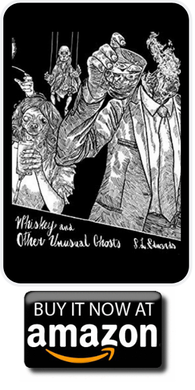 Whiskey and Other Unusual Ghosts debuts a meteoric new voice in modern dark fiction. In these tales, you’ll discover the humanity of horror, and the traumas that birth ghosts of all kinds. From inner demons to the bloodied fields of war, Edwards maintains his unique voice while whispers of classic writers such as Arthur Machen and Thomas Ligotti shine through. Edwards enters the contemporary dark fiction crowd with a standout collection that is likely to cement his position amongst the modern greats. "S.L. Edwards is a natural storyteller, with a keen command of voice, a delightfully twisted imagination and a wily, prodigious intellect. Whiskey and Other Unusual Ghosts lives up to its inventive title with tales of hauntings that are chilling, funny, moving and—quite often—all three at once. I loved this collection." - Jon Padgett, Author of THE SECRET OF VENTRILOQUISM   Comments are closed.
|


Archives
May 2023
|
 RSS Feed

|

|