

 Joshua Chaplinsky is the Managing Editor of LitReactor.com. He is the author of ‘Kanye West—Reanimator.’ His short fiction has been published by Motherboard, Vol. 1 Brooklyn, Thuglit, Severed Press, Perpetual Motion Machine Publishing, Pantheon Magazine, and Broken River Books. Follow him on Twitter and Instagram at @jaceycockrobin. More info at joshuachaplinsky.com. And check out his books at his Amazon Author Page Could you tell the readers a little bit about yourself? In West Philadelphia, born and raised… Just kidding. I live in Queens with my wife and two kids, Donut and Nino. I work in film production as an assistant office coordinator. I’ve been the Managing Editor of LitReactor.com since its inception in 2011. I’m the author of the hip-hop/horror mashup, Kanye West—Reanimator. I co-directed a no-budget documentary on Chuck Palahniuk with two guys who have gone on to have actual Hollywood careers. I knew I wanted to be a writer since high school, but didn’t start pursuing it (semi-) seriously until a few years ago. The internet really helped facilitate that. To get the ball rolling and get everyone relaxed, here is a hopefully lighthearted question to break the ice, which one of your characters would you least like to meet in real life and have them complain at you about they way you treated them in your work. Most of my characters are pretty troubled, if not outright horrible people, so I probably wouldn’t want to meet any of them. I barely like the people I like! I suppose it would be interesting to meet the real Kanye West and hear his thoughts on how I portrayed him in Kanye West—Reanimator. Preferably in public, with witnesses. For my own safety. Or that poor character I gave a gasoline enema to. Yeah, he didn’t deserve that. Other than the horror genre, what else has been a major influence on your writing? I’d say screenwriting, as a form. I spent a good ten plus years writing screenplays before I decided I wanted people to actually read what I wrote. But the minimalist style of the screenplay has stuck with me, especially when it comes to short stories. The term horror, especially when applied to fiction always carries such heavy connotations. What’s your feeling on the term “horror” and what do you think we can do to break past these assumptions? Personally, I love horror, and it’s a term that draws me in, especially when it comes to movies. When it comes to books, I have to admit I skew more to the weird and literary side of horror. I know sometimes those terms are viewed as part of the problem, that all genre is literary and shouldn’t be ghettoized. I guess what I’m trying to say is I like my horror atypical. And I’m more willing to throw away 90 minutes on a movie that might be terrible than spend a week or more reading a bad book. As for assumptions, I think from a marketing standpoint, certain assumptions are viewed as a positive, at least by marketing types. I don’t think those are gonna change much, at least not in the mainstream. A lot of good horror movements have arisen as a direct result of the socio/political climate, considering the current state of the world where do you see horror going in the next few years? I see horror continuing to do what it’s been doing so well for so many years now, which is addressing issues people are hesitant to talk about otherwise. It might require a little more ingenuity, though. I think it’s getting harder to present evil as an abstraction, because real evil has become so cartoonish and abstract. Given the dark, violent and at times grotesque nature of the horror genre why do you think so many people enjoy reading it? Because it’s the fucking coolest! Also, confronting your fears in a safe space, escaping reality—the usual armchair psychoanalytical stuff. What, if anything, is currently missing from the horror genre? If I had the answer to that, I’d keep it to myself and write it! Horror has become so broad, there’s something for everyone. You just have to know where to find it. It’s like those people who complain “they don’t make ‘em like they used to.” Sure they do. You just have to wade through the garbage. People always namecheck the same few properties as to why horror “used to be good,” but they forget about all the other schlock that came and went. Thankfully, we now have Paperbacks from Hell and Grady Hendrix to remind us. In the past authors were able to write about almost anything with a far lesser degree of the fear of backlash, but this has all changed in recent years. These days authors must be more aware of representation and the depiction of things such as race and gender in their works, how aware are you of these things and what steps have you taken to ensure that your writing can’t be viewed as being offensive to a minority group? I mean, I’m definitely more aware of it. It’s a sign of the times. I recently read a big horror title from the early 90s and the depictions of race, even though they were mostly from the perspective of “evil,” made me cringe a little. I just try to be open to people’s feelings and defer to those who have more experience and knowledge than I do. Who wants to double-down on being an ignorant jerk? (A lot of people, apparently.) Does horror fiction perpetuate it’s own ghettoization? For example Julia Armfield’s latest collection Salt Slow has a cover that most horror fans would walk past in a book shop, and is one that probably is not marketed as horror, does the genre’s obsession with horrific covers cause harm than good? This goes back to what I was saying earlier. Marketing a book is a whole different beast than writing one. Different aesthetics attract different consumers, and in the end, I suppose publishers are going to cater to the group most profitable for them. For me, personally, it’s about being true to the work. To thine own self be true! You know, if your publisher allows. And if they don’t… maybe you chose the wrong publisher? What new and upcoming authors do you think we should take notice off? You hear of this kid, Josh Malerman? Haha. Now that people like Josh Malerman and Paul Tremblay are “big” authors, we need a fresh crop of young blood to get excited about. I don’t know if I can name any horror authors your readers haven’t heard of already, or that haven’t been toiling away at it for years. People outside indie publishing are starting to catch on that Gabino Iglesias and Max Booth III are awesome. My publisher, CLASH Books (I know, I know…) are putting out some really unique stuff—African horror from Unathi Slasha and Mame Bougouma Diene, Jewish horror from Maxwell Bauman. Outside the genre, I’m reading a book right now called Mary Toft; or, The Rabbit Queen by Dexter Palmer, which is actually pretty horrific. It’s based on a true story about a woman in 18th Century England who gave birth to over a dozen dismembered rabbits. What are the books and films that helped to define you as an author? Growing up it was mostly fantasy. Tolkien and C.S. Lewis. I was a softy and didn’t get into horror until much later. And when I did, it was through movies, first. My fragile mind was scarred by stuff like Faces of Death and The Exorcist at middle school sleepovers, but eventually I decided to face my fears. I developed a taste for the works of the Davids—Lynch and Cronenberg—and those have definitely had a lasting effect on me as a writer. I am also a huge fan of author Steve Erickson. His writing showed me there are endless narrative possibilities available, you just have to be brave. Are there any reviews of your work, positive or negative that have stayed with you? I’m still new at this, so I’m happy to get any reviews at all. I think I have a pretty good stomach for bad reviews, especially if they are constructive. And I get a good chuckle from the kneejerk, vitriolic ones. We’ll see how well I do once I have a novel out. What aspects of writing to do you find the most difficult? I wish I worked faster. I’m a compulsive rewriter, and often rewrite as I go, so I’m not as prolific as I’d like. I envy the Stephen Graham Jones’ of the world, who can crank out quality work like nobody’s business. Is there one subject you would never write about as an author? I haven’t come across it yet. Let’s just say that whatever I write about, I want to be well informed and treat the subject matter with the requisite respect. How important are names to you in your books? Do you choose the names based on liking the way it sounds or the meaning? Some characters I like to have nondescript, unobtrusive names. Others, I like to have unique, memorable ones. Depends on the story. Meaning isn’t always important, but I think how a name sounds in the head definitely is. Writing, is not a static process, how have you developed as a writer over the years? Like I mentioned earlier, I was obsessed with screenwriting for a good long while. I worked out a lot of the kinks and retained a lot of the lessons I learned doing that. Lessons about plot, structure, dialog, economy of language… When I started writing fiction, I sort of just ported my voice over from there and started fine-tuning. What is the best piece of advice you ever received with regards to your writing? Learn the difference between good and bad advice. Discernment is the name of the game. To many writers, the characters they write become like children, who is your favorite child, and who is your least favorite to write for and why? I don’t particularly care for children. For those who haven’t read any of your books, which of your books do you think best represents your work and why? Definitely Whispers in the Ear of A Dreaming Ape. Aside from Kanye West—Reanimator, which is sort of a goof, it’s the only one I’ve got! It is definitely representative of my work over the last few years, and gives a good indication of where I’m going with it. Do you have a favorite line or passage from your work, and would you like to share it with us? I do, and I would not. I mean… I would, if I had one? Can you tell us about your last book, and can you tell us about what you are working on next? The aforementioned story collection, Whispers in the Ear of A Dreaming Ape, out October 15th from CLASH Books. It is a weird, dark, medley of genres. I also have a novel coming out from them in 2020, which I haven’t really talked about and don’t know if I can yet. I would describe it as a family drama masquerading as a supernatural sci-fi collage obsessed with Stanley Kubrick. And I am also currently in the planning stages of a second novel. If you could erase one horror cliché what would be your choice? Terrible decision making for the sake of plot convenience! We hates it, precious! What was the last great book you read, and what was the last book that disappointed you? The last book to really surprise me and knock my socks off was Liminal States by Zak Parsons. Jut a really well done melding of genres. As for disappointment, I recently read Mindhunter, and while the individual stories were fascinating, it was really just a collection of anecdotes. The Netflix series strung them together into a narrative so masterfully that the book just paled in comparison. What's the one question you wish you would get asked but never do? And what would be the answer? These are the first questions I’ve ever been asked! And I’m grateful for every one! Whispers in the Ear of a Dreaming Ape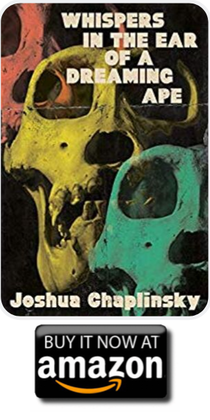 The debut short story collection from Joshua Chaplinsky, author of Kanye West—Reanimator. Thirteen weird pieces of literary genre fiction. Singularities, ciphers, and reappearing limbs. Alien messiahs and murderous medieval hydrocephalics. A dark collection that twists dreams into nightmares in an attempt to find a whisper of truth. "This is dark stuff, but fun, without any hipster wink of irony or cynicism. Writing stories that are simultaneously grim and good-hearted is a fucking tough line to straddle, and writing them well... let's just say I don't see that often. Chaplinsky walks a barbed-wire tightrope here. In short, good shit." Craig Clevenger, Author of The Contortionist's Handbook “If you're sick of tepid short stories that taste like watered down milk, "Whispers in the Ear of a Dreaming Ape," is the collection of multi-colored, bite-sized brain pan bullets that might just be the cure. Joshua Chaplinsky has an imagination both of depth and breadth, and no two stories are alike. You can practically hear the lively, fascinating, hallucinatory click of his brain throughout the book. An enjoyable read for all of us dreaming apes.” Autumn Christian, Author of Girl Like a Bomb   Comments are closed.
|


Archives
May 2023
|
 RSS Feed

|

|