

 JASPER BARK JASPER BARK Welcome to the second and final part of Kit Power's mammoth interview with horror author Jasper Bark. To read the first part of this fantastic interview click here GNoH: With ‘How The Dark Bleeds’ you go to some very, very dark places. As a parent, how hard do you find it to ‘go there’, when the story dictates it? Or do you have a distance from what you’re writing while writing it?A JB: I have no distance from what I write, if I want it to emotionally affect the reader I can't allow myself any distance, I'm right there, suffering and crying along with my characters. This means, as you quite rightly said, I go to some very dark places and please believe me when I say that I do pay for it. As a parent, writing this story was incredibly difficult for me. I had thought it impossible, if I'm honest. When I'd touched on this subject matter, in other work, I always backed away very quickly and had come to consider it taboo. But this story just kept getting darker and darker and I let myself move along with it. To come back to your question about exorcising, this would be one of those instances where I’m exorcising those negative aspects. I think we all have the potential to indulge these aspects and if we don't admit this, face up to it and take ownership, then these aspects still have power over us and the way we engage with our children. So this story is, in part, a way of facing up to that and creating a fictional repository for this particular demon. GNoH: Following on from that, have you ever abandoned a story because of extreme or harsh content? What do you feel your responsibilities are as a writer (and human) in this regard? JB: I've never abandoned a story due to extreme content, only because I didn't think it was good enough, and then only at the planning stage, not once I'd begun it. I think my responsibilities as a writer are to the story I'm telling and to how well it is told. As a human being I'm reaching out to other human beings, providing them with a safe, fictional outlet where they can face up to their dark sides, accept their primal urges and rehearse their behaviour in the face of the worst possible thing they could imagine happening. GNoH: ‘How The Dark Bleeds’ has at its heart a mythos that put me in mind of some of Clive Barker’s work, whilst still being utterly original. Have you ever revisited that mythos? Is that something that appeals? JB: Thank you for that compliment. I have yet to revisit the mythos, but I am not averse to doing so, I'm sure there is more to be done with it, I just need to find the right story. Quite a few people have asked me about extending the mythos, so I'm guessing it resonates with some readers on a particular level. I must confess that every time the moon wanes, I still think of the Heolfor and the dual goddess Monanom. GNoH: This story also creates a real tension between fatalism and free will, which I felt was ultimately left up to the reader to resolve (or not) for themselves. These themes also come up elsewhere in this collection. Was that a conscious choice? What do you think it is about horror fiction that makes it such fertile ground for exploring these themes? JB: The British philosopher Galen Strawson considers that, given the vast amount of evidence pointing to the fact that human free will, and absolute moral responsibility, are a total fallacy, our insistence on believing in these concepts can only be seen as a form of pathology. There is a conflict here between the world as it probably is, and the way we want to see it. This conflict is ripe with dramatic possibility, but more than that, we're dealing with a huge case of mass denial, it's almost a consensus denial. We've all bought into the concept of free will, it sits at the very root of our political, economic and moral philosophies, it shapes our entire world view. But what if this view is entirely wrong? What if the world as we want to see it, is not at all the way we hope it is? What if we truly don't have any free will and never had? Every logical examination of this situation points to this conclusion, but it is a truly scary conclusion because it means the world is nothing like we hope it is. What better form of literature to explore this terrifying disconnect between belief and reality than horror fiction? Because it deals with a concept that frightens us all. GNoH: Similarly, I've seen experiments that suggest that depressives have a clearer view of reality than 'normal' people, in that they see their own inherent powerlessness clearly, whereas 'normal' people have an over-inflated sense of their own agency... JB: That is a very interesting and sobering thought. It would suggest that the non-depressive world view is essentially a fiction that helps us cope better than the depressive, who sees the real futility of any purposeful action and is often frozen into inactivity because of this. So, in this sense, horror might be said to be a fiction that helps us deal with the actual reality of the world, namely that our cheery view of it is really quite fictional. It might also explain why many modern horror writers have such a world weary and somewhat depressive tone. I'm thinking of Laird Baron, Gary McMahon, Joel Lane and especially Thomas Ligotti. Although I have to say, I detect a huge degree of dead pan humour in a lot of Ligotti's gloomier excesses, like the fictional equivalent of a Morrissey lyric. GNoH: Does this perhaps explain why there's such a strong fatalistic streak in horror in general? Do you think that’s due to writers in the genre trying to engage with this basic flaw in the free will concept, either consciously or subconsciously? JB: In 'In The Dust of This Planet', the first volume of the excellent Horror of Philosophy series, Philosopher Eugene Thacker says: "horror is a non-philosophical attempt to think about the world-without-us philosophically. Here, culture is the terrain on which we find attempts to confront an impersonal and indifferent world ..." The Ancient Greeks used Tragedy to cover the conceptual terrain that philosophy failed to confront. Thacker argues that we now use horror. That's why Tragedy is so caught up with fate and destiny, and the way this is determined either by fatal flaws in our character, in the form of hamartia, or by the cruel whims of the gods. In it's sometimes fatalistic outlook, horror is essentially doing the same thing. In fact, if you look at the plots and subject matter of most Greek Tragedies they are rife with as much gore and taboo breaking as most modern horror is. Given this obvious link, and given that horror can be argued, in many ways, to be the literary heir to Tragedy, it's a shame that while many classicists see Tragedy as the very pinnacle of human creative endeavour, most people see horror as the nadir, barely a step above porn and probably more suspect. I think this is more of a reflection on the age in which we live, than the genre in which we work. GNoH: Do you think it's possible for there to be non-fatalistic horror? What would that even look like? Also, does this link to Tragedy help explain why horror is so often morally conservative? JB: That's a really good question, and one I have been wrestling with myself. I'm not sure I have an answer and without wanting to get into the specifics of what makes genre what it is, I wonder if it would continue to be horror if it wasn't fatalistic? Does tragedy continue to be tragedy without fatalism? Does it become a different genre without it, such as tragicomedy? Would horror just become dark fiction or another sub branch of fantasy? I don't know. It certainly is the sort of intellectual challenge that might inspire some interesting fictional experiments though. The social conservatism, which also worries me, isn't an innate feature of fatalistic, or horrific fiction, I think it comes from the literary and artistic legacy we've inherited from the middle ages, which were often strictly Christian and morally dictatorial in their official world view, but there was a lot of leeway in this dictatorial approach, if you were careful. From the carving of hideous gargoyles on the entrances to churches, through to the paintings of Bosch and the apocalyptic writings of Adso of Montier-en-Der, medieval Christians were just as interested in the grotesque, the forbidden and the taboo, but they had to exorcise this fascination in the form of moral warnings and strictures. The explicit message was: "if you deviate in any way from the strictures of this narrow moral path, this is what you will fall prey to." The implicit message was: "wow, look at this, isn't it cool?" They were no different in this than modern tabloid newspapers, who print all manner of salacious details about deviant behaviour, ostensibly to condemn them, but in actual fact we know that the readers are enjoying them on a purely prurient level, rubbing their hands over all the nasty details, then pretending to shake their heads in moral repugnance. Horror is just about tolerated so long as it inevitably condemns the things it depicts. We can have a cheap thrill over anti-social behaviour, or the excesses of those who hold other religious or magical beliefs to us, just so long as those people come to no good at the end and we leave the cinema, or put down the book, knowing that the moral order hasn't ever been effectively challenged. I don't think this is an undeviating rule though. This same moral stance can be turned against the worst excesses of conservatism as well. An example of this would be the amazing EC comics, which were highly moral but incredibly progressive, even by today's standards. The influence they've had on the genre is incalculable. For me one of the principle attractions of horror is that it flirts with the unknowable, the unthinkable and the unspeakable. Sometimes you can succumb to that flirtation and be liberated by it. Maybe that's where our non-fatalistic horror lies, on the bleeding edge of all that's possible not only in fiction but in our very existences. In that exhilarating moment when we stand poised to leap into abyss of the unknown, in search of true insight and freedom. I mean, how scary is that ...? But enough philosophical asides - why don't you ask me about Mouthful? GNoH: Fair enough! With ‘Mouthful’, I’m curious as to if you had always intended the story to be told exclusively with dialogue, or if there’s a draft that’s more ‘traditional’... Why did you make that choice for this tale? JB: As with everything I write, there were at least three drafts, but it was always told exclusively in dialogue. If I recall the choice was an instinctive one. Initially I had intended to include some third person prose between the dialogue but as a I continued with the piece, it became increasingly obvious that the prose was extraneous. It began to remind me, as I was writing it, of the type of story they'd do on the old time radio horror shows in the US, like Inner Sanctum, The Witches Tale or Lights Out with Arch Obler, which were the forerunners to TV shows like The Twilight Zone and Outer Limits. So I decided to continue with it purely as a duologue. GNoH: Any plans for a radio play/podcast version of this one? JB: Given what I've just said, it would lend itself rather well to that medium. There is an audiobook of the collection planned so this piece will definitely be included in that. I'm also involved in a theatrical venture that I can't say too much about at present, which may also include this piece as a live performance, so watch this space.  JASPER BARK GNoH: Haunting The Past is another first person narrative with a very distinct voice. What was it about this story that led you to take that approach? JB: I often plan out the bare bones of the story, but the voice of my characters is something that emerges as I write and is often a surprise to me. Some characters take a bit of coaxing, they don't emerge all at once and they can actually hide things from you and surprise you, either with revelations, or with hidden depths that you didn't know they had. Some characters are desperate to talk to you. They've been waiting for you to start the story and they have SO much they want to say. Writing these characters is like taking dictation. The narrator in this piece was very much like that, I was careful to make sure his dialect and the cadences of his speech were accurate, but he was pretty much there from the word go. GNoH: One of the things that I've seen many new writers cautioned about is the use of first person perspective. The example I was given was an editor who'd rejected a short story he'd otherwise loved because 'it was first person, but at the end, the narrator was turned into a crocodile, so how did he tell the story?'. There's a moment in Haunting The Past where you address that issue quite explicitly. What led you to make that choice? Or did it just come out of the voice? JB: I adapted this story from a comic script I'd written for a horror anthology comic called Flinch which was briefly put out by DC's Vertigo imprint. Unfortunately the artist I wrote it for, who is now a rising star in the industry, was down on his luck at the time and had moved back in with his parents. The subject matter of being trapped in a house and unable to escape was too close to his actual condition at that time. For this reason he kept stalling on the script and by the time he got around to roughing out the pages the anthology had folded. It was actually his idea to develop the story as a prose piece. When I finally got around to doing that it was for an audiobook that I was commissioned to write, so I knew I was going to be recording it. As I was writing it, I was asked, by the Rondo Theatre in Bath, to adapt some of the content of the audiobook into a one man multimedia show. So I was aware, while writing it, that I would be saying all these words directly to an audience, as the central character. For this reason I began to think very specifically about who the narrator thought he was speaking to and why. I also found it fun to break the fourth wall and draw the audience in. The final word came from the character though, this was his rationale, I think I subconsciously posed the question to him and this was his response. GNoH: There's a story within a story here which represents a microcosm of the larger tale. Did that inner story come about organically as you wrote, or did it occur to you as you planned the story out? JB: The idea occurred to me as I was planning the story out. Much of my fiction plays with symmetry in terms of construction and also character motivation, I knew that this was a character whose whole life was determined by a series of patterns he felt powerless to break. This of course mirrored the final predicament he found himself in, which mirrored the wider actuality of his situation and his response to it and so on. However, the minutiae of his back story, all the little details, only really came out when he began to talk to me and I was able to coax the full story out of him. I had an inkling and a broad outline about what had happened to him, but I needed him to fill me in on the full picture, when I began taking down his story, in his own words. GNoH: Parents and children again feature heavily here. To what degree are you working through your own fears as a parent in stories like this? JB: Parenthood is a big theme in my work it would appear. I've just finished a chapbook that has this as it's central theme and this week an anthology of short stories came out from Fox Spirit Press to which I was asked to submit a short story, in comic book form, with the artist Fabian Tuñon Benzo.The theme was European monsters and I chose to write about the Greek mythological figure of Echidna, mother of all monsters. Once again this story explored a darker, more disturbing side of parenthood. I've worked from home for most of my children's lives so I've been their principal carer. I take this responsibility very seriously and I naturally think a great deal about what it means, and what it takes, to be a good parent. This naturally means I will also ruminate on the many pitfalls of parenthood, and the lengths to which some parents will go on behalf of their children. This, it seems, has been a rich seam for some seriously disturbing fiction. GNoH: 'End Of The Line' is arguably a science fiction tale, as well as a horror story. Do you enjoy working in genre collision, as it seems to happen a few times in this collection? JB: I like cross pollinating genres, taking a well-worn trope from one genre and transplanting it into another. But the trope has to function according to rules of the new genre into which it has been transplanted. In this way you can breathe new life into both the trope and the genre. In this instance the story of course deals with time travel, which is one of the oldest and most well-worn sci-fi tropes there is. However, this is effectively a supernatural horror story, so the time travel is not achieved through scientific means, as is usually the case, it is accomplished through parapsychological and supernatural means, in a way I don't think has ever been done before. The results are also quite different from the usual time travel story, although effectively they follow the same format. So I would hope this story will surprise you in several different ways, as well as scare you. GNoH: The time travel element creates a puzzle box effect for the story, in some ways. With that kind of story, is it a case of working back from the conclusion, or were you discovering the plot as you went? Or some hybrid? JB: Jonathan Oliver, Editor in Chief of Solaris, contacted me and asked me for a short story set in the underground. I pitched him an idea about a guy waking up in a pool of blood on a disused station platform with no memories. An ancient train carriage pulls up to the platform and he gets in. When he looks at the route planner every stop is a incident from his life, he realises the train will take him back to those points in his life and maybe he's being given a chance to change whatever has happened to him on that platform. Jon loved the idea and commissioned it. Then I was left with no idea what on earth was going to happen next. After hours of making notes, I came up with the ending and wrote several drafts, but the time travel element wasn't working so I had to rethink the whole business of the chrononauts and the idea of exploring time travel through group minds and past life regression. This was a meticulously constructed story and practically every word was weighed for its purpose and effect. It's one of the oldest in the book and probably marks a turning point in my writing. 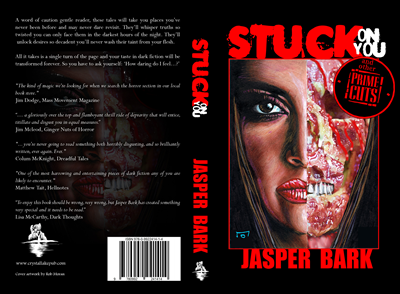 GNoH: And so to Dead Scalp. There a heck of a lot going on with this story. Without giving too much away, where on earth did the idea of 'ingrowing' come from? JB: The first scene came to me in a fever dream. I tend to hallucinate quite heavily when I get a high temperature and to be honest, I quite enjoy it. The scene played out in my head like a really weird movie and left me wondering what on earth was going on. As my temperature rose and fell, I started to get little snippets of other scenes. When I was a little more lucid I wrote the scenes down, thinking that they might make a good story. About a year later, as we were compiling this collection, I found the time to sit down and puzzle out just what was going on. So I think the ingrowing came from a collaboration between my fevered consciousness and my lucid imagination. GNoH: I have to ask if Big Bill is a reference to 'Unforgiven'.. JB: You know, I hadn't thought about that, but Gene Hackman's character Little Bill is exactly the sort of archetypal western figure I was basing Big Bill on, along with Ian McShane as Al Swearingen in Deadwood, which was obviously a big influence on the story. Big Bill also has that authentic ring to it, I like to think it sounds like an old time outlaw boss and that you can begin to picture him just from the sound of his name. I also like to think that he's more dangerous than either Little Bill or Al Swearingen, but that may simply be my conceit. GNoH: How much of the Native American mythology in this tale is whole cloth invention, and how much was based on research? JB: The beliefs regarding hair and dreams are from research, as was the cultivation of corn, which is not a natural plant but, according to myth, was grown carefully over several generations from grass seeds and entirely created as a means of nutrition by the Navajos. The Eternal Dreaming was entirely my creation. GNoH: There's a fiercely angry moral centre to this story. Was it in your mind that you wanted to tackle that aspect of American history from the start, or did it come about organically as a product of the 'weird' elements of the tale? JB: Although there's a lot I have to say in my writing, I rarely start a story with a theme or a message in mind. I usually get excited about the idea or the characters and want to learn more about them and what happens to them. Writing is a very concentrated and contemplative pursuit, and as I'm working on the story I become increasingly aware of the subtext and the themes of the story, because I'm thinking quite heavily about them. In effect the story begins to tell me what it's really about. At this point it becomes clear to me what I'm actually writing about and this begins to colour the work and the direction I'll take in the preceding drafts. So, as I was working on the story, it became clear there was a strong metaphor for the colonisation of America and the destruction of the native culture that preceded the United States. GNoH: Looking back on the collection as a whole, which of these stories would you most like to see adapted for TV or a film, and why? JB: I was in talks for a while with an indie filmmaker about adapting 'End of the Line' into a weird, 'Jacob's Ladder' style splatterfest. Due to the compact nature of the short story it would have had to be expanded quite a bit. Nothing came of the talks but I still think it would make quite a good basis for a film. Imagine if the Midnight Meat Train were to take a detour through the Twilight Zone and you'd have the sort of thing I have in mind. Jack Ketchum wrote that novellas often make the perfect subject matter for film, as they're about the right length and have a similar story arc as a movie. As such, both novellas in the collection might make good films. Many readers have said they'd like to see a film of Stuck On You. I don't think it would have much mainstream mileage, as it would have to be R rated, but it might make a really good low budget indie shocker. It has a small cast, a single remote location and no real special effects to worry about. Dead Scalp might have more mainstream potential, it would need a lot of CGI but I think it would have some great character parts in it and I don't think cinema audiences have ever seen anything quite like it before. Moving on to other mediums, I have actually performed The Castigation Crunch and Haunting the Past as part of a one man multi media stage show. They were also part of an audiobook presentation, along with Ill Met by Moonlight and several other stories, that attempted to resurrect the spirit of Old Time Radio Horror shows, like Lights Out and Inner Sanctum, complete with soundtrack and sound effects. The audiobook is called Dead Air and is still available on i-tunes. GNoH: Are you still working on short form fiction? What is it about the form of the short story that appeals to you, as a writer and as a reader? JB: Yes I am, and I always will, even though I completely agree with a quote that is attributed to Chekhov (that's Anton not Ensign) which says: "I write novels because I haven't the time to write short stories". In the introduction to his Collected Short Stories, JG Ballard wrote that the novel by its very nature is an imperfect form but the short story is a perfectible one. This means that you're never going to write a perfect novel, no matter how hard you try, because it's not in the nature of the medium. However, it is possible to write a perfect short story, and that, for me, is the attraction. I think Ballard has written a handful of perfect short stories, as has Bradbury. The sci fi writer Robert Sheckley is another, as is the now nearly forgotten, but all too sublime, John Collier and many of the Russian writers too, like Pushkin and Leonid Andreyev. The potential that I might read something that is perfectly constructed, without a word, an idea, or a character out of place, is what draws me to short stories as a reader. I've always loved them. My favourite horror films are anthologies too. As a writer, what I love about short stories is that same potential. One day I may just write something that is as close to perfect as I can get. It keeps me striving. It also means, to return to the opening quote, that I spend far longer, per word, on a short story than I ever do on longer works, so that's the downside and the reason I don't produce as many short stories as I'd like. GNoH: Finally, what do you have in store for 2015? JB: I have a graphic novel called Bloodfellas coming out imminently with Markosia. It's drawn by Mick Trimble and Aljoša Tomić with covers by Rob Moran, who illustrated Stuck On You and Other Prime Cuts. It's a horror/crime mash up and is an homage to the banned crime and horror comics of the 1950s such as Tales From The Crypt and Crime Doesn't Pay. It's been a long time in gestation (ten years in fact) it's been through four publishers and several creative teams, but it's finally finished. It's set in prohibition era America, in the mythical Atros City which is like a cross between Chicago and New Orleans, and it's an entirely new take on that old staple the walking dead. Your life will not be complete until you've bought a copy and read it. Parassassin, the on going sci fi series I've been doing with artist Alfa Robbi, for David Lloyd's award winning digital comic Aces Weekly, is also coming to an end and I'm hoping it will be collected into a graphic novel soon. Rob Moran and I are at work on a prestige Graphic Novel called Beyond Lovecraft also for Markosia, which contains some of the best art Rob's ever done. And American publishers Silver Phoenix Entertainment are due to be bringing out the next installment of 'Roller Derby Drama', the offbeat, best selling superhero/sport series I've been writing for them. I've also got a chapbook coming out with Knightswatch Press called 'Bed of Crimson Joy' and a short novel that I'm discussing with several publishers. Plus I'm writing a two man stage show with the inimitable John Llewellyn Probert. On top of all that I have a slew of short story requests, which I may or may not have time to fulfill. There are other novel projects in the works, but you'll just have to keep watching this space to find out more about them. Whenever I answer questions like this one above I'm reminded of the wonderful Jewish joke: Q: How do you make God laugh? A: Tell Him your plans. I wonder how much of this answer we'll chuckle over when we look back on it in a few years time Kit? Anyway, thank you for a most exhaustingly in-depth and insightful interview. Many thanks to Jasper for being so generous with his time and energy, and the best of luck in 2015! PURCHASE SOME OF JASPER'S BOOKS FROM THE LINK BELOWComments are closed.
|


Archives
May 2023
|
 RSS Feed

|

|