• HOME
  • CONTACT / FEATURE
  • FEATURES
  • FICTION REVIEWS
  • FILM REVIEWS
  • INTERVIEWS
  • YOUNG BLOOD
  • MY LIFE IN HORROR
  • FILM GUTTER
  • ARCHIVES
    • SPLASHES OF DARKNESS
    • THE MASTERS OF HORROR
    • THE DEVL'S MUSIC
    • HORROR BOOK REVIEWS
    • Challenge Kayleigh
    • ALICE IN SUMMERLAND
    • 13 FOR HALLOWEEN
    • FILMS THAT MATTER
    • BOOKS THAT MATTER
    • THE SCARLET GOSPELS
GINGER NUTS OF HORROR
  • HOME
  • CONTACT / FEATURE
  • FEATURES
  • FICTION REVIEWS
  • FILM REVIEWS
  • INTERVIEWS
  • YOUNG BLOOD
  • MY LIFE IN HORROR
  • FILM GUTTER
  • ARCHIVES
    • SPLASHES OF DARKNESS
    • THE MASTERS OF HORROR
    • THE DEVL'S MUSIC
    • HORROR BOOK REVIEWS
    • Challenge Kayleigh
    • ALICE IN SUMMERLAND
    • 13 FOR HALLOWEEN
    • FILMS THAT MATTER
    • BOOKS THAT MATTER
    • THE SCARLET GOSPELS
GINGER NUTS OF HORROR
horror review website ginger nuts of horror website

FIVE MINUTES WITH AUTHOR DAVID JENKINS

2/4/2018
Picture
I write short stories, comics and screenplays in all spec genres as well as historical fiction. A few of my short stories have been published including one about a Kumiho. I regularly blog about writing, the horror genre and reviews at https://www.facebook.com/davidjenkinswriter  and several of my posts have been featured on numerous sites including Bloodshed and Comic Book News UK. I’m launching a Kickstarter for the first two issues of my horror comedy comic series ‘Vampires Of Hungary: The Holy Roman Empire’ at the end of March.


Could you tell the readers a little bit about yourself?

Interview With The Vampire is my favourite film, Vampire Lestat is my favourite book and Spider-Man is my favourite comic book character. I like adaptions of works and comparing how they measure up to the original and unlike many people who say the book is better I think it depends on what you experienced first as you see that as the original.

What do you like to do when you're not writing?

I enjoy a variety of sports including badminton, roller skating and trampolining regularly.  Reading and watching films as well otherwise I wouldn’t be interested in writing or have any inspiration.

Other than the horror genre, what else has been a major influence on your writing?


My local writing group (Skelmersdale) as when I first joined them I was writing only screenplays and not even very well. Now I write across most mediums and have picked up a few things to do with writing.
 
The term horror, especially when applied to fiction always carries such heavy connotations.  What’s your feeling on the term “horror” and what do you think we can do to break past these assumptions?

When you say horror to me I assume monsters, killers and battling evil. But I feel a good section of people feel these things are childish and unrealistic. To combat this we need some more everyday horrors where it’s based on reality or where there’s a strong message so that people can see past their negative assumptions about horror like Get Out.

A lot of good horror movements have arisen as a direct result of the socio/political climate, considering the current state of the world where do you see horror going in the next few years?


In a recession, zombies tend to prosper and even though the trend has abated a bit now I still see it continuing for a while.

What are the books and films that helped to define you as an author?

I remember watching Hammer films, Munsters, Goosebumps, Are You Afraid of The Dark as a kid and many of my stories are about creatures because of this.  Anno Dracula and The Vampire Chronicles are the biggest influence on my current project ‘Vampires Of Hungary: HRO’ as they showed how politics and history can be combined with horror and the human side of vampires.

What new and upcoming authors do you think we should take notice off?

Heide Goody and Ian Grant’s Clovenhoof series is one the best horror/fantasy/comedy series I have ever read and definitely worth a look for anyone who liked Little Nicky or Bedazzled. Edge Lit in Derby is a brilliant place to discover new authors as well.

How would you describe your writing style?


Simple but visual, I don’t rely on heavy description as the point of comics and screenplays is to just give a blueprint for the picture and dialogue.

Are there any reviews of your work, positive or negative that have stayed with you?


Not any specifically, I did receive a positive review that was almost as long as the article they were reviewing and I was touched the amount of time they’d put into the review.

What aspects of writing to do you find the most difficult?

Re-editing as once I’ve been though one lot of editing I’m reluctant to change my work even more due to the time I’ve already spent creating the story.

Is there one subject you would never write about as an author?

I don’t see me ever writing anything literary or about any of the nice subjects for Take A Break or Woman’s Weekly.

How important are names to you in your books? Do you choose the names based on liking the way it sounds or the meaning?
 
I choose a few names based on meaning the rest are just random, although I like the name Alexei and have used it in several stories kinda like a Easter egg I suppose.


Writing, is not a static process, how have you developed as a writer over the years? 

I’ve branched into different genres and mediums, learnt a lot more about formatting and even my use of grammar as improved so much since I started writing.

What tools do you feel are must-haves for writers?         

For short stories and novels I’d recommend Grammarly and Pro Writing Aid to pick up any grammar issues, adverbs etc.  For scriptwriting Celtx in order to get the format right.

What is the best piece of advice you ever received with regards to your writing?

To put more comedy into ‘Vampires Of Hungary’ before that I had a few comedy moments which diluted the horror but as I enjoyed writing those moments I didn’t want to lose them. Then my writing group suggested building upon them and that’s what I did.

Getting your worked noticed is one of the hardest things for a writer to achieve, how have you tried to approach this subject?


Facebook groups, twitter, forums, asking existing writers, following different websites and blogs to hear about any opportunities.  I’ve wrote blogs across several different websites and now include a tag describing what else I do.

To many writers, the characters they write become like children, who is your favourite child, and who is your least favourite to write for and why?

I like Barbara De Cilli from my ‘Vampires Of Hungary’ work because even though she’s an evil vampire, she’s got so many problems and interacts with so many different people I feel I can explore more of her personality.  Least favourite would probably be from one of my unpublished short stories as he’s so negative about life because of his wife’s death that it was really depressing writing him particularly because the situation he found himself in was realistic.

What piece of your own work are you most proud of?
 
‘Vampires of Hungary’ as I have adapted it from my screenplay as I believe it can work across multiple mediums. I spent more time on the story and characters than any other work, I must have over 50 pages of notes and some plans on what direction the sequels can go.

And are there any that you would like to forget about?

Not really because they helped me grow as a writer.

For those who haven’t read any of your books, which of your books do you think best represents your work and why?

‘Vampires Of Hungary’ the first two issues of which I’m going to launch as a Kickstarter in late March probably represents my work best as it spans most of my interest- horror, comedy, history and politics whereas most of my other work only spans two or three interest at most. For work already published I would have to say my ‘Retirement Town’ short story in our local writers group anthology ‘Endings’ as it shows how I can tie a spec genre (in this case sci-fi) with politics and write from a bad guy’s point of view but make us care about him slightly.

Do you have a favorite line or passage from your work, and would you like to share it with us?
 
Not one that stands out above others.

Can you tell us about your last book, and can you tell us about what you are working on next?


Last published work would be my stories in ‘Endings’ the first was a sci-fi story on the attempt to transform Skelmersdale (where I live) into a town solely for old people complete with a hospital but there’s a backlash and a secret group trying to keep Skelmersdale independent. The second story was a monologue about Anthony Eden (British Prime Minster from 1955-1957) and his attempts to get back into power after his health problems and the public disgrace over the Suez Crisis
 
If you could erase one horror cliché what would be your choice?

So many to choose from, I’ll go for tripping over nothing when there’s a killer right behind you. It ruins any realism.

What was the last great book you read, and what was the last book that disappointed you?
 
Last great book’ Queen Of the Tearling’ by Erika Johansen. Last disappointing book would be God Squad (book 3 in Clovenhoof series) by Heide Goody and Ian Grant but that’s mainly because it didn’t have Clovenhoof in it.

What's the one question you wish you would get asked but never do?  And what would be the answer?

How would we survive a vampire apocalypse. Everybody focuses on a zombie apocalypse but if vampires where spreading they would be a lot harder to combat due to all their powers. My answer on how to stop the undead menace would sadly be trial and error as we’d need to deduce what the vampire’s weakness are first before we can fight back, hopefully it will be the sun I don’t think I could stand sparkly vampires.


To find out more about David's Kickstarter please follow this link 

Picture

BOOK REVIEW: ​YES TRESPASSING BY ERIK T. JOHNSON

FIVE MINUTES WITH AUTHOR KITTY HONEYCUTT

21/3/2018
Picture

Could you tell the readers a little bit about yourself?
 

Kitty Honeycutt is the single mother of an amazing daughter whom she currently home school’s. She is a publisher for over 100 authors, a writer, an entrepreneur, a singer and an animal and human rights activist.
 
Her household is comprised of various creatures that include, but are not limited to:
 
Two Chihuahua’s (Lobo) & (Tinkerbell) Thirteen cats (Merlin), (Pandra), (Salem), (Mythian), (Sabrina), (Austin), (Mestofelees), (Sage), (Zoey, aka Jadis), (Willow Pixie), (Totoro aka Tiny), (Clementine) & (Sandy) Five fish, (Pumpkin), (Thing 2), & (Orca the Oscar Fish) One Ball Python, (Dragon), Four Bearded Dragons, (Rexie), (Chubby aka Kingsley), (Samantha) & (Georgia) One Crested Gecko, (Copper) Two Uromastyx, (Mary) & (Elizabeth) Two Aquatic Turtles, (Purple) & (Myrtle) and eleven babies that have yet to be named. One Desert Tortoise, (Bubble).
 
*As you can see she is also a part-time zoo-keeper.*
 
She sometimes writes under the pseudonym Kitty 'de Chatfou and her book “Pray For Hell” is due out later this year 2018, and will be her second published work.


What do you like to do when you're not writing?

I mostly spend time with my daughter and our various animals. I also like to read and review other people’s books or just spend my time dreaming up ideas for new novels and letting the insane characters run freely in my head, just to see how much trouble they can get into.

Other than the  horror genre, what else has been a major influence on your writing?

Fantasy, I love fantasy and I also love historical fiction. I have books coming out with both in them in the very near future.


The term horror, especially when applied to fiction always carries such heavy connotations.  What’s your feeling on the term “horror” and what do you think we can do to break past these assumptions?

I feel the term ‘horror’ has been used a lot to describe gore and grindhouse, I don’t feel that it’s all encompassing enough for some people. They usually see the word horror attached to really gory outrageous writing but I feel that people need to see and understand that not all horror has to be that way. I write horror in both senses even some horror for children so there are many facets to the diamond we call ‘horror’ I feel we need to make people see and understand that.


A lot of good horror movements have arisen as a direct result of the socio/political climate, considering the current state of the world where do you see horror going in the next few years?  

Oh man, I can see it going into more of the ‘Purge’ venue. There is so much craziness out there right now I wouldn’t be surprised to see horror take on more of a political satire type venue. It’s going to be interesting that’s for sure.


What are the books and films that helped to define you as an author?

I will not lie, I am a fan of Stephen King not only for his genius in writing but also for the fact that we share a birthday. His books have been part of my library for years and I still purchase them today. Anything he writes I’ll read it. I think we have a similar style to; it could be because we’re both Virgo’s. I also love Dean Koontz, his writing is phenomenal and of course the old Wes Craven movies and such. I’m a huge fan of 80’s horror. I get a kick out of it and miss those days.

What new and upcoming authors do you think we should take notice off?  

Joe Schwartz, he just wrote a book about a year ago now called STABCO, it is very good and I think it’s worth a read for anyone that likes horror. Very dark and psychotic but with a twist of the old horror genre tricks. I loved it!

How would you describe your writing style?

I’d say a cross between Stephen King and Dean Koontz. I have a tendency to put on the gore when I feel I need to and sometimes I play things a bit cleaner. It all depends on my mood.

Are there any reviews of your work, positive or negative that have stayed with you? 

I haven’t had any reviews yet but I’ll let you know when I do!

What aspects of writing to do you find the most difficult?

The plotting, it takes a lot of time and true effort to plot the story before it happens completely and I find that a lot of times my characters have a tendency to take me in an entirely different direction. My characters are a part of me and they will not be denied!

Is there one subject you would never write about as an author?

Erotica…. I just don’t think I could do it. I’m not a very sexual person and I just don’t know if I could bring it out good enough to even try.

How important are names to you in your books? Do you choose the names based on liking the way it sounds or the meaning?

I choose some names just because I like them but to be honest a lot of names are taken from names of friends that I know. They love to be put in a book, it doesn’t even matter if they die, they just enjoy being in a book. It’s cool to do that too because I love to make people happy.

Writing, is not a static process, how have you developed as a writer over the years? 

I think I have learned to take more risks. There are times and have been times when I thought I may not should have put some things in a book that I did only to find that the readers loved it. So taking risks aren’t all that bad after all.

What tools do you feel are must-haves for writers? 

A computer is a must, editors, pens and pencils in your purse or pockets. Trust me you never know when an idea is going to pop up.         

What is the best piece of advice you ever received with regards to your writing?

Don’t let reviews bother you, they are opinions, even some of the greatest authors we know got bad reviews and it doesn’t always mean that you suck. If you get a bad review take it with grace and accept it, you can also learn from them.

Getting your worked noticed is one of the hardest things for a writer to achieve, how have you tried to approach this subject?

I do my own promoting; I love to keep in touch with fans or potential fans. I like being out there where they can ask me questions and such.  It’s hard to promote and you have to remember to promote yourself not just your book.

To many writers, the characters they write become like children, who is your favourite child, and who is your least  favourite to write for and why?

Well I feel they are more part of my own personality, but I can’t say I truly have a favorite or even a least favorite. If I did have to choose right now my one favorite from my last book would be Davina Honeycutt, my least favorite would be Seth, he’s a bad bad cat.

What piece of your own work are you most proud of?

‘Crazy Cat Lady’ that’s my newest book. I am very proud of that and hope that I will be able to get it up and going with promotions.

And are there any that you would like to forget about?

None yet.
​
For those who haven’t read any of your books, which of your books do you think best represents your work and why?  

‘Crazy Cat Lady’ because it’s my first full book.

Do you have a favorite line or passage from your work, and would you like to share it with us?  

My favorite parts is where you first meet Davina as the wise woman she is and get to see her true personality.
 
“Davina Honeycutt had been a wise-woman and midwife for these parts for some time. She was getting old faster than she’d hoped, bones were creaking, skin loosening and she didn’t mind in the least. The only thing she hated was that she’d have to stop soon. She enjoyed bringing babies into the world; she loved to kiss that wrinkled skin and missed her own little ones romping about her feet. They’d all left her a long time ago, off to Raleigh the big capitol of North Carolina to find their own way in the world. They barely even kept in touch anymore. It was as if they had forgotten her. All accept one that one was her son born of another man when she was sixty years of age. John Ovie, her precious sweet boy that had been sent to live with another family by the surname of Tew. That one was special, born of the man she truly loved, the one she could never have. Their babies, some of them lived close by but they didn’t care to be associated with the old woman in the woods. She supposed she’d been called worse so she adopted that name with ease. The crazy cat lady was the one she detested the most. She loved these old feral felines as though they were her children and made sure all were fed, safe and warm no matter the weather. They seemed to love her just as much. They called to her in the night and when she was feeling young again, in spite of herself, she’d go out sky clad into the open field and dance beneath the moon with them.

Her ways were the old ways, the ways of the world before horror and evil had taken root. The ways of the fae folk and the sidhe, the ways of old Ireland and though she was born English, she held to those beliefs with ironclad fists as though when they left and with none of her own to take up the mantle, that would be the true end and she would weep at her own passing as she moved out of this world and into the next. She hated to think what she’d be leaving this world to. So much had changed and was still changing and not for the better. She saw wise and young JFK as the only savior for this world. Little did she know that he’d follow her in death just a year after her own.”

Can you tell us about your last book, and can you tell us about what you are working on next? 

My previous book before ‘Crazy Cat Lady’ is called ‘Where This World Ends’ it’s basically some excerpts from roleplay on AOL allowing the readers to see how people use to come into a room and create stories together. It’s very interesting to read some of the excerpts and see such difference in your writing compared to others as well as compared to now.  I am currently working on the sequel to ‘Crazy Cat Lady’ another story in the Sampson County Supernatural Series.

If you could erase one horror cliché what would be your choice?

How the females are always weak! It seems in almost every book you read that the females are weak and don’t make it through the book or either they are always being chased and falling down. That just gets old. I’d love to smash that, that is why I write stories where the females are tough and can handle things.

What was the last great book you read, and what was the last book that disappointed you?

The last great book would be ‘The Call’ by Peader O’ Guillin it was meant for young teens but it was amazing! I haven’t had one that disappointed me as of yet.

What's the one question you wish you would get asked but never do?  And what would be the answer?

What my real name is. I never have people ask because I have so many. I go by Morrigan Austin, Kitty de’ Chatfou and so on … my real name is Kitty Honeycutt. I also never get asked why I don’t use my real name and the answer to that is, because I think it’s just a little too boring.
Picture
Picture

FICTION REVIEW: GLIMPSE BY JONATHAN MABERRY
​​HORROR NEWS: GINGER NUTS OF HORROR TRAVELS TO PARTS UNKNOWN FOR A SERVICE WITH JOE R LANSDALE AND KASEY LANSDALE

FIVE MINUTES WITH… DARK BEACON CO-WRITER / DIRECTOR COZ GREENOP

19/3/2018
FIVE MINUTES WITH... DARK BEACON CO-WRITER / DIRECTOR COZ GREENOP Picture
To coincide with the long-awaited release of award-winning horror, Dark Beacon, we chat to the film’s co-writer, producer and director Coz Greenop.
 
In Dark Beacon, Amy (April Pearson, TV’s Skins) loves her former colleague Beth with a passion, a relationship they had kept secret. When Beth's devastated husband dies tragically, the widow disappears into seclusion with her young daughter. Tracking down Beth to a remote lighthouse, Amy finds her there, broken, and attempts to re-connect. But before long, they experience strange and terrifying visions suggesting Beth’s husband is back and won’t stop until they meet the same fate.

Winning multiple awards including Best Film, Best Actress (for April Pearson) and Best Cinematography at the American Horror Film Festival, Dark Beacon is a must-see movie from acclaimed filmmaker Coz Greenop and co-stars Lynne Anne Rodgers, Toby Osmond and Jon Campling. Look for it in cinemas and on digital platforms!

Could you tell us a little bit about yourself?
 
I was a child actor for a long time until the age of about 14. I always had a buzz on film sets but assumed it was directly from the acting. As I got into my early teens, I was doing drama at GCSE and the department had an old camera they used to film exams. I realized I wanted to start telling my own stories, probably because I was a pretty terrible actor [Laughs]. I took the school’s camera home and made short films with my mates. As I did that, I realized this is what I wanted to do.
 
Later, when everyone in my school was getting Saturday jobs, I didn’t want to get a job I hated for the sake of money. I decided to offer a wedding video package and approached the reverend in our local village. I said that if he helped sell them, I’d put 50% of the money back into the church. With this, I started buying my own kit, like a new laptop and eventually my own camera. Around this time I started A Level media, really enjoyed it and knew this is what I wanted to continue with.
 
What was your first big intro to film and television?
 
During my A Levels I got a job on Emmerdale, since it was our local show in Leeds. I emailed and they let me go there for work experience. That led to me being a runner and eventually a camera assistant. Having done it for two years, I realized it wasn’t for me and it just wasn’t creative and fulfilling enough, so I went back to making music videos and short films. Throughout my education I got three GCSEs and my A Levels weren’t great, so university wasn’t an option, until I discovered the Northern Film School in Leeds. I got an unconditional offer based on the films I’d made, they weren’t really looking at my grades, so I was lucky. I was there for three years and working for a post-production house in Manchester who did a lot of extreme sports. It was great because I’m a rock climber and skier myself. I started working with them and got a job when I graduated from uni. This led to freelance camera work for the Discovery Channel and other companies, travelling the world.
 
When did you write your first script?
 
In 2012 I had a really bad rock climbing accident and was stuck in bed for three months. I’d always wanted to write a script for a feature film so I knew, if I didn’t write it then, I’d never do it. I’d always been a huge horror fan. Some of my earliest memories are watching Freddy Krueger in the A Nightmare on Elm Street films and traumatizing myself [Laughs]. I got the biggest telling off from my mum. I always loved the low budget, B-movie horror, but it also gave me a confidence. While some are quite bad, they were still out there and got released. I spent a month watching films and created a checklist. They often had small casts, they had an isolated location and other conventions you could replicate cheaply. After three months I had a script and shared it around with people I knew or had worked with. I even took to my local film council but since I didn’t know anyone in the industry, they turned me down.
 
I believe that if you’re a plumber or electrician, you invest in your tools, so I had to invest in my tools as a filmmaker. During university I saved £20,000 to put a deposit on a house and I took a decision to possibly live with my parents for the rest of my life and use the money to finance my first feature. I got my own crew of about six people, we went to the Scottish Highlands, stayed in a lodge and shot my first film, Wandering Rose, later known as Little Devil and Demon Baby. I didn’t think it would get anywhere but thought it might make a good calling card.
 
Later, I showed the finished film to the lead actress and she suggested I take it to Cannes. From all my DVDs I owned, I looked at the distributors and companies on the back cover and setup meetings ahead of time, then went to Cannes and stayed on a friend’s sofa. I got a phone call about two weeks later that Entertainment One in the USA wanted to buy the film, it was crazy. Now, it’s been sold to 25 territories and dubbed into six languages. That’s how it all started for me.

What do you like to do when you're not writing or working on a film?
 
I constantly write and I’m always watching movies and encouraging people to go out and make films. I also love outdoor sports.

Other than horror films, what else has been a major influence on your work?
 
I’m a huge fan of Stephen King’s novels. His work and how he develops characters is so amazing. My major influences come from other filmmakers and, surprisingly, it’s not all horror. I love musicals too and one of my favourite films is Moulin Rouge [Laughs]. I love anything that fires you up to go out and do stuff.


The term horror, especially applied to film and writing, always carries heavy connotations.  What’s your feeling on the term “horror” and what do you think we can do to break past these assumptions?
 
It’s all about getting past pre-conceptions. For me, as a horror filmmaker, my work isn’t gory, slasher stuff that relies on jump scares. “Horror” is so broad and you can have films like The Shining or The Texas Chainsaw Massacre under the same banner and they’re very different.
 
We had the title Wandering Rose for my first film, which was quite subtle, but to get it out to the market they called it Demon Baby but there are two problems with that in my view - there isn’t a demon and there isn’t a baby in the movie [Laughs]. People expecting something like that won’t get it in my film, and people who want a subtle psychological horror wouldn’t necessarily pick up a film called Demon Baby, so it’s very tricky.

A lot of good horror movements have arisen as a direct result of the socio/political climate, considering the current state of the world where do you see horror going in the next few years?
 
In terms of politics, I don’t think audiences care too much about an agenda in horror movies, they just want to be entertained. You can always go back and find some subtle political or social themes in horror but, for the most part, it’s about being taken on a rollercoaster ride.
 
On a trend of technology, I know that many sales agents and distributors have said, due to affordable technology that filmmakers now have, the market has become very saturated. Just look at all the found footage films. The Blair Witch Project and Paranormal Activity were such game changers and now there’s an influx. I think it’ll reach a climactic point where the market won’t want any more unless there’s something very different within the genre.

What are the books and films that helped to define you as a writer and filmmaker?
 
I love Stephen King and the way he writes characters is so filmic, which is why I think so many of his books have been adapted for the screen. He’s a very visual writer. I wasn’t much of a reader as a kid. Until I was 14 I mainly read Roald Dahl and a few Stephen King books! I kind of have ADHD when it comes to books. I want my mind to work as fast as I’m thinking, and if I’m struggling to keep up, I lose interest. But I’m always totally immersed in Stephen King’s stories and he keeps me engaged.
 
The Shining has been such a huge influence and remains one of my favourite films. Again, it’s not a gory slasher film, there’s a great psychological aspect. I’m also passionate about Japanese and Korean horror. I love A Tale of Two Sisters, Audition and the original Ringu. The stories are brilliant but they’re also deeply psychological.

What new and upcoming filmmakers do you think we should take notice of?
 
Tom Paton is filmmaker much like me and has the same attitude of getting out there and making as many films as possible, doing it our own way. His new film Redwood which is coming soon is a great example of that. He knows how to tell a great story on a tight budget, he does it very well and he’s a hungry filmmaker.
 
Oliver Park is one of the best horror writer-directors right now. He’s done a few shorts and will soon be making his first feature. His first short, Vicious, is literally one of the scariest films I’ve seen in my life. He’s in talks with some big companies so I hope he gets his shot soon.

How would you describe your writing and filmmaking style?
 
I get inspired by locations and things I see. I think my films are very visual, so I like to use locations. In low budget filmmaking you can’t use big sets so I like to shoot on location, find something cool and shoot the hell out of it and show off where we are. I also like to use characters that I believe in and care about. There are a lot of horror films where you don’t care about the characters, so I try to write them like real, relatable people.

Are there any reviews of your work, positive or negative, that have stayed with you?
 
I only tend to read bad reviews because I think they’re brilliant, but I also think you need to take criticism. One comment that sticks out for me is when Wandering Rose was released as Demon Baby in America. A guy tweeted me and said, “to the director of Demon Baby, I really hope you die of cat aids, it’s the worst film I’ve ever seen”. That’s a very creative insult! Then he repeated the point asking why have a film called Demon Baby when it doesn’t have a demon or a baby [Laughs]? Now with social media, everything is instant and everyone can be a critic which I think is fantastic. I look at that and think he wasn’t having a go at me or the film in general, it was the title. This is part of the industry. When I was first told the title was being changed, I genuinely thought it was a joke. The film did well and it made money so I can’t complain, but you have to be aware that it’s a product and a business.

What aspects of writing to do you find the most difficult?
 
I love developing the original idea and planning my characters. What I hate is re-writing drafts when changes come. You’ve written something for your own reasons and I understand why you need to do it, sometimes there’s a good logic from notes, but it takes away some of the creativity.

How important are names to you in your books?
 
Every single character I’ve named is after members of my family. I’ve got a big Irish family so I’m going through everyone! [Laughs]


Writing is not a static process, how have you developed as a writer over the years? 
 
I collaborate a lot more. I now write with Lee Apsey who was also my co-producer on Dark Beacon. It’s good to have someone to bounce ideas around with. After I did Wandering Rose, I completed a Masters in scriptwriting and that was the most amazing education and helped me improve a lot. If I go back to watch Wandering Rose, I cringe at some of the dialogue now, but it’s about evolving and growing. Getting input from actors is important too and they can bring a lot of ideas, both in character and dialogue, so I like to have read-throughs beforehand.

What tools do you feel are must-haves for writers?   
 
Alcohol! [Laughs] My Masters lecturer used to say, “write drunk, edit sober.” Get a bottle of red wine or whatever your tipple is and write away. Also send your work around to friends and welcome feedback. For me, a film is like building a house. The script is the architect’s plans you have to follow. Once the film is made, you can’t go back knocking down walls, adding doors and changing things. It’s the blueprint you follow, so make sure you get it right.

What is the best piece of advice you ever received with regards to your writing and filmmaking?
 
I love Robert Rodriguez’s book “Rebel Without a Crew” which gives a lot of advice and that was the point I realized I just had to go and do it. If I’m around other filmmakers or even guest lecturing, I always say that your brain is your biggest excuse… thinking you need a famous actor, a specific piece of kit, or a £50m budget. Just go out and tell your story with whatever resources you have.

Getting your work noticed is one of the hardest things for a writer to achieve, how have you tried to approach this subject?
 
Don’t be scared. With sales agents, distributors or even publishers, once you’ve made it, you’re the one with the product and you’ve got something they want. Don’t think “please take my work” but ask “what are you going to do for my work?” No one is a better salesperson than you, so you need to go out and have confidence because they need what you’ve got.

To many writers, the characters they write become like children. Based on that idea, who is your favourite child and who is your least favourite to write for and why?
 
I always seem to write about women with psychological problems, but they’re anti-heroes! I think my favourite character would be Rose from Wandering Rose because although she’s got a lot of psychological issues, she’s the first character I ever wrote. I couldn’t name a least favourite because you always have an affection for them, even the bad, sick characters!
 
What was your experience making Dark Beacon?
 
I loved it and always enjoy being on set with great actors, seeing it come alive. Dark Beacon is another psychological horror and we had a great time with it, but it was tough at times, filming at night on the rocks next the beacon on hard terrain. It’s a small price you pay for such a stunning location and we had an amazing team on hand. After many festivals, I’m excited for everyone to see it here in the UK.
 
Can you tell us a bit about your next film, House Red?
 
I had an incredible time but it was also terrifying and daunting. I found myself there with incredible actors from huge Hollywood blockbusters, a legendary DOP with many classic films under his belt and a whole crew. They were standing, looking at me, waiting to be told what to do. Part of me wanted to hide [Laughs], but you need to get that out of your head and realise you’re the best person for the job. I love being on set and, as a writer, I love seeing your own words come to life. We were standing in this amazing location in Italy and it’s crazy that this all happened as a result of something in my head, from writing in my bedroom.
 
We have a brilliant cast including Tamer Hassan (The Football Factory, Layer Cake, TV’s Snatch) who also produced the movie with me. He’s known as a tough guy but he’s the sweetest, loveliest person. We’ve got Natasha Henstridge (Species, Ghosts of Mars) who is a Hollywood icon, and Clara Paget (Fast & Furious 6, Black Sails) who is wonderful, so it’s a great cast. Douglas Milsome was our DOP and, earlier on in his career, he worked with Stanley Kubrick on films like A Clockwork Orange and The Shining. He was also the DOP on Full Metal Jacket and Robin Hood: Prince of Thieves so he’s a real icon and it was incredible working with him. It’s certainly the most commercial horror film I’ve made and quite a lot more gory than my other work. It’s in post-production now and we’re planning for a release later this year.

Which of your films are you most proud of?


In everything I do, I see mistakes and I see things I like, but I’m fond of all of them for different reasons. It’s a body of work I’m proud of and want to continue growing.


If you could erase one horror cliché what would be your choice?
 
I think it would be the jump scare. I hate false scares. Don’t rip off your audience! It’s been overdone, overused and you need to be more creative than that.

What was the last great horror film you saw, and what was the last one that disappointed you?


The last great one was The Ritual. For me, it’s the best British horror film since The Descent. It was a real surprise. I didn’t think much of the trailer, but the film blew me away and I’d encourage everyone to see it.
 
The recent remake of It did very well but, in my opinion, it wasn’t a scratch on the original. There was so much hype and it didn’t feel like the Stephen King film we grew up with and loved. There was something missing and it just didn’t have the payoff that I wanted.

What's the one question you wish you would get asked but never do?  And what would be the answer?

The question would you be: “Would like to come and direct this £50m horror movie?” and my answer would be “hell yeah!” [Laughs]


Dark Beacon is released in Cinemas 22nd March and Digital Download 27th March 2018
Book tickets

Pre-order on iTunes
https://apple.co/2th3fv2

Social Media
Official Page: www.darkbeaconmovie.com
Twitter: @DarkBeaconMovie
Facebook: DarkBeaconMovie
Instagram: darkbeaconmovie

Trailer: https://youtu.be/YQvJCy8z23o
Picture

TIM LEBBON THE DIFFICULT MIDDLE BOOK - HOW TO MAKE THE MIDDLE BOOK OF A TRILOGY STAND OUT
​
EXPLORING THE LABYRINTH: KIT POWER VISITS THE CITY OF THE DEAD

WE'VE GOT IT COVERED: AN INTERVIEW WITH ARTIST BOB FREEMAN

14/3/2018
Picture
Ginger Nuts of Horror launches a new series of interviews with the artists behind the book covers.  To launch the series of interviews we are honoured to have our long term friend Bob Freeman pay us a visit.  

How did you first get into book design?

 
It started when I first dipped my toes into the independant comic book scene in the 90s. Then, years later, after I started writing novels, I was surrounded by really bad cover art and a few ended up draped over things I'd written and I thought I could do better. I've been at it ever since and I've been lucky enough to cover some of my favorite authors — guys like William Meikle, Steven Shrewsbury, and Michael West.

Would you say you have particular style or does it vary between projects?

No. I approach every project differently and try to capture the atmosphere of the author's work appropriately.

What’s your preferred medium to work with?


These days I tend toward pen and paper to start and follow-up with Photoshop, but I have done everything from oils to watercolors to charcoal, depending on what the work calls for.

And what’s your process from initial concept to final proof?

There's still nothing better than brainstorming with a pencil in hand. The doodle is your friend. From there, its refined, over and over until some semblance of what the client is looking for takes shape. Then it's all assembled and addressed on the computer.

What specific challenges or constraints do you face in designing a book cover, as opposed to a poster, an album cover, or other print design platforms?
 
Size and the wraparound aspect, I suppose. I prefer to be more than just the artist. If I can handle the graphic design as well, more's the better, then I know where the word placement is handled. Some clients do not think those things through and I like it better when I have a more thorough hand in the whole process.


Is working with an independent author different than working for a publisher?
 
They both come with their own unique challenges. I find that most authors face similar issues when dealing with clients who are not artists. There is a language barrier that must be overcome. Trying to capture someone else's idea on paper is the hardest part of the process, often times because they seldom know what they want, but almost always know what they don't.

What do authors need to know to have the best outcome when working with a professional cover designer?
 
Be clear and precise, and most of all honest. The artist wants to deliver the best piece they possibly can. Clarity is a must.

Do you usually read the book before designing the cover?


In almost every case, though sometimes I am just presented with a couple of scenes that the author wants captured.

Your job can sometimes be frustrating, when the publisher pursues a direction that you’re not 100% in agreement with, and you still have to comply. Do you think that designers should have more creative freedom?
 
Well, I would be lying if I didn't say yes to this question. But the fact of the matter comes down to who is signing the check. They need to be happy. I need to eat.

What in your opinion is your favourite book cover?  And why is it your favourite?
 
The first edition of my short story collection, That Olde Black Magick. It's moody, atmospheric, and tells a story.

And what is the one cover from another artist that you wish you had designed?
 
My favorite book cover, without a doubt, is Ken Kelly's Red Nails. It is evocative and feral and gets you right in the gut. While my favorite artist is Frank Frazetta, it's his nephew who brings home the prize. I aspire to create something as visceral as this.


What’s the one design feature that annoys you the most on book covers?
Stock images.

Do you have any tips for authors who are self-publishing when it comes time for them to start thinking about their book covers, hiring designers, or any other part of the process?
Be patient and be clear about what you want up front.
 
What is the best way for  any prospective clients get in contact with you? 
Email is your best course: caliburn@comteck.com


Bob Freeman is an artist, game designer, paranormal adventurer, and author. He lives in rural Indiana with his wife Kim and son Connor. You can find him online at:

TWITTER 
FACEBOOK 


CLICK ON THE IMAGES FOR A FULL SIZED VERSION 

Picture

GINGER NUTS OF HORROR NEWS  SENDS FLOWERS TO A BUNCH OF STRANGERS FOR ARTSPLOITATION

FIVE MINUTES WITH THE HORROR SCRIBES

7/3/2018
Picture
​Could you tell the readers a little bit about yourself?

Horror Scribes is a repository for horror fiction.
 
We started out a couple of years ago as a new-age campfire around which horror fans would gather and share their tales of the macabre. We grew, and this is a common trend among horror blogs, into a tight-knit community of users who turn out at every campground event with the sole purpose of scaring the hell out of each other.
 
Our events consist mainly of competitions that we constantly run on the blog. Each, of course, with a variety of themes aimed at wringing the creative lifeblood out of our followers. And, also, pretty neat prizes.
 
When did you first know you loved horror and why do you love it so much?
 
There doesn’t seem to be a time when I wasn’t a horror fan.
 
I’m the youngest of 3. My elder siblings are both horror fans. Both are way older than me. And both were terrible at babysitting.
 
By the time I was 10 I had watched The Exorcist, Alien and, my personal favourite, the 1979 Salem’s Lot mini-series.
 
I’ve followed, studied, and dissected the genre as I’ve grown older.
 
And the main reason I love horror is because of what it tells me of its audience.
 
Fear, in its essence, is contextual. I’m not talking about jolts, which is a cheap trick that anyone can use to elicit a reaction. I’m talking about pure undiluted fear that lingers long after that last page is turned. Fear has always been a reaction to what is smothering in the zeitgeist of any given time. Good horror exploits (and explores) that Fear. Good horror exposes contemporary shortcomings; social, cultural or historical. Good horror strips its audience bare, defenceless and forces it to LOOK. And good horror is what we celebrate at Horror Scribes.
 
The term horror, especially when applied to fiction always carries such heavy connotations.  What’s your feeling on the term “horror” and what do you think we can do to break past these assumptions?
 
This only applies to films. We’ve moved past these assumptions when it comes to writing around the time the second Mrs De Winter went to Manderley again. Films, on the other hand, have pinned horror into a clichéd and formulaic mess which has resulted in 8 Saw and 4 Insidious films.
 
And it’s easy to pinpoint why when you look at how horror is used in the two mediums.  In films, horror drives the plot. This, unfortunately, often makes the latter feel contrived to accommodate the former.
 
In writing, horror informs the plot. It lurks and looms underneath it and exposes actions and motivations. This makes it a crutch rather than a peg in terms of narrative device and is the main reason why it doesn’t restrict the story as it seems to often do in films. I’m not saying that I don’t enjoy horror films (I do. Massively). But they are the reason why the term horror is loaded with preconceived notions.
 
So here’s my advice to you, consumers of fiction, on how to challenge your own assumptions on what horror is and can be. Read John Ajvide Lindqvist’s “Let the right one in” and watch its film adaptation. They’re both examples of good horror but the film will tick boxes that you, as a viewer, will unconsciously expect to be ticked. The book, on the other hand, take you through seldom explored themes that are wholly unexpected. And these make the horror, when it emerges, utterly debilitating.

A lot of good horror movements have arisen as a direct result of the socio/political climate, considering the current state of the world where do you see horror going in the next few years?
 
We’ve unfortunately gone back a few decades on this.
 
I’ve mentioned above that horror has always been a reaction to what is smothering in the zeitgeist of any given era. And this current one, unfortunately, has shades of the 40s and the 60s. Eras where horror would reflect shambling, rambling masses turning on one another while desperately looking for brains and following powerful leeches at the top. This is what horror will tackle in the next few years and I, for one, can’t wait for it to satirise and dissect this climate.


What are the books and films that helped to define you as an author?

I’ve grown up reading authors like Clive Barker, Susan Hill and Ramsey Campbell. The one who stands above all for me, however, is Stephen King.
 
I can already hear the groans from some readers. Stephen King has, somehow, turned into a caricature of himself over the last decade, regardless of the fact that he has been back to form for a while now. I mentioned what I like about horror in one of the previous questions. Stephen King at his best, for me, hits all of the points that I made. He understands naked fear and exploits it.
 
It’s not the bloodsuckers of Salem’s Lot that we fear. It’s the underlying lies and weaknesses of small town America.
 
It’s not the Walking Dude that we fear in The Stand. It’s the choices that we, as a society, can and will make when backed against a wall.
 
It’s not Pennywise the clown that we fear. It’s… actually no. It’s Pennywise.
 
What new and upcoming authors do you think we should take notice of?

We feature new and upcoming authors on our blog quite regularly, so we couldn’t be so unfair as to pick one!

How would you describe your writing style?
Direct.

Are there any reviews of your work, positive or negative that have stayed with you?

Yes, the first one I ever received on Goodreads! Man talk about a confidence knock!  But it is all part and parcel of being a writer.
 
What aspects of writing to do you find the most difficult?

Definitely editing your own work, it gets really hard to stay objective when you’ve read your own work a dozen times!

Is there one subject you would never write about as an author?

Hmm, that’s a good question.  I guess probably a subject I didn’t feel knowledgeable in, so maybe science.
 
How important are names to you in your books? Do you choose the names based on liking the way it sounds or the meaning?
 
Names for me have to be memorable but not ridiculous.  I either choose the first thing that pops into my head or use an online name generator.

What is the best piece of advice you ever received with regards to your writing?
 
Don’t get it right, get it written!
to find out more about The Horror Scribes follow the links below 

www.horrorscribes.com
@horror_scribes
Picture

DARK SOULS DOES HORROR: A GAME THAT MATTERS

FIVE MINUTES WITH G.B. GABBLER

1/3/2018
Picture
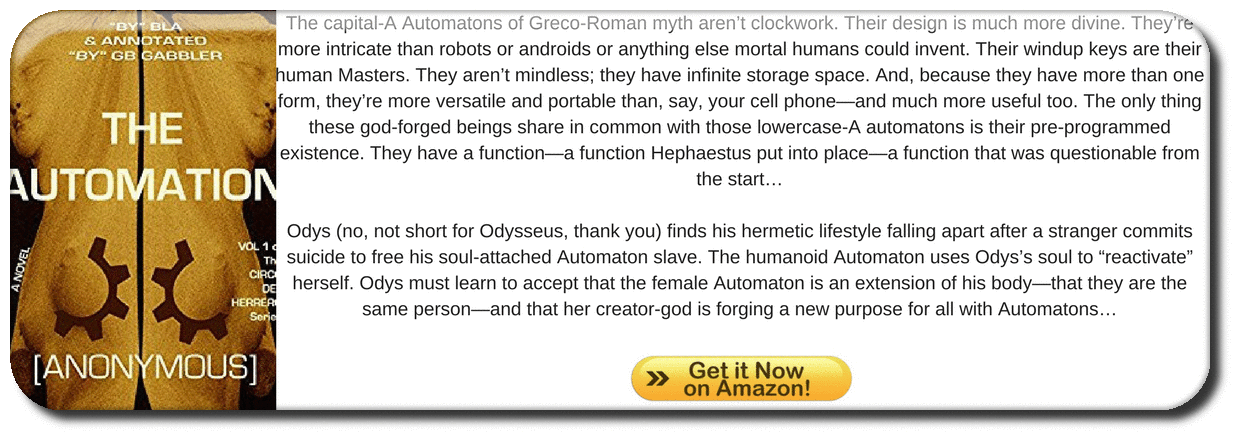
G.B. Gabbler is the editor [and half the pen name] behind The Automation and its upcoming sequel The Pre­-programming. The books are part of the Circo del Herrero series (don’t worry, it’s in English). Gabbler has most recently written on the Zombie genre for TheFanzine, but has other publications under their full name. More info at circodelherreroseries.com.

Could you tell the readers a little bit about yourself?

I probably seem weird—promoting a book when I am only “The Editor,” but it’s a bit more complicated than that! My contribution to the novels are apparent—I’m the footnotes. I’ve taken a manuscript from my partner, B.L.A., and have not only edited it into a much more digestible story (a story that B.L.A. claims is true, but we all know that is not the case—ancient robots and gods are not walking around the earth today), but I have added annotations to the Narrator’s mythmaking.

What do you like to do when you're not writing?

When I’m not writing/editing, I’m trying to get my Narrator (B.L.A.) to write.

Other than the horror genre, what else has been a major influence on your writing?

Besides the exploding head in the first chapter of our first book, there is a horror of oedipal complexes throughout (and I mean that in the more mythic sense of the word). It’s the same grotesqueness that propels people to watch Game of Thrones, I think. We saw GOT get away with it, so I wasn’t as scared to let these horrors slide. Beyond that, there is the horror of inescapable fate and predestined outcomes—the illusion of choice. Religion—old and contemporary—shadows many of our characters. They have so much power, yet very little control over their lives.

And while we’re on religion: Our work was once nicely rejected by a literary agent who said it reminded him of The Master and Margarita—a book where Satan comes down to earth and there is a talking cat. While our book deals with Greco-Roman myth, you’d be surprised how Satan and cats have worked their way into it…

The term horror, especially when applied to fiction always carries such heavy connotations.  What’s your feeling on the term “horror” and what do you think we can do to break past these assumptions?

Oh, this is a hard one. I was recently introduced to the concept of Post-Horror when researching the film A Ghost Story--a movie we liked, by the way.  For Christ's sake, the ghost in that film is represented by an absurd bed sheet but still manages to scare me into existential dread. It took what I call "bed sheet lore" and made us accept it and that is what’s chilling—something so silly can be made to feel real and believable and allegorical. On the flip side, part of how we talk about Horror now is “the old slasher no longer does the trick”—at times feeling ridiculous. Being startled at the movie theatre is more funny than scary. Funny is now scary and scary is now funny. The “Post-Horror” term itself is laughable, but part of a Post-Genre movement I’m happy to embrace. Horror will always be a descriptive term, at  least. You can’t have Post-Horror without Horror.

What are the books and films that helped to define you as an author?

Me? Well, I guess you could say I was inspired by the Norton Anthology of Literature. So many damn footnotes.

How would you describe your writing style?

Marginal.

Are there any reviews of your work, positive or negative that have stayed with you?

The book blog called The Loaded Shelf once said my footnotes “were like eating Saturday dinner with my Grandparents and listening to [them] argue…Entertaining at first, but then you kinda wish someone would suddenly start choking…”

That was the funniest thing! The reviewer has no idea just how close to murder the Narrator and I sometimes get.

How important are names to you in your books? Do you choose the names based on liking the way it sounds or the meaning?

As the person with the editorial role who did the obfuscating of names and dates, I did choose the names. I took a “Marvel” approach and made the names alliterative. Example: Odys Odelyn, Pepin Pound, Gwendolyn Gwendy. And of course they have double meanings and harken to other literary characters. That's part of the job.

What tools do you feel are must-haves for writers?

Money. If you don’t have money, you can’t promote your work. Even mainstream publishers aren’t doing as good a job of promotion these days.

To many writers, the characters they write become like children, who is your favourite child, and who is your least favourite to write for and why?

My favorite character is the cat in our novel. Cats and gods and Automata get along quite nicely, as you’ll see.

Least favorite is a character named Mecca. Mecca is a little turd of a character that only served as a vehicle for our Narrator to explore Peter Pan Syndrome. I wanted to cut him out, but B.L.A. would not let me. I still don’t understand it.

Do you have a favorite line or passage from your work, and would you like to share it with us?

“Leeland doesn’t kill people. They kill themselves. They triggered their own fate.” That’s a passage from B.L.A., there. It’s about a man who is too moral to kill people, yet they find ways of ending up dead all the same.

Can you tell us about your last book, and can you tell us about what you are working on next?

The Pre-Programming is volume número 2 of the CIRCO series. It picks up right where The Automation left off. It’s sprinkled with just as many exploding heads—yet with a dash of suicidal cannibal, possessed young girl, and gladiator sport.

What was the last great book you read, and what was the last book that disappointed you?

The last great book would be The Library at Mount Char. Seriously, go buy yourself a copy. When Scott Hawkins followed me back on Twitter I almost pissed my pants. We are HUGE fans.

The last book to disappoint is The Clockwork Dynasty. Why wasn’t someone like Charles V, Holy Roman Emperor and king of Spain, a focus of the book rather than Peter the Great? Charles V was known to commission actual automata. There were a lot of missed opportunities in this book that I just can’t move past.  I. Don’t. Under. Stand. It.

What's the one question you wish you would get asked but never do?  And what would be the answer?

"Are we selling the film rights to this series?" The answer is yes, but talk to me, not B.L.A.

Twitter: @CircoFootnotes
Picture
Picture

FICTION REVIEW: THE HUNGER BY ALMA KATSU
HORROR NEWS: THE BLACKOUT CLUB, BREAKING THE WORLD AND THE TERRIFIER

FIVE MINUTES WITH CARMILLA VOIEZ

26/2/2018
Picture
 
Carmilla Voiez is a proudly bisexual and mildly autistic introvert who finds writing much easier than verbal communication. A life long Goth, living with two kids, two cats and a poet by the sea.

She is passionate about horror, the alt scene, intersectional feminism, art, nature and animals. When not writing, she gets paid to hang out in a stately home and entertain tourists.

​​Carmilla grew up on a varied diet of horror. Her earliest influences as a teenage reader were Graham Masterton, Brian Lumley and Clive Barker mixed with the romance of Hammer Horror and the visceral violence of the first wave of video nasties. Fascinated by the Goth aesthetic and enchanted by threnodies of eighties Goth and post-punk music she evolved into the creature of darkness we find today.

​Her books are both extraordinarily personal and universally challenging. As Jef Withonef of Houston Press once said - "You do not read her books, you survive them."


Could you tell the readers a little bit about yourself?
 
I’ve been writing novels since 2007. Wanting to regain my self-identity post motherhood I went back to university and studied creative writing. I ran a Gothic Clothing before and during the early days of writing, called Drac-in-a-Box, which has since closed down. I had a few pieces of poetry published in zines in my late teens, but I don’t consider myself a poet. I do however love the rhythm and beauty of language for its own sake.

I live with a lot of fear and anxiety and I’m drawn to horror stories as a reader and writer as a way of sublimating that. Supernatural terrors are easier to endure than the shadows at every corner.

What do you like to do when you're not writing?
 
I read widely. I consume close to eighty books a year without sating my hunger. I enjoy walking. I am privileged to live in a small seaside town skirted by woodland and find it easiest to tap into my creative side while wandering among trees or staring out to sea.

I’m a working mum. I edit for other writers and I work in a museum and art gallery. For the time being writing cannot provide enough income to cover the bills. And when I need to wind down I cuddle my cats. It’s a quiet life, which I find perfect for my mental health.

Other than the  horror genre, what else has been a major influence on your writing?
 
Politics – I’m a leftie and a feminist. Both colour my writing, probably never more obviously than the short story “Eat the Rich” that will be part of the “Zombie Punks Fuck Off” anthology to be released in 2018.

People – as someone on the autism spectrum I have spent a lot of my life watching how these alien creatures known as human beings behave and interact with each other. As a reader and a writer I am drawn to complex characters who are both good and evil, and how that balance plays out within a story. The stories I write and the books I love best tend to be character rather than plot driven.

The term horror, especially when applied to fiction always carries such heavy connotations.  What’s your feeling on the term “horror” and what do you think we can do to break past these assumptions?
 
For those who don’t love horror, it seems to suggest a bleakness that they want to avoid. For those who love the genre we find the darkness life-affirming. I believe horror will always be avoided by those who want to keep their eyes and minds shuttered against the reality of violence in the world. Perhaps the only way to break away from that is to mix horror with other genres they find more palatable.

A lot of good horror movements have arisen as a direct result of the socio/political climate, considering the current state of the world where do you see horror going in the next few years?
 
Absolutely, vampires and zombies being great examples of your point. Either horror will reflect the world and entrench itself in Fascist dystopia or end of the world disasters, or it will look to escape the current climate and deal with smaller monsters.

What are the books and films that helped to define you as an author?
 
I owe a lot to Clive Barker. My writing has a similar mix of violence, magic and sexuality. From a stylistic perspective Iain Banks taught me brevity and helped me cut the purple prose from my manuscripts. Also Zadie Smith taught me about good dialogue and how to write in a way that reflected without copying the way people actually speak. I don’t think I can point to particular books or films though. My voice has developed slowly.

What new and upcoming authors do you think we should take notice of?
 
Eden Royce, a fellow horror writer whose stories are immersed in Southern magic. I’d go as far as to say she might be the Lovecraft of our time.

How would you describe your writing style?
 
Putting the feminine into horror literature and all the rage that entails.

Are there any reviews of your work, positive or negative that have stayed with you?
 
I’ve had great reviews from Houston Press. On a reader level there have been some very flattering comments that place my work into a pantheon of classical literature and references, although as a working-class lass I am not entirely at ease with such elevation.

What aspects of writing to do you find the most difficult?
 
Getting started on a new story. Once I’m “in the zone” I dream about my characters, but until I reach that point it can be a lonely and frustrating struggle.
Promoting myself is tricky as well. I wish there was an easier way to point the right people towards your books without feeling as though you are slowly shredding your soul.

Is there one subject you would never write about as an author?
 
No. But I wouldn’t presume to know anything without researching a subject thoroughly first.

How important are names to you in your books? Do you choose the names based on liking the way it sounds or the meaning?
 
Sometimes I choose names because of their meanings or because they were used in other work and carry that cultural weight. Mostly I just choose names that sound good to my ears.

Writing, is not a static process, how have you developed as a writer over the years?
 
I am more aware of things like info dumping, pace and repetition than I was when I started. I think that’s probably what changed most. I have a great editor who will tell me straight when things don’t work and I’ve learned a lot about style from her.

What tools do you feel are must-haves for writers?
 
My pet peeve is unfinished work being published. I think every writer needs an editor, not just someone who will alter spelling or punctuation, but someone who notices holes in the story or lack of continuity. Someone who is strong enough to tell them their work isn’t good enough to sell. We get to close to our own stories at times to notice whether they have value. I think you realise that when you reread work you wrote years before.

What is the best piece of advice you ever received with regards to your writing?
 
One of Stephen King’s words of wisdom from “On Writing” has stuck with me.  “Write with the door closed, rewrite with the door open. Your stuff starts out being just for you, in other words, but then it goes out. Once you know what the story is and get it right — as right as you can, anyway — it belongs to anyone who wants to read it. Or criticize it.”

Getting your work noticed is one of the hardest things for a writer to achieve, how have you tried to approach this subject?
 
I agree with your statement and sadly haven’t found a successful method to date. I blog, I share promotional posters and quotes on social media, I advertise with magazines and websites when I can afford to. I attend book signings and conventions, but so far I remain a unknown cult writer.

To many writers, the characters they write become like children, who is your favourite child, and who is your least  favourite to write for and why?
 
I love Freya, from Starblood. She’s the most broken and long suffering of all my children. From the same series of books I am most disappointed by Paul. I tried to write backstory and give justification to his evil, but I feel that I barely scratched the surface of what made him tick before I killed him off.

What piece of your own work are you most proud of?
 
The Starblood Trilogy. It’s also the most autobiographical piece I’ve published.

And are there any that you would like to forget about?
 
Yes, but I pretty much have forgotten about them, in any detail anyway. Like those teenage poems.

For those who haven’t read any of your books, which of your  books do you think best represents your work and why?
 
The short story collection “Broken  Mirror and Other Morbid Tales” gives a good representation of all the subjects and styles that I delve into deeply in my novels.

Do you have a favorite line or passage from your work, and would you like to share it with us?
 
“There is no shame in love, only completion.”

Can you tell us about your last book, and can you tell us about what you are working on next?
 
The last book I released was a short story collection. Works in progress include a dystopian novel “Venus Virus” and Psychonaut the graphic novel – the second graphic novel in the Starblood series.
 
If you could erase one horror cliché what would be your choice?
 
Have sex and die.

What was the last great book you read, and what was the last book that disappointed you?
 
The last great horror book I read was “Twenty Days of Turin”, by Georgia de Maria. I don’t want to state which was the last book that disappointed me, but it was a poorly edited one.

What's the one question you wish you would get asked but never do? And what would be the answer?

Can I make your Starblood Trilogy into a series of films? The answer would probably be yes, depending on who was asking.
Picture
Picture

FICTION REVIEW: HELLRAISER: THE TOLL BY MARK ALAN MILLER
​
GINGER NUTS OF HORROR'S NEWS BLAST 26 FEB 2018

FIVE MINUTES WITH TABITHA THOMPSON

21/2/2018
Picture
Could you tell the readers a little bit about yourself?

Sure. I’m a college student graduating in English Literature and currently live in South Florida with my family and two cats. I’ve always loved to write stories since I was five years old, but I didn’t get into horror fiction until I was sixteen. Before that, I was trying to write drama and romance stories, inspired by Sidney Sheldon and Danielle Steele, but they weren’t working out so well. Other stories that I was reading in my early days of writing were the typical urban lit about thugs and being hardcore in the streets. Although they were great stories, as a black female I wanted to do something different and be different. So, once I started reading authors such as L.A. Banks, who was a huge influence for me as a teen as she was the first black female that I discovered who wrote dark/horror fiction, Edward Lee, Stephen King, and Jack Ketchum, I knew that horror was the genre for me and I’ve been writing it ever since.

What do you like to do when you're not writing?

I love to cook, play video games, watch a bit of tv, hang out with friends, yoga and meditation. Exercise and maintaining good health is one of the things that I love and passionate about that helps to keep me sane when things can get a little stressful, plus a sexy body never hurts when finding a boyfriend in my book.

Other than the horror genre, what else has been a major influence on your writing?

I’m influenced by life and experiences that has either happened to me or others that I’ve witnessed. I was a bit of an introvert when I was growing up, more so then than now, so turning to writing became therapy for me to release negative emotions next to punk rock and heavy metal. I also turn to crime shows, movies, and music when I feel a bit stuck on a certain part in my story which usually helps in creating a new twist or idea for what I’m writing.

What are the books and films that helped to define you as an author?

A lot of people have probably mentioned him, but it is the king of horror Stephen King. His book On Writing has helped me a lot in terms of honing my writing skills, made me feel like I was taking an English course with an awesome teacher. Another magnificent author’s novel that has helped me a lot is the late Jack Ketchum’s Off Season. He was amazing at capturing true terror, shock, and horror through his words; once I read that book, it instantly inspired me to write with such emotion, shock, and gripping terror.

How would you describe your writing style?

Emotive, gripping, clear, and concise. When I started writing stories, I was all the all over the place, so over time I taught myself through reading different authors how to produce stories without being over-descriptive and long winded. I’m also a visual person so not only do I love stories that grab you immediately and won’t let you go but I want the reader to feel like they’re experiencing the events in the story and not just reading words.

Writing, is not a static process, how have you developed as a writer over the years? 

I’ve become more disciplined. I try to have a minimum of 500 words and a maximum of 1,000 and try my best to not go to sleep until that is accomplished. Yes, lack of sleep and making caffeine a food group has become part of my routine as of late, but I’ve managed to work best at night although there have been times where the second I wake up in the morning an idea for a story would pop up.

What tools do you feel are must-haves for writers? 

On Writing By Stephen King. Also, being persistent, having faith, and being patient with yourself. Oh, and coffee.

A lot of good horror movements have arisen as a direct result of the socio/political climate, considering the current state of the world where do you see horror going in the next few years?

In my opinion, America is in a horror story given the way things have been going down as of late, making plenty of material for new horror stories.

What aspects of writing to do you find the most difficult?

Dialogue. For a while, it was one of the hardest things to achieve but when I started a creative writing course on dialogue, it has become less of a difficulty.

Is there one subject you would never write about as an author?

Not really, no. I always try to use different subjects as a challenge and new twist on any story.
For those who haven’t read any of your books, which of your books do you think best represents your work and why? 

If I were to pick one, I would say Highway 54. It’s a short story that I wrote for an online magazine in Feb. 2017’s Women In Horror Month for Sirens Call Publications and it was about an unfortunate car accident between a father and his son with an unexpected twist. I feel that story really helped me grow as a writer and really cemented the ‘show and not tell’ aspect of writing. Plus, the reactions to it after people read it are always great, it makes them think and it sticks with them.

Can you tell us about your last book, and can you tell us about what you are working on next?

My last story was called Decency Defiled, it is featured in the anthology ‘Rejected For Content 6: Workplace Relations’, which is available on Amazon Kindle and paperback, and it was about a well-known plastic surgeon named Eric Flynn who was raised to believe that body modifications are disgusting and there’s nothing more beautiful than beautiful skin. So, after years of “altering” his clients’ looks, his office unexpectedly closes down and he becomes unemployed. After spending a year looking for jobs, Eric decides to become self-employed and do whatever it takes to reclaim his name as a well-renowned plastic surgeon. I just recently completed a story called Alternative™, which will be featured in an anthology titled ‘Black Magic Woman’, and it is about a new birth control pill that is being sold but has disastrous side effects and will be available on Amazon on February 14th. I feel honored and excited to be a part of a great anthology that showcases black women that writes horror, something that is long overdue. I’m currently working on a story titled ‘Eat Fresh’, which is about a militant, deranged vegan who became tired of being mocked for having a healthier lifestyle by family and friends so decides to put ethics aside and make homemade pizzas to serve for them. Unfortunately for them, there’s a hidden agenda behind the pizza and the source of the ingredients are pretty sketchy.

If you could erase one horror cliché what would be your choice?

Jump scares in horror movies. They’ve become so overused and make horror films lazy to me if we need a constant jump to feel terrified instead of letting pure silence and imagination do some of the work.

What's the one question you wish you would get asked but never do? And what would be the answer?

Would you accept this $5 million-dollar check for your writing services? My answer would be of course! Hell yeah!
If you would like to connect with Tabitha please use the links below 
Facebook   Twitter

Instagram  Wordpress blog
​

Tumblr
Picture
Picture

​JASON’S FRIEND BENNY BY EDDIE GENEROUS

naming the bones with laura mauro

19/2/2018
by Kit Power
Picture
 
Following the release of her Dark Minds novella, Naming The Bones, we catch up with Laura Mauro to talk writing process, influences, mental health, and much more. Enjoy!
 
Gingernuts of Horror: Let’s start with 2017 - how was it for you?
 
Laura Mauro: It was a decent year, all things considered! Probably not my highest output, story-wise, but I was pleased with the things I was able to publish - returning to Shadows and Tall Trees was a particular highlight, as was getting a story published in Interzone. The most exciting thing for me was getting my debut novella out there, though that was also quite daunting - you have nothing to hide behind, no other stories to cushion the blow if yours is a total stinker! So as exciting as it was, and still is, there was also a nagging doubt in the back of my mind that everything was about to go completely pear-shaped and I’d be ‘found out’. (Imposter syndrome, friend to all writers!) The launch at Edge-Lit was fantastic - the Dark Minds team did a brilliant job. I got to share the spotlight with Mark West and helped him launch his collection “Things We Leave Behind”, which was a real pleasure. And of course, Fantasycon was tons of fun. I also started my Masters’ degree in late 2017, so it’s been fairly busy all round.
 
GNoH: Talk to us about the Interzone sale! Is that your first foray into science fiction? What do you think are the specific challenges associated with short science fiction writing?
 
LM: I’ve always had a deep fear of writing science fiction whilst simultaneously desperately wanting to write it. I think a large part of that fear stems from the possibility of getting things wrong. With horror, unless you’re referencing real-life events you’ve generally got very broad scope to make things up- the ‘science’ part of science fiction sort of precludes that a little bit (though you could make the parallel argument that the ‘fiction’ part is its own invitation…) With the Interzone story, it was really more a case of having a particular story I badly wanted to tell, which by virtue of its subject matter (Laika, the Soviet space dog) was always going to fall somewhere under the science fiction umbrella. So even though I did initially bog myself down in research, once I started writing I realised that the speculative elements were really the skeleton of the story I wanted to tell; the actual flesh of the story was about the characters. (Though of course, one cannot exist without the other.) I don’t suppose the same will be true of all science fiction stories, but it helped me overcome my fear of getting my facts wrong! (I did find a really cool/morbid website which simulates the aftermath of a nuclear explosion in any given location, which crossed over from ‘fascinating’ to ‘horrifying’ when the possibility of actual nuclear war began to raise its head in real life…)
 
GNoH: Getting on to Naming The Bones, can you recall now where the origins of the idea came from? I assumed when reading it that the opening was at least partly a response to 7/7...
 
LM: I think there were a lot of ideas swirling around at the time I started writing it. I’d wanted to write something about the London Underground for a long time. My dad & I had been talking about ghosts on the Underground, and all the weird stories you hear about strange happenings in the tunnels and stations. There’s so much mythology surrounding the Underground that you can’t help but be inspired by it. And from there it was a bit like sewing a patchwork quilt, except instead of fabric scraps I had bits of ideas, and instead of a quilt I shoved together a basic first draft. You’re right about 7/7 coming into play - as someone who has lived in London my entire life it’s endlessly fascinating, in a horrific kind of way, to consider just how much horror permeates every part of the city - from the Black Death to the Blitz, Jack the Ripper to the 7/7 bombings, from the momentous to the mundane. And the more I thought about that, the more sense it made to me (in fictional terms!) that trauma and horror might be retained somehow. Almost like scar tissue, or perhaps more appropriately, like the emotional and mental scars these events leave on us as individuals. So it started off as a very big idea, which I had to whittle down in order to make narrative sense of it.
 
GNoH: Is that line of thinking what led to the decision to include PTSD in the story? What kind of research did you undertake to help with writing about that subject?
 
LM: I think it was a natural extension to the idea of retained trauma in a geographical sense. When you’re talking about the possibility that inanimate objects might absorb trauma, then it feels strange not to at least mention the way the same thing happens to people. Over the course of writing the story it became an integral part of Alessa’s character - I wanted it to be a part of who she is, but also not all that she is, and I hope I’ve been at least somewhat successful in that. It’s not necessarily about Alessa defeating her demons, but about coming to terms with them - which to my mind is the major difference between Alessa and Casey. As someone with mental health issues which will probably never be ‘cured’, it was important to me to show that you can be ‘broken’ in some way and be no less ‘whole’ a human being. Partly, this involved looking back over my own past experiences of trauma and how this affects me and my experiences today. I read and listened to a lot of interviews with survivors of various incidents, including the 7/7 bombings. I was also fortunate enough that a friend was willing to talk me through some of the scenarios and compare Alessa’s experiences to their own. I learned in the course of doing this that everyone experiences trauma and PTSD in different ways - there is no one definitive experience.
 
GNoH: Naming The Bones is very a grounded story, I felt, that evoked working life in London very well. What techniques do you employ, when writing or drafting, to create that sense of place?
 
LM: I’m really glad the sense of place worked well for you. I like to travel a lot and experience new places, so I try to use that sense of exploring a place in describing and depicting place when I write. I think small details are important, but I also try to be sparing with them; I try to remember what it’s like to notice those things in the moment, so to speak. With London, and Elephant and Castle in particular, it’s slightly different because I know it all so well. The things you love and loathe about a place are the things which make it ‘real’ - so the grubby tiles of the Underground, the abundance of chicken shops in and around the Elephant, the colour of the Thames at night - they’re not important in the grand scheme of things, but they’re the things you notice when you spend time there. If something strikes me about a place, even if it’s a weird or seemingly inconsequential detail, I try to remember it.
 
GNoH: To what degree was Naming The Bones planed out in advance, and how much of it was discovered in the writing?
 
LM: I had a very rough map of the major plot points in my head before I began, but I am generally resistant to planning things in advance - not that there’s anything wrong with it as a technique! I like to know as little as possible about the story except for the bare skeleton, and then piece it together as I go along. So with Naming the Bones, there were the fragments of concepts I mentioned before, and not an awful lot else to start with. I knew it would begin with a bomb, and I knew there would be a monster, and I knew the protagonist would have to find a way to vanquish the monster. Actually, in its earliest stages, the monster was a giant anglerfish type creature which lived in the dark depths of the tunnel and lured people onto the tracks - I was partly inspired by a video by the band Fightstar (which I can’t seem to find anywhere so I wonder if I dreamed it!) in which a strange, monstrous child lures a man onto tube tracks into the path of a train. The anglerfish monster popped up in the final chapter of the story until it was pointed out to me, by some very helpful writer friends, that it basically ripped off the Alien Queen. So, goodbye anglerfish monster, perhaps we’ll meet again sometime.
 
The original draft of Naming the Bones clocked in at around 60k words! It was a very different story at that point in time, with a bigger cast of characters and subplots and all kinds of things. Paring it down to fit the novella length made it a much better story, in my opinion. I tried to fit too many ideas in, when really the story I was trying to tell under all of that was much simpler, much more introspective.
 
GNoH: Could you talk a bit more about that whittling process? That sounds to me like you lost somewhere between 40 - 50% of the word count between D1 and the published story…
 
LM: Yeah, I ended up dumping quite a lot, which was heartbreaking at first! I’m actually glad I was forced to do that as it meant I had to jettison a lot of unnecessary padding. There was another character in the first draft who, in hindsight, was a distraction to the dynamic between Alessa and Casey. In the end, it was a matter of asking myself what story I was trying to tell, what the important waypoints were in that story, and what didn’t fit within that framework. Kind of reverse planning, if you like! I lost a fair bit of backstory for Alessa’s parents, which would have worked fine if I’d been writing something longer, but as it stood, bogged down the story with narrative diversions that just didn’t need to be there. Alessa’s parents weren’t the key to the story, but Alessa was. They got dropped down the same hatch as the anglerfish monster.
 
GNoH: I’d also like to ask about Strange As Angels from Great British Horror Vol. 1, if I may. I found this to be an incredibly effective short story, with a lot packed in, in terms of both incident and emotional content. Give your preference for not planning, how do you approach writing a short story as opposed to a longer piece? Do you have a good idea of length before you start, or do you let the process of discovery drive you?
 
LM: Thank you, I’m pleased you enjoyed it! That story sat around for about six months as just an opening scene before I knew what I wanted to do with it. I generally have no idea how long or short a piece is going to be unless I’m working to brief (and in those cases you do have to be slightly more disciplined about planning the story, because it can very easily get away from you and develop a life of its own if you’re not strict.) I originally thought of Strange as Angels as being maybe 2-3k words until the subplot with Jimmy emerged, and that grew quite organically out of my own dislike for him, given his behaviour and demeanour in the opening scene. I think the best way to describe it is that the moment I realise what story I’m trying to tell is the moment when everything else falls into place. For Strange as Angels, that was the realisation that Frankie finding strength through experiencing genuine (albeit unorthodox) love was at the centre of the story, and that everything else would feed directly from that point. I think a short story requires a degree of focus - not necessarily a tight plot, but something recognisably central to the narrative. You can meander with a novel, or even a novella, but the short story form doesn’t usually allow for much in the way of deviation. (That’s not to say it can’t be done. All rules are there to be broken!)
 
GNoH: Talking of Jimmy, one of the things I think the story does very effectively (and this resonates even more in the current #metoo environment) is deliver a warts-and-all portrayal of a toxic relationship with a ‘nice guy’...
 
LM: I’d been thinking about this for a while as it’s been a recurring theme among my female friends, who all seem to have experience of this in some way or another. And I’ve had similar experiences, so when people finally started talking about the inherent toxicity of the ‘nice guy’ attitude it was almost a relief to realise that this was a real thing, and that we weren’t being hideous human beings for feeling wary of men who behaved like this (and, I know, not all men, but…) And in thinking about the kind of person Jimmy was, especially in relation to Frankie’s vulnerability and dependency, I drew on those experiences - someone whose help and care has strings attached. And that’s a thing which scares me too - the notion of ‘owing’ someone ostensibly because they treated you like a human being. You see this presumption borne out in so many scenarios, from the notion that immigrants must contribute something special in order to be worthy of a place here, to the behaviour patterns of abusive people.
 
GNoH: Another theme in Strange As Angels is the claustrophobia of poverty. Is that a subject you feel strongly about, and do you think it’s a theme you’ll return to?
 
LM: I think it’s probably a theme that already recurs throughout my writing! I do feel strongly about it, not least because I grew up poor, and I grew up in a part of London in which poverty was pretty ordinary. Anyone who knows me will know I’m a bit of a lefty, and that I tend to wear my politics on my sleeve. But also, I write what I know, and that’s probably why I do tend to write a lot about working class people and places, or as Tom Johnstone once put it, ‘people on the fringes of society’. I don’t think enough people are telling stories about working class people, especially working class people who don’t quite fit, so it feels important to me that I try to write stories from that perspective, or at least considering that perspective.
 
GNoH: Finally, can you let us know what 2018 holds for Laura Mauro? What's coming out, and what are you working on?
 
LM: I don’t have an awful lot upcoming to be honest, which is largely due to university. I do have a short story coming out in an anthology which I am thrilled to be a part of - I can’t say anything until the ToC has officially been announced, but I am appearing alongside fellow GNoH alumni Kit Power which is really exciting. My short story ‘Sun Dogs’, originally printed in Shadows & Tall Trees 7, has been selected by Johnny Mains for Best British Horror 2018, which is a huge privilege. And as to the rest, well, I should probably get my backside into gear and start writing - hopefully there’ll be more to come yet!
 
​
Picture
Picture
Picture
Picture

THE STAY-AWAKE MEN AND OTHER UNSTABLE ENTITIES BY MATTHEW M. BARTLETT 
THE ORGANISM IS GROWING: 30 YEARS OF THE BLOB ‘88 BY NICK LA SALLA

FIVE MINUTES WITH ​ANTHONY WATSON

14/2/2018
Picture
​Anthony Watson has placed short stories in various indie press publications including State of Horror: Louisiana, Sanitarium magazine, Far Horizons and Morpheus Tales.  He has also seen publication of his war/horror novella Winter Storm in a six author collection Darker Battlefields from The Exaggerated Press, and Stitches for Smiles in a new horror magazine Worlds of Strangeness as well as a story in The Beauty of Death Volume 2. Forthcoming is an appearance in The Black Room Manuscripts Vol 3.
​

His weird western novella The Company of the Dead made up a double-header with Benedict J Jones’ Mulligan’s Idol in Volume 1 of Dark Frontiers. Work has begun on Volume 2.
January 2018 saw publication of his novel, Witnesses, by Crowded Quarantine Publications.
As well as writing, and – until recently - being one half of Dark Minds Press, he runs a horror review blog “Dark Musings” (found at: http://anthony-watson.blogspot.co.uk/).


Could you tell the readers a little bit about yourself?

I live in a very beautiful part of Northumberland with my wife Judith and our two dogs. I work in Newcastle in the pathology labs of one of the hospitals there – which sounds a lot more interesting than it actually is.
I’ve been a fan of horror since I first discovered it as a callow youth and after a brief dalliance with writing back in the nineties which produced two and a half unpublished novels, I started again about ten years ago, joining a forum where writers could post up and critique stories. It was there I first encountered Benedict J Jones, a very fine writer who has become a very good friend and the dark and mysterious entity known as Ross Warren with whom I went on to set up Dark Minds Press.

What do you like to do when you're not writing?

Reading. I’m a chain reader and can’t remember the last day I didn’t spend some time reading. Other than that, taking the dogs for walks in the beautiful countryside around us. We’re in a beautiful part of the country with both beach and countryside to choose from.

Other than the horror genre, what else has been a major influence on your writing?


The bulk of my reading is horror but other genres I enjoy are crime and westerns. I’ve yet to try my hand at a crime story but have dabbled in weird westerns with a couple of novellas finished and one nearing completion.
I never really connected with history at school – the path I took was the science one – but I love it now and it’s fair to say that the majority of my output is horror set in the past. I’m slightly obsessed with World War One and it features in many of my short stories as well as the novel and two novellas but I’ve also written stories set in British Empire India, the Congo Free State of the 1850s, Russia in the sixteenth century and 1800’s Missouri and three weird western novellas. I think I find it easier to couch horror in the past, the suspension of disbelief which is often required is harder in a contemporary setting – for me at least.
 
 
The term horror, especially when applied to fiction always carries such heavy connotations.  What’s your feeling on the term “horror” and what do you think we can do to break past these assumptions?

I’m not sure the connotations are that heavy, there does seem to be a lot of snobbery around horror though, and it’s easily dismissed (by those who don’t read it) as trashy or without literary merit.
Which, of course, is bollocks.
With regards breaking those assumptions - I’m not entirely sure they need to be. Horror is a broad church with a multitude of sub-genres within but I’m not sure there’s a need to try and convince those who choose not to read it of its merits. Of course I’d love to see authors whose work I admire being able to make a living from their writing, and to garner success after success but there’s another part of me that likes the fact that the horror genre is, on the whole, in a good place at the moment with some excellent writing being produced by small, independent presses run by real enthusiasts. I’d take small scale and passionate over corporate and indifferent any day.

A lot of good horror movements have arisen as a direct result of the socio/political climate, considering the current state of the world where do you see horror going in the next few years?

I’ve joked on my blog that the sub-genre of post-apocalyptic fiction is in danger of becoming reclassified as “contemporary horror” and that may still be the case…
The best horror fiction holds up a mirror to society but when society is quite as horrible as it is right now I’m not entirely sure what we’ll see in there. Fear of “the other” seems to be a common theme in today’s world so maybe that will be the trope which develops in the years ahead.
Or, I don’t know - more zombies.

What are the books and films that helped to define you as an author?

I guess I was fortunate in that at the time I started reading horror, Stephen King had not long started writing it and I’ve been a Constant Reader since Carrie hit the shelves. The double whammy of The Shining and then Salem’s Lot changed my world completely – I re-read both fairly recently and was just as blown away by them again.
The book which probably affected me most profoundly was The Survivor by James Herbert. Until I read that, I hadn’t been properly scared by a book but whoa, that one literally kept me awake at night. I re-read that too, a couple of years ago and found it just as powerful. Some of the set-pieces in it had stayed with me for the best part of forty years and exposing myself to them again brought back all those emotions which had kept me awake when I first read them.
With regards film, the double bill of horror that was shown on BBC2 on, I believe, Saturday nights came at just the right time in the development of my horror appreciation. It was usually a combination of old and new films and I will forever be thankful to it for my first viewing of Night of the Demon which remains one of my favourite films ever.
I saw both An American Werewolf in London and The Thing on their original theatrical releases within a year of each other, both of which confirmed that monster movies were still incredibly cool. Probably as a direct result of those two classics, a lot of what I write is old-school with monsters aplenty.
And then there’s The Exorcist. But I don’t talk about The Exorcist…

What new and upcoming authors do you think we should take notice of?

Rich Hawkins writes some incredible stuff and should really be reaping the benefits of his undoubted talent. Real horror but real emotion too.
The aforementioned Benedict J Jones – whose clipped and tight prose lends itself wonderfully to the crime, western and horror stories he writes.
Laura Mauro seems on the brink of greatness and I’m confident she’ll get there very soon. Intelligent, thoughtful and emotional writing.
A writer new to me who I think will be destined for great things is Liam Ronan whose debut Novella Creeping Stick blew me away with its imagery and imagination.
James Everington is a writer I admire greatly and I’m looking forward to what Phil Sloman will produce in the years to come.
On the other side of the Atlantic, Philip Fracassi is writing stories which are never short of brilliant – something I can say for Ted E Grau too.

How would you describe your writing style?

Haphazard.
Before I start any piece of writing I’m full to the brim with literary intent. All the best authors have a distinctive style, that’s what marks them out and that’s what I’m going to achieve.
Except then the plot kinda takes over and my pulpy heart takes control with the narrative dragging sketchily drawn characters behind it in its wake.
If I’m being kind – cinematic. I like to set my stories in dramatic, or interesting places. Landscapes and weather usually play a big role in most of what I write. Possibly because I believe flowery descriptions of mountains, sunsets and snow = literary genius.

Are there any reviews of your work, positive or negative that have stayed with you?

It’s not a massive pool to choose from but I was chuffed that my story in Forever Hungry was chosen as one reviewer’s favourite out of twenty eight and a review of my novella Winter Storm by DLS reviews was very complimentary and a massive boost to my confidence.

What aspects of writing to do you find the most difficult?

Exposition. If you don’t know what that is, let me explain…
Seriously. I always hit a brick wall when I have to drop in some exposition. I think it’s because these moments are crucial, this is where you’re telling the reader what your story is all about, asking them to take that leap with you and invest – or not – in what you’re trying to say.
And doing so using believable dialogue that doesn’t sound forced or contrived…
I once wrote an extra 2000 words in a story to delay having to write that scene.

Is there one subject you would never write about as an author?

There are. Which isn’t a censorship issue rather than my lacking the skill – and confidence – to write them in such a way that wouldn’t seem exploitative. Fiction, particularly horror fiction, should be able to confront any issue but there are some subjects where great care is needed.

How important are names to you in your books? Do you choose the names based on liking the way it sounds or the meaning?


Names are second on the “difficult” list after exposition. They are important though and I spend a ridiculous amount of time working them out. Most of the names I come up with are little in-jokes, often lifted from real people linked, however tenuously, to the subject matter of the story.
I have a story whose characters are all named after the cast and crew of King Kong and a novella where the names are variations on the characters in All Quiet on the Western Front translated into English.
It’s quite sad really.
 
Writing, is not a static process, how have you developed as a writer over the years? 

I think I have become pulpier, concentrating on plot above other aspects. Despite the self-deprecation which comes easily to me I know I am a better writer now than when I first started (just reading some of my earlier stuff is ample proof of that).
I’ve also found that I tend more towards longer pieces now, I’ve bashed out five novellas in the last three years and am 22,000 words into what is going to end up as a novel.
I think now I’ve also taken the pressure off myself. I’m not going to make a career from writing so I can indulge myself and write the kinds of story I would like to read myself. I have written themed stories specifically for submissions but on the whole I write what’s in my head.
I’ve also realised that I have to write – just to get all this stuff out of my head. It’s a different kind of “have to” to someone who does write to earn money and I’m very aware of how lucky I am to be in my situation.
I write because I want to, and enjoy doing so and will continue even if I never have another story published. (I’d obviously prefer it if this remains a hypothetical scenario).

What tools do you feel are must-haves for writers?         

A good imagination.
An enquiring mind.
That said, I love my chainsaw too.

What is the best piece of advice you ever received with regards to your writing?

Not specifically about my own writing, but: Don’t wait for the muse. Write even when you think you haven’t got anything to say. It works.

Getting your worked noticed is one of the hardest things for a writer to achieve, how have you tried to approach this subject?

The whole idea of self-promotion is one which makes me deeply uncomfortable. (And yes, I’m aware if the irony of me saying that in an online interview about myself). Getting yourself noticed is probably easier now than in days past with access to the internet and social media but the fact of its availability means that there’s a huge amount of competition and standing out from the crowd is becoming increasingly difficult.
I started my review blog at a time when the ideas for stories weren’t coming as thick and fast as they are now as a means to keep on writing but also by way of support and appreciation of the writers whose work I admire. Whilst I’m still little more than a seagull chasing the wake of the mighty Ginger Nuts of Horror trawler, the blog has given me a certain amount of recognition in the horror community (and brought me into contact with some very talented people) – which is lovely but the reviews were always meant to be secondary to my own writing.
Quality always finds a way but I guess a lot is down to luck – having a reader connect with something you’ve written and then actively seeking out other pieces.

To many writers, the characters they write become like children, who is your favourite child, and who is your least favourite to write for and why?

My western novellas which are being published in the Dark Frontiers series which I created with Benedict J Jones feature the same protagonists, ex Confederate artilleryman Nate Lee and his companion Wolf, a Cherokee Indian. They’re probably my favourites to write and I always really enjoy myself spending time in their company and writing them into trouble.
I don’t have a least favourite as such but the character I found most difficult to write was Dilly Chambers, one of the cast of characters in my novel Witnesses. The difficulty arose from my having a Y chromosome in place of an X – and trying to write a realistic female character without coming across as superficial or stereotypical.

What piece of your own work are you most proud of?


It has to be the novel. It’s a highly competitive market in which to get a short story published and to manage that with a novel is even harder – so massive thanks to Adam and Zoe at Crowded Quarantine for taking a chance on Witnesses.
It’s an ambitious novel, with seven main characters in four different time periods and countries but with a central narrative connecting them all. There were times I thought I’d bitten off more than I could chew but I persevered and managed to produce something I truly am proud of.
I’m excited – and a little anxious – to see what people make of it.

And are there any that you would like to forget about?

Honestly, no. I’m not a perfectionist by any means but I never have – and still wouldn’t - persist with something I knew wasn’t going to work or which I realised was just plain awful.

For those who haven’t read any of your books, which of your books do you think best represents your work and why?

Probably my novella Winter Storm which features most of my “trademarks”. It’s set in the past and features not just one but two world wars along with a proper monster – and lots of snow.
It can be found in the Darker Battlefields anthology which has a massive added bonus of containing five other brilliant novellas.

Do you have a favorite line or passage from your work, and would you like to share it with us?

From Witnesses, and presented entirely without context:
“You’re called Colin! What kind of name is that for the Devil’s envoy?”

Can you tell us about your last book, and can you tell us about what you are working on next?


Just published is my novel Witnesses which is my take on the end of the world. Its inspiration is the Book of Revelations and the prophecies around Armageddon contained within. Just for fun I thought I’d try writing the story in a variety of narrative voices and set it in four different locations across the world in four different time periods.
The plan was to take the reader on a journey of discovery, uncovering the mysteries of the story alongside the protagonists – but having an edge over them by being involved in all of the stories rather than just one.
Currently I’m working on edits to another novella set in World War One which will hopefully be published next year in a follow up collection to Darker Battlefields. My new work in progress is another novel which is set both in the Russia of Ivan the Terrible and the Second World War onboard a ship in an Arctic convoy. It began life as a novella but when the “prologue” ended up 22,000 words long I realised it would work better as a novel…
Also, I’m working with Ben Jones again on a series of stories which combine both our passions for horror and the Second World War. We’ve created a special operations group – DAMOCLES – whose role is to combat the occult machinations of the Nazis. We’ve plotted out the operations which we’ll send the team on and which will span the course of the war and are busy writing the stories now.
 
If you could erase one horror cliché what would be your choice?

I’m actually fond of clichés – if handled correctly they can bring a pleasing flush of recognition and a sense of familiarity. I get annoyed when I see open submissions stating “no zombies, vampires or werewolves” as they are some of my favourite things and I love seeing original takes on the respective mythologies.
If we’re talking film, I’d love to see a blanket ban on jump scares. It’s a cheap trick and takes little to no skill on behalf of the film-maker – usually it’s the accompanying noise that makes you jump rather than the visuals. They’re just annoying. There’s a vast difference between getting a fright and being frightened.

What was the last great book you read, and what was the last book that disappointed you?


My chain-reading tendencies bring many brilliant pieces of writing before my eyes. A sign of greatness, in my opinion, is still thinking about a book long after you’ve read it and that’s certainly the case with Adam Nevill’s Last Days. It’s a seriously scary piece of writing, one that made me actually put the book down and stop reading because it was so intense. To evoke such strong emotions by words on a page is an indication of great skill and it’s something Adam achieves in all of his writing.
I’ve struggled through a fair few less than brilliant books too but I think real disappointment comes from having high expectations only to have them dashed by the final product. Such was the case with The Scarlet Gospels, a book I found to be truly dreadful – but not in a good way. Clive Barker remains a literary hero of mine but this was atrocious.

What's the one question you wish you would get asked but never do?  And what would be the answer?

Q: Would it be okay if, rather than going out to work, you stayed at home but we paid you the same?
A: Yes.


Picture
The End Times are upon us…

In the small village of East Lee in north-east England, Dave Charlton is studying for his PhD, an academic work that will probably be read by only a handful of people. His research is of limited interest – certainly nothing that will change the world.

The world is changing though, and as his perception of reality mysteriously begins to alter - bringing new abilities to see what others cannot, a stranger arrives with revelations which will transform the course of his life for ever – and the lives of everyone else on the planet.

Dave finds himself a key player in a story as old as time itself, forced into a situation where the decisions he makes really are the most important in the world. He has become part of the endless cycle of conflict between the forces of good and evil, the struggle which will culminate in the final battle: Armageddon.

Moving between the present day, the battlefields of World War One Belgium, 1940s Virginia and Malaysia in the 1970s, WITNESSES is an epic tale of destiny and apocalyptic horror.

Picture
horror website uk

BOOK REVIEW: BLANKY BY KEALAN PATRICK BURKE
GINGER NUTS OF HORROR'S NEWS BLAST 05 FEB 2017

Picture
Previous
Forward
    Picture
    Picture

    RSS Feed

    Archives

    May 2023
    April 2023
    March 2023
    February 2023
    January 2023
    December 2022
    November 2022
    October 2022
    September 2022
    August 2022
    July 2022
    June 2022
    May 2022
    April 2022
    March 2022
    February 2022
    January 2022
    December 2021
    November 2021
    October 2021
    September 2021
    August 2021
    July 2021
    June 2021
    May 2021
    April 2021
    March 2021
    February 2021
    January 2021
    December 2020
    November 2020
    October 2020
    September 2020
    August 2020
    July 2020
    June 2020
    May 2020
    April 2020
    March 2020
    February 2020
    January 2020
    December 2019
    November 2019
    October 2019
    September 2019
    August 2019
    July 2019
    June 2019
    May 2019
    April 2019
    March 2019
    February 2019
    January 2019
    December 2018
    November 2018
    October 2018
    September 2018
    August 2018
    July 2018
    June 2018
    May 2018
    April 2018
    March 2018
    February 2018
    January 2018
    December 2017
    November 2017
    October 2017
    September 2017
    June 2017
    April 2017
    March 2017
    February 2017
    January 2017
    December 2016
    November 2016
    October 2016
    September 2016
    August 2016
    June 2016
    May 2016
    April 2016
    March 2016
    February 2016
    January 2016
    December 2015
    November 2015
    September 2015
    August 2015
    July 2015
    June 2015
    May 2015
    April 2015
    March 2015
    February 2015
    January 2015
    December 2014
    November 2014
    October 2014
    September 2014
    August 2014
    July 2014
    June 2014
    May 2014
    April 2014
    March 2014
    February 2014
    January 2014
    December 2013
    November 2013
    October 2013
    September 2013
    August 2013
    July 2013
    June 2013
    May 2013
    April 2013
    March 2013
    June 2012

https://l.facebook.com/l.php?u=https%3A%2F%2Fmybook.to%2Fdarkandlonelywater%3Ffbclid%3DIwAR1f9y1sr9kcIJyMhYqcFxqB6Cli4rZgfK51zja2Jaj6t62LFlKq-KzWKM8&h=AT0xU_MRoj0eOPAHuX5qasqYqb7vOj4TCfqarfJ7LCaFMS2AhU5E4FVfbtBAIg_dd5L96daFa00eim8KbVHfZe9KXoh-Y7wUeoWNYAEyzzSQ7gY32KxxcOkQdfU2xtPirmNbE33ocPAvPSJJcKcTrQ7j-hg
Picture