

 Ginger Snaps is a brand new segment for Ginger Nuts of Horror. It is a quick-fire “bite-sized” interview, where your answers relate to what you’ve been doing in the past month (30 days or so). Keep your answers short and sweet, but also add your own flair where you can. Please include a brief bio, a photo that we can use, and any links that you would like us to add to the interview. If you would like to take part in this series Download the template here Who are you? I am Pippa Bailey – although I got married three weeks ago and due to lock-down, I’m both Pippa Bailey and Pippa Pilgrim. I am an author and voice actor. Your signature style: I write supernatural, speculative fiction, with a lean towards the crude and unusual torture of my characters. There’s generally sex, dribbling, overly spindly people, and someone always dies. Toot your own horn: I’ve co-written and released four books in the last year and a half under a co-owned publishing company – Pugnacious Press. Books read: My favourite book is Cabal by Clive Barker. I really enjoyed the NPC series by Drew Hays, and the audio series is terrific. I read a big mish-mash of horror and fantasy. Movies watched: Favorite film is Fifth Element. Recently we’ve been delving into foreign horror, there are so many amazing films and series. The film Terrified is beautiful and twisted; also the French series Marianne is stunning. Games and/or music played: I’m currently hooked on Slime Rancher and Stardew Valley, I like kid’s games with bright colours. I play wholly inappropriate card games, like Cards Against Humanity and Disturbed Friends. Music-wise, I’m obsessed with Ghost, I’ve been to see them twice and love, love, love, satanic rock. I have a music degree myself and like to sing, but I get a bit shy about it. Words written: This month I’d like to finish the first book in a series that I have been prodding for the last two years. It’s erotic horror, so it should be interesting. I’d really like to be writing every day if I can. Future stuff: In the next couple of weeks there will be a new story released through the Wicked Library for their podcast, a story called “Close Your Mouths and Clench Eyes Tight”. A review for one of Robert Shearman’s stories from a book collection “We All Hear Stories in the Dark” will be out soon through Gingernuts of Horror. Most of my solo projects are likely to be around next year. Still, for the foreseeable future, I’ll be creating not completing, unfortunately. Brain worms: Did you know that as you digest casein (casomorphins) from cheese, it released a chemical like morphine, which is why cheese is so addictive. It’s a feel-good food. When finding out this fact, I found out that I have Tyramine sensitivity. I have a major Tyramine Hypertensive Response when eating aged cheese; some people get it with wine and chocolate as well. You’ll most likely know this as “The Cheese Sweats” Tyramine has the same effect as adrenaline on the nervous system, blood pressure will rise, heart rate will increase. You’ll find yourself feeling all sweaty around your eyes. So, warning – CHEESE CAN KILL, BUT IT’S SO DAMN TASTY. IT’S A RISK I’M WILLING TO TAKE!  Pippa Bailey lives north of the wall in the Scottish Highlands. Principally a horror writer with Pugnacious Press Publishing, and YouTube personality and independent reviewer at Deadflicks with her partner, Myk Pilgrim. Pippa's work has appeared alongside Clive Barker, Ramsey Campbell, Jack Ketchum, Joe R Lansdale, and the marvellous Myk Pilgrim in Dark Faces Evil Place 2. Her stories have been published in 13 Wicked Tales; a Wicked Library Anthology, featured on the Wicked Library podcast, Frisson Comics, Sirens Call Magazine, & Holiday-themed horror collections with Myk Pilgrim; Poisoned Candy: Bite-sized Horror for Halloween, Bloody Stockings: Bite-sized Horror for Christmas, & Rancid Eggs: Bite-sized Horror for Easter. You can spot her drinking too much tea, making terrible puns, and bothering the local wildlife at pippabailey.co.uk  From the Authors of Poisoned Candy and the publishers of The Little Book of Harm, comes Devil's Night, a collection of bite-sized horror stories for Halloween. Halloween has returned in all its dark and depraved glory, and Devil's Night: Bite-sized horror for Halloween will satisfy your carnal urges for death, decay, and far too much sugar. Inside this short horror fiction goody bag is brimming with poisoned candy, ravenous haunted houses, casual necrophilia, yummy scrummy cat faeces, teleplasm, and of course an angry skeleton called Bob. So slip into something a lot more creepy (we suggest your Nan’s nightie) crack open a cold cider and dip into Devil's Night: Bite-sized Horror for Halloween! "Pippa Bailey and Myk Pilgrim return to form with the all-new Devil's Night collection. Simply put, the two authors deliver hard with tight sharp wit, humour and horror hand in hand. As it should be." ★★★★★ Nelson W. Pyles - author, Creator and executive producer of The Wicked Library  THE HEART AND SOUL OF HORROR PROMOTION WEBSITES  Sascha Stronach is an author from Wellington, New Zealand. His debut novel, The Dawnhounds, is a genre-bending fantasy-horror-noir that won the 2020 Sir Julius Vogel Award for Best Novel. You can find him in the forest, chanting in a language that seems to leave fish-hooks under your skin, his face wet and red with the blood of ... a deer? It is hard to say, it is not quite right, its limbs are too long, its eyes too dark, its arrangement too spiderlike, but it will have to do. Best leave the way you came, and do not under any circumstances heed the call of the bone pipes. Amazon Goodreads Blog Could you tell the readers a little bit about yourself? I’m Sascha. I’m an author and poet from Wellington, New Zealand. My debut novel, The Dawnhounds, won the SJV Award for best novel just last month, and I won the SJV for Best New Talent. I’m Greek, Māori (Kāi Tahu), and Scottish so I’m a bit of a mutt, and I think that syncretism often influences my writing: I’m a little bit horror, a little bit sci-fi, a little fantasy, a whole big pile of miscellaneous fungi. Which one of your characters would you least like to meet in real life? A woman came up to me at the launch of The Dawnhounds and said “Monkey’s the guy you see when you try to kill yourself, right?” and I’m still not sleeping right after that. I slammed Hastur into a sleep paralysis demon into, well, yeah that woman at the launch wasn’t wrong. It’s probably just a coincidence or a random fact about human neurochemistry or the power of storytelling to bridge two peoples’ traumatic experiences to provide cathartic release-- but also I’m going to live the rest of my life wondering whether I created Monkey or whether he was there already, just waiting for me to call him. Other than the horror genre, what else has been a major influence on your writing? Well, my debut novel was speculative fiction with a nice horror glaze and I feel like that’s often the direction I come from—I write a lot of short horror and it bleeds over into my longform work aesthetically and thematically, but SF/F is really where my heart lives. I love me some dark fantasy or sci-fi horror: I’ve been chasing the rush I got from the first Dead Space for over a decade now. Outside of that, I think it’s important to read broadly: literary fiction, poetry, music criticism, engineering manuals, labels on soup cans etc. There’s a sort of genre tunnel vision that rookie writers can fall into where they only consume the genre they want to produce, and it ends up … too tropey? A reflection of a reflection of a reflection. Read everything. If you had to rank the seasons of Community from best to worst, what would your ranking look like? 3, 2, 1, 6, 5, 4. We all know why the first three seasons are great and why the fourth is awful. Five, despite a few knockout episodes, still hasn’t quite figured out what it wants to be doing post-gas-leak. Six is highly underrated, it rings with real grief and I think that sudden turn to darkness caught a lot of people by surprise. It’s remembered as bad because it didn’t go where people expected it to, but if you take it on its own terms it is genuinely very powerful television. Also spy paintball is best paintball. Fight me. The term horror, especially when applied to fiction always carries such heavy connotations. What’s your feeling on the term “horror” and what do you think we can do to break past these assumptions? There’s often this assumption that horror is cheap, that it’s the exclusive domain of hack authors putting out airport schlock. We often tack it on as an afterthought: “Science Fiction and Fantasy, oh and horror can come too”. I dislike the term ‘elevated horror’ because it comes with this assumption built in: oh well I know you don’t like horror, but The Babadook is different. My personal response has always been that I just don’t care. I feel like the distinction between ‘high’ and ‘low’ art is fundamentally classist; I don’t think a book goes from ‘art’ to ‘not art’ if you put a zombie in it, y’know, it’s what you do with that zombie. It’s a person infected with a disease that forces people around them to make complex moral and ethical decisions—if you can’t see a way to make a statement with that I don’t know what to tell you. Maybe it’s coming from SF/F, which has been dealing with this same shit since forever (see: “Never Let Me Go cannot be science fiction, because the prose is good, that’s what makes it literary fiction”) but I say just write the words and let your audience find you. The baggage of being Low Art is just weighing you down, so why not just throw it out? It never meant much. A lot of good horror movements have arisen as a direct result of the socio/political climate, considering the current state of the world where do you see horror going in the next few years? Obviously we’re going to start seeing a lot of plague books (oh god I locked myself in for a plague trilogy in 2017, I swear I didn’t do it on purpose) but, more than that, I’m really curious about the idea of cop horror, which is starting to be explored a little, which flips a lot of standard cop book genre conventions on their head by making the cops monstrous, which is a lot scarier than a lone slasher to me because it has implicit support from the state. What do you do when fighting back against the monster is a crime? It leads to some fascinating explorations of sociopolitical power that could also be some damn good horror. Given the dark, violent and at times grotesque nature of the horror genre why do you think so many people enjoy reading it? I was fascinated by Cory Doctrow’s horror panel at coNZealand: my friend and colleague Sek Han Foo spoke at length about his time in a Chinese Vernacular School in Kuala Lumpur and how all those schools are haunted (which contained the incredible line “the toilet is very dirty, and by dirty I mean filled with ghosts”, and which he has since turned into a Twitter thread). He talked about being forced to go to the toilet in a room reputedly haunted by a headless Japanese soldier, and how the experience of being able to do that made him feel brave, and he took that courage with him out into the world. Horror can inoculate us against suffering; we take a little in a safe way, and it builds up an immunity. We live in dark, grotesque times, and—quite apart from catharsis, which is also crucial but gets enough attention in these discussions already—and horror can empower us to survive them by granting us resilience and teaching us tools to survive. If you’re not scared of the headless toilet ghost, then pandemic and political corruption and police brutality become things that you can maybe stand up to and defeat. What, if anything, is currently missing from the horror genre? COP HORROR DO IT, YOU BEAUTIFUL NERDS MAKE IT HAPPEN What new and upcoming authors do you think we should take notice off? My wheelhouse here leans much more to sci-fi and fantasy, but I feel like I should shout out the old Seksan Gallery grew from Kuala Lumpur, many of whom are crushing it right now (Zen Cho in particular, and I think Cassandra Khaw used to also hang out there but I admit that might just be something my memory made up to trick me), but I’m also really excited about Eeleen Lee, Zedeck Siew, and Sek Han Foo, who all seem to be having a moment right now. Back home in NZ, I’m enjoying Melanie Harding-Shaw’s Censored City books, a series of dystopian novelettes which are tickling that cop horror itch for the time being. The journey from starting Dawnhounds to finishing came close to ten years to complete, taking in many rewrites to find your own voice. How did you keep your motivation up during this period, and was there anything that stopped you from throwing in the towel? Well, it wasn’t really ten years. I wrote the first draft in 2013–2014, but it sat mouldering in a folder until 2018 when I picked it up again. It’s more like two years, just very spread out. There is also almost nothing of the first draft remaining in the final book, not in the least because my attitude towards the police changed a lot in those four years and I couldn’t write a book about hero cops saving the world by breaking the rules any more. I think if I did try to write something for ten years I might just chuck it in. That sounds torturous. The world changes too fast these days: if you take ten years to finish, you’ll be a relic by the time you debut. The first draft was based on Sanderson's rule system, what was the initial appeal of using his methods as a template for your own? I was a young writer and I wanted rules, you know? I wanted scaffolding to help me build. Eventually the thing grew like the Winchester House, busted out of the scaffolding, became something strange and new that the old shape couldn’t contain. Part of finding your voice is learning to impersonate writers you like, but at some point you can’t keep doing it if you want to be honest with yourself. I have to admit that I don't read a lot of fantasy, but The Dawnhounds for me has one of the most unique settings I have ever come across. How did you create this unique world? After years of trying to write to market, I sorta just jammed all the crap I love into one place. “You can’t have engineered bioweapons in the same book as old-fashioned sailing ships! You can’t just write a revenant warlock noir set in Wellington-Kuala Lumpur, those aren’t European cities at all! You have to draw from the Western canon, what’s this Journey to the West I’m just now hearing about for the first time?! And it worked. It worked significantly better than all my failed attempts at generic Euro fantasy, because it was about things I cared about, things I’d grown up with, things that genuinely inspired and moved me. It was rooted in my real experiences of the world rather than second-hand accounts of a fantastical England. If you want to start building a fantasy world, first you need to go outside. I assure you, there's enough fantasy in the cracks in the sidewalk to power a thousand stories. Historically fantasy fiction is rooted in the European dark ages, but The Dawnhounds doesn't fall into this setting. Was this something that you were keen to avoid throughout its development? We write what’s around us, and I wrote the first draft half while living in rural Indonesia and half while living in Kuala Lumpur. The first seed of the book came while I was in a plane descending over Singapore at dusk, and there were so many ships approaching the port that they formed a single contiguous line over the horizon, all trying to get into the harbour. The first draft had a sort of floating city made of boats welded together, sort of like The Scar, which ultimately complicated things too much and didn’t work with the rest of the book so it got cut, but it was a hard thing to cut. Then I came home and revised and totally rewrote the thing while living in Wellington. The first draft was very Malaysian, and I felt a little bit uncomfortable with that—it was a culture I'd lived in, but only temporarily, only as an outsider. I'd written a world of first impressions, it was all too surface-level. The rewrites dug deeper into my Greek, Māori, and New Zealand European cultures, and I think that synthesis really brought it to life. KL is still very much visible in the mix, but whenever I felt out of my depth, I could lean on something I'd actually grown up with. With that in mind I don’t think it was ever going to be traditional Tolkien-esque fantasy. I particularly loved the magic system in your book, could explain the basic rules of it to the readers? It’s electricity, except instead of circuits it powers life. Organic material is a conductor and nonorganic material is a resistor. Capacitors get blown out, sufficient voltage can arc, two people turn themselves into a lightning rod, at one point I explicitly use the metaphor of a lightbulb blowing when somebody tries to pull too much. My dad’s an electrical engineer and I grew up building circuits and devices with him, and it apparently rubbed off on me more than I thought. I only realised any of this after the book came out. Now that I’ve realised what I was doing, book 2 explores it in ways that are a ton of fun to write. Ladowain is a city that requires some new tricks. My notes referred to Ajat as “cool trans hacker mum” and book 2 is the one where she gets to actually hack things. I had a fun sitdown with some hacker pals and I asked them with a very straight face “so how would you hack a golem?” and it was like throwing steak into a lion enclosure—the minds on these folks, I love them all. People love to pigeonhole books into genres and sub-genres, how would you describe The Dawnhounds? How about MycoPunk? Mycopunk is exactly what we called it! “Biopunk” leaned much more heavily towards sci-fi like The Windup Girl and “Funguspunk” didn’t flow off the tongue as well, and I figured my fellow mushroom nerds would recognise “myco” anyway. Not that the books aren’t sci-fi but uh, leave that for book 2. I think one of the reasons I was fascinated by the book was the inspired way in which mycology is such an integral part of the story, (I'm a microbiologist by training) where did your love of mycology come from? On what was meant to be one of my last nights in Indonesia, Kelud blew. I woke up and looked out the window and the world was black and white, and I thought I was dreaming and went back to sleep. I would later realise the whole town was under an ankle-deep blanket of volcanic ash. If you look up the eruption you’ll see shots of heavy ashfall in Jogja, which is about twice as far away as I was in Kota Sidoarjo. That whole day had a strangely dreamlike quality, and one thing I distinctly remember is that, somehow, a mushroom had come up through the floor and punched its way into my nightstand. I’d never seen that sort of explosive plant growth before. It didn’t feel real. Before that, there was a cordyceps plague because I saw the same BBC documentary as everybody else in 2009, but the fungi weren’t super integrated into the setting otherwise. That bizarre dreamlike day got me reading more about mushrooms and things sort of snowballed from there. They’re not plants! They’re not animals! They have a lot of potency as a metaphor about connectivity and civilization! You can sometimes even eat them! Fungi are the best. Apart from the main themes of the novel, the one thing that grabbed me right from the start was the "worm gun", what in the world inspired the development of that tech? When I was a kid my parents came back from eXistenZ and my mum couldn’t stop talking about the gristle gun. It obviously really freaked her out, and she was bringing it up for weeks. This was in the 90s when it was hard for a kid to watch a restricted movie, so for years and years it occupied this place in my mind as The Scariest Movie Ever, the one with the gun made of meat and teeth. I spent years working it up in my head, and when I eventually saw it at 17 it actually managed to at least partially live up to the hype. It’s that AND one of my big formative experiences with science-fiction being my friend’s 3rd edition Tyranid codex, which had an extensive section on biomorphs; they were my favourite part, and I’m still praying for a ‘nid codex that goes into that level of detail on them again. I took the Cronenberg gristle gun and smashed it into a tyranid devourer and bam, borer rifle. The narrative wears its LGBTQ themes proudly on its sleeves, were you ever concerned that by having these as such an integral part of the story would put off the substantial core of conservative fantasy fans? Not really. Nobody’s forcing them to read it, and I’m more interested in telling good stories than pandering to any particular group of fans. How much of Yat's story is based on your experiences? Parts of it here and there. I’m also a deeply neurotic queer who has spent most of their life sad and broke, and I think naturally I’m overprotective of people and had to teach myself to stop policing their actions. That’s her damage, right? She wants to help everybody but she doesn’t listen to anybody, she sort of just charges in and slams her solution down on top of them regardless of what they want and ends up hurting them. I think that’s definitely something I’ve had to learn in my own life, that it is a fine thing to care and want to keep people safe but there are toxic ways of going about it. The other thing in there is her response to the terrorist attack in the first half of the book. I wrote that scene in 2018, then when I was querying in 2019 the Christchurch Mosque Attacks happened. I hastily went back and rewrote the scene to make it less similar, to pull away from this thing that I couldn't bear to look at, but with hindsight it’s very clear to me that I rewrote it in the white-hot horror of the moment, that I made it something closer to reality than I’d started. That scene is still hard for me to read; I think there’s a real pain coming from real experience, and I still don’t know how to feel about it. Typically until recent times the "gay" character in fantasy fiction served more of a noble sidekick who ends up dying to save the hero role, was this something that you were keen to address in The Dawnhounds? The sidekick thing was less of an issue to me than the Burying Your Gays. I made a decision that I was going to write about gays who refused to stay buried, who woke up in darkness, punched their way through coffin lids and clawed back up into the light. They’ve got that regenerative healing factor that makes them hard to kill in the first place, and if you successfully take them down they just pop straight back up angrier. Which leads to some tension problems: how do you keep the stakes engaging if the characters can’t die? Well, you get creative. And talking of characters in the novel, none of them are your clear cut stereotypes, was this something you were keen to avoid? One thing I find really interesting is that LGBT+ characters are often expected to be perfect. I don’t like that, I think it’s putting us on a pedestal that we can’t hope to achieve. It’s dehumanising, just from the other direction. We’re not angels, we’re just folks like everybody else. I wasn’t out to write queer-coded villains either, but I wanted everybody to be messy, you know? I wanted them to have neuroses and unresolved trauma and I wanted them to make bad calls sometimes. I got very nervous when I saw the venom in criticism around Gideon the Ninth calling Harrow an abuser because like … yeah Harrow’s a mess, Harrow’s this knot of scar tissue, Harrow is spiky and difficult. Why can’t she be? Why are queer characters expected to be paragons of virtue? Harrow’s thorniness and refusal to communicate with Gideon is a big part of the mystery that pulls the book through its first half, and the crumbling of her walls is a cathartic—and often deeply painful—emotional arc. Harrow is awful, and watching her realise that is sort of the point. My protagonist is gay so I started there, with this idea of taking us off the shiny pedestal and depicting us as vulnerable, flawed and human, and the rest of the world developed around that. If Yat was a bit messy, then her straight colleague Sen was going to be messy too, and the world sorta blew outwards from those two. Everybody was a lot more straightforwardly heroic in the first draft, but I started playing with Yat’s characterisation during the big rewrite and the boulder rolled downhill. That first draft is a much less interesting book than what I ended with, which is about a world of fucked up people doing their honest best. Were there any compromises that you had to make in terms of how you approached the themes of the book to make it more commercial? Thanks to the Little Hook team consisting entirely of me and my mate Dave, I managed to retain a shocking amount of editorial control. I suspect if this gets picked up by a US publisher (hi! Please contact littlehookpress [at] gmail [dot] com!) I’m going to be asked to make Sen less incomprehensibly Australian. Yeah nah yeah mate, not keen on all these bloody bin chickens, just gonna punch the fuckin bundy aye. So long as I get the final say, he is gonna be a big soft bogan and there’s nothing anybody can do about it. For those looking for more examples of good "gay fantasy" who would you recommend we check out? If you’re in the mood for more New Zealand dark science-fantasy with mushrooms and gay people, might I suggest Into the Mire? It was a finalist at the SJVs and while it didn’t win, Casey won Best Short Story for a separate piece called A Shriek Across the Sky. I’m glad Casey is finally getting the attention she deserves, partly because she’s a great writer and a dear friend, and on a more mercenary level because Mire is a great comp title for me and suddenly a bunch of agents recognise it. I know it’s bending a little to call it fantasy, but I absolutely loved The Amberlough Dossier. It’s a trilogy about a gay spy who falls for a cabaret MC in Weimar Berlin and they get caught up in the rise of the Nazi Party, except they’re about none of those things because they happen in a fantastical secondary world. I’m finally getting around to AJ Lancaster’s Lords of Stariel as well, and if gay regency fae is your vibe then I’d highly recommend them. On the more horror-adjacent side of things, I really dug The Monster of Elendhaven, a wicked little book about a warlock who summons a demon to help him get revenge on the men who wronged his family, and who falls in love with the demon. It ends … well, uh, let’s just say it ends and leave it at that. Are there any reviews of your work, positive or negative that have stayed with you? Octavia Cade described The Dawnhounds as ‘a cross between Ankh-Morpork and Ambergris’ and that really made me smile: both Pterry and Jeff VanderMeer have been massive influences on my writing. Tamsyn Muir saying nice things about it was also a massive boost—I’d sold about 30 copies at that point, mostly to friends and family, and I was starting to think I’d made a huge mistake by publishing, and then the woman who wrote Gideon the Fucking Ninth told me she loved it and I went “well she’s got better instincts than me, so I guess she’s right? Better keep on grinding” and that grinding paid off. I don’t think we’d be having this interview without Tazza. What aspects of writing to do you find the most difficult? Getting the ball rolling. I find once you hit the 50–65% mark, it’s all just flying downhill; I wrote the first 40,000 words of The Dawnhounds in eight months and the last 40,000 words in three weeks, because I hit a point of critical mass where the thing basically just piloted itself. Getting there is agony, though. It’s a truly bizarre process, it’s like … you just keep lying at your keyboard until the lies unionize and you let them have whatever they want. Is there one subject you would never write about as an author? People being sad for a long time and then drowning. That was the default mode of New Zealand literary fiction for a long time and it drives me up the wall.Not that sadness and drowning are off limits (I am a New Zealand author, and my influences are gonna make themselves known) I just don’t think they’re inherently deep or interesting on their own. I won my first major award for a short story that I wrote by pinning a bunch of NZ fiction cliches to a dartboard--sad child wise beyond years, the nice people aren’t helping, death in/near water, drinking tea miserably—and twisting them into something that didn’t make me hate myself. It’s not a bad story, but that’s not who I want to be as a writer. Or at least, I’m fine with being that author but only if I can throw in a bunch of gay warlocks on a teleporting fungal pirate ship and maybe a Cronenberg plague or two. Writing, is not a static process, how have you developed as a writer over the years? God, I used to be pretentious. I wrote poems with names like Fall Out Boy songs. Baby What You’re Gonna Learn Is That I Make My Friends By The Milligram, that’s an actual title I wrote, which made SSRIs sound like heroin because it was so vague. Don’t get me wrong I’m still pretentious, but it’s more manageable now. At some point I transitioned from “you just don’t get my art” to appreciating that writing is an act of communication and if you’re failing to communicate then you’re not doing your one job. I’ve written about this at length, but learning to embrace the things I actually like was also huge. I spent a solid four years trying to basically rewrite Mistborn with the serial numbers filed off before realising that I wasn’t Brandon Sanderson and trying to write like him wasn’t working for me. It works for him (I’m not here to start a fight with BS: I loved Write About Dragons my dude), but trying to emulate that rather than explore all the weird little things I’m passionate about—mycology, old sailing ships, cosmic horrors as metaphor for personal trauma—was holding me back. What is the best piece of advice you ever received with regards to your writing? I ended up having a chat with Neil Clarke at WorldCon and I told him I’d been working on a piece for Clarkesworld for five years and he was shocked and he told me to just, y’know, submit something. I’ve come to realise that ‘perfectionism’ is a way to cover up anxiety—you never have to risk rejection if you just tinker forever. You never have to have a bad date if you just never go on dates, but I’m not sure it’s any way to live. Which of your characters is your favourite? One of my beta-readers started referring to Wajet as DADDY in all caps and it was then that I realised I was in big gay trouble: “What if I made this strongfat gay man with lots of facial hair who is extremely chaotic and definitely fucks? This is a fun background character who isn’t going to steal every scene he’s in and eventually derail the entire plot. I am smart and know how writing works.” I spent a solid hour just crafting the insult he hurls at the Cronenberg Dog Monster, and it’s still my favourite line in the whole book. Wajet is a force of nature, destined to take over any text he appears in. He is my Jack Sparrow, which is why I am going to use him extremely sparingly in future books; we all know what happened with Jack Sparrow. It’s worth noting that in the first draft, way back in 2013, Wajet is the protagonist. I cut his role down a lot in rewrites but I think that’s why he has so much life: he has his own whole novel the reader never sees, and every time he’s offscreen I know exactly where he is. I honestly don’t know why I ever thought I could control him: I just sort of grab a hold and try not to get bucked off. Which of your books best represents you? Well I’ve only got the one right now: everything else I’ve put out is short stories, and I feel like The Dawnhounds represents my whole vibe pretty well: it’s gross and weird and hopeful and extremely gay. There was also that time I got home drunk at 3am and found an email from my editor at Esquire Malaysia asking for a short story for ROCKTOBER and I immediately sat down and smashed out 2000 words about a band of Heavy Metal Wizards who use the power of sick guitar solos to literally melt demon faces. It’s called And All Hell Rode With Them, it’s in the October 2015 issue of Esquire Malaysia and it is basically impossible to get your hands on these days, but people still ask if I’m “the heavy metal demon slayer guy” occasionally so apparently it made an impression. I think on some level, The Dawnhounds is my ego but And All Hell Wrote With Them is pure id. Do you have a favorite line or passage from your work, and would you like to share it with us? The part of my shouting about THE BRAND wants to do something deep and powerful and strange but … No, it’s totally the Wajet going off at a horrifying flesh-melted dog monster. [quote] A few officers with rifles pushed past them, and threw open the windows. Their borers opened up with a series of wet thumps, and she heard a ghastly, inhuman shriek from the street below, followed by a familiar voice. “GODS-DAMNED JELLY-ARSED MISMATCHED GALLOWS-BIRD,” boomed Wajet. “COWARD! WEAKLING! ARISTOCRAT! I’M NOT DONE WITH YOU, SIR.”[/quote] Can you tell us about your last book, and can you tell us about what you are working on next? The Dawnhounds is a book about a gay cop who gets murdered by her fellow officers, and comes back as a revenant to solve her own murder while on the run for a crime she barely understands. It’s a fantasy-horror noir about plague, about police brutality, about the slim possibility of light piercing the darkness. I inexplicably wrote it in 2017 so I guess I’m a precog. It’s got queer found family, the gradual-but-unstoppable revelation that all cops are bastards, a pirate ship made out of mushrooms, two (count ‘em, two!) horrifying flesh-melting Cronenberg dog monsters. Y’know, normal stuff. I’m currently working on the followup, which has the tentative working title Lions & Ghosts. It is … spectacularly ambitious on a level that is worrying me, but dammit Harrow the Ninth pulled off something similar, and Tazza believes in me so I guess I’ve gotta believe in myself too. There was a blink-and-you’ll-miss-it line in The Dawnhounds about lights in the sky over Ladowain, which is what the crew of The Kopek are drawn in to investigate. Why did the villain-apparent never show up in book 1? You’re about to find out, and I warn you: it’s about to get weird. If you could erase one horror cliché what would be your choice? Clichés are patterns, right? They’re the best-loved-bear, they’re this idea that resonates so deeply with readers that they use it and use it until they break its spine and it becomes meaningless. You don’t slow down for the phrase falling in love, it’s pedestrian, but the instant somebody asks why do we talk about love as though we were falling? it hits you like a truck. I don’t want to erase any clichés, I want to breathe new life into them. Now tropes are a different matter: I’m sick of queer-coded villains and I’m sick of how much we rely on sexual assault and I wish our depictions of trauma were more willing to actually explore trauma rather than exploiting it, but I do think we’re seeing positive change on that front and I’m happy to be part of the cohort making that change. What was the last great book you read, and what was the last book that disappointed you? God, Harrow the Ninth is such a thing. It’s a Swiss watch, it’s a minefield, it’s spinning a hundred plates at once. It may test your tolerance for memes and/or dad jokes (the line is becoming increasingly blurry as my generation ages), but it’s this absolutely superb piece of craft, this masterwork of tension, this strange delicate puzzle box. I liked Gideon a lot, but I understand why Taz lost to Arkady Martine (A Memory Called Empire is simply incomparable, I’m a Greek-But-Not-Classical-Greek history nerd and the instant you say ‘Space Byzantines’ I get shot into goddam orbit) but if Harrow doesn’t win next year I’m starting a riot. For whatever reason I really didn’t click with Nevernight. People have been telling me for ages it’s a great comp title, it’s exactly the sort of thing I like, and somehow I just had a difficult time engaging with it. I’m not so arrogant to say I’m an objective barometer of taste and I don’t have anything negative to say about Jay’s craft, but it just wasn’t working for me somehow. I think maybe it hit the gas too hard, too early, and I found myself getting run down? It was just sort of relentlessly brutal and I was in a very dark place when I was reading it, and it was too much. Which is a selling point for a lot of people (and maybe me on a good day: I intend to circle back to it), so you get a 2-for-1 on recommendations in this section. Go nuts, throw Jay a few bucks. What's the one question you wish you would get asked but never do? And what would be the answer? Right now, as New Zealand goes back into lockdown and I wasted all this beautiful freedom I was granted, I wish a stranger would come up and ask “would you like to pat my dog?” to which I would respond “fuck yes I have not patted a dog for the entire year of 2020, thank you stranger, I will pat your dog.” Cats are good too, but they know too much; cats have secrets. I love cats, but I do not trust them and I think they prefer it that way. Winner of the Sir Julius Vogel Award for Best Novel 2020. "...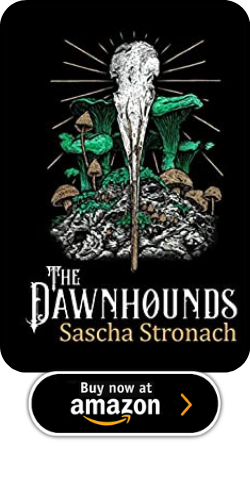 a wonderful queer noir fever dream"–Tamsyn Muir, author Gideon the Ninth. A ship rolls through the fog, its doomed crew fallen victim to a fungal plague that melts and repurposes flesh. Yat Jyn-Hok—disgraced cop and former thief—stumbles across its deadly trail. As the spores spread through the city, she pulls at the threads of conspiracy, and the threads pull back; powerful men will do anything to keep their secret. They kill her. It doesn’t stick. An ancient intelligence reanimates her, and sends her back into the city to enact its mysterious designs. She has her own plans: she’s going to find the source of the plague before it turns her home into a charnel house. On the run from her own colleagues, she follows the thread down into the ruins of her old life, where she finds unexpected allies, ancient magic, and a secret that could leave the world in ruins. Set in Hainak Kuay Vitraj, where the miracle of alchemical botany makes flesh as malleable as clay, The Dawnhounds is a story of rebirth, redemption, and the long road home.“The Dawnhounds packs hard-hitting, mind-bending weirdness into a story that’s still touching and human. If you’re looking for gritty queer spec fic that isn’t unrelentingly grim, you’ve found it.” –Casey Lucas, author of Into the Mire   the heart and soul of horror review websites
Today we welcome writer and director Henk Pretorius to the site to chat about his latest horror film The Unfamiliar, where a British Army doctor comes back from a war, thinking that she has PTSD only to discover that there is a more daunting malevolence at work making the life that she knew unfamiliar.
Hello Henk, how are things with you?
I am excited, nervous, insecure and sometimes overly confident. I have been emotionally, physically and otherwise invested in The Unfamiliar for the last five years and the film is about to be seen by an audience. Although I have made numerous other features before, this is the first one I have made for Britain and North America. It is a massive jump for me as a filmmaker from being a local South African filmmaker, to having a more global presence, and I can honestly not predict the outcome. The one thing that assists me in my current state of mind is a bunch of spiritual Ram Das podcasts about how one should detach from your emotions. Which I am usually able to do, but this is so new. Your filmmaking career began in South Africa, what are the most significant differences between making films in South Africa and the UK? I thought that the in-front-of-camera talent in London is incredible. The pool of highly skilled performers to choose from, and their dedication to the craft, is commendable. The on-set Heads of Departments in London was a bit less experienced than the Heads of Departments I usually work with in South Africa, which was cool because it reminded me of making my first film back in 2006. I will probably work with a bit more experienced team of HOD’s going forward in the United Kingdom, but there is a certain romance in working with a crew that is still trying to find their voice in a noisy industry. I hope that the film means something for the team of HOD’s that worked on the movie with me, hence why I tried to name everyone in our marketing campaign too. My first film in South Africa started a wave that led to a more economical suitable independent sector. The film industry in the United Kingdom is more mature in that sense than South Africa, so time will tell if the film had a positive effect on other people’s careers. On “The Unfamiliar”, I worked with post-production companies in both the United Kingdom and South Africa. This was a phenomenally positive experience. I had the pleasure of working with composer Walter Mair in London, who’s work made a sizeable difference in how an audience may emotionally receive the film. The colouring of the "picture" and the visual effects on The Unfamiliar took place in The United Kingdom and the final mix in South Africa. In summary, I would say that the British industry is more mature than the South African industry, which makes the approach generally in South Africa more entrepreneurial. Employees in the United Kingdom has a more Swiss-clock maker approach to solve particular problems, rather than taking on vastly more responsibility that South Africans are known to do. Off course I am generalizing, and off course both methods have their merits. You got to work with Nelson Mandela's grandson on the film Fanie Fourie's Lobola what was that like? Kweku Mandela doesn’t talk about his heritage but did introduce me to a couple of his family members. I haven't met anyone in the Mandela-family that was in politics, and everyone was super unique. Which, I think it a sign of good parenting, where the sons and daughters of your children are all encouraged to follow their dreams. I also believe that it ties in with The Great Nelson Mandela’s life’s goal: to give all the opportunity to become the induvial they want to be, irrespective of their race or gender. This ideal, in my opinion, really translated in all the Mandela family members I have met. I loved making Fanie Fourie’s Lobola because it was a cultural clash romantic comedy that I envisioned to show how South Africans can move forward and celebrate shared traditions. I meet people in South Africa, in all walks of life, that watched the film, and it had a positive effect on their journey. The idea that a story can offer people an alternative, and sometimes more positive way of thinking about life, is one of the great perks of being a filmmaker. Before The Unfamiliar, you were primarily known for writing and directing comedies, what prompted the move from laughs to scares? Most people I know that believe in the phycological concept of “having a personality” describe me as A-type. I am always up for a challenge and to evolve beyond my comfort zone. I am someone who is never completely happy with what he has achieved and always want to obtain a little more. Or grow a bit more, which led me to the need to decode the horror genre. Luckily my fascination with the film genre was supported by my horror-fan producer and business partner: Llewelynn Greeff as well as our company CFO and producer: Barend Kruger. Llewelynn’ sister was so excited about us wanting to do a horror film that she dropped a massive box of horror films at my house. I watched these, which translated into the scariest and most anxious two weeks of my film career, but I eventually noticed the poignancy of the genre. The horror genre to me now is best described as the search for truth and, ironically, finding the light in the face of perceived darkness. The best horror films to me managed to capture the dark in a way that brings new understanding to our psyches as a human race. For example: How we deal with fear, in the face of clear and imminent danger, is, of course, a deep reflection of our character. Do you think your experience of setting up "the punchline" in your comedy films gave you an insight on how to set up the "scares" in The Unfamiliar? Setting up a scare and the building of tension is rhythmically similar to building towards a laugh or creating a comedic film. In a sense, you have set-up, and a punchline for both genres and timing are incredibly important in both. I think an excellent example of that is Jordan Peele’s work, and how he has mastered comedic timing as well as the incredibly impressive: “GET OUT” horror film. However, storytelling across all genres all have the golden thread of the pursuit to create memorable characters, with strong arch’s, in a uniquely told plotline at their core. These story principals never really change across genres, and I believe in dabbling in different film genres makes you a more skillful filmmaker. The horror genre’s command on the film making medium surely left an imprint on how I can use the medium to strengthen my next film with. My background in comedic films helped infuse my understanding of the rhythm behind a scare. In 2012, you co-founded the Britain-based company Dark Matter Studios with Llewelynn Greeff, what was the reasoning behind setting up your own film production company? The truth is that I, as a young director, was born into a country with no real opportunities to make a living from directing films. It inspired me to think of both the business side of things, as well as the creative facets involved to make a film. I joined another film company as a partner and helped steer the company into creating several commercially successful South African films. My ambition soon outgrew South Africa as a market, and Llewelynn flew to South Africa to introduce himself to me and my previous company. Although Llewelynn had no experience in producing a feature film, we shared a couple of essential characteristics as people. We had integrity in our business dealings, we both took responsibility for our actions, and we had a dream to open a company where filmmakers can make a sustainable living out of films. Llewelynn made me two promises before we opened Dark Matter Studios in 2012: he will take responsibility of the almost impossible task of raising money for our endeavors, and he is strong enough not to let the industry corrupt him. I promised Llewelynn that day to create content that people will want to see and always to stay loyal to the bigger picture of building a sustainable industry in the creative arts rather than just jumping at a career opportunity. This code of conduct is why I prefer being part of our Dark Matter Studios family, rather than building my career on my own. Success also feels better shared than when it’s only focused on you as an individual. So, out of the impossibility of making a career in film in South Africa, we now have a functioning British production company, with a global distribution reach and numerous creative assets we are motivated to create soon. What has been the hardest thing associated with running your own company, and what has been the most rewarding thing related to it? I luckily don’t run Dark Matter Studios alone; I do it with Llewelynn. The hardest thing about running a company is that you are always 100% responsible for both the things you can control as well the things that are outside of your control. The best thing about running a company is that with taking on this responsibility, you have the freedom to make choices. And these choices ultimately significantly contribute to your fate. What is the biggest hurdle you face as an independent film production company? If you ask Llewelynn, he may tell you it is raising the capital for producing, distributing and marketing our intellectual properties. I would say it is predicting what intellectual property to create next that may be in demand for the trends of tomorrow and will justify the budget spent on creating and marketing them. In truth, I think it is both raising the money and creating assets for sometimes a distant future. Plus, the added pressure to run all day-to-day tasks associated with managing a business. Your latest film The Unfamiliar, at first look, could be considered just another "possession horror film,(it's OK folks it isn't, when the film is released be sure to check it out). There's a lot of twists and defying the expectations that have commonly become associated with possession-type horror movies. How were you able to keep that originality while paying homage to the stories that came before? I think it has to do with respecting the audience enough to know a film will only really appeal to them if it’s fresh. I then do an incredible amount of research into the genre, the subject matter, as well as everything that surrounds the film. Luckily, Jennifer Nicole Stang, who wrote the script with me, helped me with the research. I also wanted to make a film that appears to be one thing, and then turns out to be something completely different. A film that uses horror tropes to guide and sometimes, miss guide the audience to a different conclusion. I am a fan of John Carpenter’s idea of activating an audience’s imagination oppose to showing the monsters, as well as the modern master of horror: James Wan. His ability to make the building of tension truly cinematic is something I thrive to achieve. I was also inspired by Jennifer Kent’s thematically rich telling of The Babadook yet tried not to borrow any story ideas from any of the films. The film could be considered "heavy" in the sense that it touches on a soldier's PTSD, feeling like a stranger in your own family, being a stepmother, and many others that I don't wish to spoil. How did these elements come about? The idea of the film being dramatic grew out of my affinity for drama as a genre. I think that our “human suffering” is an essential emotional-in for an audience in identifying with a character, and I use dramatic beats even in my more comedic films. There was another film: Ready or Not, that was quite a lighthearted and delightful film to me, and I remember watching it and thinking: maybe I should have put more “laughs” in The Unfamiliar. And then I thought: even a comedy-horror like Ready or Not has a dramatic backdrop of the prejudges of classism, and it’s that backdrop, that I believe, creates the connection for the audience with the lead character who, is this particular film, disrupts the class system. The PTSD element in the film was inspired by a group of marines that I hung out with in LA when writing the script with Jennifer. The idea of a mother trying to keep her family safe, in the face of danger, was inspired by my observation of just how brave people can be when it comes to protecting their family. The idea of making the lead character be a stepmother showed the cracks of her alienation and the insecurity that Izzy experienced in an attempt to fit into the family nucleus. And what was it like dealing with that subject matter? The balance between the genre and weight of the subject matter was the challenge. The film had to deal with it freshly, without taking away from the seriousness of someone experiencing PTSD, yet as you know, the film is not really about that. So, it can’t just be used as a device, because that will come across as exploitive. It has to be dealt with, with enough care to motivate the inclusion, but not with too much screen time to confuse the genre and the audience of horror films. Time will tell what the majority of the audience thinks, and you will only honestly know the impact when “the lovers” outweigh “the haters” of the film. Why Hawaiian folklore? Jennifer Nicole Stang read this incredibly thick book of Hawaiian mythology that she brought to my attention. The amount of the culture that most people didn’t know about Hawaii captivated our imaginations as writers. The idea that Hawaii is often portrayed as a tourist destination and that only a small number of films have attempted to portray a more three-dimensional picture of its inhabitants, was also inspirational. I was born in Cape Town, and sometimes people think they understand the complexities of living in South Africa just because they have read about it or visited it for a short holiday. And although I love the fact that I come from a place that tourists want to visit, and I hope people continue to do so, I also know that living in South Africa and experiencing its people is vastly different from the holiday experience. I can’t possibly hope to capture the spirit of Hawaiian people in ninety minutes, and it is also not the point of the actual film. Yet, I do hope that it inspires interest in the culture or any foreign literature for that matter. I have made numerous films that explore different cultures, and I have often found myself wanting to know more, the more I get to know the customs, rituals and traditions of the people. I have also found that people stripped from their culture, behave in quite a similar way, which off course brings us closer to the shared human experience and each other in the process. Without giving too much away, what was it like having actors embodying multiple characters? To take Tommy, the lead character’s son, as an example. His inherent understanding of the different dimensions he played was already evident in his audition tape. He had this almost superhuman quality about him to remember lines, stage direction as well as the more emotive and physical requirements of the role and just did it, seemingly without thinking about it. I was very impressed with the amount of research the cast brought to the roles and the effort that went into their preparation. It is easy to direct a well-prepared cast, and so it was, for the most part, a gratifying process. I made them all the promise that I would put as much effort as humanly possible into all the other facets of filmmaking to make sure that their performances are shown in the best possible light, and I hope they are delighted with the result. The film has multiple locations, such as the UK, Hawaii, and a netherworld, what were your techniques to stylistically set them apart? I used different lighting methods and grading to set them apart. If you view the scenes set in Hawaii, the grade is much more saturated than the scenes set in England. For the “netherworld” we used the colour of a corpse as a model construct, in finding the right hue for the blueish tint. Andy Lee was the colourist on the film, and we spent a lot of time on each sequence to make sure they are different to the other setting. We also used a 35 mil film grade as filter to tie all the worlds together, and I wanted to make the film seem very organic and have a classic cinematic feel. The production design played a role in setting the worlds apart too. You will rarely notice a shot in Hawaii without the presence of a tropical plant in the frame, for instance. And the sound design by especially Jim Petrak contributed significantly to how the different worlds would sound. Jim came up with this idea to take all the natural sounds and “atmos”, out of the netherworld. The idea that this is a place of death, where nothing, not even sound survives, motivated the choice. Most of the music used in the Hawaiian scenes also had an authentic Hawaiian instrument in them. Walter Mair imported Hawaiian instruments and combined them with classical and other musical instruments to create a unique feel for the film. What inspired you to tell this story? My inspiration to tell this specific story is because I wanted to create a film that has a lot of unique twists in it. A film that is difficult to predict. Finding ways to twist the plot activated the left and mathematical part of my brain. In contrast, my emotional sphere was activated by the journey of watching a mother go to heroic lengths to protect her family from an invisible enemy. Where and when can we watch The Unfamiliar? The Unfamiliar is available on all digital platforms on 21 August in North America and on 11 September in the UK. We are announcing more dates soon, and it’s best to follow our socials for dates on @unfamiliarmovie for details around other releases. Your next project is called Novus, can you tell us what this film is about? At this stage, I can only say that NOVUS is just the working title for the film and maybe changed after production. The word NOVUS gives you a clue what it is about because NOVUS means: “to renew” in Latin.

THE HEART AND SOUL OF HORROR PROMOTION WEBSITES  Daniel Reiner was born, raised, and still lives in Pittsburgh, PA. Influenced at an early age by the imaginations of Larry Niven and Stephen King, it was a later encounter with H.P. Lovecraft’s dizzying use of adjectives that set him on his course. That path has led to the creation of a set of characters within Lovecraft’s universe, their tales currently being published by Vulpine Press in The Shadow Saga. Though the bulk of his creative output remains Lovecraftian, he does branch out and dabble in shorter pieces with horror, science fiction, or other, uncategorizable flavors. Samples of his work are available at https://www.danielreinerfiction.com. WEBSITE LINKS https://www.danielreinerfiction.com/ https://www.facebook.com/Daniel-Reiner-Fiction-273386506648355 Could you tell the readers a little bit about yourself? Though I’ve done little reading recently, I devoured science fiction and, well…comic books…when young. As a teenager, I got hooked on Larry Niven’s Known Space universe, and Frank Herbert’s Dune is still in my top three overall favorites. At about the same time, Stephen King’s early tales also grabbed me, especially ‘Salem’s Lot and The Stand. But in college I was absolutely captivated by the adjectives used by H.P. Lovecraft and the overall atmosphere he evoked. So, even though I fed my voracious imagination with all that fiction, writing was an after-after-thought. My logical, problem-solving personality fit in well with mathematics and computer science, and that’s where my career went. Writing was an on-again/off-again hobby, all self-taught, self-learned, with no early success because I didn’t know how to proceed or how to truly get better. Finally, in my fifties, I found a writing group, made the right connections, and had measurable progress. Which one of your characters would you least like to meet in real life? From the book that was just released, The Shadow Effect, Frances is even worse than I present her. And I tried to make her atrocious in this one. By the end of the series (The Shadow Saga), her full awfulness will have been revealed. Other than the horror genre, what else has been a major influence on your writing? I’m going to scrape everything together into a big bucket and label it “fantastic” fiction, but fantastic in that far-fetched sense: things that are wildly thought provoking. For me, that means science fiction, fantasy (such as The Lord of the Rings), mythology, and Dungeons and Dragons (the role-playing game). There’s lots of overlap between the final three. But in particular, I enjoy adding in elements of mythology whenever I can. The term horror, especially when applied to fiction always carries such heavy connotations. What’s your feeling on the term “horror” and what do you think we can do to break past these assumptions? For good or bad, we’ve come a long way from the gothic horror of Stoker and Shelly. These days, it takes quite a lot to shock the average reader, so I think that the concentration should be on building tension, or taking perfectly normal events and twisting them just enough to create the abnormal. It becomes more psychological then, rather than explicit gore. But that isn’t a new concept. A lot of good horror movements have arisen as a direct result of the socio/political climate, considering the current state of the world where do you see horror going in the next few years? I am sincerely afraid to speculate. We’re going to have to see what else 2020 has in store for us. The world of 1984 is right around the corner, and THAT is genuinely scary. Given the dark, violent and at times grotesque nature of the horror genre why do you think so many people enjoy reading it? Pure escapism: It’s that other person going through the trauma, not me. I’m here, on my couch, and everything is fine. It’s all fine. I just wish it wasn’t quite so dark, and the house would creak a bit less… What, if anything, is currently missing from the horror genre? I haven’t kept up enough to offer an opinion on trends. It’s hard to imagine that anything is missing, but something must be, though. Right? Somethings. Otherwise, why do authors bother to keep writing? What new and upcoming authors do you think we should take notice of? I wish I could comment authoritatively on this. With a full-time job that is not writing, and the hobby/second-job of writing, I am far, far, far behind on reading. I have no idea what’s really happening out there. If it’s a valid response, I can give myself a plug and say, “Hey, that Daniel Reiner is turning out some pretty good stuff.” Are there any reviews of your work, positive or negative that have stayed with you? Not so far. Or, maybe. But see the question after next. What aspects of writing to do you find the most difficult? Outlining. I would so much like to make a habit of jotting down an outline, charting out the chapters, and adhering to it. I managed to do that once, but no longer. I have ideas and sequences and scenes in my head. Sometimes those things are static, sticking around from beginning to end, and sometimes they’re fluid, morphing as I write. Is there one subject you would never write about as an author? I’m not comfortable writing about sex or relying on profanity, though I’m trying to get past that when it fits with the piece. The one thing I shy away from completely is anything autobiographical. I see no need to expose my life to the world, partly because it’s private, and partly because it was/is so fucking uninteresting! (And there you go: I dipped into some profanity for the audience.) Writing, is not a static process, how have you developed as a writer over the years? I hardly developed at all until I joined up with the Millvale Writer’s Group. Reading one’s own work aloud, in front of others, is a terrific way to see and hear the details that aren’t quite right. Equally, seeing and hearing others read their work aloud is extremely insightful. I guess what it boils down to is: You can’t write in a vacuum. Unless you’re naturally gifted (like Lallafa, if I may pull in an obscure reference from Life, the Universe and Everything), interaction and feedback is required. What is the best piece of advice you ever received with regards to your writing? I had the good luck to meet the late Joe Pulver at a NecronomiCon in Providence back in the 1990’s. He told me of the struggles he went through to get his Nightmare’s Disciple published, and we kept in contact for a time. Essentially, he told me to just keep going, keep trying, and things will happen one day. And, things eventually did happen. I wish I’d known him better. Which of your characters is your favourite? Jebediah Higgins. I often think the way Higgins does, but, thankfully, I don’t speak or act like him. At least, I hope not. Which of your books best represents you? Hmmm. I don’t think that one has been written yet. It will one day, though. Do you have a favorite line or passage from your work, and would you like to share it with us? Favorite is such a hard thing to nail down. I can think of a number of examples from the newest book, but—in order to avoid any spoilers—I’m going to go back to The Shadow Beyond. I’m not a poet or lyricist by any means, but I was very pleased with the sea ditty that I came up with: No skin, no flesh, them bones shine through. Hackin’, scrapin’, the best we do. The best we can, though pretty rough. Others though, they polishes off. Beaks and teeth, they eat their fill. All blood, all gore, a devil’s meal. So clean, so clean, that skel’ton gleams. With flesh stripped clean, that skel’ton gleams. It’s white, so white. It’s oh so-- And the singer gets interrupted at that point, so we don’t find out how it ends. Or how interminably long it may have been. Can you tell us about your last book, and can you tell us about what you are working on next? The most recent work, The Shadow Effect, is a follow-up to The Shadow Beyond, but not a true sequel. I always imagined the first volume to be akin to The Hobbit, setting the stage, and the remainder to be more connected, not unlike The Lord of the Rings trilogy. In the first book, Quentin Gardiner is introduced and disappears early on. In The Shadow Effect, we learn all about his adventure. Next up will be the third volume, which has been started, but I’m also always at work on short, or flash, fiction to stretch my brain in different ways. I also work on serial tales that fill in some holes in The Shadow Saga: stories that relate to the characters and plot in general, but that don’t make it into the books. Many of those bits and pieces show up on my website. If you could erase one horror cliché what would be your choice? Personally, I don’t like the unkillable villain. They can be unkillable, or resurrected, if there’s a good reason. But I want a really, really good reason. Even in fantasy I need logic. What was the last great book you read, and what was the last book that disappointed you? To be perfectly honest, I was very pleased, or satisfied, with the way that Rowling wrapped up everything in Harry Potter and the Deathly Hallows. Satisfying may not sound like a great compliment, but that’s really what it boiled down to. For an honourable mention, I have to add Pulver’s A Long, Dark, Grim Road. At only a few dozen pages, it’s not a conventional book, but it is an intense, unique, and memorable read. As far as disappointing: I really liked the concept of Riggs’ Miss Peregrine’s Home for Peculiar Children, but that wasn’t an ending. That first book just stopped due to lack of time, or energy, or whatever. What's the one question you wish you would get asked but never do? And what would be the answer? Is there a beer you won’t drink? I won’t touch beers made with habanero, or similar, hot peppers. Also, watermelon and pickle are out. I’m game to try anything else, though, be it bitter, malty, sweet, or sour.  For a mistake to be corrected, it must first be made. Tenets such as this are the foundation upon which Quentin Gardiner has built his world. Logic. Reason. Cause and effect. Such basic principles are vital to one such as he, devoted to science. But as the head of the Archaeology department at Miskatonic University, Gardiner is one of the few aware of just how much lies beyond the commonlyaccepted boundaries of science. Magic is just one of those secret truths. When a mysterious package arrives from Gardiner's former mentor, he finds himself caught up in a globe-spanning quest, forced to peer into the shadows and discover the truth. But shadows conceal much, and some truths—some secrets—are quite ugly.  the heart and soul of horror author interviews BIO B.R. Yeager reps Western Massachusetts. He is the author of Negative Space (Apocalypse Party), Amygdalatropolis (Schism Press) and Pearl Death (Inside the Castle). Could you tell the readers a little bit about yourself? It’s nothing too exciting. I’m a lifelong New Englander. I’ve been writing and coming up with stories since I was little, before taking a long hiatus between high school and my mid-20s being in bands, since that’s what all my friends were doing. I got back into writing in 2013, and it’s taken over my life since. Over the past five years, I’ve written two novels and a limited-edition deck of cards that functions as a non-linear novelette. Which one of your characters would you least like to meet in real? I’ve already met them. Other than the horror genre, what else has been a major influence on your writing? Music is an enormous influence—it’s how I set and develop the tone and mood for a book. Negative Space, for instance—the tone was heavily informed by artists like Khanate, Fever Ray, Wicca Phase Springs Eternal, Bohren & Der Club of Gore, and Pig Destroyer. I prioritize atmosphere over everything in my writing, and because music is so effective at conveying mood, finding the right music to reinforce the atmosphere is essential to my process. The term horror, especially when applied to fiction always carries such heavy connotations. What’s your feeling on the term “horror” and what do you think we can do to break past these assumptions? I think of horror as being any work that induces a feeling of dread, strangeness and unease. Working from that assumption, every boundary falls away. A lot of good horror movements have arisen as a direct result of the socio/political climate, considering the current state of the world where do you see horror going in the next few years? I have no idea. I’m going to say up front that I’m too big on direct allegory—it usually feels shallow to me. But the horror genre is frequently a terrific record of psychology and emotion—while the stories may not capture the precise events of an era, they certainly capture the feelings. An example I like to use is the original Dawn of the Dead. While it’s often referenced for how it satirizes consumerism, I don’t think that reading goes far enough. There’s so much going on in that film. One thing that stands out is this sense of utter desperation to maintain the dream of affluent, homogenous, suburban living even after that dream has collapsed. It goes beyond consumerism. It’s the decimation of lifelong assumptions around what constitutes reality. It’s the sudden realization that your country is a monster. The anxiety of realizing you cannot return to a more naïve state of being. The characters could have done anything after society collapsed, but they tried to build a life like their old one. Given the dark, violent and at times grotesque nature of the horror genre why do you think so many people enjoy reading it? I read and write horror for identical reason—as a means of processing and reconciling aspects of myself, of others, and of the world that appear too ugly to directly address. Horror is at its best (in my opinion) when it is revelatory. And like I said previously, horror can function as a document of the era’s psychological and emotional climate. That’s a key reason for why I write—to document aspects of the present that seem underacknowledged. What, if anything, is currently missing from the horror genre? I’m not sure I would say anything is missing from the genre—there is so much out there across the entire spectrum of styles and topics. I suppose I would love to see more fiction less concerned with straightforward narratives, and more concerned with abstraction, or immersion in a feeling, a place, or an event. I love work that disorients, that does away with plot and exposition altogether and lets you wallow in strange darkness. Some great books that accomplish this are The Orange Eats Creeps by Grace Krilanovich, 300,000,000 by Blake Butler, The Unyielding by Gary J. Shipley, and Love Hotel by Jane Unrue. What new and upcoming authors do you think we should take notice off? Elytron Frass is another writer who accomplishes what I describe above. His novel Liber Exuvia is one of my favorite pieces of horror in recent years. He’s currently working on the graphic novel Vitiators with illustrator Charles N. Charlene Elsby’s Hexis is also a terrific read, for similar reasons. Are there any reviews of your work, positive or negative that have stayed with you? Honestly, I’m just thankful to be considered at all. What aspects of writing to do you find the most difficult? Maintaining my faith in the process. In the early stages of a manuscript, I need to force myself to believe it will someday be good, because it will be years before it actually is any good. I rely heavily on revision—my early drafts are so syntactically garbage they’re borderline unreadable. Honestly, I’m probably a better editor than I am a writer. I need to scrub practically every sentence until they’re clear, until they become musical. Then later, I sometimes need to go in and muddy those sentences up a little, because there will be too much clarity, and nothing is less scary than knowing exactly what’s going on. But even when I’m finished, it’s difficult for me to look at one of my books and see anything other than what I would have done differently now. Is there one subject you would never write about as an author? None I can consciously identify. If there’s a subject I’m compelled to write about, and I believe I can write about it honestly, I will find a way to write about it. That said, I never want to be exploitive, or pursue a topic solely to shock or provoke. That’s hollow and boring to me. Writing, is not a static process, how have you developed as a writer over the years? It’s difficult to tell. Whenever I begin a new book, I feel as though I am starting from scratch. I am not very conscious of my development, though when I look at my older writing, I can see it is as being weaker than my more recent work (though some aspects feel freer and wilder, which I’d like to harness again). What is the best piece of advice you ever received with regards to your writing? I’m paraphrasing, but Ben Hersey (a performance artist and author of the excellent The Autograph of Steve Industry) once said “When you’re writing something and it begins to make you uncomfortable, that’s usually a sign you’ve uncovered something worth exploring further.” That’s the impulse I chase. Which of your characters is your favourite? Tyler from Negative Space, because he’s still an enigma to me, and I can let some of my memories live with him. Which of your books best represents you? Negative Space, by far. While it is far from being strictly autobiographical, there are so many pieces of my life in it. Many of the anecdotes are based on things I’ve actually experienced—perhaps through a heightened lens, but ultimately rooted in reality. A friend recently said it seemed as though I was transposing my experiences as a teenager onto the present generation, and I think that’s an accurate read. Do you have a favorite line or passage from your work, and would you like to share it with us? I’m still pretty proud of Negative Space’s opening. It feels like an apt summation of what’s to come: It was the way he just threw his body away. How he’d carve up his torso and arms with a box cutter, or go days without sleep, replacing whole meals with pills and cigarettes. Everyone knew Tyler was going to die young. Can you tell us about your last book, and can you tell us about what you are working on next? Negative Space came out back in March through Apocalypse Party. In a dying New Hampshire mill town, four teenagers abuse a bizarre hallucinogen in order to cope with a devastating suicide epidemic. As the drug quickly takes over their lives, violent and uncanny abilities awaken within them, while a separate bleak force emerges from the surrounding mountains, threatening to ruin everything they love. For fans of Kathe Koja, Clive Barker and Mandy. I’m currently finishing a story to be included in Hymns of Abomination: Secret Songs of Leeds, a tribute anthology to Matthew M. Bartlett. That will be released through Silent Motorist Media sometime next year. I really appreciate having the opportunity to contribute, as Bartlett is a great horror writer whose work focuses on the Western Massachusetts, where I also live. If you could erase one horror cliché what would be your choice? This might be an unpopular opinion, but I think ‘70s and ‘80s-centered retro-horror has run its course. I don’t think we need any more (aside from Puppet Combo games). What was the last great book you read, and what was the last book that disappointed you? I really enjoyed Christopher Zeischegg’s The Magician. A great mixture of autofiction and occult horror. I was a little disappointed by Zoje Stage’s Baby Teeth. I enjoyed it, and while the daughter’s voice was compelling at times, many other moments felt a bit inauthentic—leaning a little too far into cutesy talk, like an impersonation of a child rather than a child. But maybe that’s just me. What's the one question you wish you would get asked but never do? And what would be the answer? “What is uniquely unsettling about New England?” But I’m not sure I have a good answer for that. Obviously so many horror/macabre writers and artists have helped give New England a reputation for eeriness, but even if you took all that away, there’s still an extremely elemental, primordial, uncanny vibe surrounding this place. I adore it.  "Like smoke off a collision between Dennis Cooper’s George Miles Cycle and Beyond The Black Rainbow, absorbing the energy of mind control, reincarnation, parallel universes, altered states, school shootings, obsession, suicidal ideation, and so much else, B.R. Yeager’s multi-valent voicing of drugged up, occult youth reveals fresh tunnels into the gray space between the body and the spirit, the living and the dead, providing a well-aimed shot in the arm for the world of conceptual contemporary horror." —Blake Butler, author of Three Hundred Million “Ever wonder where teenage children go at night? Perhaps it’s best not knowing the answer. There’s something amiss in Kinsfield, a drab, boring city much like your own, except for the teenage suicide epidemic, stagnant, ineffectual parents, cultish behavior that borders on psychosis, and strings, strings everywhere. B.R. Yeager’s Negative Space is a hypnotic collage of message boards, memes, and ruined bodies twisting at the end of a rope. Most modern novels have lost all concept of magic. B.R. Yeager’s Negative Space is a stunning refutation of the quotidian.” —James Nulick, author of Haunted Girlfriend & Valencia  the heart and soul of horror author interviews I’m currently working on something I can’t easily explain just yet. It’s about a young man who’s mother and father met under mysterious and tumultuous circumstances. As he’s coming of age in the 1970s, he learns more about his mother’s and father’s murky background and the past comes rushing forward to drag them all down. It’s a mix of SciFi and horror with a love, black power, and COINTELPRO backdrop. Errick Nunnally was born and raised in Boston, Massachusetts, he served one tour in the Marine Corps before deciding art school would be a safer—and more natural—pursuit. He is permanently distracted by art, comics, science fiction, history, and horror. Trained as a graphic designer, he has earned a black belt in Krav Maga/Muay Thai kickboxing after dark. Errick’s work includes: the novels, blood for the sun, All the Dead Men, and Lightning Wears a Red Cape; Lost In Transition, a comic strip collection; and first prize in one hamburger contest. The following are some short stories and their respective magazines or anthologies: Uniform (Fiyah Literary Magazine), Penny Incompatible (Lamplight, v.6, #3 and the Podcast Nightlight); Jack Johnson and the Heavyweight Title of the Galaxy (The Final Summons); Welcome to the D.I.V. (Wicked Witches); A Few Extra Pounds (Transcendent); and A Hundred Pearls (PROTECTORS 2: stories to benefit PROTECT.ORG). Eventually, Errick came to his senses and moved to Rhode Island with his two lovely children and one beautiful wife. Visit erricknunnally.us to see his work. WEBSITE LINKS http://www.erricknunnally.us Could you tell the readers a little bit about yourself? I was born and raised in Boston, Massachusetts, but currently prefer Rhode Island. Married with two children, my career is built around graphic design. I’ve been writing most of my life, but seriously leaned in around 2012 before getting my first publications in 2014. I have served in the Marine Corps, graduated from art school, and earned a black belt in Krav Maga. Somewhere in there I won a hamburger contest by 5 Napkin restaurant. I’m a big fan of cocktails, food, and comics—sometimes all at the same time. Which one of your characters would you least like to meet in real life? The Lathe. It is a dystopian cyborg built to demoralize and kill the state’s perceived enemies. There’s only one way to stop it and I ain’t it. Other than the horror genre, what else has been a major influence on your writing? I started out reading quite a bit of SciFi, but I was undirected. Since I lived in something of a book desert, there wasn’t a network of friends, family, or classmates reading and recommending reading. As a result, I sort of missed most of the “must read” books in various genres. Still, I’d say some milestones would be Bradbury’s The Illustrated Man, Asimov’s Caves of Steel and sequels, Gerrold’s War Against the Chtorr series, Collins’ Sonja Blue novels and the first few of Hamilton’s Anita Blake series. The term horror, especially when applied to fiction always carries such heavy connotations. What’s your feeling on the term “horror” and what do you think we can do to break past these assumptions? As the only genre titled after a feeling, I consider horror to be a thrilling escape. Whatever people envision for their novels and short stories can’t outdo history. What we’ve actually done or experienced as a species will always outshine fiction! Therein lies the true horror. A lot of good horror movements have arisen as a direct result of the socio/political climate, considering the current state of the world where do you see horror going in the next few years? I hope folks stay away from pandemic stories for a while. That said, I bet there’s going to be even more wily stuff that deals with the socio-political conflicts in societal cultures around the world. We’re seeing the rise of writers from a far more diverse pool and their experiences are coming with them. Given the dark, violent and at times grotesque nature of the horror genre why do you think so many people enjoy reading it? It’s an escape. As I mentioned earlier, I consider horror—and other genres—an escape from reality. Our existence is the most soul-crushing thing we experience, fiction is our release, our way out for a while. What, if anything, is currently missing from the horror genre? A broader diversity of experiences. What is it that engenders horror in people who are not like us? What new and upcoming authors do you think we should take notice of? Cadwell Turnbull, Chesya Burke, John Goodrich, Gerald Coleman, Erin Roberts, Kenesha Williams, Zin E. Rocklyn, Teri Clarke, uh… Are there any reviews of your work, positive or negative that have stayed with you? It’s the random reviews that always stick with me, regular readers taking a moment to share their feelings. Recently, I’ve had a few pop up on Twitter for my short story, Uniform in FIYAH Lit Mag and it has been super-cool. What aspects of writing to do you find the most difficult? Consistency. For a number of factors. Family responsibilities, work, exercise, other obligations. It’s tough enough to manage all that and write at the optimal times with a damned pandemic and protests against police brutality ravaging the nation, insisting that it change. It’s a powerful force that certainly draws the attention. Is there one subject you would never write about as an author? Probably rape or child abuse. But if it fits a story and eventually satisfies my basest needs for vengeance… Writing, is not a static process, how have you developed as a writer over the years? Getting better at pinpointing the emotional condition of characters and conveying it. It seems to be what people find most compelling. The stories that seem to get the most attention are the ones that dwell in the suffering of the characters the most. What is the best piece of advice you ever received with regards to your writing? I think, as it pertains to editing, what to cut away in order to leave the most streamlined story. It’s definitely difficult and takes time to hone. I’m not all the way there just yet! Which of your characters is your favourite? Alexander Smith from the Blood for the Sun/All the Dead Men/The Headless Woman trilogy. Which of your books best represents you? I haven’t completed them yet, but a series of short stories intended to make up two novellas. One is a horror-thriller about a woman who works in animal control and finds herself up against unusual aspects of nature. The other is science-fiction about a Marine Warrant Officer serving as the head security officer on an orbiting combat satellite in Earth’s on-the-brink future. I wrote it as a piece of military-noir, flinging the detective role into a crumbling future where joining the military (or an international corporation) is the best option for survival. Do you have a favorite line or passage from your work, and would you like to share it with us? Maybe this one, for now: He didn’t have to look up to see the night sky stretching forever in all directions, a pitched blanket smothering the world. Can you tell us about your last book, and can you tell us about what you are working on next? My last book was, All the Dead Men, a sequel to Blood for the Sun, both books are about a werewolf with a kind of supernatural Alzheimer’s who puzzles out cases of missing or murdered children in order to keep his mind intact. They’re supernatural crime, noir, pulp, and horror. I’m looking forward to writing the third book! I’m currently working on something I can’t easily explain just yet. It’s about a young man who’s mother and father met under mysterious and tumultuous circumstances. As he’s coming of age in the 1970s, he learns more about his mother’s and father’s murky background and the past comes rushing forward to drag them all down. It’s a mix of SciFi and horror with a love, black power, and COINTELPRO backdrop. If you could erase one horror cliché what would be your choice? Weak-ass flashlights. What was the last great book you read, and what was the last book that disappointed you? The last book that I felt was truly great—above and beyond entertaining, well-written, etcetera—was probably The Lesson by Cadwell Turnbull. I mentioned my origins with SciFi earlier and this one was on par with Childhood’s End, by Arther C. Clarke. Better, in fact, considering where we are in history. It’s a modern and engaging take on first contact and the consequences of Colonialist empires. What's the one question you wish you would get asked but never do? And what would be the answer? Oh, shit…  The plot was broken, but something more sinister has taken its place: a vampire church built around the image of a woman who seems strangely familiar to Alexander. These zealots are hellbent on restoring what they believe the status quo to be, one of vampire over human, and Alexander wants nothing to do with it. Until a child—one he’d rescued decades ago, now an adult—turns up in a pornographic video made by a film crew that has been slaughtered. His adopted daughter, the vampire Ana, seems to be missing. At wit's end, Alexander has few allies. With Majispin in hiding, the pack decimated, and only a few willing to both hate and help him, Alexander must confront The Church of Our Lady of Perpetual Death and deal with the unexpected threat of Ana’s grandsire, an old and powerful vampire who has consumed his own soul. The monster wants nothing more than to possess the only love Alexander has left in the world. THE HEART AND SOUL OF HORROR REVIEW WEBSITES
|


Archives
May 2023
|


 RSS Feed

|

|