

 The Vanishing Room captures the soul of what I’m trying to do with my work. Essentially, I want to take genre fiction and present it with a literary style. This discordant union will appeal to those who enjoy some grand descriptive writing, even though it may feel out of place in a modern setting. S. M. Fenton is a writer of Gothic tales, quirky mystery novels, and horror fiction. His blend of supernatural rationalism comes from his equal respect for Shelley, Le Fanu, and Lovecraft on the one side and Conan-Doyle and Christie on the other. Having devoured the literary works of ghostly tales, inhaled the classic detective duos, and assaulted his eardrums with many years of doom pop and goth rock, it’s no surprise that he ended up birthing the lovechild of these influences. WEBSITE LINKS https://smfenton.uk/ Could you tell the readers a little bit about yourself? I’m a programmer, technical author, and failed musician who lives in Hampshire with my wife, my daughter, and a cat who hates me and stabbed me through the eyeball to make sure I know how much. Which one of your characters would you least like to meet in real life and have them complain at you about they way you treated them in your work. Robert Mercier is a charming businessman. He’s confident, dominates the conversation, and is just the kind of personality I struggle to deal with. If he confronted me to challenge my portrayal of his character, I would crumble in an instant. He’s the kind of person that you voluntarily apologize to when they let a door slam in your face. Why am I saying sorry to this guy? Because he shines like a sparkling beacon of success. Other than the horror genre, what else has been a major influence on your writing? Outside of the horror genre (ghostly tales, and Gothic novels mainly), I read piles of crime fiction. Ellis Peters, Agatha Christie, M. W. Craven, and Arthur Conan-Doyle, with more planned once I have swept out the very last cobwebs of these collections. I’m a sucker for the contrasting-duo formula. Holmes/Watson, Poirot/Hastings, Andre/Price. Well, perhaps not the last one. I’m also deeply obsessed with the lyrics that you swim in when you listen to great lyrical bands. Imagine a song based on the philosophy of Immanuel Kant, well that’s Crooked Timber, by Therapy – or a song about the glamourous life and the grisly death of an actress, that’s Kiss Them For Me by Siouxie and the Banshees. It all merges and blends onto the page. The term horror, especially when applied to fiction always carries such heavy connotations. What’s your feeling on the term “horror” and what do you think we can do to break past these assumptions? A great deal of my time is spent feeling like I’m “not horror enough” to claim the epithet. When I look at other writers, I think “they’re doing horror, that’s what it is, they do it so well.” But that’s what is so great about this community. It can be the ghostly visitation of The Turn of the Screw, or the sexually charged vampirism of Carmilla, or the religious devilry of The Monk, or it can be that chest-pounding fear of Jaws, the flesh-ripping of Cannibal Nuns from Outer Space, or even the utterly haunting tragedy of Frankenstein. While some people mistakenly think horror is a thin genre, I can only see the vast richness of work and the immense variety on offer. On top of this, other categories delve into horror when they need to reach for that darkly emotional connection with the reader. I welcome these incursions. We need to constantly challenge the edges to prevent them solidifying. A lot of good horror movements have arisen as a direct result of the socio/political climate, considering the current state of the world where do you see horror going in the next few years? Well, let us brace ourselves for a run of isolation-inspired works of fiction. Half the world is on lock down, there is a virus with no current vaccine, and we’re all sat watching hockey-stick line charts that trigger our anxiety. For many of us, we our getting our first taste of that chest-crushing unexplainable lethargy that comes from unacknowledged stress. When the virus/quarantine flood arrives, let’s not dismiss it. This is a healthy way for all of us to explore this strange feeling and it will document something more human and more vital than raw statistics. We uncover vastly different perspectives on the pandemic that may challenge us and shake us from our metaphorical comfortable armchairs. Given the dark, violent and at times grotesque nature of the horror genre why do you think so many people enjoy reading it? My ego demands that I mention how fiction is a healthy way to exorcise the darkness that lurks deep within our souls. However, this feels like a cheap rationalization. There is something deeply interesting about a writer being inspired to render accounts of ghastly terror; and it’s wonderful that we can read it and enjoy it without the American Psychological Association trying to diagnose us with a mental illness. Speaking personally, there is something magic in the descriptive challenge of horror fiction. Many authors manage to make picturesque the obscene. This is one of the attractions for me as a reader. What, if anything, is currently missing from the horror genre? We’re a good few-hundred years into this journey and we’re beyond the benefits afforded to the early writers. They did a great job and I’m obsessed with reading old horror books, but they could pick a couple of random traits and invent something groundbreaking. The weight of all these past works makes it hard to create something entirely new, but I’m excited when author’s reinvent and twist ideas into new shapes. When I read Class Three by Duncan P. Bradshaw, the treatment of a zombie as a fully rounded character with a perspective and thoughts blew my socks off. In the past authors were able to write about almost anything with a far lesser degree of the fear of backlash, but this has all changed in recent years. These days authors must be more aware of representation an the depiction of things such as race and gender in their works, how aware are you of these things and what steps have you taken to ensure that your writing can’t be viewed as being offensive to a minority group? We are all still participants in this broad discussion and every day we learn and progress. We often stumble blindly into silly mistakes, so we need to be empathic on both sides of the conversation. When we become to emotionally myopic, we only move apart from one another when we should be seeking to come together. If you want to tackle this issue, you need to make your own bias visible. If your book is set in the UK and has no particular reason to be otherwise skewed, around 8% of your characters should be Asian. If it’s less than this, you’ve uncovered a bias. When you are undertaking this self-exploration, be honest about your character treatment. Achieving a balance of female characters is not an achievement if they are all doe-eyed, two-dimensional, tripping-up-while-running-away types. I would love to say I’m a trailblazer on this, but I’m as flawed as the next privileged westerner. Does horror fiction perpetuate it’s own ghettoization? I don’t believe there is some self-harming agenda in horror. The community suffers from the beatings it gets from the very people that borrow its devices. Just remember there is an unrivalled history of this wonderful corner in fiction and draw strength from those great fore-runners. There is no such thing as “proper writing”. If there were, we would all tire of it. What new and upcoming authors do you think we should take notice of? M. W. Craven is producing excellent crime with a horror twist starting with The Puppet Show, and Gareth Powell’s Ragged Alice is one of my favorite books of recent times with its supernatural theme. Autumn Christian has been going from strength to strength, and I’m always wondering what Bradshaw is going to come up with next. What are the books and films that helped to define you as an author? In a Glass Darkly is the lightning rod that energized me to write. It is probably the most influential work in my writing. From the world of movies, I watched Nightmare on Elm Street and Scanners when I was far too young and they scared the heck out of me. When I get over-tired, Robert Englund chases me up the stairs and into my bed. Are there any reviews of your work, positive or negative that have stayed with you? It’s early days for my writing output, but having been an active member of several bands, I have learned there is value in all reviews. One small but prominent magazine published an article that focused heavily on my lack of talent as a singer. They dwelled on this for several paragraphs, entirely missing the opportunity to mention my guitar skills were little better than the singing. I still loved the review because I had made it into the magazine! Every time someone spends time with my work, I’m grateful. What aspects of writing to do you find the most difficult? There are two giant pits filled with spikes that I find myself impaled upon regularly. The first is research. Two people sit down on a bench next to a rose bush, which should be simple enough. Six hours later, I’ve made sure that the rose grows in that region, flowers at the appropriate time of year, is the correct colour, can tolerate the soil, and myriad tangential facts that end up supporting one or two brief references. The second bear trap that I willingly step into is making “just one more pass-through”. Each time my heart believes I have finished, my brain starts eating away at me. Before I know it, I’ve opened up the manuscript and I’m making another edit. Both of these issues seem to point towards some terrible insecurity that I haven’t yet faced up to. Thanks for helping me work through it. Is there one subject you would never write about as an author? This will surprise many people that know me, but there is no latent Fanny Hill coming from my pen. Erotic scenes are not on the cards. Ever. Asides from this, I dare not dismiss anything else as my current work in process surprised me a great deal when it started to pop out of my fingers. How important are names to you in your books? Do you choose the names based on liking the way it sounds or the meaning? Names fall directly within the category of “research” for me. Many hours are spent getting the name geographically sound and I’m always looking for subtle connections to wind around my story elements. Without giving too much away, there is not a name in anything I write that doesn’t hint at something. Many of these connections will only ever exist in my brain and I don’t expect people to try and work them all out. Writing, is not a static process, how have you developed as a writer over the years? My first published book was a technical book with a company called Apress. I have since moved from non-fiction into fiction. This was a tremendously difficult transition to make and it taught me just how challenging it is to maintain all the lies you create during a story. My current writing feels more fluid, and I seem to have more control than I did while writing The Vanishing Room, which thrashed and fought against me like a wilful horse in the hands of a new stable boy. What is the best piece of advice you ever received with regards to your writing? Though I cannot attribute this advice to whichever great friend passed it on to me, I was told that when the writing won’t happen to change my location. Finding somewhere new to write always sparks new ideas and takes the work in new directions. To many writers, the characters they write become like children, who is your favorite child, and who is your least favorite to write for and why? Richard Beckett is something of an adopted child. He needs looking after because he’s young, cocky, and naïve. Sophie Harlock is difficult to write, because she is so different to me in every way. While I feel guilty when I may have upset someone, she literally doesn’t care. Perhaps I wish I were more like her. For those who haven’t read any of your books, which of your books do you think best represents your work and why? The Vanishing Room captures the soul of what I’m trying to do with my work. Essentially, I want to take genre fiction and present it with a literary style. This discordant union will appeal to those who enjoy some grand descriptive writing, even though it may feel out of place in a modern setting. Do you have a favorite line or passage from your work, and would you like to share it with us? There is a passage in The Vanishing Room that tingles several old emotional scars, which are painful and enjoyable at the same time. This paragraph sums up my awkward teenage years in a slightly elaborate way. Richard is at a party and they are playing a game where someone tucks a red ribbon into their clothes to be torn out. It’s a symbolic slaughter of summer to bring on the autumn: Pulled into the swirl, I realised Hannah was our next mock-sacrifice, taking her spot in the centre of the maelstrom. She pointed towards me and made a gesture that told me I was to be the one to rip out her silk heart. A nauseous wave of nervousness made my muscles stiffen as I was bumped and cajoled into place before her. The music became muddled and formless, mere noise, as I reached out my hand. The smallest thread of the scarlet strip danced before me and I reached to take it. My anxious disposition and propensity for imaginative notions when under stress made me feel as if I were about to reach into her ribcage and search her core by touch to find the beating heart within; a strangely petrifying thought. Can you tell us about your last book, and can you tell us about what you are working on next? The Vanishing Room was my debut. It was like the first bike race I had as a kid. I went fantastically fast, hit the front brake on the finishing line, and spent a good amount of time flat on the floor, dazed, and wondering what happened. My current work in process will be stylistically similar, although it came as a total surprise to me and has a different pace to its predecessor. If you could erase one horror cliché what would be your choice? The problem with a cliché is that it starts off amazing, which is why everyone wants to use it. The travesty is that we turn the brilliant into the mundane through our very love of it. As a tortured writer, which is banality itself, I ought to secure the glasshouse before I proceed further. Nevertheless, the “it’s all over, no wait it’s not” ending to horror films has become very tired. What was the last great book you read, and what was the last book that disappointed you? Having already mentioned both Ragged Alice and The Puppet Show, these are the two titles that enter the ring to punch it out for the title of “last great book”. They are such different styles that I find it impossible to eliminate either. The last book that disappointed me was Beckford’s Vathek. It failed to live up to my pre-conceptions and seemed rather pale compared to The Monk, which has many parallels and flawless execution. What's the one question you wish you would get asked but never do? And what would be the answer? I’d love to tell you who will supply the soundtrack when they turn my book into a film, thanks for asking. We’ll be opening with the rich tones of The Delays, swimming past some doom-pop with The Cure, raising the volume with the dark post-grunge of Bushbaby, and rolling credits with Rapture-era Siouxie and the Banshees.  A haunted inn. A scarecrow festival. A cursed room. When Richard Beckett quits his job to travel the world, he soon learns that he is a magnet for trouble. His attraction to the unearthly beauty of a young married woman leads him to a strange room in a dilapidated inn. Can the headlines about mysterious disappearances be explained rationally, or will he become the latest victim of The Vanishing Room? "In a world of body-horrors, slashers, and splatter movies Fenton returns to the romance of vintage psychological horror." Paralysed and in pitch darkness, I was assaulted by the dust that rose from the thick fabric I now rested on. It burned my airways with each shallow breath; and the tiny motes stuck to my dry eyes, causing a fierce itch that I was helpless to remedy. The rush of panic lasted several minutes and though I suffered it in both stillness and silence, my mind screamed and thrashed. THE HEART AND SOUL OF HORROR REVIEW WEBSITES  Award-winning author HP Newquist is a writer with more than two dozen books to his credit, including This Will Kill You (St. Martin’s Press), The Book Of Blood (Houghton Mifflin), and Here There Be Monsters (Houghton Mifflin). They explore the science behind scary subjects: how we die, the mythology of blood, the reality of unseen creatures, and how we replace body parts. He explores themes of the unknown and the unseen in his new novel, BEHEMOTH. WEBSITE LINKS http://www.newquistbooks.com/behemoth.html INSTAGRAM @hpnewquistbooks TWITTER: @hpnewquist FACEBOOK: https://www.facebook.com/hpnewquistbooks AMAZON: https://www.amazon.com/HP-Newquist/e/B003XLMPWY As a species, humans love to categorize things—regardless of whether those things need categories or not. “Horror” is a great word, but it has such a variety of interpretations that it gets overwhelmed by individual perspectives. Too many people think of horror as slash and gore, or zombie fiction. Could you tell the readers a little bit about yourself? I’ve authored over two dozen books, which are apparently popular enough that they’ve won several awards. The subjects range from artificial intelligence and mythical creatures on to weird science and music. BEHEMOTH, my new book, is my first horror novel. The reception to it has been overwhelmingly positive, and I’m very grateful for that. Outside of writing, I created The National GUITAR Museum, live in New York with my family, and travel as much as time permits. To get the ball rolling and get everyone relaxed, here is a hopefully lighthearted question to break the ice, which one of your characters would you least like to meet in real life and have them complain at you about they way you treated them in your work. That’s a great intro question—kind of like being nudged unwillingly out onto a skyscraper ledge. There is a woman in BEHEMOTH named Mrs. Loretta Bower. Early in the novel, she is charged with keeping an eye on a sick neighbor, and she tries to straddle the line between doing what she’s told by her boss, and attending to the welfare of her neighbor. It’s an unwinnable situation. I purposely pushed her to the breaking point, so much so that she became shrill, irrational, and homicidal—a thoroughly unlikable human being. Not her fault, completely mine. I can’t say as I blame her, but I would hate to have her come at me in a knife fight. Other than the horror genre, what else has been a major influence on your writing? Good writers are distillations of everything they’ve ever read, so it’s hard to narrow down specific influences. I would say that, for me, science fiction is a close second to horror. I appreciate that sci-fi often incorporates well-thought out histories that help support the plot. In sci-fi you can’t just throw up a few interesting words and themes and hope they stick. You’ve got to really address the suspension of disbelief to make it work. Bradbury was a master of that. Mysteries have been important to me in the same way, whether it’s the entire Sherlock Holmes canon or tales like Capote’s In Cold Blood. I want a story that keeps me turning pages long after I know I should have been asleep. The term horror, especially when applied to fiction always carries such heavy connotations. What’s your feeling on the term “horror” and what do you think we can do to break past these assumptions? As a species, humans love to categorize things—regardless of whether those things need categories or not. “Horror” is a great word, but it has such a variety of interpretations that it gets overwhelmed by individual perspectives. Too many people think of horror as slash and gore, or zombie fiction. I can’t even begin to count the number of friends I have that say “I can’t read horror” or “I don’t like scary books.” So I find that calling horror pieces “suspense” or “thrillers” or “dark mysteries” often makes people much more comfortable with the content. Think of how much more palatable the term becomes by positing Shirley Jackson’s The Lottery as horror, or Poe’s The Raven, and then adding new work like Jordan Peele’s Us. Suddenly, horror is the obviously cool stuff (but only when you don’t call it horror). If the reading public was able to view horror as an emotion—or a reaction—derived from a written work, rather than thinking of it as a blood-soaked genre populated by rictus grin corpses, we might get more “popular” acclaim. A lot of good horror movements have arisen as a direct result of the socio/political climate, considering the current state of the world where do you see horror going in the next few years? We’ve been told since the 1940s that the popularity of horror and sci-fi is regularly pegged to specific global events or crises. World War II, the Cold War, the Space Race, September 11. Whether that’s always true is a matter of ongoing debate. I think that notion ascribes motives and perspicacity to horror writers that we only wish we had. That said, themes for the next “movement” are hammering down on us as I write this. Pandemics, income inequality, healthcare breakdown, and widespread homelessness are their own horror stories. You need horror inspiration? Watch the nightly news. Given the dark, violent and at times grotesque nature of the horror genre why do you think so many people enjoy reading it? I am a firm believer that the two greatest and most evocative forms of writing are horror and humor. They are built on the two extreme emotions that can be conjured up instantaneously: laughter and fear. Intriguingly, they are also polar opposites of each other. Everyone likes to laugh and feel joy, which is experienced in our advanced human brain, while most people don’t want to be afraid or feel fear, but the visceral response to it is encoded deep in our reptilian brain. Reading good horror shocks that part of our brain into reacting, which puts our primitive selves on high alert. It’s comparable to an adrenaline rush, but at a more primal, subconscious level. I also think horror and humor are the two most difficult forms of story telling to write well. When you write biography, say, or a western, you’re not asking the reader to have an emotional reaction to the story. You want the reader engaged, but horror and humor ask for—indeed, demand—more than that. Horror sets the bar quite high for reader engagement. What, if anything, is currently missing from the horror genre? Originality. Seriously. New monsters, new villains, new creepy crawlies, new worlds are all desperately needed. There are some tremendous zombie stories out there, but how about if we give the post-apocalyptic undead a temporary rest? They could really use it. So could the rest of us. In the past authors were able to write about almost anything with a far lesser degree of the fear of backlash, but this has all changed in recent years. These days authors must be more aware of representation an the depiction of things such as race and gender in their works, how aware are you of these things and what steps have you taken to ensure that your writing can’t be viewed as being offensive to a minority group? I have two kids—daughters—and after they were born I became aware of how things in life were not balanced in their favor. Scholastic recognition, sports resources, career expectations—as recently as a decade ago these still seemed to be automatically geared towards males, and that doesn’t even factor ethnicity into it. Writers who are true to their characters can avoid giving offense in their writing. That happens by creating characters upon whom readers can imprint their own formats, beliefs, and imagery. Look at Poe, Mary Shelley, or M.R. James: their characters transcend or circumscribe ethnicity. There are other great horror writers who failed miserably at this—we are all aware these days of who they are—by delineating unfair differences between people. Shakespeare might be the finest example of how to transcend this. Almost any of his characters can be played by any gender, ethnicity, or disability. The best King Lear I ever saw was played by a woman. That’s what we should be shooting for—characters that allow us to see how they deal with the human condition, regardless of gender or race. Not only is it inclusive, but it has the value of making the writing more attractive to more people. And we all want to get our work in the hands of more people, don’t we? Does horror fiction perpetuate it’s own ghettoization? No. Believe it or not, every genre is its own ghetto. The best-selling books in the world are romance novels, but you’d have a hard time convincing the general public or any literary reviewers that those books represent of what society wants to read above all else. Same with horror, sci-fi, westerns, historical fiction, or any other labelled form. Each genre has its own adherents, and each gets its turn on the popularity pedestal in due time. Taken out of the ghetto, as it were. This typically happens when Hollywood goes all in on a particular script trend. Horror’s had it for a good chunk of the last few years (thanks to Jordan Peele, Karyn Kusama, Guillermo del Toro, and others), with deep space disasters prevailing just before that, and westerns in vogue prior to that. The trend lasts until something else is determined to be better fodder for making movies. It’s generally about a decade and a half, on average, for each genre to cycle back to the fore. What new and upcoming authors do you think we should take notice off? I am guilty—over the last five years—of committing myself to reading horror classics to the exclusion of all else. I decided that I wanted to find the crucial elements that initially drew me into the horror genre and unravel why they worked—and why they continue to work today. Specifically: What is it they have that makes them stand the test of time? So I’ve been reading the obvious, the not-so-obvious, and perhaps the not-as-well-known: M.R. James, Arthur Machen, Nikolai Gogol, Joseph Sheridan Le Fanu. Reading their collectively brilliant work from the last two hundred years has helped me dissect my own work and attempt to make it better. I do, however, look forward to emerging from the depths to begin searching for new writers who are picking up the gauntlet. What are the books and films that helped to define you as an author? The books I read as a kid were mostly short story collections by classic horror writers. Edgar Allan Poe, HP Lovecraft, August Derleth, Ray Bradbury, Shirley Jackson, amongst many others. As far as films, the Universal movie monsters started me off--The Wolf-Man, the Creature From The Black Lagoon, et al. Then movies like War Of The Worlds, Don’t Be Afraid Of The Dark, The Omen, Hellraiser, and Alien cemented my love of the genre. Equally important were The Twilight Zone episodes written by Richard Matheson that left me in shock (which Black Mirror does today). Anything that leaves you with your mouth wide open and your mind grinding into overdrive is worth spending the time with. Are there any reviews of your work, positive or negative that have stayed with you? When you start getting published, every review matters, positive or negative. They fill you with pride, or they slice your ego to the sidewalk. They become like little scars on various parts of your skin that you eventually wonder where they came from. You can’t even remember them after a while. Over time, you realize that all that matters is if your work has connected with people. If it hasn’t, there’s nothing you can do. But if people get something out of your writing—a moment of escape, release, emotional overload, entertainment, anything—theirs are the only reviews that matter. What aspects of writing to do you find the most difficult? I’ve enjoyed writing since I was in grade school, so I’ve never found anything about it difficult. Never had writer’s block, never had a moment where I wanted to give it up. That said, the element of time might be the most inherently difficult thing to deal with as a writer: finding the time to write out everything that is in your head, taking the time to make it work on paper, and the time it takes waiting for it all to get published. Is there one subject you would never write about as an author? If you’re asking about subjects in horror, the answer is no. Everything is on the table, because horror comes in more flavors than a Baskin Robbins ice cream cone. And you’ve got to be ready to sample them all. How important are names to you in your books? Do you choose the names based on liking the way it sounds or the meaning? Names are extraordinarily important. I change them often during the course of writing, even up to publication. The names have to sound natural coming out of other character’s mouths, and yet look good on the page. They also have to give the reader a comfortable attachment to the character, because the name is the one thing that marches through every page of the book. I’ve read excellent books that were nearly ruined for me by the introduction of characters with outlandishly silly or cartoonish names. My one tip: avoid alliterative names. It’s a kiss of death. Writing, is not a static process, how have you developed as a writer over the years? I have been writing for more years than I’d like to admit. The one thing I’ve learned, and still try to apply every day, is that you constantly need to slice away any fleshiness in your wordsmithing. Do it until your writing is made up solely of strong, shiny bone . . . with a sheen of blood. Cut, cut, cut. Cut some more. Till it stops bleeding. What is the best piece of advice you ever received with regards to your writing? Never release any of your work to the world without having first put it aside. Give it a rest, even if it’s just overnight. Then take a fresh look at it. Resist the impulse to get it out of your system and make it available to everyone. Edit it first, because once it’s out in the world, you can never truly get it back. And, trust me, you will most assuredly regret that. Read what you’ve written. Read it again. And again. If you’ve given it an honest assessment, it just might be ready for public consumption. To many writers, the characters they write become like children, who is your favorite child, and who is your least favorite to write for and why? I think of them more as old girlfriends instead of children. You have kaleidoscopic memories of all of them—some great, some not so good—but they’re a part of your past so you can now view them a bit more objectively. And you can—in your own mind—give them some sort of preferential and prioritized treatment. That said, I look forward to writing despicable characters because there are no constraints. You can get as twisted, loathsome, and evil as you want. In BEHEMOTH, Leonard Smeak fits that profile. I savored every moment of slithering into Leonard’s psyche. For those who haven’t read any of your books, which of your books do you think best represents your work and why? As far as horror fiction, BEHEMOTH is my first effort. It certainly represents my interest in clawing at the margins of the unseen world. Outside of that, my nonfiction book, “This Will Kill You,” mixes horror and humor with real science to describe how humans actually die. It’s a blend of the two extremes I talked about earlier, because reading about death can actually be engaging. Readers learn about the lethality of everything from shark attacks and lightning strikes to drowning and being burned at the stake. These methods of human departure are then ranked on a horror-meter of why you don’t want to die that way. Do you have a favorite line or passage from your work, and would you like to share it with us? I won’t go quite so far as to say this is my favorite line in BEHEMOTH, but it’s one that encapsulates the sinister underpinnings of the story. One character views the results of a night gone horrifically wrong, and tells his adversary: “I’m guessing that even God won’t forgive you.” We always expect redemption. Maybe sometimes there isn’t any. Can you tell us about your last book, and can you tell us about what you are working on next? BEHEMOTH is my most recent horror work, which is a story about the hidden evil in a small town. I’ve been asked to do a sequel (and even a prequel), which I’ve already plotted out. I also have a short story collection waiting in the wings, as well as a history of crime and forensics that will be published by Viking next year. If you could erase one horror cliché what would be your choice? Zombies. Zombies. Zombies. And then, for good measure, zombies. What was the last great book you read, and what was the last book that disappointed you? The last great book I read was Bill Bryson’s A Short History Of Everything, which will corkscrew the inside of your head for days—no matter what genre you’re a fan of. There is so much incredible and bizarre information about our world in those pages that it’s almost impossible to believe. As for disappointment, I learned long ago to never go near writers that I know will be overhyped, yet fail to deliver. I do my homework before I pick up any book. Once you set your level of expectations, you won’t be disappointed. What's the one question you wish you would get asked but never do? And what would be the answer? One question I think should be asked of every horror writer and fan is “What is the definitive horror moment in popular culture?” I have two answers, and they’re mine alone. In movies, the definitive horror moment is when the xenomorph bursts out of John Hurt’s chest in the first Alien film. No matter how steely you imagine yourself to be, the first time you saw that on a screen, it kicked your skull back against the chair. Hard. As far as a literary moment, it’s this from the ending of The Lottery: “Although the villagers had forgotten the ritual and lost the original black box, they still remembered to use stones.” That’s the moment the story about a group of neighbors doing their civic duty transforms into a story about children and adults preparing to kill their friend—and their mother. She flicks that horror switch in one sentence and all of a sudden you know that things are going to turn wicked.  A DEADLY ACCIDENT After losing three local boys to a devastating car crash in the upstate village of Morris, the neighboring town of Ashford suffers even more tragedy over the next couple of weeks when several townspeople mysteriously vanish in the middle of the night. Sensing that there’s a rational explanation, however strange it may be, local reporter Robert Garrahan decides to get to the bottom of the matter. A DESPERATE FATHER THE HEART AND SOUL OF HORROR REVIEW WEBSITES Five minutes with the three U.K. authors, Barrie Darke, Liam Hogan, and Louis Stephenson, appearing in Shadowy Natures: Stories of Psychological Horror, available everywhere on September 10 from Dark Ink Books. Shadowy Natures is a collection of psychological horror stories. What is unique about psychological horror as a subgenre? What about it appeals to horror fans? Is it a subgenre in which you often write? Why or why not? LIAM HOGAN: One of the forgotten tricks from the age of CGI-less cinema is that things you don't see can be scarier than those you do. Perhaps modern cinema isn't the ideal medium for horror, for that very reason! And perhaps, because cinema means we've all seen what a vampire looks like, a lot of the imagined creature horror is no longer as horrible as it could be. But when the threat has no obvious form, when you can almost convince yourself it isn't real, then the horror isn't a jump shock. It's a cold bath, leeching away your warmth and comfort... LOUIS STEPHENSON: Agreed. A lot of horror requires you to really stretch your suspension of disbelief, but I find the psychological approach is a great tool for things to just go wild and still be effective because acknowledging that it’s all in the mind can give it a stronger sense of reality. I wouldn’t say I write about it exclusively, but I think every good story has a significant element of the psychological in it because you are creating a character or characters with their own thoughts and feelings, and how they react and are affected by each moment that bears some personal significance to them. BARRIE DARKE: I suppose some horror fans want the horror to be grounded in uncomfortable reality. A psychological element does that nicely, throws you back into the workings of your own misbegotten head. In one or two sentences, tell us what your Shadowy Natures story is about. BARRIE: “The Wolf Gang” is about a man who stays over at a work colleague’s house one night, where he spots something that strikes him as, let’s say, unusual. It’s a long night, and a long morning, too. LIAM: “Cuckoo” deals with half-remembered traumatic childhood memories and a sibling rivalry inspired by what never, ever gets talked about. And what doesn't get talked about turns out to have a much bigger effect than what is. LOUIS: “Itch” should hit everyone a little bit too close to home. The leading lady of my tale of terror becomes increasingly afraid that she may have been infected by the same ghastly condition as her older brother when he moves back in with the family. So interestingly, each of your Shadowy Natures stories contains an element of home or home life, one that is upended or is deceptive. How does the setting or theme of “the home” lend itself to the horror genre? LOUIS: It’s one of the most effective ways to unnerve your audience, in very much the same way the villain or threat would your main character, because you are invading somewhere that they consider to be the safest place on earth and turning it against them. BARRIE: “The Wolf Gang” was inspired by a What if? moment I had while watching a film with a domestic setting. While the home is supposed to be your safe haven, most of the terrible things that happen to you, that make you the broken-down wretch you are today, take place in the home. So that contradiction is a juicy one to explore. LIAM: There is something about a home you grew up in that inks it deep into the memory. And with short stories I think you need that familiarity to save pages--world building space is at such a premium. I've written a few stories lately where the secrets the walls hide begin to seep out again. The familiar is not always comforting. A lot of good horror movements have arisen as a direct result of the socio/political climate. Considering the current state of the world today, where do you see horror going in the next few years? LIAM: There will no doubt be a glut of people writing about pandemics, (zombies optional?) but most will go unpublished; who wants to read about a horror they've just lived through? The more interesting questions perhaps are how society reshapes itself afterwards—or how it argues its way back to where it was. Stories about isolation, fear of others, the powers governments decide they'd rather not relinquish... LOUIS: Art reflects poignant moments in history. How can it not? There will also be those who sniff out an opportunity. That said, being locked down is not going to change what a person wants to write. If anything, it has given some of us more time to work on the stories we want to tell. BARRIE: Maybe the global situation is too big to tackle head on, so horror will dive underground and reflect it on the personal level: mental breakdown stories, life collapses, family horror, the psyche as a battleground. More like The Shining than The Stand. On that note, given the dark, violent and at times grotesque nature of the horror genre, why do you think so many people enjoy reading it? BARRIE: I think most people believe they aren’t very far from being dark, violent and grotesque at the best of times themselves. Whether they actually are or not, of course, is a different matter. Life often feels like it has the potential to be a horror story far more often than a spy thriller, say, or a satire set in a University. LIAM: For me the horror has to be in some way fitting. And that doesn't just mean as a punishment for being bad. In some cases, it's for making decisions that to you and I probably signify nothing. But, to a person in the cellar of a cabin in the woods... Well. Given that, the best horror (the best stories...) to me have a kind of inevitability. It was always going to end like this. And if you can write that, then however horrible, it's a what if experiment readers can buy into. That said, I've written a couple of stories some of my family members can't read, and I'm still not entirely sure if I should be proud or concerned. LOUIS: Fascination. We have always been captivated by destruction. Every genre has its substitute, whether it’s taking out an entire building with an explosion in an action thriller novel, or a bride falling face first through a giant wedding cake in a romantic comedy. Ours just happens to have a little more blood. The term horror, especially when applied to fiction, always carries such heavy connotations. What’s your feeling on the term horror, and what do you think we can do to break past previous assumptions? LOUIS: I don’t think that will happen. But I do think we could try changing our response to criticism. Stop bloody apologizing for a bit of absolutely harmless fiction, be proud and stand up for ourselves. BARRIE: I don’t mind it at all. I think it should be heavy, should be off-putting to some; should be the snarling, flick-knife wielding brat of the literary family. LIAM: Thankfully, there are alternative descriptions! Gothic, or dark, or noir. When I see the word horror it's a little like seeing the word funny. I'm going to be reading the piece with a big part of me sitting on the sides asking: “is this scary? Is this working on me?” I'm not overly keen to describe stories of mine as horror, (or indeed, comic), I'd rather the reader made the judgment. But twisted... yeah, I'll happily describe my short stories as that! Writing is not a static process. How have you developed as a writer over the years? What aspects of writing, if any, do you find the most difficult? The most rewarding? LIAM: I trained myself to write 2000 word stories for submissions to Liars' League, and then had to train myself to write different length stories for other markets (I'm still working on that!). Over the years, I've definitely got better at editing my work. Writing is a deceptively simple activity. You don't need any special equipment, you can do it pretty much anywhere. And yet, perfecting a story is tricky. Sometimes, a story resists polishing. Sometimes, you need to come back to it after a decent spell of time. I have a LOT of stories to come back to, and I always worry I never will. LOUIS: For me, it’s been a process of finding the balance of how much description is necessary in each instance. More often than not, I will be quite direct and blunt during a violent act as a way of stunning my reader. Then, hopefully, they won’t know what hit them. When needed I can paint a pretty nasty picture, but in those cases, the mood will dictate whether what is happening is portrayed as a thing of beauty, or just a gross, mess of fireworks. A great death is always a reward to write and to read. BARRIE: Recently I’ve been going over stories I wrote when I was just starting out, to see if they could be rewritten, so this has been on my mind a lot. The main improvement is that now I can see through to the point of a story/scene a lot more efficiently. There’s not so much flailing around. Things are a lot tighter and a lot shorter. Endings are the hardest part for me. All those big scenes to orchestrate just when you’re starting to flag. The most rewarding thing is the mix of imagination and craft. Taking these cloudy visions and wrestling them into something solidly readable. Writing isn’t just dreaming, it’s using a hammer and chisel. For those who haven’t read any of your stories, which of your stories do you think best represents your work and why? LOUIS: I’m hoping that my contribution to Shadowy Natures will showcase my darkness, creativity and some substance. I do like to leave a lasting impression. LIAM: This is a little like being asked to choose your favourite child, isn't it? Although, this being horror, perhaps like being asked to choose someone else's favourite child... Let’s go with “Feathers,” which I've read out a few times at events and was read out for me at Liars' League. It's short, it's playful, and yet it has the kind of bittersweet darkness that is very much me. BARRIE: I don’t know–in fact, I hope there isn’t one. I want to jump around, reinvent myself every now and again. What you are working on now/next? BARRIE: I’m currently polishing a collection of short stories, which should be out at the end of October. There’s a lot of genre hopping, a lot of variety, but I hope it’s still cohesive–there’s been a lot of swapping stories in and out, a lot of shuffling of the running order. LOUIS: I’m straddling two projects at the moment. One is a collection of short horror stories, and a novella in which a paramedic who lives on a small island comes to the realization that he is the main focus of a maniac that leaves young men by the side of the road for him to rescue from death. LIAM: Short stories, as per usual! A number of them, which will either be finished or discarded by the time this interview is released. But by then, there will be a number more I'll be working on... I'd like to cobble together a collection or two, Sci-Fi and something in the general area of Shadowy Natures - somewhat dark but not requiring explicit fantasy or Sci-fi elements. That'd “complete” a trilogy with my existing dark fantasy short story collection, Happy Ending Not Guaranteed.  Barrie Darke lives in Newcastle upon Tyne, in the north-east of England. He has had several plays performed, and has worked with the BBC, but prose was always the main thing. While working on the next novel–he’s always working on the next novel–he sends short stories out everywhere. This gathers in a lot of rejections, but also a fair few acceptances: more than 50 and counting, anyway, which is enough to keep the confidence going. He teaches Creative Writing, in more than one venue, on more than one evening a week. @BarrieDarke, and on Amazon  Liam Hogan is an award winning short story writer, with stories in Best of British Science Fiction 2016, and Best of British Fantasy 2018 (NewCon Press). He’s been published by Analog, Daily Science Fiction, and Flametree Press, among others. He helps host Liars’ League London, volunteers at the creative writing charity Ministry of Stories, and lives and avoids work in London.  Louis Stephenson (“Itch”) is a horror writer based in the Northwest of England. A Nightmare on Elm Street (1984) is the first horror movie he ever saw, and much like its director, Wes Craven, Louis' stories are inspired by his most terrifying nightmares, such as his works, “TUNNEL” and “bad.dreamer84” from the short horror anthologies The Stuff of Nightmares (2019) and Dark Ink's Ghosts, Goblins, Murder & Madness (2018), respectively. With the release of Shadowy Natures, he is making things personal with his disturbing tale, “Itch,” which is inspired by Louis' real life, as he suffers from a severe form of psoriasis. In spite of this, he has a wonderful family and keeps his head high with making music, watching great horror movies, and eating cheeseburgers. check out sam kurd's review of shadowy natures here With its twenty-one stories of serial killers and sociopaths, fixations and fetishes, breakdowns and bad decisions crafted by authors as diverse as their writing styles, Shadowy Natures leads fans of psychological horror down dark and treacherous roads to destinations they will be too unsettled to leave. From unique twists on traditional terror tropes to fresh frights found in the most innocuous of places, these tales will surprise and unnerve even the most veteran horror fans. Featuring brand new fiction from Jeremy Billingsley, C.W. Blackwell, Barrie Darke, Matthew R. Davis, Christina Delia, KC Grifant, Liam Hogan, K.N. Johnson, Thomas Kearnes, Rudy Kremberg, Scotty Milder, Bryan Miller, Hollee Nelson, Elin Olausson, James Edward O’Brien, Andrew Punzo, Lee Rozelle, Joseph Rubas, Paul Stansfield, Louis Stephenson, and Thomas Vaughn.    Today we welcome Steve Urena to the site to talk about his new comic book creations Slow Pokes. Written by Steve Urena, Drawn by Juan Romera (IDW, Monkeybrain, Comics Experience) and lettered by Sean Rinehart, (Grief, The V-Card, Dead End Kids) this sloth horror-comedy is a bloody thrill ride you won’t be able to take your eyes off of. London James is a rebellious high-school teenager ready to move on to the next phase of his life. The only thing standing in his way is a request from his best friend Karate Carlos…oh and a bio engineered sloth who is now freakishly fast and out for blood. Hey Steve, how are things with you? Hey Jim! Considering what’s going on in the world, I’m feeling good. Just been working and hanging out with the people I love the most when I can. Just trying to stay positive and stay busy. Could you tell the readers a little bit about yourself? Sure. My name is Steve Urena and I am a 31-year-old comic book writer publishing my first original comic book this Halloween. I’ve been a writer for over 15 years dabbling in journalism, copywriting, sports writing, and other writing endeavors. I love horror, I love comics, and I love making people laugh whenever I can. Out of all of the creative mediums, why comics, what is it about them that appeals to you over say straight prose writing or movies? I have always wanted to write a comic book since I was a kid. I was sick in the hospital and my dad brought me an entire stack of comics. I loved the cartoons on TV, so I quickly flocked to them. Comics provided an escape and I just fell in love with it. The art, the storytelling, the pageantry, it just has everything you could ever want. I remember making my own comics as a kid and just getting lost in them. The first job I ever wanted was to be a comic book artist, but when I put pen to paper it was not to be. My drawings are horrible ha! I did not get the artist gene, however once I found out I could write, I always had in my mind that I wanted to write a comic. I have written commercials and jingles and articles, so I thought if I could write those things, I can probably write a comic book. It is scary to go after something you want, but getting over that fear and giving it a try has been nothing but an exhilarating experience. How does an independent comic book writer get started? Are there many outlets that publish indie comics, or is the do it yourself approach a more common option? I was incredibly lucky in finding Andy Schmidt’s Comic Experience. I’m from New Jersey and I looked for a comic book writing school but couldn’t find any. A lot of schools are mostly about the art, so I gave up on my search. Last year I got the itch to write a comic and searched online to see if there were any online courses. I found Comic Experience, took a few courses and here I am. In terms of publishing Slow Pokes myself, I just knew that I wanted to do this my way. I felt like self-publishing was the way to go because It’s all on me. If it’s a success its on me. If it’s a failure its on me. Regardless of the outcome, it sounded like a challenge and an outlet where I can be creative, and I can be me. I’m sure there are tons of great outlets that publish indie comics, but I just wanted to get Slow Pokes out into the world and go from there. This is my first time, so I don’t really know if any publishers would have entertained this idea. I think they would have looked at me like I had two heads. There is still some snobbery in the book world about self-publishing writers, is this something that exists in the comic world? I was prepared for snobbery ha, but I have not come across any so far. I figured real comic book writers who have been doing this for decades would think I’m not taking this seriously. Luckily, everyone has been supportive. The horror community, the comics community, friends and even strangers! The whole experience has been positive, and I hope that continues. I used to be addicted to comics, and I mean addicted, to the point where I haven't bought one for close to 30 years, has there been much change over the years, is it still bloated with massive crossovers and huge breasted women? I think comics have changed a lot since I was kid because there’s so much to choose from. There’s something for everybody in the comic medium and I think that’s cool. There are problems in any medium of course, but I think the good stuff always stands out. Which comic book artists and writers do you admire, and who would you kill to work with? I want to work with anyone who wants to work with me. There are so many talented writers and artists out there. Writers I’ve always loved that would be a dream to work with include the likes of Neil Gaiman, Garth Ennis, Tom King, Sean Murphy, just to name a few. In terms of the art side, I need to do a deeper dive into who’s out there, but I remember loving Alex Ross and Frank Miller growing up. Comics more than any other form of writing allow for a massive suspension of belief, why do you think that is? Comics are a beautiful medium. You got art, you got writing and when both works well, it’s magic. So many things could go wrong, but instead they go right. I love long term storytelling and comics are the perfect place for that. Anything can happen in a comic book and I love that feeling. 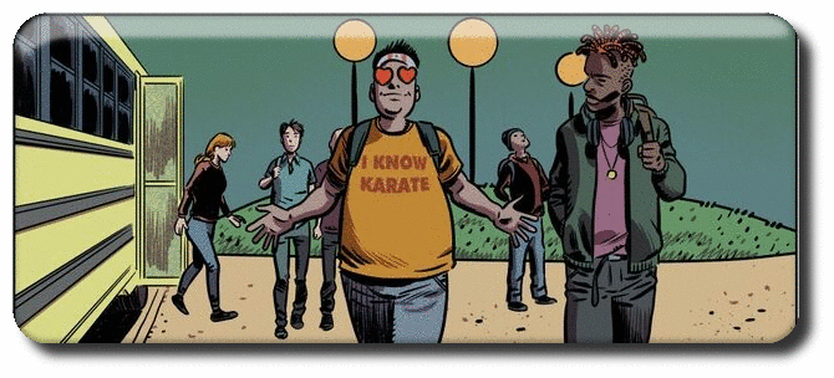 Which brings us to Slows Pokes, is this your first published comic? Technically, it is my second. I did a biography comic years ago about John Wayne, but I knew nothing about writing comics. Slow Pokes is my first original comic. It is the first time I’m self-publishing something and I hope everyone enjoys it. Slow Pokes is based on the notion of a Bio-engineered Sloth; now I mean this with the utmost respect WTF? Why did you decide on sloths? If people are saying WTF, then I did what I set out to do. The idea comes from a lunch with friends at work talking about Syfy channel movies. They had been promoting a sequel to Sharknado and I was like what’s next, Sloths become fast and kill everyone? I always had that idea in my head and when I found Comics Experience, I thought why not? I workshopped the concept throughout the class and it got good reviews. I saw the opportunity to get it produced and here we are. They are nasty evil creatures aren't they? Sloths are nightmare fuel. They look weird, they move weird, they have sharp claws. So I thought if they were fast, maybe they would just fuck everyone up. (note from Jim Mcleod , my sister in law spent six months working at a sloth refuge, I know longer allow her in the house on the off chance that she is now a sloth in skin suit) Every comic book villain needs a nemesis, who or what would be the natural enemy of a super-powered sloth? I am currently exploring that idea for a future installment of Slow Pokes, so stay tuned! And what would make for a perfect sidekick? It's an eye-eye isn't it, they are the only other creature that comes close to a sloth's natural creepiness? I’d love to do giraffes. Giraffes are my favorite animal and if they used their necks for harm, all bets are off! What can we expect from Slow Pokes? Slow Pokes is a vulgar fun-filled filled horror-comedy thrill ride that’s filled with sloths, slaughter, and slapstick. It is bloody, but most of all Slow Pokes is fun. I hope people who read it feel the same way. 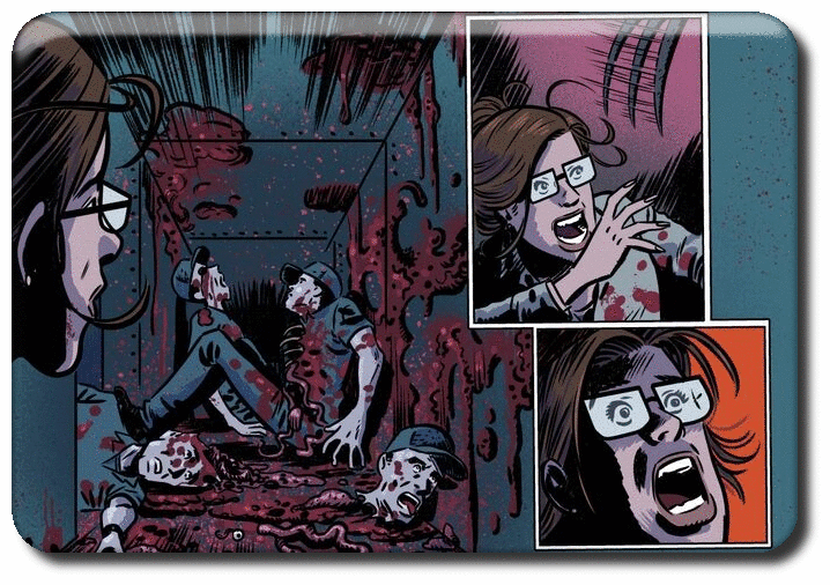 Comics have traditionally been an avenue where creators can tackle important issues, is this something that you tackle in the comic, or do you keep this as a straightforward comic romp? Without the sloths, Slow Pokes is a story about friendship, overcoming your fears, and accepting the unknown. I want to go deeper with it in future installments, but a lot of the characters and moments are drawn from my own experiences. How collaborative was creating the comic, did you, the artist and the letterer bounce ideas off each other? I was lucky that Juan Romera and the Sean Rinehart had the same vision I had. I sent them my script and they did their thing and there really wasn’t a lot of changes. I want talented people to just go. I don’t want to stifle creativity and they did an excellent job. How did you come to work with the artist Juan Romera (IDW, Monkeybrain, Comics Experience) and the letterer Sean Rinehart, (Grief, The V-Card, Dead End Kids)? I went through Comics Experience and they paired me up with Juan and Sean. I used their Creative Services program and they made sure everything went smoothly. The comic is finished, but is still awaiting its publication, what are you doing in the final stages before it is unleashed? I just got the cover finished and that was the final piece. Since that is done, I will be sending it to the printer for it to be mailed out once the Kickstarter is complete. There is a Kickstarter page for Slow Pokes, how did you decide on the perks? I have seen a lot of successful Kickstarter’s and thought this is the platform I can be really creative with. I thought about things that I would want if I were buying this and what is doable. 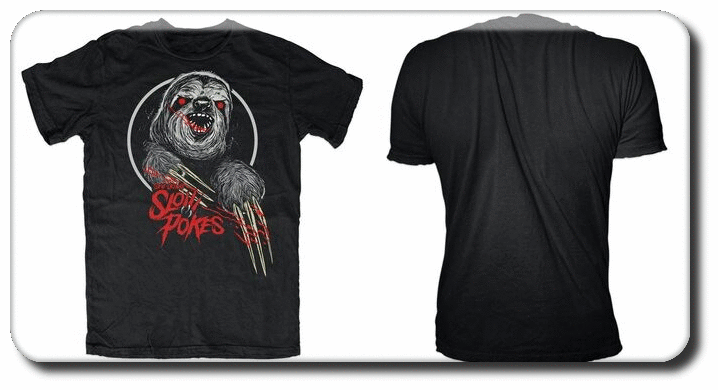 I'm really interested in the theme song written by Blake Raines, I haven't seen this before in a Kickstarter, how did this come about? Blake and I have been friends for a long time, and he is incredibly talented. I knew a song would make the comic stand out and it was an easy decision to make. I messaged Blake and he was on board from day one and we got it. He did the instrumental and wrote most of the lyrics and I wrote a few lines myself. He produced it in his stuido, and it is a fucking bop (as the kids say)! How many comics have a theme song? I just wanted to stand out and do something different. How can the readers of Ginger Nuts of Horror help to spread the word for Slow Pokes? This interview helps, but please share on your social media channels. Tweet, post, call your friends, text them, go out in the streets and yell about Slow Pokes. Shake your parents if you must and tell them all about Slow Pokes! And where can we buy Slow Pokes from once it is released? I’m still thinking about that. Once the Kickstarter is over I may make an etsy or a gumroad or a site, so people can get a copy. What's next for you? Due to my Kickstarter being successful, it means more crazy ideas can come to life. I am working on another comic with hopes of releasing next year and then Slow Pokes II. Eventually, I would like to do a serious comic or something with more of a serious tone, but I’m just having so much fun doing this. Thanks, Steve, this has been a blast do you have any final words of the readers? Thank you to everyone for reading this and thank you to whoever purchased Slow Pokes. This is a dream come true and it is extremely exciting. Please add me on social channels (Twitter and Instagram) at @TheSteveUrena and @SlowPokescomic and feel free to reach out. I also want to shout out everyone who helped me with this project. From Juan Romera and Sean Rinehart to Vertebrae 33 who made the poster, to Kristin Greco who made the trailer, to Brian Dinonno who made the logo, to Blake Raines who made the theme song. Can’t wait to share this with the world. Hopefully people like it. Thank you, Ginger Horror Nuts,! Click here for Slow Poke's Kickstarter page, where you can get full details of the perks on offer. I've gone for the T-shirt option   Robert P. Ottone is an author, teacher, and cigar enthusiast from East Islip, NY. He delights in the creepy. He can be found online at www.SpookyHousePress.com, or on Instagram (@RobertOttone). His collections Her Infernal Name & Other Nightmares and People: A Horror Anthology about Love, Loss, Life & Things That Go Bump in the Night are available now wherever books are sold. WEBSITE LINKS https://www.amazon.com/Robert-P.-Ottone/e/B07Y5FGHQK%3Fref=dbs_a_mng_rwt_scns_share https://www.instagram.com/robertottone/ https://www.instagram.com/spookyhousepress/ Could you tell the readers a little bit about yourself? I’m Robert P. Ottone, horror and YA author from New York. Which one of your characters would you least like to meet in real life and have them complain at you about they way you treated them in your work. I would say the character Royce in my collection Her Infernal Name & Other Nightmares. She’s entirely too manic and intense, not to mention, the fact that she has a dark side might be problematic. Other than the horror genre, what else has been a major influence on your writing? Growing up in the 80’s and 90’s, and having parents who believed in me watching and exploring a wide variety of film and art. I didn’t know many other kids my age who grew up watching The Shining, reading Jurassic Park, or enjoying Toho’s Godzilla movies. The term horror, especially when applied to fiction always carries such heavy connotations. What’s your feeling on the term “horror” and what do you think we can do to break past these assumptions? I love when people think a show like NCIS or CSI is horror. It is, in some respects, gory, but these are cop stories, not horror stories, so, it’s interesting to see so many other genres lift from horror for their storytelling. I don’t know how we can break past these assumptions. I think mainstreaming more names in horror might help, so that the first and only person people have to reference isn’t Stephen King? There are plenty of other authors who could use the love, too, so, pushing new authors, which I think is what folks are trying to do with Josh Malerman, with Birdbox being everyone’s favorite Netflix movie a couple years ago, is key. A lot of good horror movements have arisen as a direct result of the socio/political climate, considering the current state of the world where do you see horror going in the next few years? I was in this great children’s literature conference over the summer, and they referenced the idea of ignoring the pandemic in your writing. There’s been discussion about that in the horror community, too, and I know, personally, outside of a comedy story I wrote that has absolutely nothing to do with horror, I won’t be writing about it. Unfortunately, I think this means more pandemic stuff in the immediate wake, followed by potentially tone-deaf adaptations of said material. Given the dark, violent and at times grotesque nature of the horror genre why do you think so many people enjoy reading it? Do they, though? I know folks who run away from spiders yet love true crime nonsense, where there’s never any payoff, unless the person is already in jail. George Romero used to call his fans “trolls” in the nicest way possible, and I think that remains true today. There are trolls like us, people who seek out horror, whether it’s an escape or a doorway into a world more interesting than our everyday, and there are the normies who like their true crime stories of dead people where the offender is safely tucked away behind bars. The hardcore will always seek out the next big thing. If we’re lucky, there’s some crossover to the commercial world giving the work some love, like in the case of Birdbox or the works of Stephen King. What, if anything, is currently missing from the horror genre? I think there’s more than enough room to get a little weirder. Where’s the Clive Barker resurgence? Is that going to happen with the reimagining of Candyman? Can it, please? There’s more than enough room to get a little weirder with crossover horror lit. Let’s shine a brighter light on folks taking horror into stranger, darker places, because that’s where the fun is. In the past authors were able to write about almost anything with a far lesser degree of the fear of backlash, but this has all changed in recent years. These days authors must be more aware of representation an the depiction of things such as race and gender in their works, how aware are you of these things and what steps have you taken to ensure that your writing can’t be viewed as being offensive to a minority group? There’s certainly value in seeking the attention and aid of sensitivity readers. I, personally, love and adore the First Nations belief system, even though I’m a boring white guy from New York. To that end, if I want to write a story or novel that incorporates concepts from the tribal nations here in the United States, I’m going to do exactly that, but with the guidance and watchful eye of those I’m writing about. It’s always been important to write correctly when writing a character of a different gender or race. I asked for two women of very different backgrounds to read a story about a character I didn’t want defined by her femininity for Her Infernal Name & Other Nightmares, and the feedback was different but helpful. Does horror fiction perpetuate it’s own ghettoization? For sure. It’s unfair to say it doesn’t, because this happens to every genre. For every beautiful, honest, thought-provoking romance novel, there’s the counter. For every brilliant spy thriller, there’s the cheesy knock-off. Just as there are garbage-tier B-level horror movies, there are garbage-tier B-level horror novels, and mine are probably there, too, but there’s an audience for all of it, which I think counters the notion of “ghettoization” to a point. Who doesn’t love a direct-to-video schlockfest from time to time? It can’t be all A24-level horror all the time, we need The Asylum once in a while. What new and upcoming authors do you think we should take notice off? Michael Jess Alexander is an amazing horror author whose collection I just published via my indie label Spooky House Press. I’m biased, but his work reminds me of Brian Evenson, an author I adore. What are the books and films that helped to define you as an author? I’ve been waiting my entire life for this question. Mark Z. Danielewski’s House of Leaves is probably my favorite horror novel of all-time. I’d have to list Brian Evenson’s Songs for the Unraveling of the World on there, too, along with Stephen King/Richard Bachman’s Thinner. John Saul’s Suffer the Children is a close second to House of Leaves, too. Movie-wise, Jaws is top-five horror for me. Zodiac, Halloween, The Thing (both/all three), Dogs Don’t Wear Pants, The Droving, Black Christmas. Blue Velvet is the movie that made me want to try to write in the first place. Same goes for Day of the Dead. Are there any reviews of your work, positive or negative that have stayed with you? Not so much with me, in terms of negative, but my editor, Louis, was angry at a 3.5 rating on Goodreads. I’ve been very happy with the reactions to my work, so, I have no complaints. What a boring answer that is. What aspects of writing to do you find the most difficult? Nothing, I enjoy every second of it. Writing YA is more daunting than horror, because I have to worry about getting too weird or too dark, because you don’t want to lose the audience. Is there one subject you would never write about as an author? I wouldn’t want to limit myself in any way, so, no. The novel I’m working on goes into some very uncomfortable places, for example, and I thrive in that space. How important are names to you in your books? Do you choose the names based on liking the way it sounds or the meaning? Not very important. In a lot of cases, I forget the names of my characters once the story is done. Maybe that’ll change as I get older, but overall, I choose names that I like, in that moment, or choose them as an homage to something or someone else. The lead in my story “Elevator of the Dead” for example is named after a character in one of the Silent Hill games. Writing, is not a static process, how have you developed as a writer over the years? I think by absorbing so much from mentor texts has been invaluable. Bret Easton Ellis is my hero. I worship the ground he walks on, and by reading his work, that started my thirst for reading when I returned to the written word in high school. I think by trying my hand at writing like him, taking in more from other genres, and exploring the power of word choice, I feel like I’m developing into something better than when I was just stealing Ellis’ style in my younger days in college. What is the best piece of advice you ever received with regards to your writing? I attended a reading of Imperial Bedrooms in the Hamptons when it came out and Ellis talked about dialogue. His words of wisdom were essentially to listen to how people talk and converse with one-another. This has changed so much these days, due to shorter attention spans and the constant allure of our phones, but it remains true, we can gain a lot by eavesdropping on conversations. To many writers, the characters they write become like children, who is your favorite child, and who is your least favorite to write for and why? My favorite is probably Ebba, this dreamlike pixie-goddess character I’ve featured in one of my novellas and in a follow-up story. She’s just interesting because of her background being more or less a void, and her future remains wildly uncertain. For those who haven’t read any of your books, which of your books do you think best represents your work and why? My latest work, Her Infernal Name & Other Nightmares is a good cross-section of the sandboxes I like to play in. I’ll say that, until the next one comes out. Do you have a favorite line or passage from your work, and would you like to share it with us? “Eventually, Royce’s face emerged fully from beneath a sheet of thick meat.” Pretty gross. Pretty creepy. Can you tell us about your last book, and can you tell us about what you are working on next? My last book is a collection of short horror fiction called Her Infernal Name & Other Nightmares and plays with a lot of fears I have as an everyday person. It was written at a stressful time in my life, and served as an outlet for those stressors, in many ways. The next thing I’m working on is a horror-mystery young adult novel influenced by tensions on Long Island, where I’m from. If you could erase one horror cliché what would be your choice? I like all the clichés, but I’d love to see some more “final boys” in horror. What was the last great book you read, and what was the last book that disappointed you? The last book that disappointed me was The Thousandth Floor, and the last one that knocked my socks off was The Girl in the Video. What's the one question you wish you would get asked but never do? And what would be the answer? “Hi, I’m Guillermo Del Toro, would you like to spend the next ten years building an At the Mountains of Madness franchise with other talented writers and filmmakers, a la Avatar?” Fuck yes, I would.  From waking fears to heart-breaking nightmares, this collection of short fiction is a glimpse into the terrors we face every day from the mind of Robert P. Ottone. In “The Arborist,” a woman hears the mysterious call of the forest. Five friends exploring an archipelago find themselves set upon by the island’s hungry inhabitants in “The Monitors.” A young woman confronts the mystery of her infertility in “Kelly Watch the Stars.” These works are joined by the title novella, Her Infernal Name, about the cruel intersection of desire and desperation, and many other stories crafted in the hopes of keeping you up at night. the heart and soul of horror promotion websitesWHO LET THE DEMONS OUT? AN INTERVIEW WITH THE DIRECTORS OF HOSTS, ADAM LEADER AND RICHARD OAKES
26/9/2020
 The relentlessly gripping possession thriller Hosts is coming to VOD/Digital 10/2 from Dark Sky Films. And I was lucky to be able to sit down and chat with Adam `Leader and Richard Oakes the writers and directors of this excellent tense and unrelenting horror film On Christmas Eve, an innocent couple become hosts to a malicious entity. Throughout the night they proceed to terrorize a family of five in unimaginably violent and disturbing ways. But these demonic possessions won't end with this unfortunate family; they mark just the beginning of a horrific worldwide epidemic. Beneath its nerve-jangling suspense, the film offers a dark and bloody insight into how lying to your loved ones can not only alienate them, it can completely destroy your bonds with them forever. The film follows in the footsteps of classic successes such as, The Exorcist, The Texas Chainsaw Massacre, Invasion of the Body Snatchers, and Inglorious Basterds. Hosts was written to keep viewers on the edge of their seats and leave a lasting impression Rich ‘n’ Adam reveal all! Hello guys, how are things with you? RICH - Really Good thanks! We have been on a super high with this film and excited for everyone to check it out. ADAM - Yeah great! Same as Rich, couldn’t be more excited to start the next part of the journey! Just to get a feel and by ways of an introduction to you, you have been asked to curate an all-night horror film festival, what four movies would you pick as being the cream of the crop, and what one film would you choose for a Mystery Science Theater 3000 type mickey take/ RICH - Oh good question, I think, ALIEN, RINGU, THE SHINING, MIDSOMMAR and for the mickey take maybe TEETH ADAM - Hereditary, Last House On The Left, It Follows, The Exorcist, and for the Mystery Science Theatre I’d have to go with a film called Excision. One of the best and most horrific discoveries I’ve made film wise. It’s so messed up. You should check it out! Hosts is unleashed today how are you feeling in the run up to its release? RICH - I’m 50% excited and 50% nervous coming up to the release, when you have directed, and edited your own film and seen it 82 gazillion times, you really have no idea what you have created. It could be great and received really well or it could be a brown stain smeared on Ghislaine Maxwell's prison cell bed pan. So far we have received overwhelmingly positive responses so I am quietly optimistic for the release. ADAM - I think obviously leading up to the release, especially like Rich mentioned having watched it way too many times for our own good, I began to get nervous about what others might think, but then recently I kind of took a step back from all that fear of judgment from others and remembered why we did this in the first place. Rich is my best friend, and we’ve gone through so much to get to where we are today. After day one of shooting, we were all best friends with each other, and since then we’ve all been super tight. So the fact that we’ve all made something together that we’re all massively proud of means more to me than anything, and because of that, I already feel successful. The entire Hosts journey was incredibly special and will forever hold a place in my heart... But yeah, I hope the general public dig it, haha! In terms of being on the filmmaking scene, you are both relative newbies, can you tell the readers about how you first came on to the scene and some of the events that lead you to create Hosts? RICH - I began my career as a Bin man and hated every second of it, I quit my Job and decided to shoot music videos instead focusing on VFX, people seemed to like what I was creating. By my 3rd music video I was creating videos for bands on Universal and moving onto bands on EMI and Sony. Creating features was always in the back of my mind as the long game and after doing music videos for 6 years I felt I had gained the experience to push into narrative work as a DOP. I worked on many short films and pushed from there to shooting features before deciding to make Hosts as my directorial debut. ADAM - Since I was a kid I always wanted to make movies and play music. I chose music first, since leaving school I joined a number of bands and nothing ever really clicked. So I started my own and found the other members. We’re called In Search Of Sun and we’ve been going for eight years now. In terms of how that ties into this; Well, by chance, Rich was hired to shoot our music video back in 2014 and as of that day, the two of us just clicked. We are one but the same! Not long after that, I ended up working alongside Rich and the two of us would go out and shoot music videos for other bands, including mine, until eventually we both decided that it was about time we stepped up and made our first movie. So we did, and here we are today. We may as well get the elephant out of the room; Host was released just before your film, how has having two very similarly named horror films released so close together affect the publicity for your film? RICH - Hah Ha, this comes up a lot, The thing is we had HOSTS written, shot, and edited before the COVID 19 Lockdown in the UK and was clearly up on IMDB for a year prior to that. Host on the other hand is a film centered on the recent lockdown situation. We checked IMDB for any similar film titles out the same year before we settled on the name HOSTS, which at the time there wasn't. Whether the guys behind HOST looked into that, I’m not sure, you would have to ask them. But there is no issue there, their film is getting a lot of praise and I’m hoping ours does too, aside from the title there aren't many similarities other than them both being kick ass horrors ha ha. ADAM - Yeah, well like Rich touched on, we wrote Hosts at the end of 2018 and shot it in the summer of 2019, so it’d been floating around on iMDb for a while, but perhaps they missed it. Either way I don’t mind. I’m an optimist, perhaps both movies can do each other favours having similar titles, who knows? All we know is that it’s too late to go back now. I actually watched their film a few weeks ago and I have to hand it to them, they did a kickass job. To have that pressure of getting it shot and edited with all these restrictions in place, all the way to cutting a distribution deal in time to coincide with the lockdown ‘hype’ must have been such a huge pressure on them, and knowing what goes into making a film and how time consuming it can be, I praise them for working so hard on that. Hats off to them, and I don’t take my hat off that often.  You first came up with the concept of Hosts in 2018, did you attempt to shop to film to other production companies before deciding to produce it yourselves? RICH - Not really, We have run a music video production company for the past 9 years so we already had a lot of the tools and skills we needed already in house. We also run a semi spoof youtube channel called Dark Fable Media that teaches new cinematographers how to shoot a film so it would have been a bit hypocritical to pass the buck when the rubber hit the road. ADAM - I think I can speak for the both of us here when I say that this was always going to be our baby, and will be the film that opens doors for us moving forwards with our future projects. That was always the plan, so signing it over to anybody else just wasn’t an option. It needed to be a Dark Fable production in order for us to prove ourselves as writers and directors, and I think we’ve achieved that. It’s turned into an even bigger beast than we ever anticipated. Dark Fable Media has developed a lot of music videos, what lessons from your time producing these did you bring onto the set of Hosts? RICH - A lot of the same skills and processes carry across, I do think that having seasoned myself as a music video DOP has created a unique style to my work, and perhaps enabled me to push into more creative lighting ideas, The same with the edit. When you have been editing to a musical rhythm for years, you can take that into features and work with the rhythms in different areas, whether it be the score or the movement of the actors, you get a real feel for the pace and flow of the film. As I'm used to editing to music we asked Benjamin Symons, our composer to write us 5 tracks prior to the edit for me to edit to, this ensured the music and the edit flowed harmoniously. ADAM - And to add to that, it was amazing to be able to shoot certain things to Ben’s already written score pieces in order to really get those feels, you know? Even before we started shooting the film, having that music on as background atmosphere when we were tweaking bits of the script or creating shot lists was super helpful. In terms of what we brought to the set of Hosts, I think having worked together for a few years now, the most valuable thing the two of us could bring to the table was our friendship. Don’t get me wrong, of course the in house equipment and knowledge of shooting, lighting and rhythmical editing helps a great deal, but writing, planning and shooting a full length feature film as a duo on the foundation of a solid six year friendship was the glue, in my opinion. A lot of the time, mixing business and friendship can get ugly, but with me and Rich, everything has changed for the better! We share the same ideas, the same passion, the same morals and neither of us are ever thinking about paychecks. Who was your favourite artist to work with? RICH - Well, that would have to be Adam’s band ‘IN SEARCH OF SUN’ who also did the end credits tracks for HOSTS. We have created a music video for one of these songs titled ‘HOSTS’ which releases on the 9th of October make sure you check it out! ADAM - Yeah man, the title track and music gets released on the band YouTube channel on October 9th. It will also be out across all music streaming platforms on the same day so look out for it! Many would think that it is just a case of scaling up production, what was the biggest hurdle you faced getting the film to the filming stage of the process? RICH - I think the biggest hurdle being absolute nobodies in the film industry was finding someone willing to throw money at our project to get it off the ground. As we ran a youtube channel who had a small but loyal, passionate following, we thought it might be an idea to crowdfund through youtube. What never sat well with me tho about the usual way crowdfunding is done is that the people trusting you with their money and ultimately pay for the film rarely get anything decent back, maybe a dodgy print of a poster or a home printed DVD-R of the film. We Didn't feel happy with that and wanted anyone who contributes to have something more. So What we did was offer investment into the film itself, so anyone who invests becomes a part of the film and earns a percentage of the film's revenue for life. At this point in time, before the film has even been released, all those investors have now been paid back in full and will continue to receive payments as the film sells. ADAM - I wouldn’t have wanted to do it any other way. Essentially, our board of investors for Hosts are a handful of people who trust us fully as both individuals and as a filmmaker duo. It only extends that tight nit family of awesome people on this special thing we’ve all got going on. Something that I personally think is extremely hard to ever recreate. The fact that regular people such as ourselves can benefit a little financially as opposed to an already financially comfortable investor is so much more rewarding in my opinion. I kind of see it as creating opportunities for people who could; A, do with some extra pocket money, and B, invest their money in something they’re just as passionate about as we are. It’s a win win situation all round.  It's hard to talk about the film without giving to much away, thanks to the many "watercooler moments" that are key to the film's success, in this eras of digital knowledge, how concerned are you about people talking about these and lessening the "WTF" reaction from the viewers? RICH -It is a concern, The best way to experience this film is to go in dry without hearing anything for sure. So if you want the best experience from this film, try to avoid spoilers. ADAM - It will always be hard to keep those key moments under wraps, impossible to be honest, because there really are some scenes that still to this day make mine and Rich’s jaws drop when we watch it for the millionth time, so I think people will inevitably have no choice but to talk about those moments. I mean, those scenes were ultimately the reason the industry got talking about it, which felt great (not for the people in the scenes though… Nevermind). I've got to admit; there were a couple of scenes that I am in no rush to go back and watch again, to the point where I don't think I can look at DIY in the same way. Did you ever think, boy, we might have gone a bit too far? RICH - Quite the opposite, as I said previously I have been watching this film on repeat for what seems like 82 years in the edit, you become very desensitised in that time. The film is supposed to shock and my fear was that it wasn't shocking enough. But it does seem from the feedback we have received so far, that this may not be a problem ha ha. ADAM - We went as far as we always intended, and that never felt ‘too far’. It’s intention is to shock, and by the sound of it, they do, haha! One thing we seriously wanted to focus on in the writing process were the characters, and we can’t stress enough just how crucial it is to NOT rush into a meaningless kill just for the sake of having something violent on screen to suit an algorithm. What’s the point? That’s not horror, that’s just short lived, easy to forget senseless violence. Instead, why not feel your stomach plummet when people you actually care about are in serious trouble, and there’s literally nothing you can do about it! That’s terrifying in itself because I’m sure we’ve all been in relatable situations where we feel the sheer dread and anxiety of being absolutely powerless. I know I have, although in most of those situations I was the victim unfortunately! When filming "that scene" did the rest of the cast know what was coming, and did any of them need a sick bucket? RICH - They did know what was coming, but they did seem confused that Adam and I burst out laughing every time we called cut and a few comments of “What is wrong with you guys?” did float around the set. ADAM - Haha, yep! The cast did such a phenomenal job, but one thing that always crosses my mind is if we had the time to be able to hide what was coming to the rest of the cast, like they did in the first Alien film, just to be able to see their genuine reactions would have been hilarious for us to watch. It is set during Christmas, and you filmed the outdoor scenes during the winter, what challenges did that throw up? RICH - It threw up a few when we first tried to film these scenes in the summer, something about the blossoming flowers and butterflies just didn't quite work so we put the film on hold for 6 months and shot in the winter. It turns out it was the coldest night of the year and the poor Girls were out in thin dresses in the icy night. Half of our equipment died a death right there. But we got through. ADAM - Shooting the majority of it in the summer was such a challenge. Obviously the film is set mostly at night, so come 3am, we were boarding up all the house windows and waiting for the damn birds to stop singing. But waiting for the winter to shoot those outdoor scenes was definitely the right call, even though we were all freezing to death, haha. The cast of the film is very small, did this allow them to riff off each other? RICH - it was a very intimate cast and crew, 20 people all in all. But to be honest we were tripping over each other as it was in that small bungalow any more would have been a nightmare. It was like a family all going mad together for 10 nights, we all loved each other and had such a great time, there were no complaints, everyone chipped in wherever they thought something needed doing and it was the best shoot of my life. The cast became very close, combining that with the long all night nature of the shoot and confined spaces really brought magic from the cast onto the screen. ADAM - I cannot praise the cast enough. They’re all just phenomenal actors. The way they bought the script and those characters to life was just pure magic. They’re all insanely talented and I can’t wait to see what comes their way next! One of my favourite scenes in the film is set in the attic, where Samantha appears to relish her role as a soulless killer, how many times did you have to shoot that scene, it looks like it was perfect for the cast cracking up? RICH - Like I said before us and the cast are so close we are like siblings especially Nadia and Neal as we go way back. Now and again we like to prank each other, especially Nadia. We did that dribble shot about 15 times, I think the first one is perfect. We just had fun making her have to get dribbled on a lot ha ha. (this is actually be the reason we wrote it in in the first place but shhhh) ADAM - Yeah, that entire night shooting in the attic, I think Nadia had it the worst! Not only the many, many dribble retakes, but I remember taking Neal aside before we started rolling and telling him to make Nadia feel as uncomfortable as humanly possible, and I’m sure you can tell that this comes across on screen. Bless her. I'll assume that wasn't all her spit; there had to be some SFX involved there? RICH - It was a saline solution I believe. ADAM - Or was it... In terms of casting, when did you know that you had the perfect actors for Lucy and Jack? Samantha looks like she wouldn't say boo to a ghost, at least with Neal he has that look in his eyes ( no offence Neil) RICH - Neal was cast before there was a script and he even sat in on the writing sessions and offered ideas, many of which ended up in the final film, he is one of my best friends and an incredibly talented actor. Sam was a different story, we initially didn't cast her (stupid I know) but the Actress we cast pulled out 2 days before the shoot because she demanded a private villa or something which we couldnt provide. So Neal stepped in and Recommended Sam and she stepped up, learned 20 pages of script for the first day of shoot and smashed it! Then there is the pure dread the both of them bring to the screen when it hits the fan, Incredible! I really can't rate these 2 enough! ADAM - Yeah, the fact that she literally had to learn 20 pages of full on dialogue in like a day and totally nailed it only shows how talented she is. Not only that, but later on in the film, the times where she isn’t speaking at all, the way she composes herself, the expressions she pulls off, her movement and her overall presence throughout Hosts is a product of sheer talent. Same goes for Neal. The guy is a chameleon. One minute he can play the kindest, most thoughtful dude in the world, and then the next, he’s a cold blooded devil. There will never be a better Jack and Lucy. In terms of extraneous plot, Hosts is a very tight and lean film; you don't waste any time with needless supposition or explanations. Is there a draft of the script where everything is explained fully? And are you concerned that some people might not like that the film isn’t all wrapped up in a nice neat package? RICH - What you see was what was written. Our favorite films are the ones that don’t give you all the answers, they are the ones that sit with you or make you have a second watch. We wanted to create conversations and theories about the non spoken elements of the film. There is a lot of allegory hidden in there if you want to look. On the flip side of that we didn’t want to make a film that you couldn't follow, you needed to be able to just mindlessly watch with some popcorn and find enjoyment that way too. ADAM - There’s a time and place for handing people things on a plate, and there’s a time and place for leaving things open to interpretation. Sometimes we don’t always know what’s next or what’s likely to happen in the moment, and if anything, not knowing makes it that more frightening. In this instance, it’s impossible to just close the book and be done with it. Your imagination runs away with you, and before you know it, you’ve got your own theory based on what you think should happen, or what you want to happen and sometimes that keeps us awake at night. The unknown is scary! Where did the inspiration for the demonic plague come from, and what is the significance of the TV? Rich - Growing up in the church I read a lot about the history of demons and the end times etc . What I find interesting is their origins. God initially made them as his children but they were ultimately banished. The whole film is a duality between the henderson children who feel let down by their father in our reality and the demons who are angry that they were cast out by their father God. Mixing these themes together created some really interesting concepts. The TV is very Metaphorical being Michaels inheritance that he must pass on, it represents the truth of a situation in plain sight that noone wants to look at and after knowing the truth nothing can go back to how it was. We inherit a lot of our problems and flaws from our parents, and the fact that Michaels inherited the TV from his father makes you think what did Michael's father do to pass on his demons to him? ADAM - I’m huge on metaphors, and being able to express something that happens in day to day life via the use of horror can really help emphasise a powerful message. There are layers to this film, there’s so much subtext. On the surface, what you see is obviously what you get, then you’ve got the metaphor of your truth being locked away because you can’t face it, only to manifest itself as a demon and eventually finding its way out to destroy everything you love, all because of your own selfishness and deceit, which you were too cowardly to take responsibility for, and all of a sudden there’s this negative, unstoppable domino effect. Then there’s the whole biblical story similarity, which is another layer in itself! When writing it, I was super keen on involving the supernatural element, not because I believe it, but because I find it fun and fantastical, and I grew up watching films like The Exorcist, Poltergeist etc, so it was a huge influence on me. Rich is more into the real home invasion type films, things that can actually happen in real life. So with Hosts, we married the two and it works well I think. The visceral side is very real and, let’s face it, could and does happen, and the supernatural side is a platform to tell the story on, in order to elevate that metaphoric message. Some of the scenes make excellent use of colour grading, was there a reason other than it looks really cool for this? Rich - Most horrors we see are bleak and desaturated, we wanted to have the welcoming warmth of the home evident representing the seemingly happy family at christmas and slowly bring in that cold darkness in the outside scenes and finally into the house as the film progressed. I’m a fan of classic horror and wanted to give a timeless feel to the film and using very tungsten lighting gave a more classic feel. Juxtaposing that with the steely cold blue on the outside and mirroring the eyes helped shift the tone of the final scenes to elevate the horror and the feel that the outside is coming in. ADAM - Rich is a cinematic genius. Need I say more? You wrapped up shooting of the film just before lockdown hit the country, but the film could be seen as a metaphor for what has happened since. Stay indoors, don't socially mix, and wear a mask. How would you feel if Hosts is tagged as a pandemic horror film? Rich - I see the resemblance for sure, and people will put their current fears onto a film that has a lot of ambiguity. But personally I wouldn't want to push it that way, everyone and their mums have asked us since if we should do a pandemic locked in movie and I'll be honest, I’m not interested. If everyone is having the same idea then it won't be original to do that film and I personally wouldn't feel comfortable trying to cash in on a world wide tragedy that has claimed the lives of thousands of people just because It’s currently on trend. ADAM - We’re not about following trends. We’re not about making a quick buck. We’re about telling powerful stories and making films that leave you thinking about life, the ones you love and encourage personal growth, and sometimes, to really learn a lesson, you need something drastic and traumatic to slap you in the face. And on that note is the film a metaphor for anything? Rich - Yes it is, the theme of the film is failed fatherhood and is laced throughout if you know where to look. ADAM - If you lie to the ones you love, it will always find its way back up to the surface after consuming you for so long. It’ll destroy everything you love! How happy are you with the film, if you could go back with a magic bucket of cash is there anything that you would change? Rich - hmmm, you know what? There may be some things I would change given more budget, but I do feel that the lack thereof made the film and the whole experience we had together as a family on set the most amazing experience ever, and I wouldn't change that for the world. ADAM - I wouldn’t want to change anything. Sure, having a higher budget always means bigger, but not necessarily better. I feel like a lot of films these days can spend millions on crazy elaborate sets and CGI etc, but then, more often than not, the story gets left behind. You don’t need an endless pile of cash to tell a compelling story. The film is distributed by Dark Sky films, what does working with a company like them bring to the table? Rich - Dark Sky are amazing and they showed us from day 1 that they understood our vision and what we creatively made with this film. We really didn't want some corporate company throwing numbers and algorithms around, Dark Sky are that continuation of the family of HOSTS and they truly believe in the film like we do and that was so important for us as a distributor. ADAM - We had our eye on them for a while, and having them keen to sign with us was a dream come true. They’re an incredible team of people who, like us, are fans of horror first and foremost. Hosts is released on 2nd October, where can we watch? Rich - US and CANADA for now not sure on them all but most VOD channels including APPLE TV and ITUNES, Playstation store etc ADAM - Follow us on our socials too Facebook/hostsmovie Facebook/darkfablemedia Instagram - @hosts_movie, @darkfablerich Twitter - @hostsmovie, @DarkFableMedia So what's next from you guys? Rich - We have 3 more films written and they are some crazy shizzle, just watch this space! ADAM - Yep, what Rich said. The world isn’t ready for what we’re about to pull out the bag! tune into tomorrow for my review of Hosts   Ginger Snaps: Mini Interviews with Bite! Ginger Snaps is a brand new segment for Ginger Nuts of Horror. It is a quick-fire “bite-sized” interview, where your answers relate to what you’ve been doing in the past month (30 days or so). Keep your answers short and sweet, but also add your own flair where you can. Please include a brief bio, a photo that we can use, and any links that you would like us to add to the interview. Tell us: Who are you? My name is Joshua Rex. I’m an author of speculative fiction and historical nonfiction. Your signature style: I write literary horror. The primary themes of my fiction are memory and the inescapability of Time. My historical research/writing deals primarily with the American Victorian era. Toot your own horn: I’ve worked as a luthier. I can cross stitch (poorly). I can “eat and drink” in the Thai language. Books read: Currently: Famous Men Who Never Lived by K Chess; The Chronicles of Stephen Foster’s Family (Vols. 1&2) by Evelyn Morneweck Movies watched: The Basil Rathbone Sherlock Holmes—on repeat. Games and/or music played: Currently: Vertigo by French harpsichordist Jean Rondeau; and lots of Fleetwood Mac. Words written: My new collection What’s Coming for You: Stories is available now at Amazon. Future stuff: My novel A Mighty Word, which involves a city poisoned by the runoff from an anti-depressant factory and the “civilized undead” the chemical awakens, will be released in the spring of 2020 from Rotary Press. Brain worms: I’m guessing this means what’s been in my head the past several weeks? If so: White Sands, NM; cholla cacti; Fraiser; N/A gimlets; Currier & Ives prints.  Bio Joshua Rex is an author of speculative fiction and historical nonfiction. His horror collection What’s Coming for You was released in August, 2020. He lives in El Paso, Texas. Links Website: www.joshuarex.com Goodreads: https://www.goodreads.com/author/show/7905036.Joshua_Rex Twitter: @JoshuaRexAuthor Instagram: @joshua_rex_author Amazon: https://www.amazon.com/dp/B08GCVY75L  In these ten unsettling tales—the debut collection from Joshua Rex—cities and houses become predators, mothers macabre curators, dormant antique coats and colonial legends revivified dangers. A psychometress resurrects a rapacious fiend, and a psychologist counsels an eerily familiar patient. A man returning home to bury his father is forced to exhume a horrid secret, and a bullied adolescent’s game-winning shot is not only a team victory but a bloody and visceral personal triumph. Uniting these doomed is the unequivocal certainty that what is coming is coming for us all. Includes: The Leap. Breakout Season. The Unfinished Room. What’s Coming for You. A Mother’s Museum. Coattails. The Whispering Wheel. The Reveal. In Situ. A Voice Below.   L.C. Barlow is a writer and professor working primarily in the field of speculative fiction. She has studied with popular writers, including Nancy Holder, Elizabeth Hand, and James Patrick Kelly. Her fiction has reached over sixty-five thousand readers and garnered praise and multiple awards. Barlow’s horror trilogy – Pivot, Perish, and Peak – was picked up in 2018 by California Coldblood Books, an imprint of Rare Bird Books. The first of the trilogy, Pivot, was released in October of 2019. Perish will be released in October of 2020. Peak will be released in October of 2021. Barlow lives in Dallas, TX with her two cats, Smaug and Dusty. WEBSITE LINKS Amazon Link: https://www.amazon.com/Pivot-L-C-Barlow/dp/1644280531/ Audible Link: https://www.audible.com/author/LC-Barlow/B00CRQLPCM Book Trailer: https://www.youtube.com/watch?v=utwJ0g6cvLo Author Website: https://lcbarlow.org/ Twitter Link: https://twitter.com/LCBarlowAuthor Instagram Link: https://www.instagram.com/lcbarlowauthor/ GoodReads Link: https://www.goodreads.com/book/show/44579050-pivot Could you tell the readers a little bit about yourself? My name is Lindsey Barlow, and I am an English professor at a community college, as well as a writer. I have been writing stories off and on since probably middle school (though I did recently find one of my first stories that I wrote in kindergarten). When I started college, I began writing more seriously – so I’ve been writing seriously for a little over a decade, now. I have a wide array of hobbies in addition to writing. I like to travel on my own and have visited many European countries, including England, Ireland, France, Italy, Switzerland, the Netherlands, Liechtenstein, Germany, and the Czech Republic. I lived with a host family for a few months in Talheim, Germany, which is halfway between Stuttgart and Frankfurt, while teaching their daughter English. I have gone ziplining, parasailing, skiing, and indoor skydiving. I attended an intensive acting workshop at the William Esper Studio in New York City for several months one summer. Before becoming a professor, I had an array of jobs, and I volunteered in an Emergency Room for about a month. I enjoy outdoor activities and recently re-achieved my backflip, which is saying something, since I’m nearing my mid-thirties. Which one of your characters would you least like to meet in real life? I would least like to meet Cyrus Harper in real life. Cyrus is the “primal father.” What I mean by that is that he is the unstoppable adoptive father who heads the following, has unearthly tools at his disposal, and is able to discover those who blaspheme before they can stop him. To Jack, the main character of the Pivot-verse, he is a charismatic and maniacal mentor (think Charles Manson meets Lucifer from Supernatural). The immenseness of Cyrus, and the details of him, came about in the act of my writing. In other words, I didn’t plan him in the way he revealed himself, and so there were moments where he was a surprise to even me. He has no remorse and is willing to do anything to achieve what he wants. I definitely would not want to meet him. Other than the horror genre, what else has been a major influence on your writing? My studies in English during my BA and MA had ensured my exposure to more literary works that I loved just as much, like Moby Dick (which greatly influenced me). In addition, I also ventured into the sexier, semi-mystery, semi-fantasy, and semi-erotica works of Laurell K. Hamilton right before and then during my MA. I primarily read her Anita Blake series, falling in love with the variety of her characters and the sexiness imbued in each and every one. Though the series often had me rolling my eyes, it also had me smirking, and I devoured about fourteen or so of the novels. One other literary influence was actually not really a book at all, but rather a theory that I took to heart and mind very earnestly during my MA—Jacques Lacan’s psychoanalytic theory. Lacanian theory aided me not only in deconstructing television series during my first master’s, but also in getting into the psychology of my own characters, of deconstructing them, as well as simply understanding the movements of plot. Though Lacan did not necessarily help me write, he did help me understand. Many times, when encountering new ideas that might have otherwise seemed foreign to me, I am able to hook them onto something in Lacanian theory so that I can more quickly absorb what there is to know. The Lacanian Subject by Bruce Fink is despised by many graduate students, but I truly appreciate everything it offered and don’t know where I would be in my academic or literary career without it. Lacan shows me a different magic than, say, Anne Rice or Stephen King—the magic of the human mind. The term horror, especially when applied to fiction always carries such heavy connotations. What’s your feeling on the term “horror” and what do you think we can do to break past these assumptions? My psychoanalytic graduate school background is probably going to show here. Horror is the abject, which Kristeva discusses quite a bit in Powers of Horror. It is that which disturbs the sense of identity and reality – a breakdown in the self and other, to where they mix in interesting ways. One example of this would be a person staring at a cadaver and having the sense of self break down to the point that one feels like one is the cadaver. Thus, horror could be found in the simplest, most mediocre of things. If one has seen the movie Incendies, what causes the utter breakdown of a woman’s sense of reality and identity (inside and outside) are three dots on the back of man’s ankle – a man that represents two men (which is, of course, the Lacanian split subject). One essential piece of the abject (and of trauma) is that it is not expected. I think the “easy” route to exploring the unexpected is through jump scares or the gross out. Through a bit more work, though, it could be three dots on the back of an ankle or the sound of a silver spoon in a teacup. I think that to break past assumptions of horror, horror has to become more complex, in that how authors explore the unexpected is beyond the easy “jump scare” or “gross out.” That is, the plot and story need to lay out certain rules that get twisted, such that what was once thought to be inside is outside and vice versa. I hope this makes sense. A lot of good horror movements have arisen as a direct result of the socio/political climate, considering the current state of the world where do you see horror going in the next few years? Due to the current socio/political climate, I can envision a lot of horror stories revolving around the following: climate change, the end times, the patriarchal cult, matriarchy, chemical warfare, nuclear war, genetic experiments, zombies, and dystopias. I’m sure this is just the tip of the iceberg. Given the dark, violent and at times grotesque nature of the horror genre why do you think so many people enjoy reading it? People have to be civilized day in and day out for the sake of their survival. There are, of course, wonderful things about civilization; however, to be required to be civilized – without any community-oriented way of burning off steam – means that people are often wound tight. For six weeks I took an acting class at the William Esper Studio in New York City one summer. (I did this because Daniel Knauf recommended acting classes so that authors could see just how difficult it is for actors to bring a character to life). While at that studio, I discovered that it is very difficult for most people to remove the mask of civilization. Even in a room where people are given the permission to scream and cry, to bring things to a boiling point, they have lost much of the ability to do so. They have to re-learn how not to be civilized to one another, to scream, to cry – essentially, to be human again. And when they do finally find a way to take off the mask of civilization, it is an accomplishment. I feel like reading and writing horror does something similar to acting. It is a way of exploring that which is not allowed in society, of finding a way to remove the mask of civilization that we don’t know how to take off, anymore. It is, one could argue, a way of staying sane, since horror is willing to admit something about us that nothing else is – that there’s something about us that isn’t civilized, and that it’s okay to acknowledge that. What, if anything, is currently missing from the horror genre? I’m not sure that I can argue anything is missing from the horror genre, right at this moment. It may simply be that there are aspects of horror that are not yet mainstream, and, thus, you have to dig a little to get to them. From my own perspective, there are aspects of horror that I simply haven’t experienced yet; for instance, I’m just now reading my very first military sci-fi/military horror novel by Weston Ochse, and it’s fantastic. At one panel, I remember an author saying that genre is just a way to advertise, and many things that could be classified as horror are often instead classified as a different genre that is, perhaps, more marketable. So, one could argue that horror pervades the other genres, too, and is simply not named. What new and upcoming authors do you think we should take notice of? I would like to mention Barry Lyga (I Hunt Killers), Josh Malerman (Bird Box and Black Mad Wheel), Lucas Mangum (Gods of the Dark Web), Stephanie M. Wytovich (Brothel), Maria Alexander (Mr. Wicker), Sylvia Moreno-Garcia (Mexican Gothic), and Rena Mason (The Evolutionist). Are there any reviews of your work, positive or negative that have stayed with you? I tend not to read very many reviews because they can become an obsession. There are a few, however, that have stuck with me. Several readers have either compared my writing to Poppy Z. Brite’s or stated that my writing is what Stephen King’s is lacking. Though I don’t feel like I am deserving of this praise, it does encourage me on those nights where writing is tough and slow, and I’m doubting myself. Most recently, I had someone write to me on my Facebook author page and say that he reads about 100 books a year, decided to give my book a shot, absolutely loved it, and cannot wait to read the next in the series. It meant so much to me, especially since he said he doesn’t use social media. He had gone out of his way to find a means of contacting me. Second to last, the Publisher’s Weekly and ALA Booklist reviews of Pivot were just so meaningful, so positive, and it just felt like they vaulted my understanding of myself to a new level. They were also quite unexpected! Finally, Josh Malerman’s and Weston Ochse’s blurbs for Pivot, as well as Wes’ blurb for Perish, blew me away. I don’t know what I would do without these people. What aspects of writing to do you find the most difficult? Whew! This is difficult to answer. I’ll start off by saying that the only thing harder than writing is not writing. It’s a beast, and there’s a lot of blood, sweat, and tears poured into each novel. One thing that’s hard is you really have to get into the world, much like an actor gets into character, and you have to live there for a while. Being so immersed in it, you can feel overwhelmed because at times, it feels like you’re carrying it with you to the grocery store, to class, to your doctor’s appointment, etc. It’s there, begging for your attention. At least, that’s how it was a lot of the time for me. I am curious if this will change as I continue writing. In addition to this, though, good art I suspect is always incredibly difficult. I remember going to an art gallery and hearing various artists talk about their work. One pointed at three different twenty-foot sketches he had created and described them as “Sisyphus pushing a boulder up a hill.” It’s so true. Writing is like that. At the same time, what can be so difficult is the isolation – the four walls all around you. It doesn’t matter if those walls are a mansion or a shack. It’s the same four walls, and they’re always there. You have to get out, you have to live, you have to travel, to go to restaurants and cafes, in order to continue to write, in my opinion. I think this is one of the reasons why writers pursue writing conventions so much. We need them. The wait is tough, too. This has more to do with publishing than writing, but waiting on a response or critique can be so difficult. It was about two years between when I found an agent and when my books landed with a publisher. In those two years, I did several revisions, and before the agent, I did several revisions, so there was a lot of writing and waiting for feedback and writing and waiting for feedback. I also think that going back to square one after finishing a novel is tough. If you can imagine putting years and years of work into a novel or two and then starting a brand new one, it feels a little bit like finding your sea legs again. That’s because all novels are different. I remember a fellow writer telling me one time that writing the second novel is tougher than writing the first, and I think that that’s right. It’s because as a young writer, you’re still getting your system down, the elements of plotting down, and you accomplished it (somehow) in the first novel (woohoo!) and guess what! You have to do it again! But differently! This is how you learn, though. It’s part of the process. Is there one subject you would never write about as an author? I can’t think of a subject on which I would never write. I suspect I do have some boundaries; however, I also think that phrasing and plotting is paramount and that almost anything can be phrased, plotted, etc. in such a way that it is palatable. Writing, is not a static process, how have you developed as a writer over the years? My process of writing changed dramatically over the course of producing my first book. Pivot was originally self-published, and when I wrote the novel, I didn’t really know anything about writing. I wrote the chapters alternating between past and present, with two plot lines that complemented one another. When I finally met up with several people who were willing to help me produce a more professional, publishable version of the novel, they helped me to significantly change, enhance, and build those different plotlines. When an agent took on the novel, he wanted me to separate the book into two books. At first, I declined, but as time went on, I realized that the book needed to be separated into two, that my agent was right, and I did so, taking the time to build the first one up and knowing the second one would be the second of the trilogy and that it needed to be built up like the first one. The thing, though, was that I had really kind of built that first book through trial-and-error. I had written over 1,000 single-spaced pages to produce a 250-page single-spaced novel, and even though I had managed to make it work, I wasn’t exactly sure how. At this time, I had started an MFA program because I had anticipated this problem. Nancy Holder—an amazing writer, woman, author, person in general—was my professor for two semesters and two residencies, and she told her classes about two books that she uses to help plot books: Black Snyder’s Save the Cat! and Christopher Vogler’s The Writer’s Journey. I immediately purchased these books and read them. Subsequently, I compared Pivot to see how much its plot points lined up with the 15-point beat sheet in Save the Cat! As it turned out, 13 out of 15 points lined up. Thus, I was able to see how I had made the book work and move onward to the next novel. I used the same beat sheet to help finish the second of the trilogy, and I, like Nancy, will most likely use the two beat sheets from these books for every novel in the future. Writing requires so much problem solving, and these books help me better able to address those problems before seeking outside help. They help me produce things that I didn’t know I could produce, and I learn something new every time I read them. Ultimately, though, after learning how to more effectively plot, I also learned that plotting isn’t everything. There’s just something about letting the novel develop organically that is so important. Really, if you sit down and say exactly what you wanted to say when writing, you’ve kind of failed. It’s only by writing something beyond what you knew to write that you have succeeded – when you write more than you thought you knew. So, when I do pre-emptively plot, I do so while taking it with a grain of salt, and often times the plot shifts dramatically three or four times as I go back and revise. What is the best piece of advice you ever received with regards to your writing? Remember that the first draft doesn’t have to be perfect. It just has to be written. You can’t revise something that isn’t there. Once you have a draft, and someone suggests trying something, feel open to trying it. You can have several versions of the same story, and just because you take it a new direction doesn’t mean your old draft disappears if you need to go back to it. Be brave and take your story to foreign places. It’s not foreign, anymore, after you write it. Do not expect professionals to be mean. Many are some of the kindest people you can meet. You can only enter a room for the first time once. That’s why it’s important that you get your work to as optimum of a level as possible before submitting it to an agent or editor. Because once they “enter the room” (read your work) for the first time, they can’t see it nearly as objectively after. Your own objectiveness is compromised because you’ve been with the work for so long. That’s why you need workshoppers you can trust (and who know how to get you to emphasize things and back off things without being cruel or mean). In every story there are “crunchy” and “floaty” items, also known as literal and figurative. The crunchy is the bare facts that ground the story. The floaty is the unnatural, metaphorical things. Often times, writers throw in figurative things to feel better or redeem the story. The reality, though, is that you don’t need to do this. You don’t need to “redeem” the story. The more you add trying to “redeem” the story, the more work you make for yourself when revising. Trust the reader to follow you. Keep in mind the Hemingway Theory – that 10% of the story is what the author lets the audience see, and 90% is hidden. It’s very much like a glacier – the top 10% is visible, and the bottom 90% is below water. The amount of work you put into a novel is the 90%. When I wrote Pivot, I wrote about five times the amount that the book ended up being. The book is around 280 pages. I definitely wrote over 1,000 pages while constructing it. Read Save the Cat! by Blake Snyder and The Writer’s Journey by Christopher Vogler. These were books that Nancy Holder (a prolific author and one of my professors) recommended to all of her students in my MFA program. Both books have beat sheets in terms of how a story should move. When I read them, I was so incredibly impressed. Before my MFA, I had written my first novel without any plot guidance. I retroactively compared it with Snyder’s 15-point beat sheet. To my surprise, I found that 13/15 elements in my manuscript aligned. That was the Aha! moment of, “Oh, this is why it worked. I know what I did, so now I know what to do.” I regularly return to these books and always learn something new. Which of your characters is your favourite? I wouldn’t dare choose a favorite. All my characters have a place and a need that they fulfill, and they work in harmony (or disharmony) with one another. They need each other, and together they create something much greater than each one could: a conversation, a statement, etc. That being said, the character of Patrick in The Jack Harper Trilogy is a departure and contrast to the other characters. He is not so dark, he is energetic, he’s funny and entertaining; he has a sparkle. In a way, I think he (or the scenes he’s in) sold the novels to my publisher. I also had a lot of fun writing him; however, I have a lot of fun writing all of my characters. Which of your books best represents you? I don’t know about which of my books represents me, but currently, I really feel as though Perish is a solid representation of my work; however, it is the second of the Jack Harper Trilogy, and I highly recommend reading Pivot, first. Pivot, though, as many have noted, is a more claustrophobic novel, and the main character really doesn’t enter the “real world” until Perish. I was able to have a wider variety of characters in Perish, simply because the world allowed for it, and I think there is a lot there for the reader to enjoy. Do you have a favorite line or passage from your work, and would you like to share it with us? The following is one of many favorites I have: “The repetition of these particular lessons helped me—the time and effort I devoted to them. Winning a fight had nothing to do with an instantaneous surge of power and awareness but was about maintaining a sense of normality in the moment. It was about what I could forget. I got used to the sensation of a body against my body, of someone coming at me, the foreign twisting, pulling, and driving. When it became the norm, then it all fell away, much like a common denominator. Only the crosshairs, the target, the wind, the heart, the head, the veins were left. Training meant learning what one should remember and, more importantly, what one should forget. The winner is the one for whom the fight feels most like home.” – Jack Harper, Pivot Can you tell us about your last book, and can you tell us about what you are working on next? I am currently working on the copyediting of Peak, the last book in the Jack Harper Trilogy. In addition, I just finished up a dark fantasy novel separate from the trilogy titled Seize. The main character of Seize is Beryl Portant, a seventeen-year-old seer who has just entered into her sight. In her world, there are many like her (millions of individuals) who can see potential futures, as well as the past. They are the aristocracy of Tiresia, and they rule over all those who are not clairvoyant. Though the elite of this world have obvious advantages—knowing everything that might happen before it might happen—there are downsides to visions, including the threat of knowing too much and being driven insane. Thus, seers must use a drug called Imogen to stop or limit their visions, and the government requires seers to dose regularly with it. If seers do not use Imogen, the effects are obvious—their silver eyes shift to black under the weight of too much knowledge. Unfortunately, Beryl soon learns that Imogen does not work on her like it does with others, and after a particularly traumatic vision, one of her eyes turns black. In order to find a way to make Imogen work for her and to maybe reverse her eye’s alteration, she must seek help from an underground vigilante group who has mysteriously managed to thwart the seer dictatorship. As Beryl seeks this group’s help, she discovers the unexpected. There are objects in her world that have no history or future, that are invisible to seers’ perception. In addition, there are people invisible to her, in that they seem to have no future and no past. As she delves deeper into who and what these individuals are, all while seeking refuge from Tiresia’s Capital, she learns that she is at the center of a threatening change in her world—the rise of those who are outside of seer sight because they exist outside of time. If you could erase one horror cliché what would be your choice? If I could erase one horror cliché, it would be that of a character not believing what one is seeing/questioning what one is seeing. Characters lose so much time just coming to terms with the fact that what they are seeing is reality. I feel like, as a result, they seem less intelligent or less sure of themselves. I would like to see characters who trust themselves and act immediately. What was the last great book you read, and what was the last book that disappointed you? I recently read David Lynch’s Room to Dream and was blown away. It’s an incredibly short book but so well done. I also highly recommend Eddie Izzard’s Believe Me, Joe Hill’s NOS4A2, and Weston Ochse’s Seal Team 666. I can’t think of the last book that disappointed me. What's the one question you wish you would get asked but never do? And what would be the answer? I gave this answer some thought and was not able to come up with anything. You have been very thorough!  “Beyond good and evil, Pivot juggles archetypes until you’re not sure which ball is airborne and which is still in the author’s hand. A story about cracking free of your intended role in life, as plot and depth travel at the same exceptional speed.” ―Josh Malerman, author of Bird Box "Suspenseful and delightfully disturbing (...) This is a promising beginning to the Jack Harper trilogy." ―Booklist “Impressive and arresting prose drives this vivid debut. (...) Barlow’s gorgeous writing will easily propel readers through the rest of the series.” ―Publishers Weekly From the age of seven, Jack Harper is raised by the leader of a mystical cult, Cyrus Harper. Through Cyrus, Jack receives a full education in all usual subjects―economics, literature, mathematics, history―as well as one unique skill useful to a person in Cyrus's position: assassination. With the help of Roland James, a man incapable of dying, Cyrus hones Jack into the perfect weapon to use against all who oppose him. It is not long, however, before Jack discovers that Cyrus and Roland are not the only ones living in Cyrus’s mansion. There, too, exists a mysterious creature in the depths of the house with supposed immortal magic. According to Roland, this creature is responsible for all the miraculous things Jack has witnessed throughout her childhood, including Roland’s resurrection. The creature, potent and powerful, only weakens in the presence of Cyrus’s red velvet box―a dark, enchanted tool that grants Cyrus his invincibility and ensures his reign. Lonely and terrified by her life in the cult, under Cyrus's neverending watch, Jack desperately pursues the mysterious being. When they finally meet, her world is turned upside down, as he offers her more than she could have ever expected―the possibility of escape and her own secret, magical power.   Occult technology. Mind-bending hallucinations. The very fabric of reality broken down and reconfigured before your very eyes. Oh, and Bigfoot, too. All these things and more have found a home in the transgressive, transhumanist, transcendent syntax of one Scott R Jones: author, cyborg, Canadian. As the head (in every sense of the term) of Martian Migraine Press, Jones has helped preside over dramatic interrogations of Lovecraftian fiction, cosmic horror, and the weird tale. As an anthologist, he’s weaponized some of the most cutting-edge voices in the genre against its own regressive elements. And as an author himself, he has crafted a own uniquely subversive, psychedelic storytelling style designed specifically, one must assume, to turn readers’ psyches inside out. It is in that role of creator that two of Jones’ most recent contributions, his first solo collection, Shout Kill Revel Repeat, and his first novel, Stonefish, have been unleashed. Jones spoke with The Ginger Nuts of Horror to reveal the spiritual roots of his fiction, how the global coronavirus pandemic is impacting the publishing world, and what he really thinks of everyone’s favorite foot-in-mouth capitalist tech-daddy Elon Musk. Wear a helmet for this one, kids. In terms of publishing 2020 has been a big year for you, with the release of your first collection Shout Kill Revel Repeat coming right at the very end of last year and your first novel Stonefish coming out a few months later. Was there any planning on your part to come into 2020 all guns blazin’ or is that just how coincidentally fell together? That is the way it all fell together, indeed. No planning on my part anyway; I can’t speak for my publishers, maybe they knew better? I’d like to think so. But yes, it’s been a bit of an accelerated timeline since last December. Feels all right, too, if that makes sense. I feel I’m on a decent track now and I can plan for more progress in future. Releasing not one but two new books has got to be exciting, but 2020 has turned out to be a pretty chaotic year all around with coronavirus and all the global political drama. Has that taken the wind out of your sails at all? My allostatic load is HUGE, not gonna lie. Reading other material is difficult. I don’t think I’ve read a book cover to cover since March. And creating new stuff has had its challenges, although in recent weeks I’ve found reason to go on, writing-wise. Finally, new stories are rising out of the mire of my mind, so that’s nice to experience. But yes, it has been rough. Do you think the current world climate has had a positive or negative impact on these releases? On one hand, with the lockdowns people have had more time to stay indoors and read. On the other hand, people have less spending money and have a lot of other things vying for their attention. Exactly. No, I think the overall impact is negative and I think, given the world situation, that we should expect that and normalize that. Finding other ways to connect with and provide entertainment for readers is a key issue now. But then, I’m not privy to all the sales information (as I was when I ran Martian Migraine Press) so I’m quite comfortable with the idea that I am completely wrong on this and the impact of plague and cultural disaster has been a boon for books and those who read them. Who knows? We’ll find out as the years pile on, I guess. So since Shout Kill Revel Repeat came out earlier, let’s talk about that first. The stories included are very eclectic, but many of them share, at least on some level, a kind of cosmic scope and/or questioning of the nature of reality. Are these themes intentional fixtures of your work or is it something that just naturally finds its way into your stories? What is it about these themes that speaks to you? Nice question. I would say that there’s a definite lean in my work towards those perspectives first, and other themes second. For myself, I think we don’t question reality enough because here we are, as a species, on the brink of extinction largely due to our own unthinking manipulation of the planet and its resources, and on the brink of social and economic catastrophe because we can’t seem to think differently enough to fix these dangerous issues. We have the capability but we don’t seem to use it to its full capacity. So, humbly, I present these small fictions as a tonic. I hope they help readers to start seeing the planet in a new, dangerous, alien way. It’s weird here! The bulk of the stories included in Shout Kill Revel Repeat were originally published elsewhere. You’ve certainly been around the block a few times, having your work appear in various magazines and both themed and non-themed anthologies. Compiling the stories for this collection, see them all together in one place and having them laid out one right after another, were you surprised by any recurring motifs or, alternately, vast differences? Do you feel like the stories in the collection revealed any stylistic or thematic evolution for you, as a writer or just a person? I wasn’t surprised. I mean, I knew what was in there. Certainly seeing them all in one place created a kind of solidifying effect. If I didn’t know what my themes were before, then I do now! I like transhumanist narratives. I like writing about drugs, monsters, things unseen that nevertheless have a deep impact on the world, hyperobjects, the occult, AI science, camouflage. These are the big items in my bag! On a similar note, were there any stories you wanted to include but for whatever reason just didn’t fit? How well do you feel the three original pieces published for the first time in Shout Kill Revel Repeat pair with the others? I wanted to include “The Damage” as it’s my latest written story and honestly, it feels more like my recent work than, say, “Turbulence,” which was the first story of mine someone published. In case you are looking for someone to blame for that instance, look to the inestimable Silvia Moreno Garcia; “Turbulence appeared in one of the last issues of her Innsmouth Free Press. As such, “The Damage” I think points to a spot on the horizon where I seem to be heading, which is to say more intimate narratives between close characters as they come up against the world in all its strangeness. Moving on from Shout Kill Revel Repeat to your first ever novel Stonefish, I have to ask what it was like making the leap into long-form storytelling. Many authors seem to find writing their first novel a daunting task. How was it for you? And what made you want to try your hand at a novel? Why would this idea only work as a novel and not as a short story? Well, Stonefish isn’t my first kick at the can. There is a novel called The Waiting Deeps which is as awful a piece of Lovecraftian pastiche as you can imagine. In fact, it’s more Brian Lumley than ol’ HP, if that makes any sense. I have gone through my Innsmouthbreather phase, as have we all. And there’s another disaster, missing body parts and generally a shambling Burroughs-influenced metanarrative called The Boy’s Own Guide to Sorcery which I hope will never see the light. So I was ready for the grueling aspects of writing a novel when I began Stonefish. As for size and length of it, I’d approached some of the themes before, in stories like “Assemblage Point,” and I knew if I wanted to lay down the full Gnostic horror of the situations the characters Den and Gregor find themselves in, I would need more spacetime/pages in which to do it. Stonefish is set in a near future world devastated by unchecked climate change, and it tells the story of a journalist following the trail of a tech industry wunderkind gone missing, in the process plunging himself into a cyber/cosmic horror nightmare that includes sentient artificial intelligence systems, interdimensional entities, the fundamental hostility of the universe itself, and even Bigfoot. A less respectable interviewer might jokingly ask “What are you smoking?” As a professional, however, I am going to sincerely ask “What are you smoking?” It’s a special blend of my own devising. Thanks for asking! The climate change and tech guru themes are obviously very relevant to the current social climate. What made you want to explore these ideas in Stonefish? Did the process of working on this novel refine your understanding of these matters in any way? I’m especially curious how you feel about real-life figures like Elon Musk and Mark Zuckerberg. I wanted to explore them because they are there to explore and hugely relevant to our continued existence on this planet. Despite being surrounded by PNW hippies and lightworkers, despite living most of my life so far in one of the more socially and environmentally progressive places in Canada, I realized also that I didn’t know all that much about climate change, so I contacted the climate science department of the University of Victoria and sat down a couple of times with two researchers there and boy, did they help me dig down. Dig down into the terrifying meat of the problem! It’s gross in there, the situation is incredibly heinous, but they find themselves in the uncomfortable position of having to trot out the data in a way that won’t cause people to panic and yet the data is, when looked at objectively, worthy of a panic response. Or at best, a better response than what is currently being offered. I can’t do much as one man, and maybe a little bit more a writer, so in it goes. I’m writing about the 2070s, after all. I went to the experts to learn what that decade is going to be like; I made nothing up in Stonefish, that’s all legit climate science. As for Musk and Zuck and all those greedy boys, I say string em up, raid their larders, deal out the dollars to the rest of us. I mean, hell, also let them go to Mars and put chips in our brains, that’s un fait accompli anyway, and we kind of need them to do it because like it or not, historically, its wealthy whack jobs like them that are going to push the species in novel directions, BUT there’s more than enough to go around. Stonefish does not mark the first time your work has combined high-tech science with occult mysticism. What fascinates you about these topics? And what do you think the crossover is between the two? How are they connected? I’ve been a classic head for decades now, so I cut my teeth on those early psychedelic pioneers who’s main deal was the overlap between, say, poorly understood quantum physics and oh I dunno, the frequency differentials found in the angelic Keys of John Dee. Or the kabbalistic Tree of Life mapped onto the drive train for an automatic transmission automobile. At the end of the day, this is all we operate with: a series of mapped thought pathways that we can superimpose on any physical (or social, or environmental, or spiritual) system (yes, you can get all layered up with your religion and magic, it’s called the syncretic approach) with a greater or lesser degree of accuracy. In truth, I don’t think there are many actual things in the world, that much of it is camouflage in some higher-dimensional way, and that much of reality works more due to habit than anything else. Habits change, and tech (whether material and physics-based or occult ie. mental and spiritual techniques) can help change them. In both Stonefish and Shout Kill Revel Repeat, you revisit Lovecraftian ideas and themes without just rehashing the standard Mythos Iconography, tropes, and stereotypes. In addition to your own writing, you’ve also edited and published several anthologies inspired by Lovecraft. What is your own history with Lovecraft, what impact has his work had on you, and what do you think is different about the way you approach his influence compared to those who have basically just rewritten his tales under their own names? Like I said earlier, I went through my Innsmouthbreather phase as a younger man. Yes, I fantasized about having a dinner of tinned spaghetti, coffee, and ice cream with Grandpa Howie like everyone else, I’m not special! But even during the early days, it was more Lovecraft’s ideas, his way of looking at the cosmos, and the things he peopled it with (things that continue to increasingly resonate today) than the writing itself that attracted me. Right now, my connection with Lovecraft is, like many others, a kind of love/hate thing. By writing the things I do, and by editing the Martian Migraine Press anthologies, I feel I’m taking those ideas and either pulling them into the present so they can speak to our heightened sense of impending horror/knowledge or firing them from a cannon into the future where they can express themselves in bizarre and fulfilling ways. Pastiche is for, literally, the last century. We all had our fun, but no one wants to spend another minute in Arkham or Innsmouth or goddamn Dunwich. Well, speaking for myself, of course. Your mileage may vary. Referring to another Lovecraft-related work in your bibliography that predates both Stonefish and Shout Kill Revel Repeat, you’re also the author of the non-fiction book When the Stars Are Right: Towards an Authentic R'lyehian Spirituality, a kind of hybrid of a critical analysis and a philosophical manifesto. How do you feel works like Stonefish and the stories in Shout Kill Revel Repeat embody or echo your R'lyehian spirituality? Simple. We aren’t what we think or believe ourselves to be. We’re something stranger, stronger, and far more capable of navigating weirdness than we’re taught. Owning that, becoming what we are meant to become, that is survival, that is the clear-eyed appraisal of our place in the cosmic mechanism, that is the moment we can embrace our humanity in all its strangeness and put it to real, transformative work. In the stories of SKRR and to a lesser degree in Stonefish, I give my characters a path to that becoming. To put it in the faux-glib fashion of When The Stars Are Right, I try to open up the possibility that they, too, could be Keeping It R’lyeh! Some have greater success than others. Like Lovecraft, I am hampered, sometimes, by the conventions of the “horrifying weird tale”. You’ve written a fiction novel, a fiction collection, and a non-fiction book. In your own words, how would compare the processes of writing each? For you, what purpose does one serve that the other can’t? I found the writing of WTSAR to be the most relaxed process, as it’s basically a collection of essays on Lovecraftian-derived mysticism. Short fiction is intense and finishing a piece usually takes me anywhere from a couple of days to a month and change; I like writing these because they help me flesh out ideas for the longer works. The short story Assemblage Point was the moment I became really interested in the ideas of higher-order camouflage which led to Stonefish. The non-fiction lays out the philosophy and the short fiction builds on it in a specific way before handing over the results to the novel(s). It’s clunky but it works for now. Piggybacking off that last question, of those three types of writing (short fiction, long fiction, and non-fiction) what can we expect to see coming from you in the near future? I know Stonefish and Shout Kill Revel Repeat only just came out, but do you have any plans or projects in mind? I am currently digging down into the next novel, which will hold such things as religious and environmental hyperobjects, cults, memetic viral disease, and social engineering. In it, an estranged mother and daughter become victims of a group that is taking advantage of people who are hearing a “call” from the ocean. It’s not what you think, though. And in between bouts with the novel, I’m starting to pump out some more short fictions, the rona be damned! Finally, I just wanted to say thank you for taking the time to talk to The Ginger Nuts of Horror. How can readers best stay up to date with you and your work online? Best to follow me on Twitter @PimpMyShoggoth. I also exist virtually on the ol’ Facebook! My god, talk about a hyperobject! Also there is a website scottrjoneswriter.com but like most writer types I maintain it only sporadically. Thanks for having me! Interview by William Tea  A missing tech mogul... ...a jaded reporter... ...a damaged AI returned from a horrifying reality... ...and something lurking in the woods. When journalist Den Secord is tasked with locating enigmatic tech guru Gregor Makarios, he soon finds his understanding of reality under threat. At the edge of the world, surrounded by primeval forests, in the paradisiacal environs of Gregor's hi-tech hermitage, Den learns of the true nature of our Universe. This is the way the world ends. Heart of Darkness meets The Magus meets bleeding-edge psychedelic gnosticism in Stonefish, the debut novel from Scott R. Jones (When Stars Are Right, Shout Kill Revel Repeat).   Recently released in North America, The Unfamiliar is the newest addition to the horror genre. The Dark Matter Studios film deals with home invasion, possessions, exorcisms, and demonic rituals. Basically any horror trope you can think of is compiled into this movie. The film is carried by an excellent performance from lead actress Jemima West, The Borgias and The Mortal Instruments. I had the pleasure of asking a few questions to the Franco-English actress, and she was kind enough to oblige me.  Hello Jemima, Thank you very much for taking the time to answer a few of my questions for your upcoming release of The Unfamiliar here in the US. I thought your strong performance carried the entire picture and you were a delight on screen. This is my first questionnaire with a cast member of a mainstream production, so I am grateful that you are willing to give my questions the time of day. Hello Caleb and thank you for your kind words and taking the time to talk about the film. I’m very pleased to be your first interviewee. What was it about The Unfamiliar that intrigued you to sign on for the role of Izzy? The challenge of playing a strong role and having so much action to deal with in such a short amount of time. Also Henk, Llewelyn (our producer) and their magnetic energy. My biggest draw to Izzy was her sense of Proactiveness. It’s a common horror troupe for the “final girl” to always be running from the horror in the film, but Izzy is always moving towards the horror and trying to resolve it on her end. Did you have any collaboration over this characteristic of Izzy with Henk Pretorius? That’s a really interesting point. I think Henk and Jennifer who wrote the script always intended it to be that way. And I portrayed her as being so unsure of what the next event would bring that she had to find out, always, as she was constantly struggling with what was actually happening to her or if it was a figment of her imagination. There is a moment in the film where Harry McMillon-Hunt’s character is possessed by Izzy. Did you provide any coaching/collaboration to him on how to portray Izzy during those scenes? Haha. I had literally nothing to do with Harry’s performance. He was so good from the first read through I kept on being impressed by every scene he played. So when it came to shooting that part of the film, I just knew he’d nail it. Through the magic of the camera, sometimes scenes that look terrifying from the audience’s viewpoint look silly/ridiculous from the actor’s perspective. But was there any point while shooting The Unfamiliar that you were legitimately terrified? As I was doing all my stunting, some was slightly more challenging. Being completely covered and feeling suffocated even if only for a few seconds was one of the scariest moments as I literally had no control! Thankfully it was only a one shot, don’t know if I could have done it again If you could only take away one life lesson you learned from your experience on the set of The Unfamiliar, what would it be? Group effort is what pays off. We had only a very short time to shoot and every single person have it their best. We all did it together and that’s how it should be every time! There are several horror movie subgenres in the film (home invasion/possession/exorcisms) that all could have been resolved if you had a superpower. From the following list, which superpower would you want and why?
Def hard to choose between b and c but I’m going to go for the speed, that way I can get close to my favorite people as fast as possible. I love watching movies so much that years ago I started a YouTube channel where I select movies at random to watch and review; whether they are ones I own or if they are recommendations from my subscribers. What is your favorite movie, and do you have any recommendations for me to watch/review on my channel? I recently watched for SAMA the true story of a journalist and her family in the city of Aleppo during the uprising. One of the hardest and most emotional films I’ve seen this year. All the images are true. Utterly moving. Thank you very much for taking my questions, and I wish you all of the success in your career’s future. Thank you! Best Jemima THE UNFAMILIAR will release on 21 August 2020 with Vertical Entertainment in North America, followed by Lionsgate UK (digital) in the United Kingdom on 11 September 2020 and Filmfinity in South Africa on 28 October 2020. British Army Doctor, Elizabeth “Izzy” Cormack, returns from war to rekindle her relationship with her estranged family. Izzy notices numerous inexplicable activities in her house that her husband believes are due to her suffering from PTSD as a consequence of war. Izzy militantly pieces the daunting puzzle together to reveal a terrifying, invisible enemy that has infested her entire family. In a heroic attempt to save her family, she is pulled into a dark underworld in Hawaii to explore ancient mythology.  the heart and soul of horror promotion websites |


Archives
May 2023
|
 RSS Feed

|

|