

 Tim Major’s novel, Snakeskins, will be published by Titan Books in May 2019, followed by a short story collection, And the House Lights Dim, published by Luna Press in July 2019. His earlier novels and novellas include Machineries of Mercy, You Don’t Belong Here, Blighters and Carus & Mitch. He has also written a monograph about the 1915 silent crime film, Les Vampires. His short stories have appeared in Interzone, Not One of Us, Shoreline of Infinity and numerous anthologies, including Best of British Science Fiction and The Best Horror of the Year. Tim is a professional editor, and is co-editor of the British Fantasy Society’s fiction journal, BFS Horizons. Could you tell the readers a little bit about yourself? Sure. Yikes. When someone asks you that sort of a question, do you clam up as much as I do? Hmm. Interesting. I notice that I’ve already assigned you a character, I’m talking to you as a person, despite this being a template of questions in a document. You’re not a real person. But I’ll pretend you are. How are you? I like your… um, coat. So. Me, I’m a writer. I do actually tell people that, sometimes, nowadays. Parents at the school gates who ask what I do for a living. But I also tell them that it doesn’t make me much money, that I’m really an editor, mainly, that I’m trying to push the balance towards writing more and more, bit by bit. I have a background too, of course. I was a bookish kid, but that’s obvious just looking at me and taking into account literally everything I do for work and for fun. I made photocopied magazines when I was seven years old, selling them to friends and teachers. My mum let me use her typewriter that she won in a competition, upon which I laboriously copied out my favourite stories from books. I’ve always been a writer, even before I had any story ideas. What do you like to do when you're not writing? Like I say, I’m bookish. I read. I watch a lot of films, though not many modern ones. I work as a freelance editor in my attic, and I write for fun, still in my attic, and sometimes I come downstairs and then occasionally venture out to take the kids to nursery and school. My kids are five and two. I’ve been sleep-deprived and exhausted for five whole years. Other than the horror genre, what else has been a major influence on your writing? Without any disrespect to the horror genre, I’d be wary of any writer who was only influenced by one genre. I mean, a horror novel comprised of tropes from other horror novels and films, who’d want that? OK, sure, there are lots of novels and films that are exactly like that. And some of them make quite a lot of money. Good point. Either way, I tend to write unsettling fiction, whether or not it’s tinged with other genres, and while I watch a lot of horror films, other things and people that have influenced my writing are, in no particular order: John Wyndham, H.G. Wells, Patricia Highsmith, John Updike’s ‘Rabbit’ novels, Umberto Eco, Vladimir Nabokov, silent cinema, the films of Andrei Tarkovsky, Nicolas Roeg, Alfred Hitchcock, Olivier Assayas, and music of all sorts, to a huge degree. The term horror, especially when applied to fiction always carries such heavy connotations. What’s your feeling on the term “horror” and what do you think we can do to break past these assumptions? It’s a tough one, isn’t it? You and I, we’re comfortable with the term, we know how wide-ranging the genre can be. But of course ‘normal’ people shy away from horror fiction, at least written horror fiction, and SF too, despite the fact that the majority of their Netflix binges or cinema outings are SF or horror to some degree. You know what people are? They’re idiots. But I don’t have a helpful answer, other than giving each book, or at least each little wave of related publishing successes, its own identity. ‘Slipstream’ has been a useful publishing term for a while, with fairly broad appeal, but it’s just a clever way of sneaking horror and SF into the diet of the average reader. So I guess sneaking is the way to go. A lot of good horror movements have arisen as a direct result of the socio/political climate, considering the current state of the world where do you see horror going in the next few years? You do ask some good questions, hypothetical interviewer, don’t you? There’s a superficial answer to this question, I suppose, and I’m not certain I’m qualified to go beyond it. Broadly, the last two years of the real world have been utterly shitty, and it’s inevitable that new novels of any genre will be tainted with the sickly flavour of Trump and Brexit. We all have a lot of rage and despair to process. Let’s do it the healthy way: sitting in dark rooms and spending many hours writing novels. What are the books and films that helped to define you as an author? John Wyndham’s The Day of The Triffids was the gateway through which I passed from my introduction to genre, Doctor Who, to adult fiction. I still think that it, and The Midwich Cuckoos, are near-perfect combinations of SF and horror. I’ve written about The Day of the Triffids for this very site before, in fact. What new and upcoming authors do you think we should take notice of? Helen Marshall’s The Migration is astounding, combining a thoroughly weird central premise with a surprisingly direct coming-of-age tale and a mass of research about epidemics and climate catastrophes that is dizzying in its richness. I recently caught up with a few recent novels that I missed first time around: Catriona Ward’s Rawblood, James Brogden’s Hekla’s Children, Naomi Booth’s Sealed. As if Tade Thompson’s Rosewater SF novels weren’t enough to make you envy his talent, his Molly Southbourne novellas are terrific horror. Everything I’ve read by Aliya Whiteley has been utterly incredible. This is far from new and upcoming – we’re talking about 1872 here – but I recently read a bunch of Gothic classics, and I was blown away by Joseph Sheridan Le Fanu’s Carmilla, which is one of those books people say they’ve read. It’s hard to believe how much of the ‘modern’ depiction of vampire was established in this novella, 26 years before Dracula, and how much of a page-turner it is. How would you describe your writing style? Domestic. Down-to-earth. Unsettling. Cynical? But also the opposite: a bit warm. Are there any reviews of your work, positive or negative that have stayed with you? Actually, no. Any criticisms have seemed fair, but maybe that’s because no one’s been all that mean. I don’t think people set out to be mean. What aspects of writing to do you find the most difficult? Finding the time, what with doing part-time childcare of my two kids, and needing to earn money, and wrestling for writing time with everything else that needs to happen. I’m good at getting down to writing, once I’m in the right place, though. Having kids makes you concentrate when you finally get a moment. So, in fact, I don’t think of writing as difficult, or even the editing process, which I like, or even the admin aspect, as I’ve always thought of sending out submissions as a little like buying lottery tickets. Except they’re free! Writing is a cheap hobby. Is there one subject you would never write about as an author? Absolutely. I don’t go in for extreme subjects, which says a lot about my essential mildness, I guess. I’m interested in social and domestic discomfort. And aliens too. How important are names to you in your books? Do you choose the names based on liking the way it sounds or the meaning? Yes to both! I don’t agonise about names, though they often change, and often a character will suddenly feel real once they have the correct name. In my first novel, the protagonist was called Miles for the first few drafts, which never sat right for some reason, and then when I changed him to Daniel he suddenly felt like a person, though I’ve no idea why. In that same novel I also changed a character’s name, along with lots of locations, in response to getting the go-ahead from Paul Metsers to use a passage from his song ‘Farewell to the Gold’ in the book. The song seemed to have so much resonance that I reworked lots of aspects to make the parallels closer, on the afternoon before handing it over to the publisher. Writing is not a static process – how have you developed as a writer over the years? I’d hope I’ve got a little better. In terms of novels, the biggest noticeable change in my writing process is that I write lengthy synopses now – I have the entire novel planned out in great detail. My early novels were more freewheeling affairs, which doesn’t necessarily show in the end results, but which meant, say, eight drafts rather than four. What tools do you feel are must-haves for writers? I love the writing software Scrivener, which allows you to shift scenes around whilst writing. Even just as a means of visualizing the structure of a novel, I find it essential. What is the best piece of advice you ever received with regards to your writing? Nobody cares. In fact, nobody cared enough to even give me that advice – I came up with it myself. But when I started out writing, I agonised about what people would think of my work. Telling myself that, if it was shit, nobody would even glance at it, was enormously comforting. Getting your worked noticed is one of the hardest things for a writer to achieve, how have you tried to approach this subject? I only wish I knew. I’m not so good at blowing my own trumpet. I make myself available and as present as possible in the genre community, I suppose, though that’s no hardship because these people are great. I go to conferences and conventions and I put myself forward for things that make me sweaty and panicky, like delivering my first academic paper at a recent conference, tying in with my non-fiction book about the silent film Les Vampires. But definitely cons, which are also fun: win-win. To many writers, the characters they write become like children, who is your favourite child, and who is your least favourite to write for and why? I realized recently that I don’t really like many of the men in my stories. At first I worried that that’s because they’re most identifiably like me, but actually I think I just despair about men in general. Anyway, to answer your question, I’ve just written a novella featuring a female private investigator, and I’ve grown to like her voice a lot. What piece of your own work are you most proud of? I’m very proud of Snakeskins, which comes out any day now, and also Hope Island, which I’ve just finished writing, and which is far more horrific, a nightmare. And are there any that you would like to forget about? Some early short stories, sure. In the early days my influences – by which I mean literally the book I was reading in the same period I was writing the story – were too evident. Nobody wants to read a shitty Italo Calvino knock-off, or even a Lovecraft, though in fairness there are lots of copies of the latter out there and my thesis is that there should not be. For those who haven’t read any of your books, which of your books do you think best represents your work and why? Snakeskins. It’s quite direct, quite readable, I think, which I do aspire to now that I’ve shed some of my pretension. And more than anything it’s massively influenced by John Wyndham, which is absolutely where I’m at still. And I think it’s quite funny in parts, as much influenced by, say, Peep Show as any SF or horror fiction. Do you have a favorite line or passage from your work, and would you like to share it with us? This is from Hope Island, which I’ve just delivered to the publisher. I don’t think it’s a spoiler, and I can’t pin down exactly what makes me so happy with it: Somebody turned the streaks of dawn to blazing daylight and somebody brought a truck. Can you tell us about your last book, and can you tell us about what you are working on next? Well, if by ‘last’ you mean ‘most current’, then it’s Snakeskins. It’s about a group of British people who rejuvenate by shedding their skins every seven years – but the catch is that those Snakeskins are sentient and continue living for a few minutes, hours or days. It’s all about identity – how would you feel if you were faced with yourself, and how would you react if that person were a better version of yourself? – and the effect of privilege on the rest of the population. If by ‘last’ you mean ‘the one you’ve just completed’, then it’s Hope Island, which is due to be published by Titan in summer 2020. It’s got a remote island, creepy children, ethereal cave songs and, after a fairly quiet start, quite a lot of dead bodies. If by ‘last’ you mean ‘the one you started last’, then there’s the female-private-investigator novella. Did I mention it was set on Mars? I write quite a lot of Mars stories. And I’m just about to start planning another novel. Like all authors, I’m most excited about the next one. I’ve got a great XX-meets-XX pitch that I daren’t even say out loud, I’m so excited about it. If you could erase one horror cliché what would be your choice? None. They’re fine. Reading all those Gothic novels in preparation for writing my academic paper demonstrated to me that the tropes have been around for a long time. They don’t do any harm, but of course any clichés are ripe for subversion, which is where the interesting aspects of genre really begin. What was the last great book you read, and what was the last book that disappointed you? I’ve already named a lot of recent books I’ve loved. Most of my ‘discoveries’ have been older titles. I adored ‘Clarimonde’ by Théophile Gautier, which I’d imagine is about as Lynchian as stories got in 1836. I was surprised to find that John Polidori’s 1819 story ‘The Vampyre’ is kind of boring. What's the one question you wish you would get asked but never do? And what would be the answer? I don’t know. I do like questionnaires – I’m pretty sure we’ve spent more than our allocated five minutes together, hypothetical interviewer! But I wouldn’t presume to tell you what to ask. Maybe something about music? What’s the best album you heard for the first time recently? And the answer, unilluminating though it is, would be Marja Ahti’s Vegetal Negatives. I suppose this is why I don’t get to set the questions. Thanks, hypothetical interviewer! It’s been lovely spending time with you. SNAkeskins by tim major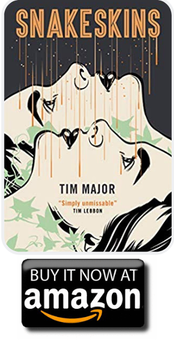 A SF thriller examining the repercussions of rejuvenation and cloning on individuals’ sense of identity and on wider society. Caitlin Hext’s first shedding ceremony is imminent, but she’s far from prepared to produce a Snakeskin clone. When her Skin fails to turn to dust as expected, she must decide whether she wishes the newcomer alive or dead. Worse still, it transpires that the Hext family may be of central importance to the survival of Charmers, a group of people with the inexplicable power to produce duplicates every seven years and, in the process, rejuvenate. In parallel with reporter Gerry Chafik and government aide Russell Handler, Caitlin must prevent the Great British Prosperity Party from establishing a corrupt new world order. Snakeskins is an SF thriller examining the repercussions of rejuvenation and cloning on individuals’ sense of identity and on wider society, with the tone of classic John Wyndham stories and the multi-strand storytelling style of modern TV series such as Channel 4’s Humans.   
The Tenants is showing as part of the Hola Mexico Film Festival at Montalbán Theatre, Regal Cinemas LA Live and LA Plaza De Cultura Y Artes. in Los Angeles on 01 June 2019, and we are honoured to bring you an interview with the director of the film Chava Cartas.
The director Chava Cartas , was born on September 15, 1971 in Guadalajara, Jalisco, Mexico. He studied photography at the Hospicio Cabañas in Guadalajara and film at the International Film and Television School of San Antonio de Los Baños, in Cuba. He began his career as director of photography in the new millennium with the short film Bala Bume Bum!, Which was followed by the feature films Love You Hurts , Dark Cities and San Pancho Athletic , among many others. His career as a director began in 2006 with the films Amor xtremo and Sexo, amor y otros perversiones 2 . In 2010 he made his first series, Mujeres Asesinas , followed by El Equipo , Gossip Girl Acapulco , Los Heroes del Norte and El Mariachi. Despite the good reception on television, Cartas returned to the big screen with Once Again and Rock Marí. Among his latest projects are the feature films Treintona, Soltera y Fantástica , Rosario Tijeras, Tenants, Mirreyes against Godinez and Solos at home, most of them premiered between 2018 and, the others, to be released in 2019. If you are in LA this weekend you can purchase tickets to the film by by clicking here Hello and thank you for doing this Interview. I have been a life-long fan of occult and possession films, so The Tenants (Inquilinos) was a real treat to watch considering many of them can be very similar. Watching horror from a different cultural lens always makes me smile because it can only further enrich the genre. As a Mexican American woman, I actively seek out these films. What drew you to this particular project? The script came to me when the producer, who I was working with preparing the film “Trientona Soltera y Fantástica”, calls me to tell me he has a great script for a horror film. To be honest, it is a very difficult genre and even more so if you don’t have a big budget to resolve all of the VFX and FX needs so my first reaction was that of horror but when I read the script I thought it was fascinating how the writers managed to tell the story, to talk about our Latin-American beliefs—one way or another there are topics that always surrounds us. In our local markets for example, you can find all types of witchcraft and “remedies or potions”, it is part of our folklore and a part that I could dare to take to the big screen. The creepiest parts for me were the bloody saints and scenes of ritual. That opening scene sets the viewer up for a very sinister story. What was your approach to filming this? Do you have any experience with Santeria? After doing a lot of research about Santeria, the saints came to play a part in the film because the base of many of their rituals was that they had to dress them up so that they could worship them, this was the common thread in all of the different practices of Santeria. One of the most important ingredients in the film was the location, an additional character in the story. I found the “vencidad” or neighborhood in Guadalajara and that is why I decided to film there, and it definitely was visually a very sinister location. Did you do any research into Santeria rituals before filming? Of course, doing research was essential because up to that point I had no direct contact with “Santeros” even though these are topics that are always present in our culture. I made it my homework to get close to the “santeros” so that I could learn and dive into their beliefs to make sure we were always portraying their beliefs in a respectful way. There are very sensitive topics that personally I don’t follow but have utmost RESPECT for. You have a wide spectrum of genres under your belt. What draws you to horror? As a filmmaker, I am more passionate about being a storyteller regardless of the genre, if a script captivates me and I know that I can responsibly talk about the theme, I film it. If the story is a horror film, well I’ll film that genre, if the story is an action film then I will be making an action film. I have a firm conviction that we should be storytellers not tellers of a certain genre. Favourite horror film and why? SINISTER (2012) Scott Derrickson This is a great example of how you combine reality with the supernatural. This story had great influence on my decision to film INQUILINOS. I felt this had dashes of The Entity and Rosemary’s Baby. Were either of these influences? Neither of them, my biggest influence was SINISTER that I believe has a very similar structure to my film. The film is set in Guadalajara and this is where you are from. Did you have ideas in mind when it came to filming locations? I loved the Santeria market scene. During my childhood my brothers and I would go to the local markets and we were always scared of walking down the halls that had witchcraft, where they sold the “remedies or potions.” Also talking to Tato Cartas, my brother and production designer of all my projects, we recalled all these moments we lived when we lived in Guadalajara and it just seemed like the best place to tell this story. Take the story out of the big city and tell it form a small city—one of the scenes that I like the most is that one shot in a market. Tato was able to recreate those halls that we were so scary. We were not allowed to film in any real market because of the superstitions people have about this so Tato had to create the entire market from scratch! Any upcoming horror projects? I am about start filming a very funny story alongside a great Mexican producer, Francisco Gonzales Compean and all I can tell you for now is the name of the film, but I think you will get the theme and the genre from the name…MEXZOMBIES Thank you again for the interview. I look forward to spreading the word about The Tenants. Thank you for your interest in my work. I really appreciate it. check out V. CastrO's other reviews and interviews from the Hola mexico Film Festival by clicking on the links below
|


Archives
May 2023
|
















 RSS Feed

|

|