

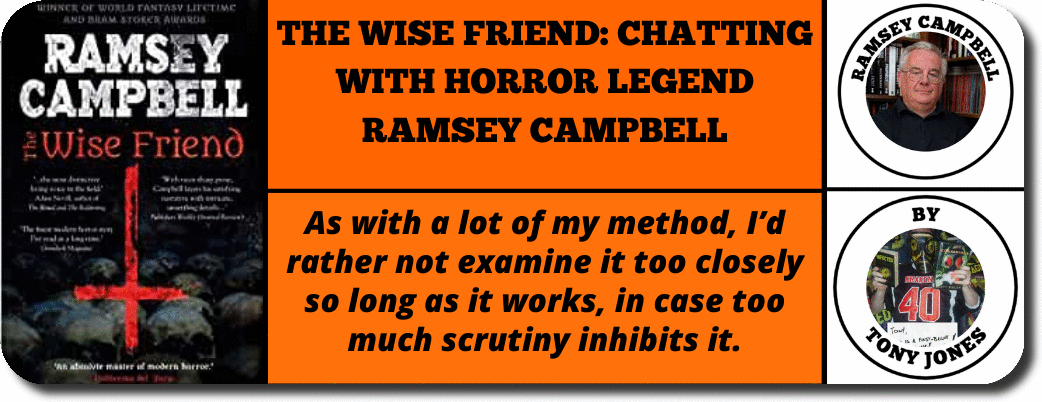
 The Wise Friend: Chatting with horror legend Ramsey Campbell Today we are delighted to give you a brand-new interview with horror legend Mr Ramsey Campbell. There are few, if any authors, who have given as much to the genre as Mr Campbell. His massive shadow and influence cloaks every aspect of modern horror fiction and in 2020, almost 45 years since his debut novel, he is in fine form with The Wise Friend, which this interview focuses upon. Considerable his status in the world of horror it is lovely to find Ramsey so accessible online and is incredibly friendly to fans and those curious in the macabre. There is a Facebook group called Books of Horror (of over 7000 members) which I just must mention which both Ramsey and I haunt. Although the odd interesting thread pops up it usually features dumb and very repetitive questions along the lines of “I’ve read Stephen King. What do I try next?” style of questions and those looking for writing tips or other recommendations. I always enjoy Ramsey’s, often amusing, comments on this page and sometimes ask myself “DO THESE PEOPLE NOT KNOW WHO THIS GUY IS?” He has much more patience for the page than I do and if he abandoned the page I would probably follow him! The darkness in paintings by the likes of Hieronymus Bosch and William Blake makes art a perfect medium for horror fiction to nod to for inspiration. What is your take on this? I think you’re right, though I’ve rarely taken directly from paintings. One exception is an image of an isolated streetlamp in The Doll Who Ate His Mother, which was my version of a favourite Magritte image – indeed, I wanted Liverpool University Press to use one of these Magrittes on the cover of Joshi’s monograph, but apparently the rights would have cost too much. I certainly feel affinities with some art – the psychedelic images in Walter Hopps’ anthology Visions remind me quite a bit of similar experiences of my own, which show up in tales such as “Above the World” and “The Voice of the Beach”. For that matter, there are book covers I love – for instance, I bought Best Horror Stories back in 1957 partly for the splendidly atmospheric cover by the gay New Zealand painter Felix Kelly, who had quite a feel for the uncanny. One artist I have collaborated with more than once is J. K. Potter, and very productive it was. Apart from a brief flashback scene Patrick Torrington’s artist aunt Thelma is dead long before ‘A Wise Friend’ begins, nevertheless her presence dominates the novel, was the character based upon/inspired by any real artist(s) or anything genuine from the world of art? No – to be honest, I invented her and her work and then went looking for actual figures who might have influenced her or were similar (though I did know of Leonora Carrington, not to mention folk like Osman Spare). It’s sometimes uncanny how that process can work – finding sources for a fictional character – though of course I could have been drawing subconsciously on them. Much of the novel involves Patrick, his son Roy and the slightly odd Bella retracing the footsteps of Aunt Thelma and the potentially magical/mystical sites which inspired her work. This was from all around the Merseyside countryside, did you use genuine locations or places with dubious histories? You obviously use Liverpool a lot in your fiction…. I have to confess, that all the magical sites are my invention – a pity, since I wouldn’t mind visiting some of them. Perhaps I shall in dreams. New Brighton is as described, though, along with Liverpool and a bit of Manchester. Thelma featured in one major flashback scene when teenage Patrick visited, was there any particular reason why there were no subsequent flashbacks or any thoughts to develop her character more fully? I thought this was a very strong sequence…. My instinct was to keep her relatively mysterious, a haunting memory and an enigma. I hope it works! Patrick is not the most likable of characters and has the habit of antagonising and getting the backs up of the rest of his family. Often when the main character is unlikable it can put readers off a book, did you ever have any concern readers would struggle connecting with Patrick? I must admit I never saw him that way. He’s just a human being, as flawed as the rest of us – certainly as the author. I do think his motives are sympathetic, even when he makes mistakes. Mind you, your question reminds me that early in my career as a novelist my old much-missed friend and agent Kirby McCauley commented that my characters were morally grey and compared them to those of the director Fritz Lang. I took this as a considerable compliment – he made quite a few great films. ‘The Wise Friend’ and some of your other very recent fiction I’ve read, such as ‘Thirteen Days at Sunset Beach’, features virtually no violence, blood, and few deaths; as you’ve got older (or mellowed) have you noticed your work moving away from the bloodier side of horror fiction? Not that I have ever seen your work as particularly bloodthirsty…. I’ve generally shown no more than necessary in terms of horror or violence, but that varies from tale to tale. The first novel where I consciously tried to avoid violence as unnecessary was Midnight Sun, and I think that has influenced my approach in some books since. I’ve certainly tended to concentrate on the uncanny and to do my best to reach for awe in some, and gore isn’t really relevant to that. On the other hand, we have a pretty grisly act of violence near the rend of Ghosts Know. It’s a matter of the requirements of the context, I believe. Along with the recent ‘Thirteen Days at Sunset Beach’, both novels for a very long period tread a fine line on whether there is anything supernatural going on at all, you’ve used this tactic incredibly successfully over the years, is this your favourite type of ‘horror’ always laced with ambiguity? It’s one of them, certainly. Perhaps multiplicity of meaning and interpretation is a larger preference that includes it. My absolute favourite would be the kind that aspires to awesomeness or cosmic terror – The Willows, The White People, The Colour out of Space lead my list. I keep making literary leaps at it and perhaps occasionally manage more than a feeble hop. Both ‘The Wise Friend’ and ‘Thirteen Days at Sunset Beach’ involve family problems as an opportunity to create a supernatural story. When you were developing ‘The Wise Friend’ did you come up with the supernatural story independently and then build the family dynamics around the core idea? I think these elements developed pretty well in parallel. In both books I began to see my way once I had some sense of the mina characters and their relationships, but that’s generally how it happens for me. In Thirteen Days the central couple came to visit my imagination almost as soon as the initial idea of Sunset Beach did, and I had pages of notes about both by the end of that first day (on Zakynthos, for the record). I couldn’t help googling the character ‘Lumen Scientiae’ but came up blank…. His presence (and book) also lurk in the background of the story, was this inspired by anything historically genuine? Lord, I hope not! I’d stay out of his environs if so, should we be able to locate them. On the other hand, there is indeed a witchcraft collection in Manchester Central Library, though I’ll swear I didn’t know that until I decided to set some scenes in that city and looked in their online catalogue to see what they had on the subject. I’m a great believer from experience in happy coincidences when it comes to writing. I should mention that the staff of the Manchester library archive in my tale bear no resemblance to the actual very helpful staff. I noticed ‘The Wise Friend’ had a first-person narrative in which the entire story is seen from Patrick Torrington’s point of view. Was this to build in an unreliable narrator element into the plot or do you have any other spoiler-free thoughts you can share with us? I have to admit that my choice of viewpoint or viewpoints in any tale, as well as person and tense, is wholly instinctive. I was recently chatting with a Twitter/reviewer friend who was just about to read ‘The Wise Friend’, which would be the first of your novels he had sampled. How good an introduction to your fiction do you see your latest effort? Pretty good, I’d say. I hope so, anyway! By day I work as a school librarian and because of my lifelong interest in horror fiction our fiction collection is superb, including yourself and the likes of Adam Nevill, Stephen King and Nick Cutter. To teens developing an interest in horror, of your fiction I usually recommend ‘The Grin of the Dark’, but a couple of years ago a kid (around 16) when he returned it commented that although he enjoyed the novel it gave him an unpleasant bad dream! Which of your novels would you recommend to a horror newbie or younger reader? The Influence might be a candidate, which could almost (or maybe not even almost) be published as young adult fiction, do you think? [TONY ADDS: OKAY RAMSEY YOU’VE CONVINCED ME, BOUGHT FOR MY LIBRARY!] I enjoyed the Spanish language version of ‘The Influence’ currently on Netflix, it was atmospheric and well-paced, retaining the spirit of your novel. What did you think of it? Pretty powerful and disturbing, I thought. Given the choice which of your other novels would you like to see filmed? Maybe The Grin of the Dark by someone suitably unsettling. Or perhaps the trilogy for television? From ‘idea to completion’ how long did ‘The Wise Friend’ take? How does this compare with some of your other recent projects? Pretty well like all my novels for decades, it was about a year in the making. I’ll usually get the basic idea or ideas earlier than that, but the concerted process involves developing them and gathering material until I think I have enough to make a start on the writing – not a preconceived plot but a looser idea of the structure and the order of events, which will change in the process of writing. Once the first (always longhand) draft is done I’ll let it sit for a while and then reread it as a preamble to rewriting it on the computer. That version is printed out for reading and further revision, and at last it’s loose on the world – on my agent, at any rate. In the last couple of years Flame Tree Press have made a major splash in the horror world and have published new work by yourself (‘Think Yourself Lucky’, ‘Thirteen Days at Sunset Beach’ and ‘The Wise Friend’) as well as ‘The Hungry Moon’ and ‘The Influence’ from your back-catalogue. With the rereleases, ‘The Influence’ was obviously picked up because of the film, why ‘The Hungry Moon’ in particular? Will Flame Tree be rereleasing other titles in future? In fact, The Influence was scheduled before the film went into production, which suggests that some benevolent force may have been sat work (thank you, Daoloth?) It and The Hungry Moon were the publisher’s choices, and more indeed may be to come. If you were to spot any author, alive or dead, reading one of your novels on the London Underground who would you like it to be? Since I can dream, Graham Greene. Ramsey, it has been a pleasure having you on Ginger Nuts of Horror. On a personal level, the opportunity to correspond with an author I have for read for over twenty years has been one of the genuine highlights of the years I have been reviewing and writing about horror fiction. The best of luck with ‘The Wise Friend’ and your future projects. Tony Jones Be sure to tune in on Thursday when we have not one but two reviews for The Wise Friend from Tony Jones And Allen Stroud THE WISE FRIEND by RAMSEY CAMPBELL An absolute master of modern horror. And a damn fine writer at that - Guillermo del Toro Patrick Torrington's aunt Thelma was a successful artist whose late work turned towards the occult. While staying with her in his teens he found evidence that she used to visit magical sites. As an adult he discovers her journal of her explorations, and his teenage son Roy becomes fascinated too. His experiences at the sites scare Patrick away from them, but Roy carries on the search, together with his new girlfriend. Can Patrick convince his son that his increasingly terrible suspicions are real, or will what they ve helped to rouse take a new hold on the world? FLAME TREE PRESS is the new fiction imprint of Flame Tree Publishing. Launched in 2018 the list brings together brilliant new authors and the more established; the award winners, and exciting, original voices.   ERIC LAROCCA IS STARVING THE GHOSTS
15/4/2020
 ABOUT THE AUTHOR Eric LaRocca holds an MFA in Writing for Film and Television from Emerson College. His fiction has appeared in various literary journals and anthologies published in the US and abroad such as, Stiff Things and Year's Best Hardcore Horror, Volume 2. He is also the author of several plays which have been developed and produced at theaters across the country including, Gadfly Theater Productions, Hartford Stage, La Petite Morgue, and Love Creek Productions. He currently resides in Cambridge, MA. Follow him on Twitter @ejlarocca. Starving Ghosts in Every Thread is his debut novella. LINKS Starving Ghosts in Every Thread (preorder): https://amzn.to/38Dd85n Could you tell the readers a little bit about yourself? I recently graduated from Emerson College’s MFA program in Writing for Film and Television. It was an incredible two-year experience where I connected with so many talented people in the film industry, as well as developed lifelong friendships with the peers in my cohort. I currently live in Cambridge, MA with my partner, Ali, who’s also a writer. Now that the weather’s thankfully getting warmer, I love to spend my weekends exploring Boston or finding a shady spot in the park to read a new book. To get the ball rolling and get everyone relaxed, here is a hopefully lighthearted question to break the ice, which one of your characters would you least like to meet in real life and have them complain at you about they way you treated them in your work. I think the character I would least like to meet in real life is Clay from my short story, “If My Face Were Transparent, You’d See the Devil” featured in Red Room Press’ collection, Stiff Things: The Splatterporn Anthology. I treated Clay very poorly in my piece and I’m sure he’d have his share of complaints if he ever met me. Of course horrible things are expected to happen in horror stories; however, I recognize I crossed a line when it came to deciding Clay’s dreadful fate. Other than the horror genre, what else has been a major influence on your writing? Though I grew up relatively insulated in a small Connecticut town, I was surrounded by courageous, intelligent, and self-sufficient women. I think their presence had such a profound effect on me and has consequently informed many of my writing choices. I love inverting the standard of male-dominated horror by writing from a female perspective and I get so excited when I attempt to bring dynamic and compelling female characters to the table. Being involved in Community Theater at a young age has also been a major influence on my writing. I grew up reading the greats such as Arthur Miller, Tennessee Williams, and Eugene O'Neill. I always attempt to infuse palpable human drama in my pieces no matter how fantastical the subject matter is. The term horror, especially when applied to fiction always carries such heavy connotations. What’s your feeling on the term “horror” and what do you think we can do to break past these assumptions? I definitely agree that the term “horror” carries such heavy connotations. I might even suggest it carries undesirable implications in certain select circles. I often found myself skirting around the word when people would ask me what I write, using more benign terms like “thriller” or “dark fiction.” I think horror’s negative inferences are obviously fueled by the limited scope with which people interact with the genre. They assume all horror content mistreats women and involves exaggerated and gratuitous depictions of violence. Horror connoisseurs know this is not the case with all horror content as the genre clearly has the potential to highlight poignant human issues. I think in order to break past these assumptions we, as writers, have a responsibility to constantly challenge our readers by subverting the tropes and producing the unexpected. A lot of good horror movements have arisen as a direct result of the socio/political climate, considering the current state of the world where do you see horror going in the next few years? I think we’ve seen a tremendous surge of home invasion-type thrillers in recent years simply because of the cultural divisiveness being encouraged by the Oval Office. I think people have always been fearful of “the other,” but I feel as of late we’ve seen more content being produced about a fear of intrusion and powerlessness. That being said, I think our fears are becoming more internally based and I think we’re about to experience a renaissance of the Body Horror subgenre with content focusing on the invader existing as an inside force as opposed to an outside antagonist. Given the dark, violent and at times grotesque nature of the horror genre why do you think so many people enjoy reading it? I think exceptionally well-done horror is a truly cathartic experience. It’s like surviving a car crash without actually getting in the car. We identify and empathize with the characters in horror fiction – their failures are our failures, their triumphs are our triumphs. I think it’s also one of the few genres to accentuate the true resilience of the human spirit. We, as viewers and readers, play witness to a character’s determination to survive no matter the obstacle. What, if anything, is currently missing from the horror genre? I’d love to see more openly queer characters in horror fiction and film. Of course it would be a dream to see a prideful gay man as the protagonist of a mainstream horror release, but I’m uncertain if the general public is prepared for that. Regardless, I think it’s important for more queer authors to unabashedly add their voices to the mix, share their experiences, and tell their stories. Is horror its own worst enemy? What do you think keeps horror from being regarded as a valid genre by the public at large? I think what keeps horror from being regarded as a credible genre by the public at large has to do with the fact that the most mainstream representations of the genre are redundant and religiously follow the overworked tropes from which we should be struggling to break free. Of course I worry horror will always be considered a “ghetto genre” because of its sordid history, but recent commercial successes in the film industry like Midsommar and The Lighthouse prove that horror has the potential to captivate audiences without tactless jump scares or unnecessarily brutal violence. What new and upcoming authors do you think we should take notice off? One of the most exciting voices in horror fiction I’ve read recently has to be J. Daniel Stone. Not only is his writing electric and vividly compelling, but he’s such a kind person and has always been supportive of me and my work. Check out his newest release, Stations of Shadow, when it’s released in May. Another equally talented writer to watch out for is Rob Costello. His queer horror story, “Emergent,” published in The Dark Magazine shook me to my very core. After you’ve finished reading this interview, head over to The Dark and read his piece! What are the books and films that helped to define you as an author? The book that resonated with me most has to be Haunted by Chuck Palahniuk. Not only is the novel one of the most disquieting and unsettling works I’ve ever read, but it’s spectacularly audacious with regard to structure and content. I first read it several years ago, but I’ll never forget how much it challenged me as a reader. When it comes to films that have changed my life, there’s only one: Pascal Laugier’s 2008 masterpiece, Martyrs. It’s probably one of the bleakest, most soul-destroying films I’ve ever seen. Martyrs showed me the unexpected, the aberrant, and the unusual. More importantly, Martyrs is excellent proof of the horror genre’s capability to explore the more difficult questions of humanity from which other genres shy away. I envy anyone seeing the film for the very first time. It’s a harrowing descent into the depths of depravity. Are there any reviews of your work, positive or negative that have stayed with you? I’m relatively new to the business, so I haven’t accumulated a massive amount of reviews yet. However, one reviewer once performed a makeshift gender reassignment surgery on me and referred to me as “Erica LaRocca.” That was a new one. What aspects of writing to do you find the most difficult? I find the most difficult aspect of writing to be actually finding the time to sit down and write. Any moment I have free I make certain to strap myself to the keyboard and hammer away at a scene until I’m satisfied with the outcome. However, the more responsibilities I accrue in my personal life, the more difficult I find it to be productivity-wise with regard to writing. Is there one subject you would never write about as an author? I don’t believe in limiting the imagination, so I can’t say I would shy away from certain subject matter others might deem offensive. If it’s relevant to the story and executed tastefully, I’ll write about it. How important are names to you in your books? Do you choose the names based on liking the way it sounds or the meaning? Names are very important to me and my creative process. Most of the time the names of my characters are references to musicians or artists I admire. Regardless, it’s a struggle to find names that suit the character in question. Writing, is not a static process, how have you developed as a writer over the years? I think more than anything I’ve learned to trust my intuition when it comes to crafting content. I used to be so consumed with self-doubt and I would constantly compare myself to others. But, I’m so proud to say I have the skills to ignore my inner saboteur and write to the best of my abilities. What is the best piece of advice you ever received with regards to your writing? The best piece of writing advice I ever received has more to do with the business side of writing as opposed to the actual craft. In my Undergrad, I had a very successful writer as an instructor tell me that “true talent never goes unnoticed for long.” It was heartening to hear those encouraging words from such an established writer. More than anything, it gave me a sense of hope. For those who haven’t read any of your books, which of your books do you think best represents your work and why? I think my new novella, Starving Ghosts in Every Thread, best represents the new direction in which I’m heading as a writer. I was engrossed in the hardcore subgenre of horror for a while, but lately my fiction has leaned into a more literary space with fantastical sensibilities. I’m excited to see where it takes me! Do you have a favorite line or passage from your work, and would you like to share it with us? My favorite passage from my new release, Starving Ghosts in Every Thread, has to be our introduction to the main character as she walks home from work: “I tuck my chin into my scarf, slide my hands into both of my coat pockets, hiding my face beneath my hood – as if I were boxing the bigness inside me. Because, even if I wasn’t so unusual, the world would still want me to be kept as small as possible. It wants all girls that way.” Can you tell us about your last book, and can you tell us about what you are working on next? My debut novella, Starving Ghosts in Every Thread, will be available on Amazon on Friday, May 1st 2020. A somber mixture of dark fantasy and queer horror, Starving Ghosts in Every Thread follows a young girl who harbors a gruesome secret – her body literally unravels unless she feeds off the emotions of others. When she encounters another girl from town with an equally disturbing secret, it’s not long before Teddy’s insatiable hunger fueled by guilt begins to threaten her safety and violently touch all those who cross her path with disaster. As for what’s next, I’m currently wrapping up a short story and then setting my sights on beginning to write my first novel. I finished outlining the concept the other night actually and am very satisfied with what I have so far. I have a title in mind, but I’d rather not share until I actually start writing. If you could erase one horror cliché what would be your choice? I think the horror cliché I would erase immediately would be the jump scare in film. I find it more annoying than anything. Being startled is not necessarily frightening, but rather a momentary inconvenience. What was the last great book you read, and what was the last book that disappointed you? The last great book I read was John Hornor Jacobs’ A Lush and Seething Hell. Both novellas contained in his collection are haunting, lyrical, and deeply unsettling. In truth, I can’t recall the last time I was disappointed by a book. What's the one question you wish you would get asked but never do? And what would be the answer? The question I seldom get from reviewers is simply “How are you doing?” My answer (though I can be somewhat mercurial) right now would be: “I’m doing OK.” Starving Ghosts in Every Thread by Eric LaRocca She's so consumed with guilt that it compels her body to literally unravel unless she feeds off the emotions of others. Teddy’s parasitic condition is usually tempered easily and is invisible to most, unless she feeds from them. However, her insatiable hunger has already begun to threaten her safety. Trapped in her tiny Connecticut hometown thanks to a careless mistake which cost her a prestigious scholarship, Teddy grieves her father’s death and cares for her neurotic mother, Mercy, who is convinced scorpion venom is the only remedy for her own peculiar skin ailment linked to her daughter’s sadness. Once an aspiring songwriter, Teddy now merely alternates between shifts at the local market and visits to the house of her eccentric neighbor, Mr. Ridley, for fresh scorpions to bring to her mother. It’s during one of her routine visits to Mr. Ridley’s subterranean grotto of exotic animals that Teddy meets an unusual young girl named Kiiara. Immediately enamored with one another, Teddy soon discovers that Kiiara is hiding a gruesome secret, too – a secret that will threaten to undo everything Teddy has ever known and loved, and violently touch all those who cross their path with disaster.   Who are you? I’m Penny Jones and I’m a writer of horror fiction. (Occasionally other types of fiction, and the odd bit of nonfiction. Basically I’ll write anything if asked.) Your signature style: I tend towards a first person narrative, in quite a lyrical style. Characters are a big part of my stories, and it’s how they react to what is happening, rather than what is happening, that I’m most interested in. Toot your own horn: I’m still a really new author, but I remember hearing Alison Littlewood talking about being invited to be in an anthology (as opposed to open submissions). And I remember thinking, if that ever happens to me I’d be ecstatic. I was, and still am. So my first ever invite would have to be my greatest achievement. Books read: I’m doing a lot of Beta reading at the moment, so can’t really talk much about what I’m currently reading, other than it is science fiction and brilliant. The other books I’ve beta read recently are Robert Shearman’s We All Hear Stories in the Dark (PS Publishing) which is a poignant magnus opus collection of Rob’s short stories. Georgina Bruce’s Honeybones (TTA Press) which was released earlier this year and is beautifully bonkers dark novella. And Charlotte Bond’s The Watcher in the Woods (Black Shuck Books) which is due to be released on the 30th April, and is a lyrical collection of horrific folk and fairy tales. Movies watched: I’m usually years out from managing to catch up on films, but with the recent lockdown I’ve actually managed to catch up on some I wanted to see, and seen some great surprises. Finally saw Midsommar and Parasite, which had been on my list to see for a while. I’ve also seen Vivarium and Extra Ordinary which were both new to me, and absolutely brilliant. Games and/or music played: Currently playing Mystery Case Files: Moths to a Flame, which is a hidden object game. I don’t play many computer games as I find them quite stressful, but do like a hidden object game. Also been playing Othello the old fashioned way across the dining table. Looking forward to being able to meet up with people and play Drinking Fluxx again though. Music is old. I like comforting music, so I’m listening to some old favourites; Pink Floyd, Fleetwood Mac, Enya, REM and Bon Jovi at the moment. Words written: I’m currently working on a submission for Tartarus’s open submission period, but as you can see from the fact that their closing date is in just over 24 hours and I’m writing this instead, procrastination levels are high. Just before lockdown I did manage to write an entire short story in a day, whilst staying at my friend’s (and fabulous author’s) house. That one is currently submitted, but I won’t say where for fear of jinxing it. Future stuff: Once my Tartarus submission is completed, I have a haunted house novella that I’m working on. I’d like to have a first draft completed by Stokercon in August. Brain worms: “At what point does biting your fingernails or chewing on the skin around your nails become auto-cannibalism?” PENNY JONES Penny Jones knew she was a writer when she started to talk about herself in the third person (her family knew when Santa bought her a typewriter for Christmas). She loves reading and will read pretty much anything you put in front of her, but her favourite authors are Stephen King, Shirley Jackson and John Wyndham. In fact Penny only got into writing to buy books, when she realised that there wasn’t that much money in writing she stayed for the cake. Suffer Little Children by penny jones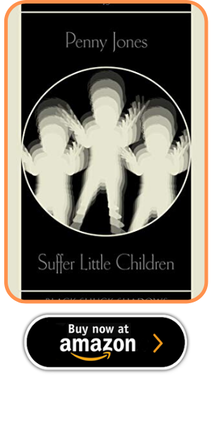 Black Shuck Shadows presents a collectable series of micro-collections, intended as a sampler to introduce readers to the best in classic and modern horror.In Suffer Little Children, Penny Jones offer six stories of juvenile peril.   URBAN GOTHIC AT 20: AN INTERVIEW WITH WRITER TOM DE VILLE A film and television writer with an impressive string of credits to his name, from Hammer's The Quiet Ones to NBC's Hannibal to Stan Lee's Lucky Man, Tom de Ville got his big break as the co-creator and writer of British horror anthology Urban Gothic, when he was only 23 years old. With this year marking the 20th anniversary of the cult show's debut on Channel 5 – and ahead of his own rewatch/analysis for GNOH – John McNee spoke to Tom to learn how the show came together and what his feelings are about it, two decades on. What's the origin of your interest in horror (specifically writing it)? I fell in love with horror at an early age. In my local library there were big books on horror from the early days through to the 1970s, with these lurid pictures from Hammer movies. Lots of Christopher Lee looking terrifying and attractive young women covered in blood. That completely caught my attention. These were things I knew I wasn't ready to watch yet, but the hook was in. Then I got to about 12 or 13 and I would go the local newsagents and flick through Fangoria, just to see the gross pictures. I still didn't feel I was ready to watch the films, but I was aware of them and became obsessed with Nightmare on Elm Street. The concept really got under my skin and I started having nightmares in which Freddy would visit me and force me to watch it. The concept of watching the film – seeing the images moving – was what really frightened me. Finally one day, I was alone in the house with a VHS copy of the film that my dad had left lying around. I decided I had to get through the experience, so I put it on. The way I handled it was, whenever I could tell a scary part was coming, I would play it on fast-forward. When I understood what was going to happen, I could rewind it and play it through again. It totally broke the barrier for me and, after that, I was a full convert and spent my teenage years watching everything I could get my hands on. These were the glory days of the video rental store and my local one was full of obscure B-movies, which I loved. While this was going on, I'd also figured out that making films was what I really wanted to do. I'd fallen in love with authors like HP Lovecraft so I was writing a lot of homages, which were basically ripping his stuff off. In my late teens, I started looking into applying to go to film school and ended up getting into Bournemouth University which, at the time, had the only screenwriting degree in the country. Whenever we had a screenwriting project I always tried to produce something very genre-based. I spent a lot of my time there reading scripts that were specifically horror or thrillers, learning how to do that kind of thing in script form. 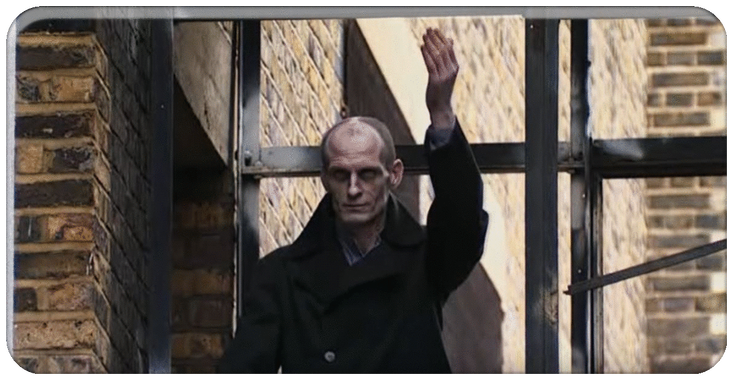 How did the opportunity for Urban Gothic come about? About four or five months after I graduated, I got a call from Bournemouth. They'd been contacted by a producer called Steve Matthews, who was looking to work with a recent graduate, so they put my name forward. I met with him and learned he had a script for a cop show from a successful but quite elderly writer and he wanted someone young to come on board and rewrite the dialogue to make it more modern. While we were at that meeting, he asked me what I really wanted to do. This was in the late 1990s when no-one, particularly in British TV, was making horror. I said I wanted to do horror and Steve's eyes just lit up. He said it was his favourite genre and he would love to do something in it too. We talked about it a bit more and he suggested doing an anthology, which I had mixed feelings about. I really loved stuff like Buffy the Vampire Slayer and wanted to do an ongoing series, but I was also hungry for opportunity and did like the idea of being able to do a different story every week. So I went away and came up with a handful of ideas, including one that I knew would be the first episode, 'Dead Meat'. I wanted to do a very simple, Sam Raimi-esque story about a bunch of kids and a zombie in a building. I wrote the outline really quickly and Steve called me back soon afterwards to commission a script. How did you decide on the overall concept for the show? Like I said, it was Steve who pitched the idea of doing a horror anthology. But I decided pretty quickly that I didn't want to do this very traditional form of British horror set in old mansions and misty graveyards. I wanted every story to be set in the modern day and city-based, not the traditional gothic style that was still lingering in British film-making at the time. We already had that urban part of the formula in place before we began shopping it around. What was the process of getting Urban Gothic onto TV? At some point, Steve took the project to Channel 5 and we had one of those amazing strokes of good fortune where someone, in a meeting that morning, had said “we really should be doing horror”. Then Steve walked in and said he had a horror project. It was just perfect timing. So I went away and wrote a couple more scripts that they really liked. I kept on pitching ideas and it snowballed to a point where they decided I should write the whole series. And because I was young and stupid, I said yes. About two or three scripts in, Channel 5 gave the green light and that was it. Were you involved much with the actual production? I was always around it. I was still writing the later scripts while they were in production on the earlier stuff. I would quite often go down to the production offices near Suffolk. I was involved in pre-production with all of the directors, getting the scripts the way they wanted them. But as a writer on set, it's very evident that no-one wants you to butt in at any point. By the time it's in production, everything is set and everyone has their jobs to do. In my head I always had this fantasy that I would be heavily involved in that part of the process, but the truth is no-one wants that. I could tell by the ambience the first time I went on set. But I was always around, though I was usually at a desk, writing. What were your thoughts when you finally saw the finished episodes? My feelings were mixed. What you learn very quickly is that once you've handed a script over to production you are not in control of it. There were definitely episodes I thought I'd conceived and executed better than others, so those were the ones I was most interested in. And each director brings their own unique approach and perspective, which means the finished product can end up very different from what you imagine. Sometimes a director would nail it and deliver something very close to what I had in my head. Other times it would be very different. With an anthology, that's just part of it. Every episode should feel different. As a writer, it was an education in realising what you imagine is not always what you get. What do you recall about the reaction the show received when it was broadcast? It had a fairly solid response. The internet was still very primitive back then, but there was an Urban Gothic chat site for fans that I would visit a lot. It was always really cool to see people talking about each individual story and I remember it being really positive. We got solid reviews in stuff like SFX, so I was definitely happy with the response. The funny thing about it, though, is that it was always a very small, cult show. One of the things that's delighted me about it is you'll just occasionally run into somebody who was a fan and will wax lyrical about it. Even now, there are people out there who hold it very close to their hearts. That's the best result I could have hoped for. How did the process differ for series two? At the time we were told we were getting a second series, I think I was feeling a little burnt out, creatively. I certainly knew I didn't want to write all of them, so it was decided I would write four and the other five would be given out to other new writers. I was overseeing all the scripts, but I was mostly focussed on my four. I was less involved, generally, but I came up with this mad idea for my episodes. I'd fallen in love with writers like Grant Morrison and Alan Moore – these very experimental storytellers – and I wanted to do something like that. At the end of the first series I had written a story which attempted to tie together the previous 12, creating a background mythology that could explain how all these things were happening in the same universe. My four-parter in series two built on that. In retrospect I kind of wish I'd just written four more juicy stories, but at the time I was young and just wanted to splash about and try different things. I do love some of the episodes in series two, but I feel way more invested in series one. Was there ever any discussion about the possibility of a third series? I'm not sure what discussions took place. I think Channel 5's management was changing a lot and people came in who wanted to focus on something else. During the production of series two I kind of got the feeling it was going to be the last one. One thing we did look at, for a while, was taking a couple of the episodes and turning them into small films. There were two in particular we were talking about – 'Vampirology' and 'The Boys' Club'. They're probably my two favourites from the first series. What was next for you, after Urban Gothic? I went over to the States and worked on the fourth season of a Canadian sci-fi show called Lexx. It was like a Canadian Red Dwarf but weirder and I absolutely loved it. I had a blast going over to Halifax in Nova Scotia, where they made it, and hanging out in their writers' room. It was my first state-side experience. After that I wanted to do more TV in the UK and pitched a few series that were very much like British versions of Buffy, but it wasn't the right time. This was just before the return of Doctor Who, so the appetite wasn't there yet, among the broadcasters, for those kind of shows. So I moved over into film and spent a couple of years working on a completely mad project that George Romero was going to direct about a British boarding school that gets overrun by vampires. After that came The Quiet Ones, which Hammer made, and then I worked with a director called Corin Hardy, who recently made The Nun, on a film called The Hallow. After that was more TV and right now I've got things happening with a couple of film scripts, one that's just about to be announced (Lord of Misrule, to be directed by William Brent Bell).  Are you still most interested in working in the horror genre? Definitely, when it comes to film. In TV, particularly in the UK, it's still very hard to get horror projects off the ground, unless it's skewed towards the more family-friendly Doctor Who-style end. There's a real appetite for that now, but more adult horror on British TV is still quite rare. Why do you think that is? Horror is not an easy format to work in, in TV. I think the two models that work best are the anthology series or the American Horror Story/Channel Zero idea where each season tells a self-contained story. I think that's a good model for TV horror, but it's really hard to sustain ongoing shows, because there always comes a point in a horror story when you have to explain what's going on. After that, an end-point is unavoidable. So it's hard for horror projects to have longevity. I also think that, over here, in the '60s and '70s, horror was very mainstream, but now it's viewed as quite niche. You get occasional films that break out and become hits, but other than that it's still quite niche. Unfortunately, that has a lot to do with the tastes of commissioners. I have no doubt the audience is there. I don't imagine Urban Gothic would have any chance of being made by Channel 5 these days. I don't think so, though they have recently begun to commission some interesting dramas. But for a long, long time they shifted away from scripted shows. What you've got to remember is, when I was writing Urban Gothic, it was just before the debut of Big Brother, which fundamentally altered the landscape of British TV. For a big part of the 2000s, reality TV was where it was at. I think the needle has swung back the other way now with the streaming boom and drama has become a big thing again.  If you look up Urban Gothic online, you'll often find references to you writing the stories when you were 13 or 17 years old. Any truth to that? No, definitely not. I met Steve just after I graduated, so in the middle of writing the scripts I would have been 23. They definitely did make it part of the publicity for the show. They would describe it as being created and written by a 23-year-old, which I find really embarrassing now. I can imagine that becoming exaggerated to the point people were saying a 13-year-old had written it. Some of the scripts I look back on now and think they were definitely written by a 23-year-old and I sort of wonder what I was thinking, but at the time it was great. Looking back 20 years on, what are your feelings on the show? What counts to me is there are still people out there who remember it, talk about it and hopefully view it kindly as a show that existed at a time when there wasn't much like it on British TV. Other than that, it's something I wrote when I was very young, I had a lot of fun doing it and I'm really glad I did it. It was such a lucky break and a great start to my career. It's something I'll always cherish. I directed one of the episodes in the second series and I've got the slate for that on my mantelpiece, so it's still something I carry with me and that I don't want to be forgotten. At the same time, it was a very small show that went out late at night on Channel 5, so I think I knew at the time that it wasn't going to be a breakaway smash hit. I certainly don't expect it to become one now, but I am so glad I got to do it.   BIO Halo Scot is the author of the Rift Cycle, a grimdark, science-fantasy series. Follow Halo on Twitter and Instagram (@halo_scot), or visit haloscot.com. Could you tell the readers a little bit about yourself? I’m a grimdark, science-fantasy author who has written stories since I learned how to write. Writing is therapy for me — a way to escape, a way to process, a way to admit what I would otherwise hide. To get the ball rolling and get everyone relaxed, here is a hopefully lighthearted question to break the ice, which one of your characters would you least like to meet in real life and have them complain at you about they way you treated them in your work. I’m fairly ruthless with my characters and tend to put them through hell, so I would prefer not to meet any of them in real life — they would all probably kill me lol. Other than the horror genre, what else has been a major influence on your writing? Science fiction and fantasy have been HUGE influences in my life. The term horror, especially when applied to fiction always carries such heavy connotations. What’s your feeling on the term “horror” and what do you think we can do to break past these assumptions? To me, horror is anything that summons a feeling of terror. However, I think it carries the stereotypes of “jump scares” and excessive violence. To break past these assumptions, I think we can ensure we include well-rounded characters, captivating plots, and a catchy voice. Good stories will dispel any cliché. A lot of good horror movements have arisen as a direct result of the socio/political climate, considering the current state of the world where do you see horror going in the next few years? I’ve seen the rise of more psychological horror, such as with the new Joker movie, and over the next few years, I could see the genre continuing in that direction. Given the dark, violent and at times grotesque nature of the horror genre why do you think so many people enjoy reading it? We, as a culture, love the taboo. Horror gives voice to our deepest fears, our darkest desires, and just as people rubberneck a car crash, we can’t help but fixate on our fear. What, if anything, is currently missing from the horror genre? I think the genre, especially over the past few years, has fleshed itself out. I don’t see anything missing, but I do see a few great trends — such as the psychological horror direction I stated above. In the past authors were able to write about almost anything with a far lesser degree of the fear of backlash, but this has all changed in recent years. These days authors must be more aware of representation and the depiction of things such as race and gender in their works, how aware are you of these things and what steps have you taken to ensure that your writing can’t be viewed as being offensive to a minority group? I have included a diverse range of nationalities, genders, and sexual orientations in Edge of the Breach and researched each in depth. As someone who identifies as gay, I understand what it is like to be a minority and went to painstaking lengths to ensure I am sensitive to the portrayal of all types of diversity. Does horror fiction perpetuate its own ghettoization? I think horror is becoming more and more popular as people are becoming more open and honest with the shape of our world. Horror is unflinching, yes, but I don’t think that ghettoizes it. People love to read about blood and gore and guts and things that go bump in the night. Take Game of Thrones, for example. It’s a fantasy, and yet, there are many horrifying elements to it. If anything, I think horror is seeping into other genres, as well, and this is increasing its popularity overall. What new and upcoming authors do you think we should take notice of? A few excellent authors I’ve read recently include Chris DeVito (@ChrisMDeVito), Evan Knapp (@MovementWhere), and Sahreth ‘Baphy’ Bowden (@Baphy1428), and a couple pre-orders I’m stoked about include Ash Knight (@ForgottenAstro2) and A.C. Merkel (@Blink_Drive). What are the books and films that helped to define you as an author? Star Wars, Star Trek, and Battlestar Galactica were HUGE inspirations to me in terms of film and TV. As for books, Red Rising by Pierce Brown, Ninth House by Leigh Bardugo, and A Darker Shade of Magic by V.E. Schwab have been instrumental in my development of voice and style. Are there any reviews of your work, positive or negative that have stayed with you? The reviews and feedback by the new and upcoming authors I listed above completely blew me away. I am very, very lucky to have their support. What aspects of writing to do you find the most difficult? Trusting my gut and taking risks. I used to hedge much more than I do now, but I still feel myself pulling back into my comfort zone every now and then, so it’s something I’m keenly aware of. Is there one subject you would never write about as an author? I don’t like to limit myself, but I’m probably not the best choice to write children’s books haha. How important are names to you in your books? Do you choose the names based on liking the way it sounds or the meaning? Names are extremely important, and I choose them based on both sound and meaning. I usually have nameberry.com open, and with absolute chaos, I search for names in different cultures and meanings until one sticks. Writing, is not a static process, how have you developed as a writer over the years? I’ve become much bolder and broken many of the “rules.” But I’ve also learned to trust my decisions more. What is the best piece of advice you ever received with regards to your writing? Do what works for you. Don’t worry about what works for anyone else. To many writers, the characters they write become like children, who is your favorite child, and who is your least favorite to write for and why? In Edge of the Breach, Kyder was my favorite to write for, and he came the easiest to me (don’t judge lol). I don’t really have a least favorite to write for, because if I’m not connecting with the character in some way, I ax them. For those who haven’t read any of your books, which of your books do you think best represents your work and why? Edge of the Breach is my debut book, and it is the most representative of my tone and style. Do you have a favorite line or passage from your work, and would you like to share it with us? “It’s easier for them to accept physical injuries than mental illness, than substance abuse, than grief. What a pathetic, backwards society on a broken, upside-down world.” – Edge of the Breach Can you tell us about your last book, and can you tell us about what you are working on next? Edge of the Breach is about how we all have the capacity for monstrosity when pushed to our limits. In a post-apocalyptic world where season of birth determines power — spring healers, summer mages, fall shapeshifters, and winter shields — a man and a woman emerge from tragic childhoods to lead humanity on opposite sides of an interrealm war. Excerpts and more information is available at my website: https://haloscot.com/books/. If you could erase one horror cliché what would be your choice? The oblivious family that doesn’t move out of their clearly haunted house after the first puddle of blood appears out of nowhere. SAVE YOURSELVES, PEOPLE! What was the last great book you read, and what was the last book that disappointed you? The last great books I read were all of the books by the authors listed above, and I haven’t been disappointed by a book in recent memory. What's the one question you wish you would get asked but never do? And what would be the answer? Oof, you’ve asked such amazing questions that I have none left! Thanks so much for having me! Edge of the Breach (Rift Cycle Book 1) We all become monsters at the edge of the breach. In a post-apocalyptic world where season of birth determines power — spring healers, summer mages, fall shapeshifters, and winter shields — a man and a woman emerge from tragic childhoods to lead humanity on opposite sides of an interrealm war.
There is a hole in the sky. They call it the Rift. A portal to the gods. The scar of a suffering world. Through it, the gods rule the last scraps of civilization, harkening war. As chaos beckons, two leaders emerge from the ashes of a dying planet. Julian Kyder is the son of an abusive rape victim who compensates for his abandonment through psychopathy. Sira Rune is a cancer survivor who dedicates her life to living free and fearless while experiencing the taboo and the unorthodox. Rune is the only one unafraid of Kyder, and that terrifies him, because he only knows how to function through fear. Even though she gives him more chances than he deserves, how much violence can she forgive? When is a person beyond redemption? While he struggles to control his demons and she struggles to find purpose, the gods drag the ruined world into war.  After growing up in the Pacific Northwest, Catori Sarmiento’s travels while being a military spouse have often inspired her unique writing style. Although she began writing at an early age, it was not until she began writing poetry during her time as a University of Maryland student that she decided to seriously pursue professional writing. She went on to study writing in a graduate program at National University of San Diego while also living in Tokyo, Japan. Upon graduation, she began writing what would become a first place Cygnus Award winning novel, The Fortune Follies. A year later, her next novel, Carnival Panic was published. She hopes that readers will find intrigue and entertainment in her stories! WEBSITE LINKS www.catorisarmiento.com https://corvusquillpress.com/ https://www.double-dragon-ebooks.com/single.php?ISBN=1-77115-403-9 Could you tell the readers a little bit about yourself? I grew up in Bremerton, Washington, just across the water from Seattle. I married my Air Force husband after High School and since then have gone with him to bases in Italy and Japan. Living overseas has had one of the largest impacts on me and my writing, and I am thankful I had the opportunity. To get the ball rolling and get everyone relaxed, here is a hopefully lighthearted question to break the ice, which one of your characters would you least like to meet in real life and have them complain at you about they way you treated them in your work. In general, I don’t much like people who act cocksure, so the character who I would least like to meet in real life would be Jax from Carnival Panic. Other than the horror genre, what else has been a major influence on your writing? Travel has been one of the biggest influences on my writing. It allows me to step out of my comfort zone and experience life in a different way. The term horror, especially when applied to fiction always carries such heavy connotations. What’s your feeling on the term “horror” and what do you think we can do to break past these assumptions? I see horror as what ushers fear in the individual. The subjects can be wide-raging because what instills fear changes depending on perspective. A lot of good horror movements have arisen as a direct result of the socio/political climate, considering the current state of the world where do you see horror going in the next few years? I think we may see more stories with themes of socio-economic inequality and systemic cruelty. Given the dark, violent and at times grotesque nature of the horror genre why do you think so many people enjoy reading it? Reading about horror can be cathartic. It can allow us to explore our fears while exercising a method of control. What, if anything, is currently missing from the horror genre? I think what is missing from the horror genre is diversity. From that, I mean a diversity of authors and of stories. I would like to see a different perspective of horror that expands beyond mere gore. In the past authors were able to write about almost anything with a far lesser degree of the fear of backlash, but this has all changed in recent years. These days authors must be more aware of representation an the depiction of things such as race and gender in their works, how aware are you of these things and what steps have you taken to ensure that your writing can’t be viewed as being offensive to a minority group? While it is true that readers are able to be more vocal about their displeasure in authors mis-representing certain races in their writing, I think that this is a positive evolution in the relationship between authors and readers. An author should be prepared for a backlash against their writing, since once it is made available to others, it ceases to solely belong to the author; an author cannot control how a reader is going to respond to their writing. I think it is less about being viewed as offensive and more about ensuring to be honest my writing. If, for example, an author has in mind to write a story about a culture other than their own, they ought to ensure that they are depicting that culture honestly and accurately. Does horror fiction perpetuate it’s own ghettoization? I think horror fiction can perpetuate ghettoization at times because the genre can be viewed by readers and critics alike as anti-mainstream fiction. Viewing horror in such a way limits the accessibility of the genre. What are the books and films that helped to define you as an author? The Bread Givers by Anzia Yezierska Battle Royale by Koushun Takami Piercing by Ryu Murakami The Vet’s Daughter by Barbara Comyns Bioshock and Bioshock Infinite Xenogears Metropolis The Prestige What new and upcoming authors do you think we should take notice of? Maurice Carlos Ruffin Jonathan Wheatley Are there any reviews of your work, positive or negative that have stayed with you? One review I had that stayed with me was actually a rejection letter. Though the publisher rejected my novel, they had written a critique in which they commended my “beautiful writing” and encouraged me to keep trying. What aspects of writing to do you find the most difficult? I find that editing is the most difficult part because I will agonize over punctuation. In one instance, I was editing a paragraph, having placed a semicolon between two sentences only to delete it two hours later and re-write the entire paragraph. Is there one subject you would never write about as an author? I wouldn’t want to censor my writing, nor should any author. How important are names to you in your books? Do you choose the names based on liking the way it sounds or the meaning? Names are typically an afterthought. Sometimes I have a name decided for a character in the beginning, but rarely does it stay the same towards the end. I focus more on character traits and plot and the names come later. Writing, is not a static process, how have you developed as a writer over the years? The way I write is heavy on scenes that have no continuity between them, and then piece those together during editing, adding transitions. When I first started writing I tried to do so chronologically and could never make it work. I would say that I’m much better at outlining. What is the best piece of advice you ever received with regards to your writing? From Ruth Scwartz: “To write well, you must feel deeply.” To many writers, the characters they write become like children, who is your favorite child, and who is your least favorite to write for and why? I enjoyed writing the character of Fletch from Carnival Panic. Since she is an anarchist, it was fun to explore her character and motivations. My least favorite character to write for was Catherine from The Fortune Follies simply because she has had so much hardship and disappointment happen in her life. For those who haven’t read any of your books, which of your books do you think best represents your work and why? My first novel, The Fortune Follies. I think this novel presents the interpersonal and political themes that I find the most interesting. Having written it while I lived in Japan, I incorporated much of what I experienced and observed. Do you have a favorite line or passage from your work, and would you like to share it with us? I don’t particularly have a favorite line, since I try not to read my work much after I’m finished. Can you tell us about your last book, and can you tell us about what you are working on next? Carnival Panic is my most recent one, but thus far I have written a total of four novels and am halfway through my fifth. I’m very guarded about my works-in-progress, so what I can tell you about the recent novel I’m working on is that it is a supernatural murder-mystery. If you could erase one horror cliché what would be your choice? Jump scares. What was the last great book you read, and what was the last book that disappointed you? The most recent book that had an impact on me was Kindred by Octavia Butler. The last book that disappointed me was 1Q84 by Haruki Murakami. I found certain aspects of the plot meandering. What's the one question you wish you would get asked but never do? And what would be the answer? I honestly don’t have an answer for this. Carnival Panic by Catori Sarmiento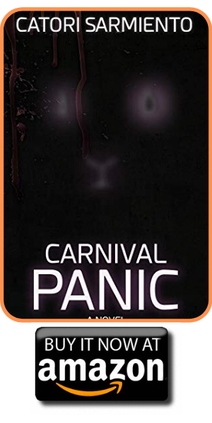 Candy makes the PonPon Bunnies sweet. Be careful if they’re angry. And watch out for traps! These are the dangers of competing in the Carnival Panic game show, a ruthless competition that tests the chosen competitors with mental and physical struggles. In order to claim the substantial monetary prize, the winner must solve a series of room puzzles and succeed in entertaining the fickle masses.
 Arthur Meursault is a long-term Asia expat who served his time in China and now writes about the country and translates works from Chinese into English. His first book Party Members, published by Camphor Press in 2016, is a dark satire on modern Chinese life. His second book is The Flock of Ba-Hui and Other Stories and is a translation of Lovecraftian tales taken from the Chinese Internet and presented to a wider audience. Could you tell the readers a little bit about yourself? There isn’t much to say! I left my native England as a teenager, throwing myself into the zeitgeist of China in the 2000s, and have remained internationally-based ever since. I started writing with my 2016 book Party Members which was a hybrid of dark-comedy and office-horror that followed a mid-level Chinese government official led astray by greed and corruption. In hindsight, it was too niche a hybrid, but horror is where my true passion lies which led to this current project. To get the ball rolling and get everyone relaxed, here is a hopefully lighthearted question to break the ice, which one of your characters would you least like to meet in real life and have them complain at you about they way you treated them in your work. The protagonist of my first book Party Members is a about a mediocre and venal Chinese government official who gradually transforms into a ruthless psychopath determined to bribe, rob, and murder his way into a promotion. For obvious reasons, I wouldn’t wish to work in the same office. Other than the horror genre, what else has been a major influence on your writing? My pseudonym is taken from the main character in the French existential novel L’etranger by Camus and that feeling of emptiness and the perpetual outsider characterizes a lot of my work. This nihilistic malaise is featured in a lot of French literature, and it was actually the despairing works of Michel Houellebecq that led me to Lovecraft after reading his essay on Lovecraft’s loathing for humanity. The term horror, especially when applied to fiction always carries such heavy connotations. What’s your feeling on the term “horror” and what do you think we can do to break past these assumptions? Horror really cuts to the heart of the human psyche, just as much as comedy and tragedy. I’ve always thought that an additional mask should be added to the original smiling and weeping Greek duo; one of outright terror. Tragedy and comedy are our oldest conceptual terms for fiction, but if you think about it both are reactions to horror – we can either laugh at the futility of it all when we realise there is no escape, or we can succomb to despair. Horror, true horror, is something that threatens not just your personal wellbeing, but your essential conception of the universe and the self. We can choose to either laugh or cry when confronted with it. A lot of good horror movements have arisen as a direct result of the socio/political climate, considering the current state of the world where do you see horror going in the next few years? Corporate horror is woefully under-represented. Thomas Ligotti has written some marvellous works of corporate horror like My Work Is Not Yet Done which handles the horror of repetition and corporate drudgery in a sophisticated manner. The problem is that for a lot of people their work is an important ingredient of their identity so they dislike corporate horror because it feels like a personal attack on how they have chosen to live their lives and the choices they have made. This is why I think that the most obvious example of where modern-horror could lead hasn’t really taken off. Given the dark, violent and at times grotesque nature of the horror genre why do you think so many people enjoy reading it? Good horror is a metaphor for real-life fears that people experience and they can see the parallels and analogies within the horror and apply it to their own situation and views. Excellent horror is a metaphor for real-life fears that people aren’t even aware they possess. They feel uneasy when reading or watching such horror but can’t quite explain why. What, if anything, is currently missing from the horror genre? The changes wrought by new technologies are some of the biggest things to happen to us, yet I feel there isn’t much horror fiction addressing it. Of course, there are schlocky movies which will re-use old tired tropes in the setting of video calls or social media, but they don’t address the fundamental issue of how these technologies themselves might be working against us… or even changing us into something else. What new and upcoming authors do you think we should take notice off? There are many unknown writers online who pump out content that goes unnoticed by the vast majority, but there are some truly unique gems out there which will never see the light of day in mainstream publishing. One example I can think of is a story called The Gig Economy that is an excellent example of taking the core of existential and cosmic horror but making it relevant to modern-day concerns. What are the books and films that helped to define you as an author? I think that great horror films and books and those that are not explicitly classified as “horror” but nonetheless leave you with a sense of shock or emptiness after viewing/reading that is unexplainable. The Terry Gilliam film Brazil has continued to be an influence on me as you are never quite sure if Gilliam is concluding the film as a happy or sad ending for the protagonist Sam Lowry or whether you are meant to laugh or cringe in fear. Another great example is the hugely complex House of Leaves by Mark Z. Danielewski. How much horror that book contains for you depends on how deeply you choose to read into its analogies and rabbit holes… and some of those rabbit holes run DEEP. What new and upcoming authors do you think we should take notice off? As mentioned above, I like the largely unknown and anonymous work that is being produced on obscure corners of the internet. The Gig Economy by Zero HP Lovecraft is one such example. Another fantastic horror experiment was the story created by a bizarre character called _9MOTHER9HORSE9EYES9 that was posted in excerpts over random subreddits. There is an explanation of it here: https://en.wikipedia.org/wiki/9MOTHER9HORSE9EYES9 Are there any reviews of your work, positive or negative that have stayed with you? One hilarious one-star reviewer of Party Members proclaimed that after reading the book she was “going to spend January taking long, hot showers, focusing on my yoga, and putting as many good books as I can between me and this nightmare. The penultimate scene probably fundamentally altered a part of my brain and left me with mild PTSD”. I was quite happy with that. What aspects of writing to do you find the most difficult? Editing. Editing is what remains when the exciting part of creating a story and delivering it to the world is done, but all that awaits you afterwards is a tedious clean-up of semi-colons and apostrophes. How important are names to you in your books? Do you choose the names based on liking the way it sounds or the meaning? Names are very important. One of the many strengths of Charles Dickens was the talent he had for creating memorable names for his characters that summarized their entire personality like Ebenezer Scrooge, Uriah Heep and Wackford Squeers. All of the names in my book Party Members have dual meanings in Chinese in order to provide little Easter Eggs for the Mandarin speaker. Writing, is not a static process, how have you developed as a writer over the years? Well, I don’t really classify myself as a writer. I’m a man with a full-time day-job that takes up 90% of my time and writing is just something I do when I have a little bit extra precious free time. The key is finding that free time and using it correctly. What is the best piece of advice you ever received with regards to your writing? Never use a long word when a shorter one will do. This obviously doesn’t apply when translating Lovecraftian pastiches. For those who haven’t read any of your books, which of your books do you think best represents your work and why? I would give The Flock of Ba-Hui a go for readers of this blog who are interested in Lovecraft and how others in other countries have viewed and interpreted his world. As far as I know there is nothing like it out there right now – a Chinese work based on English-language stories and translated back into English. Do you have a favorite line or passage from your work, and would you like to share it with us? Tekeli-li! If you could erase one horror cliché what would be your choice? The psycho who goes on a killing rampage has not only killed his victims but also the reputations of otherwise great films. Event Horizon and Sunshine were both perfect examples of this: 2/3 of both films were a wonderful masterclass in building atmosphere and transplanting old-fashioned cosmic horror to a space station, then the last one third was someone running round killing off the crew members. Ruined! What was the last great book you read, and what was the last book that disappointed you? I recently read the original Sherlock Holmes stories for the first time and I was blown away by the excellence of them. Conan Doyle knew how to craft a story and Holmes passed into the rare realm of legend for a reason. Disappointment? Easy – The City and the City by China Mieville. A book with fantastic concepts and imagination that just fell apart at the end. I find this true of most of Mieville’s books. What's the one question you wish you would get asked but never do? And what would be the answer? Can I get you a drink? The Flock of Ba-Hui and Other Stories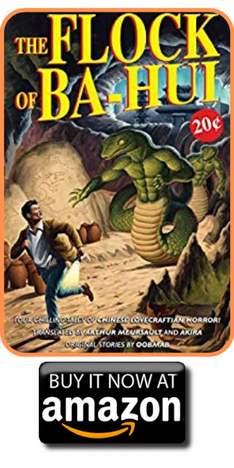 A researcher disappears while exploring the deep caverns of mountainous Sichuan, where folklore speaks of primeval reptilian gods sleeping beneath the earth. An artist dreams of a mysterious black tower stretching skyward for infinity, and glimpses the cold truth of the universe when he decides to climb it. Strange bubbling and decomposed corpses are discovered in the tunnels beneath an old mansion in the city of Qingdao, and an ancient temple in Tibet terrifies all who dare approach. Meanwhile, in an abandoned house, a stranger gathers together a group of bewildered scholars to whisper in the darkness of eldritch abominations and even weirder phantasms. From the stygian depths of the Chinese internet, we proudly present four wholly original tales of cosmic horror based on the works of H.P. Lovecraft and translated into English for the very first time. These ghoulish short stories take their inspiration from some of Lovecraft’s choicest nightmares and offer a different perspective on those things best left unseen. Follow us on a dream-quest as we explore what fresh terrors the Cthulhu Mythos has to offer from the other side of the Great Wall. Written in the authentic style of the pulp magazines of the 1930s, this unique offering of twisted tales will leave Lovecraft fans terrified and astounded by the stories’ breadth of imagination. The Flock of Ba-Hui takes Lovecraft’s world in a new direction and is essential reading for the true horror aficionado and an ideal accompaniment to the Seven Cryptical Books of Hsan.   Nick Scorza is a fiction writer and unrepentant daydreamer. He has worked as an English teacher in the Czech Republic, a construction worker, a bookseller, and many other things. He grew up in Washington, DC and currently lives in New York City. People of the Lake is his first novel. His short fiction has appeared in places like Beneath Ceaseless Skies and Podcastle. WEBSITE LINKS https://www.nickscorza.com/ https://www.amazon.com/Nick-Scorza/e/B07XWPCRRD/ref=dp_byline_cont_book_1 Could you tell the readers a little bit about yourself? I live in a little NYC apartment with my fiancee. I work in the communications office of a city government agency to pay the bills and write fiction when I can. I love to cook, and to travel (again, when I can). I agonize constantly about how many books, movies, bands, TV shows, games, comics, and podcasts I'm not keeping up with. To get the ball rolling and get everyone relaxed, here is a hopefully lighthearted question to break the ice, which one of your characters would you least like to meet in real life and have them complain at you about they way you treated them in your work. I don't want to spoil anything, but I'd least like to meet Jonathan Redmarch from my novel People of the Lake. I'm sure he'd be very cordial and well-spoken while he took me apart piece by piece. Other than the horror genre, what else has been a major influence on your writing? I've been a fan of science fiction and fantasy since I could read. It actually took me a while to get in to horror, I was an easily-frightened child. In my 20's I felt I had to buckle down and learn to write what's usually called 'literary fiction.' I didn't come back to genre until I turned 30, but I now love both “genre” and “literary” fiction. Jorge Luis Borges and Angela Carter, two of my all-time favorite writers, could write both at the same time in the same story. The term horror, especially when applied to fiction always carries such heavy connotations. What’s your feeling on the term “horror” and what do you think we can do to break past these assumptions? I sometimes catch myself telling people that I don't write “that kind” of horror, meaning horror that is overly violent or grisly. Then I get mad at myself, because that's such a subjective line, and it potentially cuts off so much good horror. Also, I think what puts some people off horror isn't necessarily violence, it's the way it can present the universe as uncaring or actively malign, and that can come from even the quietest horror. I think for me at least that's the core of the genre, that it presents a fundamentally unsafe and unknowable universe. I get that not everyone enjoys confronting that, but I think it's part of what makes the genre so important. A lot of good horror movements have arisen as a direct result of the socio/political climate, considering the current state of the world where do you see horror going in the next few years? I don't think it's an accident we've seen so many post-apocalyptic stories lately, and there still seems to be an appetite for more. I think we'll probably see more overtly political themes, which I think is fine as long as they're not simplistic. I think fears of social and environmental collapse also lead to cosmic horror as we question our place in the universe. I hope we're going to continue to hear more from more diverse voices, and I love what writers like Victor LaValle are doing these days to engage with everything that made writers like H.P. Lovecraft great while grappling honestly and meaningfully with their racism and other serious issues. Given the dark, violent and at times grotesque nature of the horror genre why do you think so many people enjoy reading it? There are so many ways to enjoy horror. For me, it's incredibly cathartic. I had terrifying nightmares as a child, but now that I've built up years and years of callouses, I almost relish the feeling of being genuinely scared. Certain kinds of fear, held at a safe distance, are a shortcut to what you could call a state of grace—and the only way some of us will experience something like that. When I was a teenager, it was more about daring myself to confront what scared me, but now I come hoping it'll break down all of my defenses. What, if anything, is currently missing from the horror genre? I don't feel like I'm widely-read enough to answer that, and if I knew I'd probably be trying to write it. In the past authors were able to write about almost anything with a far lesser degree of the fear of backlash, but this has all changed in recent years. These days authors must be more aware of representation an the depiction of things such as race and gender in their works, how aware are you of these things and what steps have you taken to ensure that your writing can’t be viewed as being offensive to a minority group? I did a lot of research for my novel, and I worked with a sensitivity reader. I think it's especially important when you're writing for younger readers, who have less life experience to compare representations in a book to, and are still forming their own identities. I'm sure I still make mistakes, but I try to always be open to learning and doing it better next time. Does horror fiction perpetuate it’s own ghettoization? I guess some lit-fic readers who would love Thomas Ligotti might not pick up one of his books because of the cover art, to think of one example, but it honestly bothers me more when people call something “elevated horror,” like it can't be great art and also horror. What new and upcoming authors do you think we should take notice off? I feel like I'm late to every party. I always tell myself I'm going to keep on top of the latest new voices in magazines, but instead I end up reading novels that have already been recommended to me many times over. Of course they're usually great, but I hope to have a better answer to this question very soon. What are the books and films that helped to define you as an author? I already mentioned Borges and Angela Carter, and I'll throw in Umberto Eco and Italo Calvino. Neil Gaiman's Sandman got me into horror as a teenager, which led me to Lovecraft, then Machen, and it kind of spread through me like a plague from there. China Mieville's fiction really expanded my horizons as far as what was possible in fantasy. Caitlin Kiernan's The Red Tree is one of my favorite contemporary horror novels. Are there any reviews of your work, positive or negative that have stayed with you? My first novel just came out, and I'm trying not to read reviews, at least not right away. What aspects of writing to do you find the most difficult? There's that famous Dorothy Parker quote – “I hate writing, I love having written.” There are days when you just feel like you have nowhere to go, but you have to keep going because otherwise you'll never leave that place. Then there are the days when you realize the house you built word by word isn't going to stand, and you'll have to move it all around or rebuild from scratch. Really I guess I'm saying it's all hard. Is there one subject you would never write about as an author? I would have to have a damn good reason to depict sexual violence directly on the page, and I'd be petrified of getting it wrong, so I don't think it's very likely I'll write about it. How important are names to you in your books? Do you choose the names based on liking the way it sounds or the meaning? I try not to get heavy-handed with my names, but I do try to make them feel right for a character, which sometimes takes some refining. Writing, is not a static process, how have you developed as a writer over the years? I feel like I'm a bit better at stepping outside of myself and assessing my own writing. One thing that helps me is to try to put myself in the mindset of someone I know, and how they would read and react to what I wrote. What is the best piece of advice you ever received with regards to your writing? Lots of the standard aphorisms for new writers, “show don't tell,” “avoid adverbs”, etc. are like training wheels on a bicycle – useful at first, but eventually you have to discard them. “Read deeply and widely” is one that always stays true though. To many writers, the characters they write become like children, who is your favorite child, and who is your least favorite to write for and why? I got pretty attached to Clara, the narrator of People of the Lake, but sometimes the characters we least expect grab us. There was one character in the novel I'm working on now I thought I'd have a terrible time writing, but she turned out to be one of my favorites. For those who haven’t read any of your books, which of your books do you think best represents your work and why? I've only got the one, so far, so I've got to say People of the Lake. Can you tell us about your last book, and can you tell us about what you are working on next? My first novel, People of the Lake, is about ghosts, twins (and cryptophasia, aka 'twin talk'), buried secrets, and messed up family history. My next project is a historical fantasy set in a magical Gilded Age New York, with secret societies, social unrest, sorcerous plots, and messed up family history (which I'm realizing might be a theme I'm drawn to). If you could erase one horror cliché what would be your choice? The standard tropes of the slasher genre kind of leave me cold. Nothing against them, I know lots of people love them, it just tends not to do it for me. What was the last great book you read, and what was the last book that disappointed you? I loved Victor LaValle's The Ballad of Black Tom, Paul Tremblay's A Head Full of Ghosts, and Nathan Ballingrud's North American Lake Monsters. I might sound like I'm trying to be too polite, but I genuinely can't think of a book I've been disappointed with lately. That probably means I'm just not reading enough. What's the one question you wish you would get asked but never do? And what would be the answer? No one's ever asked me where I get my ideas, so I've never had the satisfaction of saying I have more ideas than I'll ever know what to do with, it's turning any of them into something real and worthwhile that's the problem.  An enthralling, historically rich, small-town mystery in which a teen works with her deceased sister to solve an assumed murder.Sixteen-year-old Clara Morris is facing an awkward summer with her father in the tiny upstate town of Redmarch Lake. Clara's relationship with her parents--and with life in general--has been strained since she lost her twin sister, Zoe, when the girls were eight. As a child, her sister had been her whole world--they even shared a secret invented twin language. Clara has managed to rebuild herself as best she can, but she still feels a hole in her life from the absence of her twin, and she suspects she always will. She soon finds that Redmarch Lake, where her father's family has lived for generations, is a very unusual place. The townspeople live by odd rules and superstitions. The eerily calm lake the town is named for both fascinates and repels her. The town's young people are just as odd and unfriendly as their parents. Clara manages to befriend the one boy willing to talk to an outsider, but he disappears during a party in the woods. The next day, he is found dead in the lake under mysterious circumstances. The townspeople all treat this as a tragic accident. Clara isn't buying it, but she doesn't know what to do until she receives a mysterious note hinting at murder--a note written in the language she shared with her twin sister, Zoe.   about catherine cavendishHello, my name's Catherine Cavendish and I write horror fiction - frequently with ghostly, supernatural, Gothic and haunted house themes. My latest novel - THE GARDEN OF BEWITCHMENT - is out now from Flame Tree Press. Historical haunted Gothic horror set in the wilds of the Yorkshire moors - pure Bronte country - with a Bronte theme. My novella - THE DARKEST VEIL - is published from Crossroad Press. In case you were thinking of messing with an ouija board - don't. Especially if you're not prepared to follow the rules. Also from Flame Tree Press - THE HAUNTING OF HENDERSON CLOSE. Ghostly horror set in Edinburgh's Old Town. Available now from Kensington-Lyrical - the NEMESIS OF THE GODS trilogy: WRATH OF THE ANCIENTS, WAKING THE ANCIENTS and DAMNED BY THE ANCIENTS - set in Egypt and Vienna and featuring the sinister Dr. Emeryk Quintillus whose obsession has stayed with him long past the grave. My novellas COLD REVENGE, MISS ABIGAIL'S ROOM, THE DEMONS OF CAMBIAN STREET, DARK AVENGING ANGEL, LINDEN MANOR, THE DEVIL INSIDE HER and THE SECOND WIFE have now been released in new editions by Crossroad Press. My novels THE DEVIL'S SERENADE and SAVING GRACE DEVINE have also been released in new editions by Crossroad Press, as has my novel of the Lancashire Witches - THE PENDLE CURSE. I live with a long-suffering husband and a delightful black cat who has never forgotten that her species used to be worshipped in ancient Egypt. She sees no reason why that practice should not continue. Who am I to argue? When not slaving over a hot computer, I enjoy wandering around Neolithic stone circles and visiting old haunted houses. an interview with catherine cavendishYour new novel The Gardens of Bewitchment is out now from Flame Tree Press. Would you be able to tell us a bit about it? It’s set in 1893 and it centres around two sisters. They’re actually identical twins. Their faces are identical to look at, but they’re very very different in personality and the way they present themselves. So that’s Claire and Evelyn, Evelyn known as Ev by Claire. They have left their home, their family home in a prosperous town in the heart of the Pennines, and they’ve chosen to live in a small cottage in a little village near to Hawoth because they are both absolutely devoted to the Brontës. Claire in particular is infatuated with the Brontë brother, Branwell Brontë, who died in 1848 but as far as Claire’s concerned Branwell is still very much alive and visits her. The only thing is, things are not what they appear to be at all. It’s not a straight forward ghost story, there is a lot going on there, especially when Claire finds, miraculously it has appeared in her room, this toy called The Garden of Bewitchment. Which seems like a lovely beautiful thing to play with… but it isn’t. That’s where the fun starts! There’s a big influence of the Brontës on the feel of the novel. Was that something you wanted to play with? Yes, very much so. For a long time I’ve thought I’d love to do something involving Wuthering Heights, particularly because that’s my sort of go to Brontë book. I mean I love Jane Eyre as well and also Agnes Grey, Anne Brontë’s story, but there’s always been something about Wuthering Heights. It’s a book that when I got hooked on it when I was a child, I would fetch it out and read it at least once a year, and as I grew up, I saw different things in that book. The atmosphere of it, the whole gothic feel of it, the sinister stuff that goes on there, the ghostliness that goes on there, and the incredible moors. Now I’m writing horror myself and I’m thinking, there’s a story in there that I wanted to write and I couldn’t see how to do it. And it fermented and fermented and fermented in my mind for a very long time. So I finally thought, yes, that’s what I’m going to do. Branwell Brontë is the brother who had a troubled history with alcoholism and never achieved the same heights as his sisters. What drew you, and your characters, to him? I think that’s what it is. Branwell I find a tragic character in so many ways, because as you say he was in the shadow of his sisters. He was expected to do well. His family regarded him as a talented artist, and of course, he suffered a serious setback, that turned out to be ultimately fatal in his case, when the Royal Academy wouldn’t have anything to do with him. And I think as far as Claire, my character is concerned, she’s attracted to him because he is a bad boy. You know, that’s just Claire. Ev wouldn’t have given him house room, it just wouldn’t have happened for Ev, but for Claire, oh yes. Most assuredly. Claire is drawn because he is the total opposite of what she should be considering. Both The Garden of Bewitchment and your previous novel The Haunting of Henderson Close have really vividly imagined specific settings. How important is setting to your writing? For me it’s really, exceptionally, important. It’s critical actually. I love getting involved in the setting of the book. When I’m writing, I’m actually there. That’s why I never have music playing, I don’t have any distractions, I work in a quiet room, surrounded by books as it happens, which is lovely. And it’s just me and the computer and what’s going on in my head, my characters moving around in my head. And they’re moving around in a place. And that place is very very three dimensional in my head. So it’s critical to me, I love to paint that particular scene, especially when it involves darkness, winds, gales, yes stormy conditions, that kind of thing. At the centre of the book is the Garden of Bewitchment itself, which is a very creepy toy. What is it about kid’s toys that disturb us? To start off I think that certain toys are very scary. Clowns. They’re the classic. I’ve never liked clowns, even when I was a kid, I used to find them very spooky and sinister. Pennywise - that definitely resonated with me when I read it! But also dolls, and I know a lot of people don’t like it but I happen to love the Conjuring universe. Vera Farmiga I think has done a lot for our whole genre actually by bringing those out. Annabelle is a scary doll. Chucky was a scary doll. But an awful lot of stuff has been done already. I would have loved to have done a scary doll, but I thought it’s just been done. I have actually got a scary doll in one of my previous books, but it’s not really a major character. But I thought no I can’t do a doll. It just formed in my head, I thought, well what about a doll’s house, and then the doll’s house became a house in a garden, and it kind of grew and grew and grew, and as I was writing it it grew. And it didn’t have a working title as The Garden of Bewitchment, I can’t even remember if it did have a working title until I finished the first draft! The sisters have a shared fantasy world that they write books in, which has parallels with the Brontës and Glasstown…. Oh yes definitely. I don’t know if you’ve ever been to Hawoth, but in the Brontë parsonage you can actually see these tiny little books that they wrote. And it’s extraordinary, because the writing is so so tiny, you think well how can a human, even a child - well especially a child - have written it. It’s so exquisite, you can’t read it, you need a magnifying glass. They must have written it with a magnifying glass. It was obvious to me that as soon as I decided I was going to take the tack that I took, that those two sisters of mine were going to have to have this thing about creating their own little world like Glasstown and Angria and so on. It really makes them. And then it kind of just grew from there, and yes the crossover between fantasy and reality, and the blurring of the lines of what is real and what isn’t real. There’s a lot of that in Garden of Bewitchment in different ways, and it’s something I loved playing with. It seemed to work. You’ve mentioned that you used to write historical fiction, which is interesting because that’s a particularly strong element in your latest book but some of your other ones as well.. Yes. I’m living the dream really at the moment, because I love history. I’ve loved history since I was at school, a bit of me I’ve inherited from my mum. So I loved writing historical stuff, but then I love writing the ghostly horror stuff as well, so what do you do? You write historical horror, it’s the best of both worlds! Does getting the period detail right involve a lot of research? Yeah it can do, just to get the absolute details right. You’ve got to be careful about the language that you use because some words, it really grates on me when I read a book that is supposed to be historical and then they’ll come out with some word that didn’t come into parlance until the 1960s or 70s or 80s or even later. So there are some words which I sort of think, ooh hang on, would they have said that? Fortunately now we have the internet haven’t we, so we can consult an online dictionary and straight away find out when that word was incorporated into common parlance. But the devil is in the detail, you do have to take care with that. But again I love this whole business of research, I really enjoy it. I often do research, I keep the windows open on the computer here that’s linked to some site about whatever it is I’m working on at the time and I’ll keep dashing backwards and forwards between those, making sure again I’m not going too off course, without giving my readers a history lesson, because obviously they don’t want that. They want something scary to happen. But they want it to be authentically scary! When you have a particular idea, because the historical elements and the setting are so strong in your work, do you always know where and when it needs to be set? Yes it just seems to fall into place, absolutely. That was the case particularly with Henderson’s Close, with the character of Miss Carmichael, who of course, she dies at the beginning. She’s actually inspired by a gravestone. In Greyfriar’s kirkyard in Edinburgh, on the wall there is a plaque that says Miss Casscart, and that’s all it says. And if you ask the staff in the church, they don’t know anything more about it, other than that. Who was Miss Casscart? When did she live? Why did somebody put up that plaque, who put that plaque there? They know nothing, they don’t know anything about it. And that’s where Henderson’s Close, the story that we actually now have, came from, was initially that little gravestone there, and I’m thinking, I wonder who she was? And I tried to do my own research and I could only come up with, funnily enough, two sisters, who possibly fit the bill, around about the time that I was guessing she was probably alive. It was all guesswork, so that kind of became the period, because I sussed these people out living when they did, that’s when I wanted to set a chunk of Henderson’s Close, and the rest of it I wanted in the present day. Do you feel the historical element is useful for reflecting at a distance on aspects of the present? There is that aspect of Ev and Claire’s status as women who are very much expected to live their lives in a particular way, and they both rebel against that in very different ways… Yeah. I think if you tried to set that story in the present day it wouldn’t work, because women are not expected to behave like that. And obviously, Ev and Claire kind of broke the mold, cause really they should have in the scheme of things married well, but that was, well it didn’t happen. It didn’t happen to the Brontës apart for Charlotte, and even she married beneath her according to her father! It wasn’t really that but he didn’t approve of her marrying. He didn’t think it was the right thing for her, didn’t think her constitution would stand being married. We won’t explore that any further! You have two novels out with Flame Tree Press and Crossroad Press have put out some of your earlier work. What has your experience been of working with these two different publishers? Very different ways of doing things. Flame Tree, I’ve got nothing but praise for, I’ve got nothing but praise for Crossroad, but it’s a totally different way of working. Flame Tree I’m absolutely delighted with the amount of support that they give their writers in terms of marketing and promotion, and well just all round, there’s always somebody there if you need them. And of course working with Don D’Auria. Who wouldn’t want to work with him? Crossroad have been great because it’s quite difficult to get your books reprinted when they’ve gone out of print, especially if they are novella length as opposed to novels. There are a couple of novels that they’ve put out for me but the rest are novellas, and it’s notoriously difficult to get a publisher to put those out, even if you say well stick two together and make a novel sized package. “No. They’re reprints. We try not to touch reprints!” But Crossroad are very friendly, very informal, just they’re lovely people to work with and so are Flame Tree. So fabulous, I’ve got nothing but praise for them. What’s next for Catherine Cavendish? I have a novella coming out with a different publisher, Silver Shamrock, and that’s a new one, that’s coming out in June, and that’s a witchy story, set somewhere that isn’t actually said to be Cornwall but it’s very similar to Cornwall, which again is somewhere I know, and that involves long dead witches. Unfortunately the spirit of one of them is let loose accidentally from the place where she’s been confined hundreds of years before, and so you can imagine mayhem then ensues! and from Flame Tree I’ve got a new novel coming out in January/February next year which is called In Darkness Shadows Breathe, and that’s a very different story. Two main characters, they are both in the present, both living parallel lives but their paths cross. One of them is experiencing some major major surgery, so she’s in a hospital for quite a lot of it, a lot of the action takes place in a hospital. And that’s where their paths crossed, where timeslips occur, where they find themselves in places where they really have no business being in, rooms that can’t possibly exist, corridors that can’t possibly exist. And yeah it’s some scary demonic stuff happening. In addition to this surgery that poor Nessa has to go through, she’s got to go through all that as well. At least I only had the surgery. Oh I am cruel to my characters! Thank you Catherine Cavendish for speaking with us! The Garden of Bewitchment by Catherine Cavendish "Cavendish draws from the best conventions of the genre in this eerie gothic novel about a woman’s sanity slowly unraveling within the hallways of a mysterious mansion." – Publishers Weekly Don’t play the game. In 1893, Evelyn and Claire leave their home in a Yorkshire town for life in a rural retreat on their beloved moors. But when a strange toy garden mysteriously appears, a chain of increasingly terrifying events is unleashed. Neighbour Matthew Dixon befriends Evelyn, but seems to have more than one secret to hide. Then the horror really begins. The Garden of Bewitchment is all too real and something is threatening the lives and sanity of the women. Evelyn no longer knows who - or what - to believe. And time is running out. FLAME TREE PRESS is the new fiction imprint of Flame Tree Publishing. Launched in 2018 the list brings together brilliant new authors and the more established; the award winners, and exciting, original voices.   David J Thacker was born in 1964 and has worked in the theatre for most of his life. He is the author of a novella, The Red House, which was long-listed for a British Fantasy Award. He also wrote a play for Young People (S.O. T. – Save Our Theatre), which was performed at the Edinburgh Fringe Festival in 2001, and has penned the Libretto for a modern Oratorio, performed in 2000. He co-wrote and directed the 2014 Retro Hugo Awards Ceremony for the 72nd World Science Fiction Convention, LonCon3, and directed the 2014 Hugo Awards Ceremony at the same event. He is the Deputy Division Head for Events at Worldcon 77 in Dublin, 2019. Once: A Belmouth Tale is his first published novel. Could you tell the readers a little bit about yourself? I’m from the UK, an ex-pat Northerner who is currently living close to London. I’ve loved Horror fiction throughout my life (from watching Children of the Stones and devouring dog-eared copies of the old Pan Horror collections onwards) and have written short stories for many years. In real life, I work in Theatre Administration - which is nowhere near as glamorous as it sounds (and it doesn’t sound at all glamorous!). To get the ball rolling and get everyone relaxed, here is a hopefully lighthearted question to break the ice, which one of your characters would you least like to meet in real life and have them complain at you about they way you treated them in your work. Well, as with most horror novels or films, some characters are introduced just to be killed, so I’d guess any one of them could legitimately complain to me. And most of the rest of the characters are made to suffer in one way or another, so they could have a beef with me too. In fact, given that the central conceit of my book Once: A Belmouth Tale is that fictional, folkloric characters can come to life, I’m not sure I like this line of questioning at all… Other than the horror genre, what else has been a major influence on your writing? Many (many!) years ago, I studied Medieval Literature and Theatre at University and I think I got my love of the weird and folklore from that. The Medieval world was one where a demon could lurk behind any stone or street corner and where Death was a constant presence, but it was also a world that was striving to find meaning in, well, everything. It needed to collate and classify as much as it could and if it couldn’t then it looked at the patterns of nature and surmised that evidently all things should follow that. So, if we had Monks and Priests on earth, so there should be the same under the sea (yes, this is where Monkfish comes from), and if the Bible doesn’t tell us about the childhood of Christ, we’ll just make it up and fill in the gaps! It was a wonderfully chaotic yet structured, grounded yet fantastical world and I hope I carry some of that through to my work. The term horror, especially when applied to fiction always carries such heavy connotations. What’s your feeling on the term “horror” and what do you think we can do to break past these assumptions? I think that Horror is a very broad church, even if it isn’t always seen as such, and has subtleties that need to be brought out again. The ghost stories of M R James or Shirley Jackson’s Hill House are subtle, beautiful, terrifying works that don’t seem to have a place in today’s definition (although the loose-but-oh-so-right adaptation of Hill House recently tried hard to change that). There needs to be the breakout book (or film) that re-establishes creepiness to our genre and reminds the non-Horror loving audience of what it can achieve. A lot of good horror movements have arisen as a direct result of the socio/political climate, considering the current state of the world where do you see horror going in the next few years? I think, given the current political climate on both sides of the Atlantic, we might see a rise in works about loss of identity – about outsidership and The Other, possibly told from that outsider’s point of view as they struggle to exist in a world they no longer recognize. At the moment, it feels as if the people who never thought they had control are now getting it, for good or ill, and the ones who were traditionally in control have been ousted and are powerless – there’s a topsy-turvy feel to the world that is sure to be reflected in all fiction, not just Horror. Given the dark, violent and at times grotesque nature of the horror genre why do you think so many people enjoy reading it? It’s a cliché, but I think it can be cathartic. It can let you experience dark things outside your everyday experience but in a safe way and push you to recognize your own limits. It’s a challenging genre that, at its best, asks a lot from its readers yet hides inside pop culture. And it has a certain ‘guilty pleasure’ aspect to it as well, as if you are doing something slightly dirty but wholly pleasurable. Does horror fiction perpetuate it’s own ghettoization? If there is a ghettoization, I think it lies at the feet of the publicists, for films or books. Lots of works could easily be considered Horror but are sold as Thrillers – Stephen King’s Bill Hodges books were sold as Detective fiction or thrillers primarily when they don’t stray very far from his ‘horror’ works in reality. Se7en is pure horror but sold as a dark thriller. The Charlie Parker novels of John Connolly have cleverly moved into a world that is pure fantasy and horror, but are still marketed as pschological thrillers. Horror is a many faceted thing, from a slight creepiness at the edges of a story to out and out gore, but too often only the gore is seen as defining the genre. What new and upcoming authors do you think we should take notice of? Me, naturally (insert cheesy-but-cute grin). But seriously, I have admired the work of Rio Youers ever since I started reading him in PS Publications’ editions – he has a lovely balance of grounded fantasy and horror reminiscent of Joe Lansdale. I’ve yet to read his latest work, The Forgotten Girl, but I have it and I’m looking forward to it. What are the books and films that helped to define you as an author? Anything by Ray Bradbury. Blind Voices by Tom Reamy. Harlan Ellison. Exorcist 3. Lots and lots of books of folklore. Alien. The soundtrack work of Peter Gabriel, which always forms a backdrop to my writing. Guillermo del Toro. An American Werewolf In London. Far too many other things to mention. Are there any reviews of your work, positive or negative that have stayed with you? Stephen Volk, creator of Ghostwatch (another influence) and The Dark Masters trilogy, said of my novella The Red House that it “captures the ambient fear of growing up, reminding me of Tim Lebbon and Graham Joyce, and at times evokes the spirit of Machen" and being put in such illustrious company by someone I respect greatly really made me feel that I could actually be taken seriously as an author. What aspects of writing to do you find the most difficult? Not wanting to be glib about any of the creative process, which can be hard at times and downright impossible at others, but the thing I find hardest is what comes after it, especially in the world of self-published books, and that’s Promotion. I’m not a naturally forceful person (surprising for someone who prefers time with a keyboard, eh?) and I always seem to apologise for trying to tell anyone about my work. I meet industry professionals who could possibly help give my work more exposure and I don’t say anything for fear of seeming pushy. I know it’s a necessary evil, and one that even established publishers are putting more and more onto the author, but I do find it hard. Is there one subject you would never write about as an author? I don’t know. I haven’t found it yet. I’m not a fan of torture porn, but mainly because it bores me. But, that said, if I came up with a good reason to write it, if I suddenly had that Jack Ketchum moment where it could work in the service of something else, you bet I’d give it a go. How important are names to you in your books? Do you choose the names based on liking the way it sounds or the meaning? It’s funny but my current novel (and, I hope, a few more) is set in the fictional town of Belmouth, which I came up with after trying to find a name that seemed to belong on the English Dorset coast (typical towns: Bournemouth, Weymouth). It was only after I finished it and the book was out with Beta Readers that someone said to me, ‘Oh, you mean like Hell Mouth’. Which upset me a bit because a) that’s not what Belmouth is – it’s just a normal seaside town where strange things happen and b) it was too late to change it and darn it, I like Belmouth! So, I suppose you could say I chose it based on the sound but I possibly should have thought harder about what that sound was! Writing, is not a static process, how have you developed as a writer over the years? I think the biggest developments I’ve made have been in realizing my preoccupations and themes – Identity is a very strong motivator in my work; where it comes from, what it means – and in learning to deal with characters. I started with stories that had one or two characters in them – basically talking heads – but hopefully now I can command larger, more fully-formed casts who interact with themselves and their world in a realistic way (even if they are fighting monsters at the time). What is the best piece of advice you ever received with regards to your writing? “Carry on.” Getting Once: A Belmouth Tale published was a long hard slog. It was accepted by four successive publishers, all of whom kept it for a year or more (two, in one case) before returning it because they were no longer running the imprint they wanted it for, or they had changed their direction for new works, or in one case, they went under. It was very frustrating and over these years, I found it increasingly difficult to write as I got more and more of my hopes dashed. But what I did write, people liked and it was their support that convinced me to go the self-published route through Amazon, so that hopefully more people can now read the work and enjoy it. To many writers, the characters they write become like children, who is your favorite child, and who is your least favorite to write for and why? My favourite character is always the one I’m working on at the moment – no matter how obstinate or recalcitrant they are being at the time. At the moment, I’m writing about a homicidal man whose fingers drip electricity and, as it is a first person narrative, I’m living in his (rather weird) head. So, I have to love him or I can’t see how he would react to things. My least favourite character is probably the one who doesn’t work out, who shows a lot of promise but then his story just fades in my mind because I can’t make it work and he’s not helping me. He lives in a drawer somewhere, hoping that I’ll come back for him someday but we both know that I won’t. Or if I do it will be only to cannibalize elements of him and we’ll both have to live with the spectre of his initial faded promise. (And people wonder why I write weird fiction…) For those who haven’t read any of your books, which of your books do you think best represents your work and why? That’s a difficult one, as there are only two books out there at the moment, and I’d say they both represent different sides of me. The Red House is quite elegiac and deals with friendship (which is very important to me) and is like a small quiet whisper in your ear. Whereas Once: A Belmouth Tale delves deep into folklore and storytelling (also very important to me) and, whilst quite romantic at heart, also likes to shed a bit of blood from time to time. I’d say it’s more of a statement of intent for what’s to come from me. Do you have a favorite line or passage from your work, and would you like to share it with us? In Once: A Belmouth Tale, I have the line ‘After all, it made a better story that way’ and I get chills every time I read it. Unfortunately, to tell you why would give too much away, but I think it’s a great dark punchline to an incident. Can you tell us about your last book, and can you tell us about what you are working on next? My latest book is Once: A Belmouth Tale and it is the story of a Storytelling Festival in an out-of-season English seaside town and the spate of killings that are somehow connected to it. It blends folklore with modern horror to create a journey into one man’s nightmare, one that will have him doubting everything and change his life irrevocably. It features monsters and romance, twisted stories and gory deaths and I’m very proud of it. My next long work – after I finish the short tale of the murderer with the electric hands (see above) – is probably going to take another piece of English folklore and push it into the modern age. I don’t want to say too much about it at the moment because it’s still forming, but I think its quite original and could even be a series of books. Well, it’s that or I do have another Belmouth tale to tell… If you could erase one horror cliché what would be your choice? If it’s in films, it has to be the Cat Scare. You know, where something spooky is about to happen and then a cat jumps out instead. (This can also, thanks to the lunacy that was Aliens v Predator, be known as the Penguin Scare). In fact, jump scares in general seem to be all that horror filmsare about these days, when actually they are just one of the tools in the box and, even then, best used sparingly. What was the last great book you read, and what was the last book that disappointed you? Okay, bizarrely, I’m going to cite a limited series comic as the best book I’ve read recently, and that’s Exit Stage Left – The Snagglepuss Chronicles by Mark Russell and Mike Feehan. It takes a not-particularly well-remembered Hanna-Barbera cartoon character and, whilst staying true to him, transposes him into 1950s America where he becomes a target for the House of Un-American Activities and the McCarthyite witch hunt. It’s a masterful blend of actual history, fantasy and commentary and I love it. The last book that disappointed me has to be something I tried by Chris Carter (I can’t even remember which book). He was sold as the great thriller writer but I found that he had a habit of stretching things out too much, playing the same scene from different angles and perspectives without adding anything new. It could have just been that book, I could be maligning him, but it wasn’t for me. What's the one question you wish you would get asked but never do? And what would be the answer? “What did you think of the multimillion-dollar film adaptation of your work?” “It was fine – but the sequel I’m writing will be even better!”  The out-of-season English seaside town of Belmouth seemed like the perfect venue for a Storytelling Festival. Until the killings started. At first, Festival Organiser and Storyteller Dan Edwards isn’t that concerned by the news reports. But then it becomes obvious that the Festival is connected in some way. More importantly, the stories he is telling appear to be coming to life… ‘Once: A Belmouth Tale’ combines traditional folk tales with modern horror to create a journey into one man’s nightmare, one that will have him doubting everything and change his life irrevocably. Not all stories end with Happily Ever After. Includes 4 original illustrations from cult online artist @dansmonsters  |


Archives
May 2023
|
 RSS Feed

|

|